The Malleable Architect of Nature's Medicines: How Acyl Carrier Protein (ACP) Drives Polyketide Synthesis and Drug Discovery
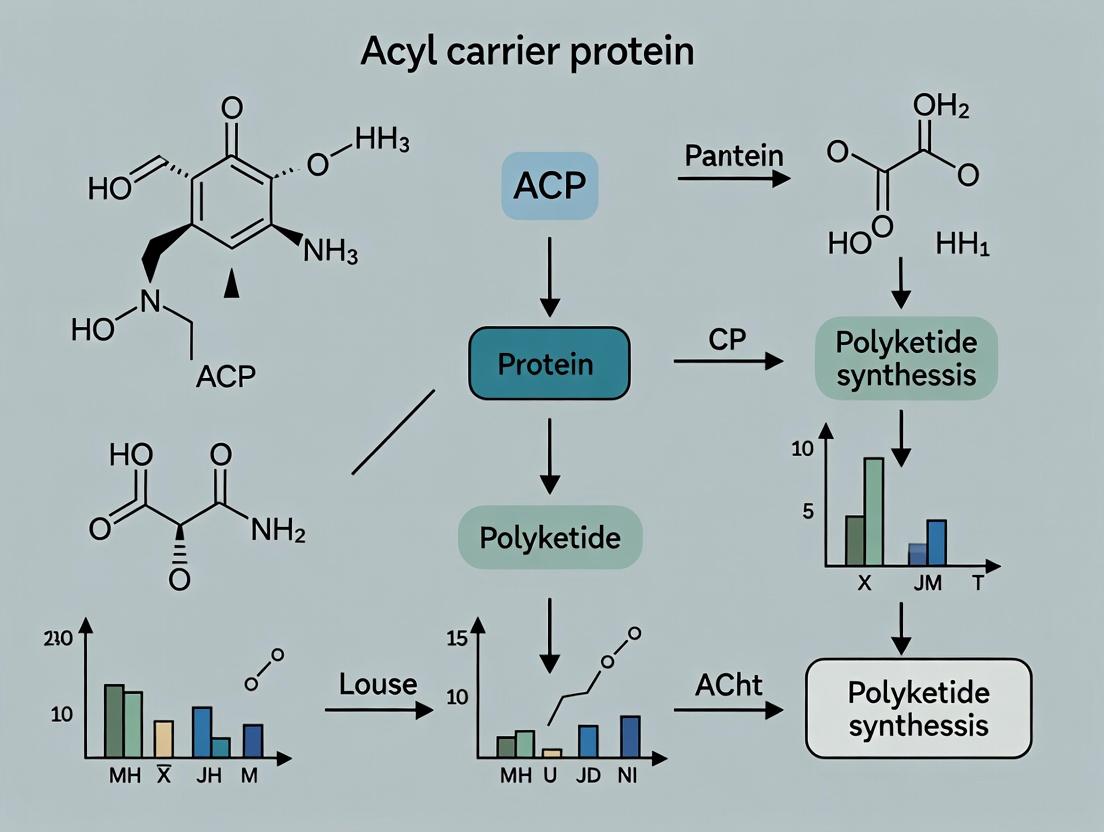
This comprehensive review explores the pivotal role of the acyl carrier protein (ACP) in the biosynthesis of polyketides, a major class of clinically vital natural products.
The Malleable Architect of Nature's Medicines: How Acyl Carrier Protein (ACP) Drives Polyketide Synthesis and Drug Discovery
Abstract
This comprehensive review explores the pivotal role of the acyl carrier protein (ACP) in the biosynthesis of polyketides, a major class of clinically vital natural products. Tailored for researchers and drug development professionals, the article first establishes ACP's structural and functional foundations within polyketide synthases (PKSs). It then details cutting-edge methodologies for ACP engineering and analysis, followed by strategies to troubleshoot common bottlenecks in polyketide production. Finally, the article validates ACP's central importance by comparing its mechanisms across different PKS types (Type I, II, and III) and against fatty acid synthesis analogs. The synthesis provides a roadmap for harnessing ACP plasticity to accelerate the discovery and engineered biosynthesis of novel therapeutic agents.
The ACP Blueprint: Core Structure, Function, and Evolution in Polyketide Synthase Machinery
Within the complex enzymatic assembly lines of polyketide synthases (PKSs), the acyl carrier protein (ACP) serves as the indispensable central shuttle and workhorse. This whitepaper, framed within ongoing research into ACP structure-function relationships, details its core role, the quantitative parameters defining its activity, and the experimental methodologies used to probe it. For researchers and drug development professionals, understanding the ACP is paramount for harnessing PKSs in synthetic biology and novel therapeutic discovery.
The ACP Domain: Structural and Functional Core
The ACP is a small, acidic protein domain that is post-translationally modified by the attachment of a 4'-phosphopantetheine (PPant) arm to a conserved serine residue. This flexible arm, terminating in a reactive thiol, carries the growing polyketide chain through the series of catalytic domains in the PKS module. The ACP's structural dynamics—its ability to interact with multiple partner domains—govern the efficiency and fidelity of chain elongation and modification.
Table 1: Key Quantitative Parameters of Type I PKS ACP Domains
| Parameter | Typical Range | Significance |
|---|---|---|
| Molecular Weight | 8-12 kDa | Small size facilitates rapid domain-domain interactions. |
| PPant Arm Length | ~20 Å | Determines the reach for substrate delivery to active sites. |
| pI (Isoelectric Point) | ~4.5 | Acidic nature aids in electrostatic steering to basic partner domains. |
| Recognition Helix Sequence | Conserved motif (e.g., in DEBS) | Critical for specific ACP-KS, ACP-AT, ACP-KR interactions. |
| ACP:Partner Domain Kd | nM to μM range | Affinity dictates transfer efficiency and prevents off-pathway reactions. |
Experimental Protocols for ACP Analysis
Protocol: Heterologous Expression and Phosphopantetheinylation of ACPs
Objective: To produce holo-ACP (PPant-functionalized) for in vitro biochemical studies.
- Cloning: Amplify the ACP domain gene and clone into an expression vector (e.g., pET series) with an N-terminal His6-tag.
- Expression: Transform into E. coli BL21(DE3). Grow culture in LB at 37°C to OD600 ~0.6-0.8. Induce with 0.5-1.0 mM IPTG. Shift to 18-25°C and incubate for 16-18 hours.
- Co-expression with PPTase: Co-transform with a plasmid encoding a broad-specificity phosphopantetheinyl transferase (e.g., Sfp from B. subtilis) or supplement with PPTase post-lysis.
- Purification: Lyse cells via sonication in lysis buffer (50 mM Tris-HCl pH 8.0, 300 mM NaCl, 20 mM imidazole). Purify the soluble His6-ACP via Ni-NTA affinity chromatography. Elute with 250-300 mM imidazole.
- Verification: Confirm phosphopantetheinylation by LC-MS or by the Ellman's assay for free thiols on the PPant arm.
Protocol:In VitroACP-Charging (Acylation) Assay
Objective: To load the ACP's PPant arm with a specific acyl substrate (e.g., malonyl-, methylmalonyl-CoA).
- Reaction Setup: In a 50 μL reaction, combine: 50 mM HEPES buffer (pH 7.5), 10 μM purified holo-ACP, 200 μM acyl-CoA donor, 5 mM MgCl2, 1 mM TCEP (reducing agent).
- Enzymatic Charging: Add 0.5-1.0 μM of the cognate acyltransferase (AT) domain. Incubate at 25-30°C for 30 minutes.
- Analysis: Quench reaction with 5% formic acid. Analyze by HPLC or LC-MS to detect the acyl-ACP thioester. Alternatively, use a radioactive [14C]-acyl-CoA and visualize via autoradiography following native-PAGE.
Protocol: Surface Plasmon Resonance (SPR) for ACP-Partner Domain Affinity
Objective: Quantify the binding kinetics (KD, kon, koff) between ACP and an immobilized partner domain (e.g., ketosynthase, KS).
- Immobilization: Dilute partner protein (KS) in 10 mM sodium acetate buffer (pH 4.5-5.5). Inject over a CMS sensor chip to achieve ~5000-10,000 Response Units (RUs) via amine coupling.
- Binding Analysis: Inject a series of concentrations of analyte (holo- or acyl-ACP, 0.1-10 μM) in HBS-EP+ buffer (10 mM HEPES pH 7.4, 150 mM NaCl, 3 mM EDTA, 0.005% v/v Surfactant P20) at a flow rate of 30 μL/min.
- Regeneration: After each cycle, regenerate the surface with a 30-second pulse of 10 mM glycine-HCl (pH 2.0).
- Data Processing: Subtract the reference flow cell signal. Fit the resulting sensograms to a 1:1 Langmuir binding model to determine kinetic constants.
Visualizing ACP Function and Analysis
Diagram 1: ACP as the Central Substrate Shuttle in a PKS Module
Diagram 2: Core Experimental Workflow for ACP Functional Analysis
The Scientist's Toolkit: Key Research Reagent Solutions
Table 2: Essential Reagents for ACP Research
| Reagent / Material | Function & Explanation |
|---|---|
| Sfp Phosphopantetheinyl Transferase | Broad-specificity PPTase from B. subtilis; essential for converting apo-ACP to functional holo-ACP in vitro and in vivo. |
| Acyl-CoA Substrates (Malonyl-, Methylmalonyl-) | Donor molecules for loading the ACP's PPant arm via the AT domain; often used in radiolabeled ([14C], [3H]) forms for tracking. |
| Tris(2-carboxyethyl)phosphine (TCEP) | A reducing agent used to maintain the thiol group of the PPant arm in its reactive, reduced state, preventing disulfide formation. |
| Ni-NTA Agarose Resin | Standard for affinity purification of His6-tagged ACP domains and partner proteins from heterologous expression in E. coli. |
| Surface Plasmon Resonance (SPR) Chip (e.g., CMS Series) | Gold sensor chip with a carboxymethylated dextran matrix for covalent immobilization of partner domains to measure real-time binding to ACP. |
| Coenzyme A (CoA) Analogues (e.g., ω-Alkynyl-CoA) | Chemical probes for chemoenzymatic labeling of ACPs; enable "tag-and-modify" strategies for visualization or pulldown assays. |
| Anti-PPant Antibodies | Tools for immunodetection of holo-ACP and acyl-ACP species in Western blots or pull-down experiments. |
| Limited Proteolysis Reagents (Trypsin/Chymotrypsin) | Used to probe ACP conformational changes upon acylation or partner binding by monitoring differential protease susceptibility. |
In the sophisticated machinery of polyketide synthase (PKS) assembly lines, the acyl carrier protein (ACP) serves as the central shuttle, delivering growing polyketide chains to spatially distinct catalytic domains. The functional linchpin of this activity is the conserved 4'-phosphopantetheine (PPant) arm, a post-translational modification appended to a serine residue of the ACP. The conformational flexibility of this PPant arm is not a passive feature but a critical, dynamically regulated determinant of substrate presentation, domain interaction, and ultimately, polyketide product specificity. Understanding its structural dynamics is therefore foundational to engineering PKSs for novel drug development.
The PPant Arm: Chemical Identity and Conformational Landscape
The PPant arm is a long, flexible prosthetic group derived from coenzyme A. Its structure can be segmented into:
- Attachment Point: Covalently linked via a phosphodiester bond to a conserved serine residue.
- Linker Region: The phosphate and 4'-phosphopantetheine moiety.
- Thiol Terminus: The reactive sulfhydryl (-SH) group that forms a thioester with acyl/polyketide intermediates.
Quantitative analyses, primarily through Nuclear Magnetic Resonance (NMR) spectroscopy and Molecular Dynamics (MD) simulations, have characterized its flexibility. The arm samples a wide conformational space, essential for reaching catalytic sites often over 20 Å away from the ACP core.
Table 1: Quantitative Metrics of PPant Arm Conformational Dynamics
| Parameter | Measured Value / Range | Experimental Method | Significance |
|---|---|---|---|
| Length (full extension) | ~20 Å | X-ray Crystallography, MD | Defines the operational radius from ACP core. |
| Rotatable Bonds | 10+ | Molecular Modeling | Underpins extreme flexibility and range of motion. |
| Population of "Pantetheine-in" state | 15-40% (varies by ACP) | Solution NMR | Measures propensity for arm to contact ACP core, relevant for sequestration. |
| Timescale of Dynamics | Picoseconds to nanoseconds (local), Microseconds (global) | NMR Relaxation, MD | Informs on the speed of substrate delivery and recognition. |
| Distance between Ser-attachment & Thiol | 10 - 20 Å | FRET, DEER Spectroscopy | Direct measure of arm extension in solution. |
Experimental Protocols for Probing PPant Dynamics
Solution NMR Spectroscopy for Atomic-Level Dynamics
Objective: To determine solution-state structure, dynamics, and conformational populations of the ACP-PPant complex. Protocol:
- Sample Preparation: Express and purify isotopically labeled ([¹⁵N], [¹³C]) ACP. Catalytically load the PPant arm with a substrate mimic (e.g., acetyl, malonyl) or use the apo-form.
- Data Collection: Acquire a suite of 2D/3D NMR experiments (e.g., HSQC, TROSY, NOESY) at physiological temperature and pH. For dynamics, collect [¹⁵N] T1, T2 relaxation, and {¹H}-¹⁵N heteronuclear NOE data.
- Resonance Assignment: Use triple-resonance experiments to assign backbone and sidechain chemical shifts.
- Structure & Dynamics Calculation: Calculate an ensemble of structures using NOE-derived distance restraints. Model-free analysis (Lipari-Szabo) of relaxation data yields order parameters (S²) quantifying bond vector flexibility on ps-ns timescales.
- Detection of Conformational Exchange: Use CPMG relaxation dispersion experiments to probe µs-ms timescale motions, indicative of major conformational shifts of the arm.
Hybrid Methods: FRET and Electron Paramagnetic Resonance (EPR)
Objective: To measure distance distributions between specific points on the PPant arm and the ACP core in real time. Protocol (Double Electron-Electron Resonance, DEER):
- Spin Labeling: Introduce site-specific cysteine mutations: one on the ACP core surface, and one at the terminus of the PPant arm (e.g., via a modified substrate). Label each cysteine with a stable nitroxide spin probe (e.g., MTSL).
- Sample Preparation: Purify the doubly spin-labeled protein and buffer-exchange into deuterated buffer to reduce solvent signal. Flash-freeze in liquid N₂.
- DEER Data Acquisition: Perform a four-pulse DEER experiment on a Q-band EPR spectrometer at cryogenic temperatures (~50 K).
- Data Analysis: Process the raw time-domain signal to extract a distance distribution profile using DeerAnalysis software. This provides a direct, quantitative readout of the population-weighted distances between the PPant terminus and the ACP core.
Molecular Dynamics (MD) Simulations
Objective: To visualize the trajectory and energetics of PParm motion at atomic resolution. Protocol:
- System Setup: Use a high-resolution crystal or NMR structure of an ACP as a starting point. Parametrize the PPant-linked substrate using tools like antechamber (GAFF force field). Solvate the system in a TIP3P water box and add ions to neutralize charge.
- Simulation Run: Perform energy minimization, followed by gradual heating and equilibration (NPT ensemble). Run a production simulation for 100 ns to 1 µs using a GPU-accelerated package (e.g., AMBER, GROMACS, NAMD).
- Trajectory Analysis: Calculate Root Mean Square Fluctuation (RMSF) of the PPant atoms, distance between key atoms, dihedral angle distributions, and free energy landscapes (Potential of Mean Force) to identify stable conformational states.
Diagram: PPant Conformational States in Polyketide Synthesis Workflow
The Scientist's Toolkit: Research Reagent Solutions
Table 2: Essential Reagents for PPant-Arm Dynamics Research
| Item | Function in Research | Specific Application Example |
|---|---|---|
| Isotopically Labeled Media ([¹⁵N]NH₄Cl, [¹³C]Glucose) | Enables high-resolution NMR spectroscopy. | Production of [¹⁵N,¹³C]-labeled ACP for backbone assignment and dynamics studies. |
| Sfp Phosphopantetheinyl Transferase | Catalyzes the in vitro attachment of the PPant arm from CoA to the apo-ACP. | Generation of homogeneous holo-ACP for biophysical studies; can also attach fluorophore/ spin-label conjugated CoA analogs. |
| Site-Directed Mutagenesis Kit | Creates specific point mutations in the ACP gene. | Introducing solvent-exposed cysteines for spin/fluorescence labeling; probing key residues for PPant interaction. |
| Spin Labels (e.g., MTSL) | Covalently attaches a stable nitroxide radical to a cysteine thiol. | Site-specific labeling for DEER EPR spectroscopy to measure nanoscale distances. |
| Fluorescent Dye Pairs (Donor/Acceptor, e.g., Alexa Fluor 488/594) | For Förster Resonance Energy Transfer (FRET). | Labeling ACP core and PPant terminus to monitor conformational changes in real-time in solution. |
| Crosslinkers (e.g., DSS, BS³) | Stabilizes transient protein-protein interactions. | Trapping ACP in complex with a partner domain (e.g., Ketosynthase) for structural analysis. |
| Substrate Analog CoA's (e.g., Methylmalonyl-CoA, Propionyl-CoA) | Loads specific acyl groups onto the PPant thiol. | Studying how substrate identity influences ACP structure and PPant dynamics. |
| Molecular Dynamics Software (e.g., AMBER, GROMACS) | Simulates atomic-level trajectories of biomolecules. | Visualizing PPant arm motion and calculating free energy landscapes of conformational states. |
Acyl carrier protein (ACP) serves as the central hub in polyketide synthase (PKS) assembly lines, responsible for the binding, activation, and translocation of growing polyketide intermediates. This technical guide examines the precise molecular mechanisms underlying these functions, a topic central to modern research on engineering novel bioactive compounds for drug development.
Structural Determinants of Substrate Binding to ACP
The ACP Fold and Phosphopantetheine Arm
The functional form of ACP is a small, acidic, predominantly α-helical protein post-translationally modified by the attachment of a 4'-phosphopantetheine (PPant) arm to a conserved serine residue. The thiol-terminus of this flexible arm serves as the covalent tether for polyketide intermediates.
Quantitative Data on ACP-PPant Complexes Table 1: Key Structural and Biophysical Parameters of ACP Domains
| Parameter | Type I PKS ACP | Type II PKS ACP | Measurement Method |
|---|---|---|---|
| Average Molecular Weight (kDa) | 8 - 12 | 8 - 10 | Mass Spectrometry |
| Isoelectric Point (pI) | 3.8 - 4.5 | 4.0 - 4.7 | IEF / Calculation |
| PPant Arm Length (Å) | ~20 | ~20 | NMR / X-ray Crystallography |
| Kd for Acyl-CoA (µM) | 0.1 - 10 | 1 - 50 | ITC / Fluorescence Anisotropy |
| Helical Content (%) | 60-75 | 60-70 | CD Spectroscopy |
Molecular Recognition and Electrostatic Steering
Binding specificity is governed by complementary surface electrostatics between the ACP and its partner enzymes (ketosynthase KS, acyltransferase AT, ketoreductase KR, etc.). Positively charged patches on partner enzymes interact with the negatively charged surface of ACP.
Experimental Protocol: Surface Plasmon Resonance (SPR) for ACP-Partner Affinity
- Immobilization: A partner enzyme (e.g., KS) is immobilized on a CM5 sensor chip via amine coupling.
- Binding Analysis: A range of concentrations of purified, holo-ACP (loaded with substrate or analogue) is flowed over the chip in HEPES buffer (pH 7.5, 150 mM NaCl, 0.005% P20 surfactant).
- Data Processing: Sensorgrams are double-referenced. Equilibrium binding responses are fit to a 1:1 Langmuir binding model using the Biacore Evaluation Software to derive the association rate (ka), dissociation rate (kd), and equilibrium dissociation constant (KD).
- Control: Run apo-ACP and/or charge-reversal ACP mutants as negative controls.
Diagram 1: SPR assay principle for ACP-enzyme affinity.
Activation via Thioesterification and the Role of 4'-Phosphopantetheinyl Transferase (PPTase)
Mechanism of PPant Arm Attachment
The inactive apo-ACP is activated by PPTase, which transfers the PPant moiety from coenzyme A (CoA) to the conserved serine.
Quantitative Data on PPTase Activity Table 2: Kinetic Parameters for Representative PPTases
| PPTase Source | KM for CoA (µM) | kcat (min-1) | Optimal pH | Essential Divalent Ion |
|---|---|---|---|---|
| Bacillus subtilis (Sfp) | 5.2 | 28 | 7.0 - 7.5 | Mg2+ |
| E. coli (AcpS) | 1.5 | 12 | 8.0 | Mg2+ |
Experimental Protocol: Radioactive PPTase Assay
- Reaction: Combine 10 µM apo-ACP, 50 µM [3H]-CoA, 100 nM PPTase (e.g., Sfp), 10 mM MgCl2 in 50 mM Tris-HCl (pH 7.5). Incubate at 30°C.
- Separation: At time points, spot reaction aliquots on nitrocellulose filters. Immediately wash with 10% TCA (trichloroacetic acid) to precipitate protein-bound radioactivity, then with ethanol.
- Quantification: Dry filters, add scintillation fluid, and count in a scintillation counter to measure [3H]-PPant incorporated into ACP.
- Analysis: Plot cpm vs. time to determine initial velocity and calculate kcat and KM.
Translocation: The ACP Shuttle Mechanism
Sequential Handoff Between PKS Modules
The PPant arm translocates the growing polyketide intermediate between catalytic domains within a module and to the next module's ACP.
Key Interactions During Translocation
- KS-ACP Docking: ACP presents the acyl/aryl chain to the KS active site cysteine for decarboxylative Claisen condensation.
- Post-Condensation Transfer: The elongated β-keto intermediate remains tethered to the ACP PPant arm.
- Processing & Handoff: The ACP shuttles the intermediate to KR, DH, ER (if present) for modification, then to the next module's KS or finally to the thioesterase (TE) for offloading.
Diagram 2: Polyketide intermediate translocation between PKS modules.
Quantitative Analysis of Translocation Efficiency
Table 3: Translocation Kinetics in a Model Type I PKS Module (DEBS)
| Process | Estimated t1/2 | Method of Determination |
|---|---|---|
| ACP docking to KS | 50 - 200 ms | Stopped-flow FRET |
| Condensation reaction | 300 - 600 ms | Quench-flow / Radio-TLC |
| Inter-ACP transfer (if discrete) | < 100 ms | Molecular Dynamics Simulation |
| Complete cycle per module | 1 - 5 s | In vitro reconstitution with timed assays |
Experimental Protocol: Stopped-Flow FRET for Docking Kinetics
- Labeling: Cys-mutate a surface residue on ACP and a complementary residue on KS outside the active site. Label with FRET pair (e.g., ACP with Alexa Fluor 488 donor, KS with Alexa Fluor 555 acceptor).
- Rapid Mixing: Using a stopped-flow instrument, rapidly mix equal volumes of labeled ACP (with substrate mimic) and KS in assay buffer.
- Detection: Monitor donor emission (518 nm) upon excitation at 488 nm. The decrease in donor fluorescence due to FRET upon docking is recorded over time (ms scale).
- Fitting: Fit the fluorescence quenching trace to a single exponential equation to derive the observed rate constant (kobs) for complex formation.
The Scientist's Toolkit: Key Research Reagent Solutions
Table 4: Essential Reagents for ACP Mechanism Studies
| Reagent / Material | Function / Role | Example Source / Notes |
|---|---|---|
| Holo-ACP Synthase (Sfp PPTase) | Converts apo-ACP to holo-ACP; essential for in vitro reconstitution. | Recombinant, His-tagged; commercial kits available. |
| Acyl-/Polyketide-CoA Analogues | Chemoenzymatic substrates for loading specific intermediates onto apo-ACP. | Synthesized via chemical synthesis or enzymatically. |
| SePhacryl S-100 HR | Size-exclusion chromatography for separating holo- from apo-ACP and protein complexes. | Cytiva. Optimal for proteins 1-100 kDa. |
| Ni-NTA Superflow Resin | Affinity purification of His-tagged ACPs and partner enzymes. | Qiagen, Cytiva. Critical for high-purity preps. |
| Deuterated (D2O) Buffers | Required for NMR analysis of ACP structure and dynamics. | 99.9% D, Cambridge Isotope Laboratories. |
| Phosphopantetheinyl Hydrolases | Enzymes that cleave the PPant arm (e.g., AcpH); used for controlled ACP recycling. | Recombinant. Useful for turnover studies. |
| MALDI-TOF MS Standards | For accurate mass determination of ACP and its acylated forms. | Protein calibration standard II (Bruker). |
| Fluorescent Labeling Kits (NHS-ester dyes) | For FRET, fluorescence anisotropy, and single-molecule studies of ACP dynamics. | Thermo Fisher (Alexa Fluor series), CyDye. |
This whitepaper, framed within a broader thesis on acyl carrier protein (ACP) in polyketide synthesis, explores the evolutionary relationship between the ACP domains of modular polyketide synthases (PKS) and the fatty acid synthase (FAS) system. ACP serves as the central hub for substrate shuttling and chain elongation in both systems, yet significant divergence has enabled the remarkable chemical diversity of polyketide natural products. Understanding this homology and divergence is critical for engineering novel bioactive compounds.
Evolutionary Origins and Divergent Paths
Type I and Type II FAS are ubiquitous in nature, responsible for primary metabolism. Modular PKS, believed to have evolved from FAS, are multifunctional enzyme assemblies in bacteria and fungi that produce secondary metabolites. The key evolutionary leap was the duplication, diversification, and organization of catalytic domains into modular assembly lines. While FAS typically produces linear hydrocarbons, PKS incorporates diverse extender units, varies reduction levels, and cyclizes products, all choreographed by specialized ACPs.
Comparative Analysis of ACP Structure and Function
The core function of ACP in both systems is conserved: it is post-translationally modified by the attachment of a 4'-phosphopantetheine (PPant) arm to a conserved serine residue, transforming it from an inactive apo- to an active holo- form. This swinging arm carries the growing acyl chain between catalytic domains.
Table 1: Quantitative Comparison of FAS and PKS ACP Properties
| Property | Type I FAS (Mammalian) ACP Domain | Type II FAS (Bacterial) ACP | Type I Modular PKS ACP Domain |
|---|---|---|---|
| Molecular Weight | ~9 kDa (as part of megasynthase) | 8-10 kDa (discrete protein) | 8-12 kDa (within module) |
| PPant Attachment Site Motif | DSL | DSL / GxDSL | GxDSL / LGGxDSL |
| Isoelectric Point (pI) | ~4.5 - 5.5 | ~4.0 - 4.5 | Highly variable (4.0 - 9.5) |
| Surface Charge Distribution | Conserved acidic patch | Conserved acidic patch | Often altered, less conserved |
| Number of Helices | 4 (Bundle) | 4 (Bundle) | 4 (Bundle) |
| Key Recognition Helix | Helix II | Helix II | Helix II (often mutated) |
| Interaction Partners | KS, MAT, DH, ER, KR, TE | KS, MAT, DH, ER, KR, TE | KS, AT, KR, DH, ER, KS, TE (+ others) |
Experimental Protocols for Studying ACP Evolution and Function
Protocol 4.1: Phylogenetic Analysis of ACP Sequences
Objective: To reconstruct the evolutionary history of ACPs from FAS and PKS.
- Sequence Retrieval: Using databases (UniProt, NCBI), retrieve amino acid sequences of confirmed FAS ACPs (e.g., E. coli AcpP) and PKS ACP domains (e.g., from DEBS, Rifamycin PKS).
- Multiple Sequence Alignment: Perform alignment using Clustal Omega or MAFFT with default parameters.
- Phylogenetic Tree Construction: Use MEGA software with the Maximum Likelihood method (JTT matrix model). Assess branch support with 1000 bootstrap replicates.
- Analysis: Identify clades separating FAS and PKS ACPs. Note bootstrap values >70% indicate strong support.
Protocol 4.2: In Vitro Phosphopantetheinylation Assay
Objective: To confirm ACP functionality by measuring conversion from apo- to holo-form.
- Protein Purification: Express recombinant ACP (from FAS or PKS) in E. coli. Purify via Ni-NTA affinity chromatography if tagged.
- Reaction Setup: In a 50 µL reaction: 50 µM apo-ACP, 5 µM 4'-phosphopantetheinyl transferase (Sfp or AcpS), 10 µM CoA (or [³H]-CoA for radiolabel), 10 mM MgCl₂, in assay buffer (50 mM HEPES, pH 7.5).
- Incubation & Analysis: Incubate at 30°C for 30 min. Quench with SDS-PAGE loading buffer.
- Method A (Radioactive): Resolve by urea-PAGE, visualize by autoradiography.
- Method B (Mass Spec): Analyze by LC-MS to observe +340 Da mass shift.
Protocol 4.3: ACP-Protein Interaction Analysis via Surface Plasmon Resonance (SPR)
Objective: To quantify binding kinetics between ACP and partner enzymes (e.g., Ketosynthase, KS).
- Immobilization: Immobilize purified partner enzyme (KS) on a CM5 sensor chip via amine coupling to ~5000 Response Units (RU).
- Ligand Injection: Inject a concentration series (0.1 - 10 µM) of purified holo-ACP over the chip surface in HBS-EP buffer at 25°C.
- Data Processing: Subtract responses from a reference flow cell. Fit the association and dissociation phases to a 1:1 Langmuir binding model using Biacore Evaluation Software to determine Ka, Kd, and koff/kon rates.
Visualizing Evolutionary and Functional Relationships
Diagram 1: Evolutionary Divergence of ACP from a Common Ancestor
Diagram 2: Experimental Workflow for ACP Evolutionary Study
The Scientist's Toolkit: Essential Research Reagents and Materials
Table 2: Key Research Reagent Solutions for ACP Studies
| Reagent/Material | Function/Application in Research | Key Considerations |
|---|---|---|
| Sfp Phosphopantetheinyl Transferase | Catalyzes the conversion of apo-ACP to holo-ACP using CoA. Essential for in vitro activity assays and module engineering. | Broad substrate specificity, ideal for PKS ACPs. Commercial availability. |
| AcpS Phosphopantetheinyl Transferase | Native E. coli PPTase. Used for studying FAS ACPs and some specific PKS ACP interactions. | More stringent substrate specificity than Sfp. |
| Coenzyme A (CoA) & Analogues | Substrate for phosphopantetheinylation. Radiolabeled ([³H]-CoA) or chemically modified analogues are used for tracking and engineering. | Stability; modified CoAs enable incorporation of non-natural probes. |
| Apo-ACP Expression Vectors | Plasmid systems (e.g., pET series) for high-yield recombinant expression of ACP domains in E. coli. | Often require tags (His₆, GST) for purification. Must exclude endogenous PPTase activity for apo-form. |
| Biacore/SPR Sensor Chips (CM5) | Gold sensor surfaces functionalized with carboxymethyl dextran for immobilizing ACP interaction partners (KS, AT, etc.). | Standard for label-free kinetic studies. Requires dedicated instrument. |
| Isothermal Titration Calorimetry (ITC) Kit | Contains matched cells and syringes for measuring binding thermodynamics (Kd, ΔH, ΔS) of ACP-enzyme interactions. | Requires high protein concentration and purity. |
| Deuterated NMR Buffers | For resolving ACP solution structures by NMR spectroscopy, critical for understanding conformational dynamics. | High cost; essential for obtaining high-resolution structural data. |
| Type-Specific PKS/FAS Inhibitors | Tool compounds (e.g., Cerulenin for KS) used to probe ACP-dependent pathway activity in vivo or in cell extracts. | Specificity and potency must be validated for the system under study. |
Within the modular architecture of polyketide synthase (PKS) assembly lines, the acyl carrier protein (ACP) serves as the central hub for substrate shuttling and transient covalent intermediate tethering. This whitepaper, framed within a broader thesis on ACP function, provides an in-depth technical analysis of the ACP's critical molecular dialogues with three core catalytic domains: the ketosynthase (KS), acyltransferase (AT), and thioesterase (TE). The precise coordination of these interactions dictates chain elongation, monomer selection, and chain termination, ultimately governing polyketide structural diversity. Understanding these interfaces is paramount for rational engineering of novel bioactive compounds.
ACP-KS Interaction: Chain Elongation Catalysis
The KS domain catalyzes the decarboxylative Claisen condensation between the acyl chain tethered to its active-site cysteine and the malonyl- or methylmalonyl-extender unit attached to the phosphopantetheine (PPant) arm of the ACP. This interaction is highly specific and transient.
Key Quantitative Parameters of ACP-KS Interactions:
Table 1: Kinetic and Structural Data for ACP-KS Interactions
| Parameter | Typical Range | Experimental Method | Significance |
|---|---|---|---|
| KM for ACP~Substrate | 0.5 - 20 µM | Isothermal Titration Calorimetry (ITC), Surface Plasmon Resonance (SPR) | Affinity of KS for loaded ACP partner. |
| kcat for Condensation | 0.1 - 5 min-1 | Radio-TLC / LC-MS-based activity assays | Turnover rate of the elongation step. |
| ACP-KS Interface Area | ~1200 - 2000 Ų | X-ray Crystallography, NMR | Buried surface area indicating interaction strength. |
| Key Recognition Residues | Charged (Asp, Arg, Lys) and hydrophobic (Ile, Leu, Val) | Mutagenesis & Activity Assays, NMR Chemical Shift Perturbation | Determines ACP-KS pairing fidelity. |
Experimental Protocol: In vitro KS Activity Assay (Radio-TLC Based)
- Reagents: Purified KS domain (or KS-AT didomain), holo-ACP (loaded with [2-14C]malonyl-CoA via Sfp PPTase), acetyl-S-CoA (primer), reaction buffer (100 mM HEPES pH 7.5, 5 mM TCEP, 10 mM MgCl2).
- Procedure: Combine KS (5 µM), ACP~[14C]malonate (50 µM), and acetyl-S-CoA (100 µM) in 50 µL total volume. Incubate at 25°C for 10-30 min.
- Quench & Extraction: Stop reaction with 50 µL 1M HCl. Extract products with 200 µL ethyl acetate.
- Analysis: Spot organic extract on silica TLC plate. Develop with 5:95 methanol:dichloromethane. Visualize/quantify radiolabeled acetoacetate (or longer chain product) using a phosphorimager. Calculate kcat/KM from time-course data.
ACP-AT Interaction: Extender Unit Loading
The AT domain is responsible for selecting the appropriate extender unit (malonyl-, methylmalonyl-CoA) and transferring it to the PPant arm of the ACP, generating an ACP-bound elongator thioester. ACP must present its PPant arm to the AT active site.
Key Quantitative Parameters of ACP-AT Interactions:
Table 2: Kinetic and Specificity Data for ACP-AT Interactions
| Parameter | Typical Range | Experimental Method | Significance |
|---|---|---|---|
| AT Acyl-CoA Specificity (kcat/KM Ratio) | 10² - 10⁴ (malonyl vs. methylmalonyl) | Coupled Enzymatic/LC-MS Assay | Fidelity for extender unit selection. |
| KD for ACP | 1 - 50 µM | ITC, SPR | Binding affinity of apo- or holo-ACP for AT. |
| Transacylation Rate (kcat) | 10 - 100 min-1 | Discontinuous HPLC Assay | Efficiency of extender unit loading. |
| PPant Arm Reach (from ACP core) | ~20 Å | Molecular Dynamics Simulation | Determines required conformational flexibility for AT active site docking. |
Experimental Protocol: AT Acyltransferase Assay (Coupled, Spectrophotometric)
- Reagents: Purified AT domain, holo-ACP, acyl-CoA (e.g., malonyl-CoA), DTNB (Ellman's reagent, 5,5'-dithio-bis-(2-nitrobenzoic acid)), reaction buffer (100 mM potassium phosphate pH 7.0, 1 mM EDTA).
- Principle: DTNB reacts with free thiols (e.g., the PPant -SH of ACP after acyl transfer) to produce TNB²⁻, which absorbs at 412 nm (ε = 14,150 M-1cm-1).
- Procedure: In a cuvette, mix DTNB (0.2 mM), acyl-CoA (0.5 mM), and holo-ACP (0.1 mM) in buffer. Initiate reaction by adding AT (0.01-0.1 µM).
- Analysis: Monitor A412 continuously for 1-5 min. Calculate initial velocity. Control: Omit acyl-CoA to correct for background hydrolysis.
ACP-TE Interaction: Chain Release and Cyclization
The TE domain, typically at the terminus of a PKS, catalyzes the hydrolysis or macrocyclization of the full-length polyketide chain from the ACP. This requires precise docking of the ACP-bound chain into the TE active site.
Key Quantitative Parameters of ACP-TE Interactions:
Table 3: Data for ACP-TE Termination Interactions
| Parameter | Typical Range | Experimental Method | Significance |
|---|---|---|---|
| Hydrolysis vs. Cyclization Ratio | Varies widely (1:100 to 100:1) | LC-MS quantification of products | Determines product outcome (linear acid vs. macrolactone). |
| KM for ACP~Full Chain | 0.1 - 10 µM | Fluorescence-based (substrate analog) assay | Affinity for the mature ACP substrate. |
| Macrolactonization Rate (kcat) | 0.01 - 1 min-1 | Radio-TLC / LC-MS | Often the rate-limiting step of the entire assembly line. |
| TE Active Site Cavity Volume | 300 - 1500 ų | X-ray Crystallography | Dictates macrocycle size specificity. |
Experimental Protocol: TE Thioesterase Activity Assay (Fluorogenic)
- Reagents: Purified TE domain, fluorogenic ACP substrate (e.g., ACP loaded with 7-hydroxycoumarin-3-carboxylate via a pantetheine mimic), reaction buffer (50 mM Tris pH 8.0, 150 mM NaCl).
- Principle: Release of the fluorophore (7-hydroxycoumarin) upon hydrolysis/cyclization increases fluorescence (Ex ~380 nm, Em ~450 nm).
- Procedure: In a black 96-well plate, mix ACP~fluorophore (1-10 µM) in buffer. Initiate reaction with TE (0.1-1 µM).
- Analysis: Monitor fluorescence increase over 30-60 min. Convert fluorescence to product concentration using a standard curve of free fluorophore. Determine kinetic parameters.
The Scientist's Toolkit: Essential Research Reagents
Table 4: Key Reagent Solutions for Studying ACP-Domain Interactions
| Reagent | Function & Application |
|---|---|
| Sfp Phosphopantetheinyl Transferase (PPTase) | Catalyzes the conversion of apo-ACP to holo-ACP by installing the phosphopantetheine arm. Essential for ACP activation. |
| Acyl-CoA Substrates (e.g., [2-14C]Malonyl-CoA) | Radiolabeled or unlabeled extender units for AT loading assays and KS condensation assays. |
| Fluorogenic/Dansyl-Labeled Acyl-PPant-ACP Probes | Synthetic ACP conjugates used in FRET, fluorescence polarization, or direct activity assays to study ACP-domain docking and kinetics. |
| Crosslinkers (e.g., BS3, DSS) | Homobifunctional NHS-esters for trapping transient ACP-domain complexes for structural analysis via crosslinking mass spectrometry (XL-MS). |
| NMR Isotope Labels (15N, 13C) | For producing isotopically labeled ACP and domains to study interaction surfaces and dynamics via NMR spectroscopy. |
| Size Exclusion Chromatography (SEC) Columns | For analyzing the formation of higher-order complexes between ACP and catalytic domains (KS, AT, TE). |
Visualization of ACP-Domain Interactions and Workflows
Title: Core ACP Cycle in Polyketide Synthesis
Title: Molecular Logic of ACP-Domain Recognition
Title: Workflow for Characterizing ACP-Domain Kinetics
Engineering the Workhorse: Advanced Techniques for ACP Analysis, Manipulation, and Pathway Engineering
Acyl Carrier Proteins (ACPs) are essential components of polyketide synthase (PKS) assembly lines, responsible for shuttling growing polyketide chains between catalytic domains. The function of an ACP is governed by its post-translational modification—the attachment of a 4'-phosphopantetheine (4'-PPant) arm from coenzyme A via a phosphopantetheinyl transferase (PPTase)—and its dynamic localization within the synthase complex. Understanding the kinetics, specificity, and spatial orchestration of ACP modification and trafficking is central to the broader thesis of engineering PKSs for novel drug development. This guide details contemporary methodologies for tracking these critical events.
Core Methodologies for Tracking ACP Post-Translational Modification
Chemical Tagging with Fluorescent or Biotin Probes
This approach uses functionalized CoA or pantetheine analogues that are enzymatically installed onto the apo-ACP by a PPTase. The installed tag enables subsequent detection or purification.
Experimental Protocol: Fluorescent Labeling of ACP in vitro
- Reaction Setup: Combine in a 50 µL reaction:
- Purified apo-ACP (10-50 µM).
- PPTase (Sfp from B. subtilis or AcpS, 0.1-1 µM).
- Fluorescent CoA analogue (e.g., CoA 488, BodipyFL-C3-CoA, 100-200 µM).
- Reaction Buffer (50 mM HEPES, pH 7.5, 10 mM MgCl₂).
- Incubation: Incubate at 25-30°C for 1-2 hours.
- Purification: Remove excess label by desalting (spin column) or dialysis.
- Analysis: Visualize via in-gel fluorescence scanning (e.g., Typhoon imager) or measure fluorescence polarization to monitor phosphopantetheinylation kinetics.
Mass Spectrometry (MS)-Based Analysis
MS provides direct, quantitative readouts of ACP modification states and can identify acyl intermediates tethered to the PPant arm.
Experimental Protocol: Intact Protein MS for ACP Modification State
- Sample Preparation: Desalt in vitro modification reaction mixtures or purified ACPs into a volatile buffer (e.g., 50 mM ammonium acetate, pH 6.8) using micro-spin columns.
- Instrumentation: Use electrospray ionization (ESI) or matrix-assisted laser desorption/ionization (MALDI) time-of-flight (TOF) mass spectrometer.
- Data Acquisition: Acquire spectra in positive ion mode. Deconvolute raw m/z data to neutral mass.
- Interpretation: Compare observed mass to theoretical mass of apo-ACP. A mass increase of 340 Da indicates holo-formation (PPant attachment). Further mass shifts correspond to specific acyl loadings.
Table 1: Common Chemical Probes for ACP Tagging
| Probe Name | Core Structure | Detection Modality | Key Application |
|---|---|---|---|
| BodipyFL-C3-CoA | CoA with Bodipy fluorophore | Fluorescence (Ex/Em ~502/510 nm) | In vitro labeling, gel visualization, FP assays |
| CoA 488 (Alexa Fluor 488-CoA) | CoA with Alexa Fluor 488 | Fluorescence (Ex/Em ~495/519 nm) | High-sensitivity fluorescence detection |
| Alkyne-CoA (ω-alkynyl-CoA) | CoA with terminal alkyne | Click chemistry (with azide-fluor/biotin) | Versatile two-step tagging in vitro and in vivo |
| Desthiobiotin-CoA | CoA with desthiobiotin | Affinity purification (streptavidin) | Gentle, reversible enrichment of modified ACPs |
Advanced Methods for Visualizing ACP Localization and Dynamics
Single-Molecule Fluorescence inVitro
Utilizes total internal reflection fluorescence (TIRF) microscopy to observe individual fluorescently labeled ACPs interacting with immobilized PKS megasynthases.
Experimental Protocol: TIRF Imaging of ACP-PKS Interactions
- Surface Preparation: Immobilize His-tagged PKS module or domain on a PEG-passivated, Ni-NTA-functionalized glass flow chamber.
- Imaging Buffer: Use an oxygen-scavenging and triplet-state quenching system (e.g., PCA/PCD, Trolox) in assay buffer to prolong fluorophore stability.
- Data Acquisition: Introduce low nM concentrations of labeled holo-ACP. Image using a 488 nm or 532 nm laser on a TIRF microscope with EMCCD or sCMOS camera at 10-100 ms frame rates.
- Analysis: Track single-particle trajectories using software (e.g., TrackPy, u-track). Calculate dwell times and diffusion coefficients to characterize binding and shuttling.
Genetically Encoded Tags forIn VivoTracking
Enables visualization of ACP localization within native cellular environments.
Experimental Protocol: Live-Cell Imaging of ACP-PKS Fusions
- Construct Design: Fuse ACP to a fluorescent protein (e.g., sfGFP, mCherry) at the N- or C-terminus, ensuring linker flexibility. Express in the native or heterologous host.
- Microscopy: Use confocal or super-resolution microscopy (e.g., SIM, PALM) to image live cells.
- Colocalization Analysis: Co-express PKS domains with spectrally distinct fluorophores. Use quantitative metrics (e.g., Pearson's coefficient, Mander's overlap) to assess spatial correlation.
Table 2: Quantitative Metrics from Single-Molecule ACP Studies
| Measurement | Typical Value Range | Technique | Biological Insight |
|---|---|---|---|
| PPTase Catalytic Rate (kcat) | 0.1 - 10 min⁻¹ | Fluorescence Polarization | Modification efficiency & specificity |
| ACP-PKS Dwell Time | 0.1 - 2.0 seconds | smTIRF | Strength of ACP-domain interaction |
| Diffusion Coefficient (Bound) | ~0.001 µm²/s | smTIRF / FCS | Confined motion during catalysis |
| Diffusion Coefficient (Free) | ~10 µm²/s | smTIRF / FCS | Rapid shuttle between domains |
| Colocalization Coefficient | 0.3 - 0.8 (Pearson's) | Confocal Microscopy | Spatial organization in cells |
The Scientist's Toolkit: Research Reagent Solutions
Table 3: Essential Reagents for ACP Tracking Experiments
| Item | Function & Application | Example Vendor/Product |
|---|---|---|
| Sfp Phosphopantetheinyl Transferase | Broad-substrate PPTase for in vitro ACP labeling with non-natural CoA analogues. | MilliporeSigma (Sfp Synthase) |
| AcpS Phosphopantetheinyl Transferase | Native PPTase for studying specific ACP modification pathways. | Recombinantly expressed |
| BodipyFL-C3-CoA | Bright, green-fluorescent CoA for direct in vitro labeling and gel analysis. | Thermo Fisher Scientific |
| DBCO-PEG4-Biotin / Azide-Alexa Fluor 647 | Click chemistry reagents for secondary labeling of alkyne-tagged ACPs. | Click Chemistry Tools |
| PEG-Silane & Ni-NTA Functionalized Slides | For generating passivated, specific surfaces for single-molecule microscopy. | MicroSurfaces Inc. |
| Oxygen Scavenging System (Gloxy) | Enzymatic system to reduce photobleaching in single-molecule assays. | Prepared from Glucose Oxidase/Catalase |
| Hydrophobic Interaction Chromatography Resin | Critical for purifying acyl-ACP intermediates, which are often unstable. | Cytiva (Phenyl Sepharose) |
| Anti-PPant Antibody (α-PPant) | Immunodetection of phosphopantetheinylated proteins (holo-ACPs) in gels/blots. | MilliporeSigma |
Visualization of Key Pathways and Workflows
Diagram 1: ACP Phosphopantetheinylation and Shuttling Pathway
Diagram 2: In Vitro ACP Tagging and Analysis Workflow
Diagram 3: Single-Molecule ACP Tracking Experiment
Within the broader thesis on acyl carrier protein (ACP) functionality in polyketide synthase (PKS) systems, in vitro reconstitution using isolated ACPs emerges as a critical methodology. This approach enables the precise dissection of individual module activity, substrate specificity, and inter-domain communication, bypassing the complexities of intact megasynthases. This technical guide details current protocols for ACP isolation, phosphopantetheinylation, loading with diverse acyl substrates, and their integration into minimal in vitro assays to validate and interrogate PKS module function.
Polyketide biosynthesis is orchestrated by multi-enzyme complexes where the ACP plays a non-catalytic but central role as a swinging arm, shuttling growing polyketide intermediates between catalytic domains. Isolating the ACP from its native module allows researchers to:
- Decouple ACP-domain interactions from the structural constraints of the full module.
- Probe the specificity of acyl transferases (ATs), ketosynthases (KSs), and modifying enzymes for ACP-bound intermediates.
- Engineer hybrid systems by combining ACPs from different pathways with heterologous catalytic domains.
- Quantitatively measure kinetics of individual transacylation and chain elongation steps.
Core Experimental Methodologies
Heterologous Expression and Purification of ACP Domains
Protocol:
- Gene Design: Amplify DNA encoding the ACP domain (typically 70-100 amino acids) with flanking NdeI and XhoI restriction sites. Include a solubility tag (e.g., His6, MBP) at the N-terminus.
- Cloning & Transformation: Clone into pET28a(+) vector and transform into E. coli BL21(DE3) expression cells.
- Expression: Grow culture in LB + Kanamycin (50 µg/mL) at 37°C to OD600 ~0.6. Induce with 0.5 mM IPTG. Shift temperature to 18°C and incubate for 16-18 hours.
- Purification: Pellet cells, lyse via sonication in Lysis Buffer (50 mM Tris-HCl pH 8.0, 300 mM NaCl, 20 mM imidazole, 1 mM PMSF). Clarify by centrifugation. Purify soluble His6-ACP via Ni-NTA affinity chromatography using an imidazole gradient (20-250 mM) for elution.
- Tag Removal & Final Purification: Cleave tag with TEV protease (1:50 w/w) overnight at 4°C. Pass over Ni-NTA again to remove protease and cleaved tag. Perform final purification via size-exclusion chromatography (Superdex 75) in Storage Buffer (25 mM HEPES pH 7.5, 100 mM NaCl, 1 mM TCEP). Concentrate, aliquot, flash-freeze, and store at -80°C.
2In VitroPhosphopantetheinylation and Acyl-Loading
Isolated ACPs are expressed in their inactive "apo" form and must be converted to the active "holo" form by a phosphopantetheinyl transferase (PPTase).
Protocol:
- PPTase Reaction: Combine in a 100 µL reaction:
- 50 µM apo-ACP
- 5 µM Sfp PPTase (from B. subtilis) or the cognate PPTase
- 1 mM Coenzyme A (or synthetic acyl-CoA analog)
- 10 mM MgCl2
- 50 mM Tris-HCl, pH 7.5 Incubate at 30°C for 1 hour.
- Purification of Loaded ACP: Desalt the reaction mixture using a Zeba Spin Desalting Column (7K MWCO) pre-equilibrated with Storage Buffer to remove excess CoA, PPTase, and salts. Confirm loading by LC-MS or MALDI-TOF (mass shift + ~340 Da for holo, + acyl mass for loaded).
3In VitroReconstitution Assays for Module Validation
Assay 1: Ketosynthase (KS) Condensation Assay
- Objective: Validate the ability of a KS domain to catalyze Claisen condensation between an acyl-ACP (donor) and a malonyl- or methylmalonyl-ACP (acceptor).
- Protocol:
- Prepare donor ACP (e.g., [2-14C]malonyl-ACP or acetyl-ACP) and acceptor holo-ACP.
- In assay buffer (100 mM phosphate pH 7.2, 2 mM TCEP), combine:
- 50 µM donor-ACP
- 100 µM acceptor-ACP
- 5 µM KS domain (purified)
- Incubate at 25°C for 30 min.
- Quench with 10% formic acid.
- Analyze products by radio-TLC or LC-MS to detect the elongated β-ketoacyl-ACP product.
Assay 2: ACP-Ketoreductase (KR) Interaction Assay
- Objective: Measure the reduction of a β-ketoacyl-ACP by its cognate KR domain.
- Protocol:
- Generate β-ketoacyl-ACP substrate via KS assay or chemical loading.
- In assay buffer, combine:
- 50 µM β-ketoacyl-ACP
- 5 µM KR domain
- 1 mM NADPH
- Monitor consumption of NADPH by absorbance at 340 nm (ε340 = 6.22 mM−1 cm−1) over 5 minutes at 25°C.
Key Quantitative Data from Recent Studies
Table 1: Kinetic Parameters of KS Domains with Isolated ACP Substrates
| KS Domain (Source PKS) | Donor ACP | Acceptor ACP | kcat (min⁻¹) | KM (µM) | Catalytic Efficiency (kcat/KM, µM⁻¹ min⁻¹) | Reference (Year) |
|---|---|---|---|---|---|---|
| DEBS KS5 (6-DEB) | (2S)-methylmalonyl-DEBS ACP5 | Propionyl-DEBS ACP6 | 12.3 ± 1.5 | 4.2 ± 0.7 | 2.93 | Nature Chem. Biol. (2023) |
| Tyl KS3 (Tylosin) | Malonyl-Tyl ACP3 | Butyryl-Tyl ACP4 | 8.7 ± 0.9 | 15.1 ± 2.3 | 0.58 | Cell Chem. Biol. (2024) |
| Hybrid KS | Malonyl-DEBS ACP2 | Synthetic N-acetylcysteamine thioester | 1.5 ± 0.3 | >100 | <0.015 | ACS Synth. Biol. (2023) |
Table 2: Efficiency of Different PPTases on Heterologous ACPs
| PPTase | Source | Target ACP (Source) | Conversion to Holo-ACP (%) | Time to >95% Conversion | Reference |
|---|---|---|---|---|---|
| Sfp | B. subtilis | DEBS ACP3 (Type I) | >99 | 20 min | Meth. Enzymol. (2022) |
| AcpS | E. coli | RhlA ACP (Type II) | 98 | 60 min | Biochem. (2023) |
| Gsp | S. roseosporus | NRPS-PKS Hybrid ACP | 85 | 120 min | ChemBioChem (2024) |
The Scientist's Toolkit: Essential Research Reagents
Table 3: Key Research Reagent Solutions for ACP In Vitro Reconstitution
| Reagent / Material | Function & Critical Notes |
|---|---|
| Sfp Phosphopantetheinyl Transferase | Broad-specificity PPTase for converting apo-ACPs to holo-ACPs using CoA. Essential for activating isolated ACP domains. |
| Acyl-CoA Synthetases / SNAP-Tag Systems | For chemoenzymatic generation of non-native acyl-CoA substrates to load onto ACPs, expanding substrate scope. |
| N-Acetylcysteamine (SNAC) Thioesters | Soluble, small-molecule mimics of acyl-ACP intermediates. Used as diffusible substrates to assay KS and AT domain activity independently of ACP. |
| Deuterated or 13C-labeled Malonyl-/Methylmalonyl-CoA | Isotope-labeled precursors for tracking chain elongation and modification steps via NMR or MS. |
| Crosslinking Probes (e.g., NHS-diazirine) | Photoactivatable or chemical crosslinkers to trap transient ACP-catalytic domain interactions for structural analysis. |
| Surface Plasmon Resonance (SPR) Chips (CMS Series) | Immobilize ACPs to measure real-time binding kinetics (KD, ka, kd) with partner domains (KS, KR, AT). |
| Fluorescent Maleimide Dyes (e.g., BODIPY-FL) | Site-specific labeling of engineered cysteine residues on ACPs for fluorescence anisotropy-based interaction studies. |
Visualizing Workflows and Interactions
Workflow for In Vitro ACP Reconstitution
ACP as Central Hub in PKS Module Function
In vitro reconstitution with isolated ACPs provides an indispensable, reductionist platform to validate the programmed function of PKS modules and engineer novel biosynthetic pathways. This approach directly tests the hypotheses central to a thesis on ACP function—regarding substrate recognition, domain communication, and kinetic efficiency. Future advancements depend on integrating these biochemical assays with high-resolution structural data (cryo-EM of ACP-domain complexes) and dynamic simulations to achieve a predictive understanding of polyketide assembly-line synthesis.
Within polyketide synthase (PKS) research, the acyl carrier protein (ACP) is a pivotal domain responsible for shuttling growing polyketide chains between catalytic modules. Its substrate specificity, dictated by its structure and interactions, is a major determinant of final polyketide structure and bioactivity. Engineering ACPs for altered substrate specificity is therefore a cornerstone strategy in synthetic biology for generating novel bioactive compounds. This whitepaper provides an in-depth technical guide to the two primary methodologies for this engineering: rational, structure-informed Site-Directed Mutagenesis (SDM) and the combinatorial, selection-driven approach of Directed Evolution.
Foundational Concepts: ACP Structure-Function in PKS
Acyl carrier proteins are small, acidic proteins characterized by a conserved serine residue that is post-translationally modified with a 4'-phosphopantetheine (PPant) arm. The acyl chain is tethered as a thioester to the terminal thiol of this arm. Specificity is governed by the three-dimensional architecture of the ACP's helical bundle, which creates a hydrophobic pocket. Key interactions involve:
- Hydrophobic Enclosure: The size and shape of the pocket dictate which acyl chains can be accommodated.
- Electrostatic & Hydrogen Bonding: Interactions with the phosphopantetheine arm and the acyl chain itself.
- Protein-Protein Interactions (PPIs): Surfaces that recognize partner enzymes like ketosynthase (KS), acyltransferase (AT), and ketoreductase (KR) domains.
Altering any of these elements can reprogram ACP function, enabling the incorporation of non-native extender units (e.g., methylmalonyl-CoA vs. malonyl-CoA) or entirely synthetic substrates.
Site-Directed Mutagenesis (SDM): A Rational Design Approach
SDM is used when structural data (NMR, X-ray crystallography) or robust homology models inform specific residue targets.
Key Experimental Protocol: Overlap Extension PCR for SDM
This is the gold-standard method for introducing point mutations.
Materials & Reagents: High-fidelity DNA polymerase (e.g., PfuUltra), dNTPs, template plasmid containing the ACP gene, two complementary mutagenic primers, two flanking primers, DpnI restriction enzyme.
Procedure:
- Primary PCRs: Set up two parallel PCR reactions.
- Reaction A: Forward flanking primer + Reverse mutagenic primer.
- Reaction B: Forward mutagenic primer + Reverse flanking primer. Use the ACP plasmid as template. This generates two overlapping DNA fragments containing the desired mutation.
- Overlap Extension: Purify the PCR products. Mix them in a new PCR reaction without primers for several cycles. The overlapping complementary ends prime each other, extending to form full-length mutant DNA.
- Amplification: Add the outer flanking primers to the mix and run a standard PCR to amplify the now-mutated full-length gene.
- Template Digestion: Treat the final PCR product with DpnI (cuts methylated DNA) to degrade the original, bacterially-derived template plasmid.
- Cloning & Verification: Clone the product into a vector, transform, and sequence multiple colonies to confirm the mutation.
Quantitative Data: Representative SDM Studies on ACP Specificity
Table 1: Impact of Key ACP Mutations on Substrate Specificity and Product Yield.
| ACP Source (PKS) | Mutation Site (Wild-type → Mutant) | Predicted/Intended Effect | Observed Outcome (Quantitative Change) | Reference (Example) |
|---|---|---|---|---|
| DEBS Module 2 ACP | I41A | Enlarge hydrophobic pocket | 2-fold increased incorporation of ethylmalonyl-CoA vs. methylmalonyl-CoA. Total triketide yield decreased by 40%. | [Valentic et al., 2013] |
| Rifamycin PKS ACP | D45K | Alter electrostatic interaction with PPant arm | Shift in preference from malonyl-CoA to methylmalonyl-CoA; 70% reduction in native product, 30% novel product formation. | [Yuzawa et al., 2017] |
| Tylosin PKS ACP | S39F, A43V | Steric occlusion of methyl group | Near-complete loss of methylmalonyl-CoA acceptance; >90% shift to malonyl-CoA-derived products. | [Koryakina et al., 2017] |
Directed Evolution: A Selection-Driven Approach
Directed evolution mimics natural selection in the laboratory to discover beneficial mutations without requiring prior structural knowledge.
Core Experimental Workflow
The general pipeline involves: 1) Diversity Generation, 2) Screening/Selection, 3) Gene Recovery, and 4) Iteration.
Protocol: Error-Prone PCR (epPCR) for Library Construction Materials & Reagents: Taq DNA polymerase (low fidelity), MnCl₂ (increases error rate), unbalanced dNTP ratios, ACP gene on an appropriate plasmid vector.
Procedure:
- PCR Setup: Use the ACP gene as template. To the standard PCR mix, add MnCl₂ (0.2-0.5 mM) and use a biased dNTP pool (e.g., higher dATP, dTTP).
- Cycling: Run 25-30 cycles. Taq polymerase's lack of proofreading, combined with the mutagenic conditions, introduces random base substitutions (typically 1-3 mutations/kb).
- Library Assembly: Clone the epPCR products into an expression vector to create a library of mutant ACP genes.
- Transformation: Transform the library into a suitable bacterial host (e.g., E. coli BL21) to create the mutant expression library.
Key Screening Methodologies
- In vivo PKS Pathway Compatibility: Host cells express the mutant ACP library within a heterologous PKS pathway. Survival or colorimetric assays linked to polyketide production are used for selection.
- In vitro Phosphopantetheinyl Transferase (PPTase) & Acyltransferase Assays: Using purified mutant ACPs, measure the efficiency of PPant arm attachment (by Sfp PPTase) or specific loading by an AT domain using radioactive or fluorescent-CoA analogs.
- NMR or MS-Based Screening: Direct detection of acyl-ACP intermediates by mass spectrometry (LC-MS) or analysis of conformational dynamics by NMR.
Table 2: Comparison of Screening Methods for ACP Directed Evolution.
| Method | Principle | Throughput | Key Quantitative Readout | Advantages/Disadvantages |
|---|---|---|---|---|
| In vivo Pathway | Functional complementation in a producing host. | Medium (10³-10⁶) | Product titer (mg/L) via HPLC-MS. | Adv: Most biologically relevant. Dis: Host physiology can bottleneck selection. |
| PPTase/AT Assay | Radioactive ([³H]/[¹⁴C]) or fluorescent labeling of ACP. | High (10⁵-10⁸) | Label incorporation (cpm or fluorescence units). | Adv: Direct, high-throughput. Dis: Measures loading, not downstream processing. |
| LC-MS of Acyl-ACP | Direct detection of acyl-thioester intermediate mass. | Low-Medium (10²-10⁴) | Peak intensity of acyl-ACP species. | Adv: Definitive, no labels needed. Dis: Low throughput, expensive. |
| NMR Conformation | Chemical shift perturbation of ACP upon acylation. | Very Low (<10²) | Chemical shift (ppm) & peak intensity. | Adv: Provides mechanistic structural data. Dis: Extremely low throughput, requires high protein yield. |
The Scientist's Toolkit: Research Reagent Solutions
Table 3: Essential Reagents and Kits for ACP Engineering Experiments.
| Item Name | Supplier Examples | Function in ACP Engineering |
|---|---|---|
| High-Fidelity PCR Kit (e.g., Q5, Phusion) | NEB, Thermo Fisher | Ensures accurate amplification for SDM and library construction with minimal spurious mutations. |
| Site-Directed Mutagenesis Kit (e.g., QuikChange) | Agilent, NEB | Streamlined, single-tube protocols for introducing point mutations via inverse PCR. |
| Error-Prone PCR Kit (e.g., Genemorph II) | Agilent | Optimized, reproducible random mutagenesis with controlled mutation rates. |
| Sfp Phosphopantetheinyl Transferase | NEB, MilliporeSigma | Broad-substrate PPTase for in vitro conversion of apo-ACP to holo-ACP using CoA substrates. |
| Fluorescent/Radioactive CoA Analogs (e.g., Bodipy-CoA, [³H]-Acetyl-CoA) | Cayman Chemical, PerkinElmer | Essential probes for high-throughput screening of ACP loading and acylation. |
| Heterologous PKS Expression System (e.g., E. coli BAP1, S. coelicolor) | Academic Sources, ATCC | Chassis for in vivo functional screening of mutant ACPs within a polyketide pathway. |
| His-tag Protein Purification Kits (Ni-NTA resin) | Qiagen, Cytiva | Standard for purification of recombinant (mutant) ACP domains for in vitro assays. |
| LC-MS System (e.g., UHPLC-QTOF) | Agilent, Waters, Thermo | Critical for definitive analysis of polyketide products and acyl-ACP intermediates. |
The synergistic application of SDM and directed evolution has proven powerful for reprogramming ACP specificity. SDM allows precise interrogation of structure-function hypotheses, while directed evolution explores vast sequence space to uncover non-intuitive solutions. The future of ACP engineering lies in integrating these methods with machine learning models trained on mutational fitness data, and employing ultra-high-throughput screening via microfluidics or next-generation sequencing-coupled assays. This will accelerate the design-build-test-learn cycle, enabling the rapid generation of ACPs tailored for the biosynthesis of novel therapeutic polyketides.
Acyl carrier proteins (ACPs) are fundamental scaffolds in polyketide synthase (PKS) assembly lines. They are post-translationally modified by the attachment of a 4'-phosphopantetheine (PPant) prosthetic group, which acts as a swinging arm, tethering growing polyketide chains and shuttling them between catalytic domains. The chemoenzymatic synthesis of PPantetheine analogs and their installation onto ACPs represent a powerful strategy to probe ACP's molecular interactions, engineer novel functionality, and ultimately expand the chemical diversity of polyketide natural products for drug discovery. This whitepaper details the current methodologies and applications within this field, framed within the broader thesis that ACP is not a passive carrier but a dynamic, engineerable platform for biosynthesis.
Core Chemoenzymatic Synthesis Pathways
The synthesis of functionalized ACPs involves two convergent strategies: 1) chemical synthesis of pantetheine analogs followed by enzymatic loading, and 2) chemo-enzymatic modification of the already installed PPant arm.
Synthesis of PPantetheine Analogs
PPant analogs are typically synthesized by coupling a modified pantothenate or pantoyl moiety with a cysteamine derivative. Key modifications are introduced at the terminal thiol, the pantoyl moiety, or the β-alanine backbone to alter reactivity, stability, or spectroscopic properties.
Table 1: Common PPantetheine Analogs and Their Applications
| Analog (Modification Site) | Chemical Group/Property | Primary Application in ACP Studies |
|---|---|---|
| CoA-S-N-acetylcysteamine (SNAC) | Thioester mimetic | Substrate for in vitro reconstitution and activity assays. |
| ω-Alkyne/azide-modified | Click chemistry handle (Alkyne/Azide) | Bioorthogonal labeling for imaging, pull-down assays, or further conjugation. |
| Fluorophore-conjugated (Terminal thiol) | BODIPY, Dansyl, Fluorescein | FRET studies, fluorescence polarization to measure protein-protein interactions. |
| Spin-labeled (Terminal thiol) | PROXYL, TEMPO radicals | Electron paramagnetic resonance (EPR) spectroscopy for distance measurements. |
| Photocrosslinking (Terminal thiol) | Diazirine, Benzophenone | Trapping transient ACP-enzyme interactions. |
| Stable isotopically labeled (Backbone) | ^13^C, ^15^N | NMR spectroscopy for structural and dynamic analysis. |
Enzymatic Installation: Phosphopantetheinyl Transferases (PPTases)
PPTases catalyze the transfer of the PPant moiety from Coenzyme A (or its analog) to a conserved serine residue on the ACP. Both broad-specificity PPTases (e.g., Sfp from Bacillus subtilis) and carrier protein-specific PPTases (e.g., AcpS) are used.
Detailed Protocol: Enzymatic Loading of a PPant Analog onto Apo-ACP
- Reagents: Apo-ACP (purified, 50-100 µM), PPTase (Sfp, 1-2 µM), CoA analog (e.g., propargyl-CoA, 200-500 µM), Reaction Buffer (50 mM HEPES, pH 7.5, 10 mM MgCl₂).
- Procedure:
- Combine in a 100 µL reaction: 10 µL Apo-ACP (final 50 µM), 5 µL Sfp (final 1 µM), 10 µL propargyl-CoA (final 200 µM), and 75 µL Reaction Buffer.
- Incubate at 25°C for 1 hour.
- Purify the holo-ACP analog using size-exclusion chromatography (e.g., PD-10 desalting column) or ion-exchange HPLC to remove excess CoA analog and enzyme.
- Verify modification by LC-MS (expected mass increase of CoA analog minus 3'-phosphate) or by a fluorescent gel shift assay (for fluorophore-CoA).
Experimental Workflow for Probing ACP Function
The following diagram outlines a generalized workflow for creating and utilizing modified ACPs to interrogate PKS function.
Diagram 1: Chemoenzymatic ACP Functionalization Workflow
Key Signaling and Interaction Pathways in a PKS Module
Understanding ACP function requires mapping its interactions within a PKS module. The following diagram illustrates the canonical acyl chain elongation cycle and key ACP interactions.
Diagram 2: ACP Shuttling in a PKS Elongation Cycle
The Scientist's Toolkit: Essential Research Reagents & Materials
Table 2: Key Reagent Solutions for Chemoenzymatic ACP Studies
| Item | Function/Description | Key Supplier Examples |
|---|---|---|
| Broad-specificity PPTase (Sfp) | Enzyme for loading CoA analogs onto apo-ACPs. Essential for chemoenzymatic modification. | Home-lab purification (His-tagged), Sigma-Aldrich, Cube Biotech. |
| AcpS PPTase | Selective for primary metabolism ACPs; used for comparative specificity studies. | Home-lab purification, specialty enzyme suppliers. |
| Apo-ACP Expression Vectors | Plasmids for overproduction of target ACPs (often as His- or GST-tags). | Addgene, ATCC, constructed in-house. |
| Coenzyme A (CoA) Triolithium Salt | Native substrate for PPTases; control for loading reactions. | Sigma-Aldrich, Carbosynth, Merck. |
| Modified CoA/SNAC Thioesters (e.g., malonyl-, methylmalonyl-, propargyl-) | Substrates for in vitro assays and precursors for analog synthesis. | Sigma-Aldrich, Cayman Chemical, custom synthesis (e.g., Bio-Connect). |
| Click Chemistry Kits (CuAAC or SPAAC) | For bioorthogonal conjugation of alkyne/azide-modified ACPs to fluorophores or beads. | Click Chemistry Tools, Thermo Fisher, Lumiprobe. |
| Size-Exclusion Desalting Columns (e.g., PD-10, Zeba Spin) | Rapid buffer exchange and purification of holo-ACPs from reaction mixtures. | Cytiva, Thermo Fisher. |
| Fluorescent Gel Stain (e.g., Coomassie, SYPRO Ruby) | Detection of protein purity and potential gel-shift upon PPant modification. | Bio-Rad, Thermo Fisher. |
Advanced Applications: Expanding ACP Functionality
Directed Evolution of ACP-Partner Interfaces
Chemoenzymatically loaded ACPs with crosslinkers or fluorophores are used in high-throughput screens to evolve KS, AT, or TE domains for altered specificity.
Mechanism-Based Probes for Pathway Engineering
PPant analogs with termination elements (e.g., chlorinated or vinylogous thioesters) can act as mechanism-based probes to trap intermediates and dissect reaction sequences, or to intentionally truncate polyketide chains for analog generation.
Detailed Protocol: Crosslinking ACP-KS Interactions
- Reagents: ACP loaded with diazirine-PPant analog, target KS domain, Reaction Buffer (50 mM Tris, pH 7.5, 50 mM NaCl).
- Procedure:
- Incubate modified ACP (10 µM) with KS (5 µM) in a 50 µL reaction on ice for 15 min to allow complex formation.
- Expose the mixture to UV light (365 nm) for 5-10 min on ice to activate the crosslinker.
- Quench the reaction with 10 µL of 5x SDS-PAGE loading buffer containing β-mercaptoethanol.
- Analyze by SDS-PAGE and Western blot (if proteins are tagged) or LC-MS to identify crosslinked species.
Table 3: Representative Kinetic & Binding Data for Engineered ACP Systems
| ACP System (Modification) | Partner Enzyme | Measured Parameter | Value | Implication |
|---|---|---|---|---|
| DEBS ACP1 (BODIPY-PPant) | Ketoreductase (KR1) | K_d (Fluorescence Polarization) | 1.8 ± 0.3 µM | Quantifies ACP-KR interaction strength. |
| Type II ACP (Propargyl-PPant) | Malonyl-CoA:ACP Transacylase (FabD) | kcat/Km (Enzymatic Load) | 2.1 x 10³ M⁻¹s⁻¹ | ~40% efficiency vs. native CoA. |
| Evolved Pik ACP III (Azide-PPant) | Hybrid KS Domain | Product Titer (LC-MS) | 15 mg/L | 3-fold increase over wild-type in chimeric pathway. |
| Spin-labeled ACP (TEMPO-PPant) | (Intra-ACP distance) | DEER EPR Distance | 3.2 ± 0.5 nm | Confirms PPant arm extension from ACP core. |
Bioinformatics and Computational Tools for ACP Sequence-Structure-Function Prediction
Within the broader thesis on acyl carrier protein (ACP) in polyketide synthesis research, understanding the link between ACP sequence, structure, and function is paramount. ACPs are essential scaffold proteins that shuttle growing polyketide chains between enzymatic domains in polyketide synthases (PKSs). Their dynamic structure and specific interactions dictate substrate specificity, chain length, and ultimately, the bioactivity of the final natural product. Traditional experimental characterization of numerous ACP variants is labor-intensive. This whitepaper provides an in-depth technical guide on leveraging bioinformatics and computational tools to predict ACP function from sequence, accelerating the engineering of PKSs for novel drug development.
Core Computational Approaches and Quantitative Data
Table 1: Core Bioinformatics Tools for ACP Analysis
| Tool Category | Specific Tool/Algorithm | Key Function for ACP Research | Typical Output Metrics |
|---|---|---|---|
| Sequence Analysis | BLAST, HMMER, CLUSTAL Omega | Identification of ACP domains, phylogeny, conserved residues (e.g., serine attachment site). | E-value, Sequence Identity %, Conservation Score |
| Structure Prediction | AlphaFold2, RoseTTAFold, MODELLER | De novo 3D structure prediction of ACP variants. | pLDDT (per-residue confidence), RMSD (Å) |
| Molecular Dynamics (MD) | GROMACS, AMBER, NAMD | Simulating ACP dynamics, phosphopantetheinyl arm conformation, interaction with partner enzymes. | RMSF (Å), H-bond occupancy (%), Free Energy (kcal/mol) |
| Docking & Interaction | HADDOCK, AutoDock Vina, PyMOL | Modeling ACP complexes with acyl substrates or enzymatic domains (e.g., KS, AT). | Docking Score, Binding Affinity (ΔG, kcal/mol), Interface Area (Ų) |
| Machine Learning | Scikit-learn, TensorFlow (custom models) | Predicting ACP substrate specificity from sequence fingerprints or structural features. | Accuracy, Precision, Recall, ROC-AUC |
Table 2: Example Quantitative Output from a Typical Computational Workflow
| Analysis Stage | Sample Data Point for a Type II ACP | Interpretation |
|---|---|---|
| Sequence Alignment | >95% conservation of Ser36 (attachment site) in homologous ACPs. | Critical functional residue is maintained. |
| AlphaFold2 Prediction | Average pLDDT = 89.2; low confidence (pLDDT<70) in loop regions. | Core structure highly reliable; flexible loops may be functionally important. |
| MD Simulation (100 ns) | Phosphopantetheine arm sampled 3 major conformations; Residence time of substrate in binding pocket: 65%. | ACP is dynamic; substrate shows stable but not permanent binding. |
| Docking with Ketosynthase | HADDOCK score = -112.3 ± 5.1; Interface involves helices II & III. | Strong predicted interaction; identifies potential recognition motifs. |
Detailed Experimental Protocols
Protocol 1: In Silico Identification and Phylogeny of ACP Domains
- Sequence Retrieval: Query NCBI Protein database using known ACP sequence (e.g., from Streptomyces coelicolor) via BLASTp. Set E-value threshold to 1e-10.
- Domain Identification: Submit retrieved sequences to domain prediction servers (e.g., NCBI CD-Search, Pfam) using HMMER to confirm presence of ACP (PF00550) or PCP (PF01641) domains.
- Multiple Sequence Alignment (MSA): Use Clustal Omega or MAFFT with default parameters on confirmed ACP sequences.
- Phylogenetic Tree Construction: Feed MSA into IQ-TREE or MEGA with model selection (e.g., WAG+G) and bootstrap analysis (1000 replicates) to infer evolutionary relationships.
Protocol 2: Structure-Function Analysis via Molecular Dynamics
- System Preparation: Start with a predicted (AlphaFold2) or experimental (PDB) ACP structure. Add missing hydrogens and charge protons using PDB2PQR or CHARMM-GUI.
- Force Field & Solvation: Assign parameters (e.g., CHARMM36m force field). Solvate the protein in a cubic TIP3P water box with at least 10 Å padding. Add ions to neutralize system charge.
- Energy Minimization & Equilibration: Perform 5000 steps of steepest descent minimization. Then, equilibrate in NVT (constant Number, Volume, Temperature) and NPT (constant Number, Pressure, Temperature) ensembles for 100 ps each.
- Production MD: Run simulation for ≥100 ns in NPT ensemble at 300 K and 1 bar, using a 2-fs timestep. Save coordinates every 10 ps.
- Trajectory Analysis: Calculate Root Mean Square Fluctuation (RMSF) per residue, radius of gyration, and H-bond occupancy using GROMACS tools (
gmx rmsf,gmx gyrate,gmx hbond).
Mandatory Visualizations
Computational Workflow for ACP Function Prediction
ACP Functional Cycle in Polyketide Synthesis
The Scientist's Toolkit: Research Reagent Solutions
Table 3: Essential Materials for Computational ACP Research
| Item | Function/Explanation |
|---|---|
| High-Performance Computing (HPC) Cluster or Cloud Compute Credit | Running resource-intensive simulations (AlphaFold2, MD) requires significant CPU/GPU power. |
| Structural Biology Software Suite (PyMOL, ChimeraX) | Visualization, analysis, and figure generation for predicted and simulated ACP structures. |
| Biopython Library | Python toolkit for scripting sequence retrieval, parsing BLAST results, and automating MSA analyses. |
| Curated ACP Sequence Database (e.g., MIBiG, PDB) | High-quality, non-redundant input data for training machine learning models or benchmarking. |
| Jupyter Notebook / RStudio | Environments for reproducible data analysis, statistical testing, and visualization of results. |
| Specialized Force Fields (e.g., CHARMM36m, AMBER ff19SB) | Parameter sets that accurately model protein and modified residue (phosphopantetheine) dynamics. |
| Interaction Analysis Webservers (PRODIGY, PISA) | Quickly estimate binding affinities and dissect interfaces from docking or MD snapshots. |
Solving ACP Bottlenecks: Strategies to Overcome Common Failures and Enhance Polyketide Yield
Within the broader context of acyl carrier protein (ACP) research in polyketide synthesis, the functional integrity of ACP is paramount. ACP domains, integral to type I and type II polyketide synthases (PKSs), must be post-translationally modified by the covalent attachment of a 4'-phosphopantetheine (4'-PP) arm from coenzyme A (CoA). This reaction, catalyzed by phosphopantetheinyl transferases (PPTases), converts inactive apo-ACP to active holo-ACP. Malfunction in this process, leading to apo-ACP accumulation, is a critical failure point that halts polyketide chain elongation and processing, directly impacting natural product biosynthesis and drug development pipelines. This guide details the diagnostic strategies for such malfunctions.
The Phosphopantetheinylation Reaction: Mechanism and Key Players
The reaction involves the nucleophilic attack of a conserved serine residue on the apo-ACP domain on the 4'-PP moiety of CoA. PPTases facilitate this phosphodiester bond formation. In type II PKS systems, a dedicated PPTase (e.g., AcpS) is often required. In type I modular PKSs, an integral PPTase domain or a standalone enzyme performs this function.
Table 1: Quantitative Parameters of Model PPTase-ACP Systems
| System (Organism/Enzyme) | Km for CoA (µM) | Km for ACP (µM) | kcat (min⁻¹) | Preferred ACP Type | Reference Key |
|---|---|---|---|---|---|
| B. subtilis AcpS | 2.5 ± 0.3 | 0.7 ± 0.1 | 3500 ± 200 | Primary Metabolism ACP | 1 |
| S. coelicolor Sfp | 15.2 ± 1.5 | 5.8 ± 0.6 | 850 ± 40 | Carrier Protein (PKS/NRPS) | 2 |
| Human PPTase (mitochondrial) | 8.4 ± 0.9 | 1.2 ± 0.2 | 120 ± 15 | Mitochondrial ACP | 3 |
Common Pitfalls Leading to Apo-ACP Accumulation
PPTase Incompatibility or Deficiency
The most direct cause. The PPTase may have low affinity or specificity for the target ACP domain, especially in heterologous expression systems or engineered PKS chimeras.
ACP Structural Mutations
Mutations near the active-site serine or alterations affecting the global fold can impair PPTase recognition or the phosphopantetheinylation reaction itself.
Co-factor (CoA) Limitation
Insufficient intracellular CoA pools, due to metabolic bottlenecks or high metabolic demand, can starve the PPTase reaction.
Improper Cellular Localization
In eukaryotic systems or complex bacterial systems, compartmentalization can separate the ACP substrate from its cognate PPTase.
Inefficientin cisvs.in transModification in Type I PKS
For modular PKSs, the modification efficiency of an ACP domain within a mega-enzyme (in cis) can differ significantly from that of an isolated ACP domain (in trans), complicating in vitro assays.
Diagnostic Experimental Protocols
Protocol: Holo-/Apo-ACP Analysis by HPLC/MS or PAGE Shift
Objective: To directly quantify the ratio of holo- to apo-ACP. Materials: Purified ACP protein, analytical HPLC system coupled to ESI-MS or materials for urea-PAGE (e.g., 12-20% gel containing 6M urea). Procedure:
- Sample Preparation: Lyse cells expressing the target ACP/PKS and purify the protein via affinity chromatography (e.g., His-tag).
- Mass Spectrometry Analysis:
- Desalt the sample via reversed-phase ZipTip.
- Inject onto an LC-MS system. Use a C4 or C8 column for protein separation with a water/acetonitrile gradient (0.1% formic acid).
- Deconvolute the ESI-MS spectrum. The mass difference between apo- and holo- forms is 340 Da (mass of 4'-PP arm minus H2O).
- Urea-PAGE Analysis (Alternative):
- Prepare a polyacrylamide gel containing 6M urea. The negatively charged 4'-PP arm causes holo-ACP to migrate faster than apo-ACP.
- Load ~5 µg of purified protein per lane. Run at 100V for 2-3 hours.
- Visualize with Coomassie or SYPRO Ruby stain. The holo-form appears as a lower band.
Protocol:In VitroPPTase Activity Assay (Radiometric)
Objective: To measure the kinetic parameters of a PPTase for a specific ACP substrate. Materials: [³H]- or [¹⁴C]-labeled CoA, purified PPTase, purified apo-ACP, scintillation cocktail, filter binding apparatus (nitrocellulose filters). Procedure:
- Reaction Setup: In a 50 µL reaction containing PPTase assay buffer (50 mM Tris-HCl pH 7.5, 10 mM MgCl₂, 1 mM DTT), combine 0-50 µM apo-ACP, 10 µM [³H]-CoA, and 50 nM PPTase.
- Incubation: Incubate at 30°C for 10 minutes (within linear range).
- Termination & Measurement: Stop the reaction by adding 1 mL of ice-cold 10% (w/v) trichloroacetic acid (TCA). Place on ice for 30 min to precipitate protein.
- Filtration: Filter the precipitate onto nitrocellulose membranes. Wash 3x with 5 mL ice-cold 5% TCA.
- Quantification: Dry filters, add scintillation fluid, and count radioactivity in a scintillation counter. Convert counts to moles of CoA incorporated using the specific activity of the labeled CoA.
Protocol: Complementation Test in a PPTase-Null Strain
Objective: To test in vivo functionality of a PPTase or an ACP's compatibility with a host PPTase. Materials: PPTase-deficient bacterial strain (e.g., B. subtilis strain lacking AcpS, or E. coli strain with suppressed PPTase activity), expression vectors for putative PPTase and ACP. Procedure:
- Strain Transformation: Co-transform the PPTase-null strain with two plasmids: one expressing the ACP of interest and another expressing the candidate PPTase (or empty vector control).
- Phenotypic Assessment: Plate transformants on minimal media. Growth rescue indicates functional phosphopantetheinylation of essential host ACPs by the candidate PPTase.
- ACP-Specific Assay: For a specific PKS ACP, extract metabolites from liquid cultures and analyze by LC-MS for the presence of the expected polyketide product, which is contingent on holo-ACP formation.
Visualization of Diagnostic Workflows and Relationships
Title: Diagnostic Workflow for ACP Malfunction
Title: Core Phosphopantetheinylation Reaction
The Scientist's Toolkit: Research Reagent Solutions
Table 2: Essential Reagents for Diagnosing Phosphopantetheinylation Defects
| Reagent / Material | Function / Application | Key Notes |
|---|---|---|
| Purified apo-ACP Substrate | Essential substrate for in vitro PPTase assays and compatibility studies. | Often produced by recombinant expression in E. coli followed by purification; may require co-expression of a phosphatase to ensure complete apo-form. |
| [³H]- or [¹⁴C]-Labeled CoA | Radiolabeled cofactor for sensitive, quantitative in vitro PPTase activity measurements. | Allows direct measurement of 4'-PP transfer via filter-binding or autoradiography. Specific activity must be calibrated. |
| Broad-Spectrum PPTase (e.g., Sfp) | Positive control for in vitro and in vivo complementation assays. | B. subtilis Sfp is a widely used, promiscuous PPTase that modifies many PKS/NRPS carrier proteins. |
| PPTase-Null Microbial Strains | In vivo systems to test functional complementation by candidate PPTases or ACP compatibility. | Strains like B. subtilis ΔacpS or engineered E. coli with suppressed AcpS activity are critical tools. |
| Urea-PAGE Gel System | A cost-effective method to separate and visualize apo- and holo-ACP based on charge difference. | Requires optimization of urea concentration (typically 6-8 M) and gel percentage. Holo-ACP migrates faster. |
| LC-MS System with ESI Source | The definitive method for determining the post-translational modification state of ACP by accurate mass measurement. | Detects the ~340 Da mass shift. Coupling with HPLC allows assessment of heterogeneity in the sample. |
| Cross-linking Reagents (e.g., BS³) | To probe protein-protein interactions between ACP and PPTase or other PKS domains. | Can help diagnose malfunctions due to failed protein-protein recognition rather than catalytic failure. |
The engineering of polyketide synthases (PKSs) to produce novel bioactive compounds represents a frontier in synthetic biology and drug discovery. This endeavor is central to a broader thesis on acyl carrier protein (ACP) function, which posits that the ACP is not merely a passive shuttle but a critical communicative hub governing polyketide chain elongation, modification, and termination. The primary bottleneck in creating functional hybrid or chimeric PKSs—assembled from modules of different evolutionary origin—is inefficient interdomain communication, specifically between the donor and acceptor ACPs and their cognate catalytic domains. This technical guide addresses the optimization of ACP-compatibility to enhance interdomain communication, thereby increasing the titers and success rate of engineered polyketide biosynthesis.
Core Principles of ACP-Domain Recognition
Effective interdomain communication in modular PKSs relies on specific protein-protein interactions. Key recognition surfaces include:
- ACP Helix II/III Face: The conserved helix II/III surface of the ACP interacts with ketosynthase (KS), acyltransferase (AT), and ketoreductase (KR) domains.
- Docking Domains: Short, conserved α-helical motifs at the N- and C-termini of PKS modules facilitate correct module-module docking and can influence ACP trajectory.
- Post-Translational Modification: The 4'-phosphopantetheine (4'-PPant) arm length and charge, attached to the conserved serine of the ACP, is essential for substrate entry into active sites.
Recent quantitative studies highlight the kinetic penalties of mismatched interactions.
Table 1: Kinetic Parameters for Native vs. Hybrid ACP-KS Pairs
| ACP Source | KS Source | kcat (min⁻¹) | KM (μM) | kcat/KM (μM⁻¹min⁻¹) | Relative Efficiency (%) |
|---|---|---|---|---|---|
| DEBS Module 2 | DEBS Module 3 | 15.2 ± 1.1 | 4.8 ± 0.9 | 3.17 | 100 |
| DEBS Module 2 | Rif Module 5 | 1.3 ± 0.3 | 22.5 ± 2.1 | 0.058 | 1.8 |
| Engineered ACP | Rif Module 5 | 8.7 ± 0.8 | 9.4 ± 1.2 | 0.93 | 29.3 |
Data derived from recent in vitro biochemical assays using phosphopantetheinylated holo-ACPs and isolated KS domains. Engineered ACP refers to a DEBS Module 2 ACP with helix III residues swapped for those from the native Rif ACP.
Experimental Protocols for Assessing ACP-Compatibility
Protocol 3.1: In Vitro ACP-KS Acylation Kinetics Assay
Purpose: To quantitatively measure the efficiency of a KS domain in loading an acyl moiety from a donor ACP. Materials:
- Purified holo-ACP (donor), loaded with [¹⁴C]-malonyl- or methylmalonyl-CoA via Sfp phosphopantetheinyl transferase.
- Purified acceptor KS domain.
- Assay Buffer: 50 mM HEPES (pH 7.5), 50 mM NaCl, 5 mM TCEP, 10% glycerol.
- Quenching Solution: 10% SDS.
- Autoradiography or Phosphorimager equipment.
Procedure:
- Mix loaded holo-ACP (10 μM) with KS domain (2 μM) in assay buffer at 25°C.
- At time points (e.g., 0, 15s, 30s, 1min, 2min, 5min), remove 20 μL aliquots and quench with 5 μL 10% SDS.
- Resolve proteins by non-reducing SDS-PAGE. The acyl group transferred to the KS active-site cysteine forms a stable thioester, causing a mass shift.
- Visualize [¹⁴C] signal. Quantify band intensity to determine the rate of acyl transfer (kobs).
Protocol 3.2: Yeast Surface Display for ACP-Domain Binding Affinity Screening
Purpose: To rapidly screen libraries of ACP mutants for enhanced binding to a target domain (e.g., KR, TE). Materials:
- Yeast surface display vector (e.g., pYD1) expressing ACP library as an Aga2p fusion.
- Purified target PKS domain fused to a fluorescent tag (e.g., AviTag for biotinylation + Streptavidin-PE).
- Flow cytometer.
Procedure:
- Induce ACP expression on yeast surface.
- Incubate yeast cells with varying concentrations of biotinylated target domain.
- Label with Streptavidin-PE and anti-c-myc-FITC (for expression control).
- Analyze by flow cytometry. The mean fluorescence intensity (PE) correlates with binding affinity. Sort high-affinity populations for sequencing.
Optimization Strategies: A Practical Toolkit
Table 2: Research Reagent Solutions for ACP-Compatibility Engineering
| Reagent / Material | Function & Explanation |
|---|---|
| Sfp Phosphopantetheinyl Transferase | Universal enzyme for converting apo-ACPs to active holo-ACPs by attaching the 4'-PPant arm from CoA. Essential for in vitro assays. |
| Crosslinking CoA Analogues (e.g., propargyl-CoA, keto-CoA) | Contain reactive groups for "trapping" and identifying weak, transient ACP-domain interactions via crosslinking or click chemistry. |
| Orthogonal PPTase/ACP Pairs (e.g., B. subtilis Sfp/ACPsfp, M. tuberculosis PptT/ACPPptT) | Enable selective labeling of specific ACPs within chimeric PKS systems for mechanistic studies. |
| Fluorescent/Mass Tags for 4'-PPant Arm (e.g., TAMRA-CoA, Bodipy-CoA) | Allow visualization and tracking of polyketide intermediates tethered to ACPs during synthesis. |
| Directed Evolution Kits (e.g., Golden Gate MoClo for PKS, yeast display libraries) | Modular cloning systems and pre-made mutational libraries for rapid generation and screening of ACP/domain variants. |
| NMR-ready Isotope-labeled ACPs (¹⁵N, ¹³C) | For solving solution structures of engineered ACPs and mapping interaction surfaces with partner domains via NMR spectroscopy. |
Strategy 4.1: Helix Grafting
Replace the helix II/III region of a non-cognate ACP with the corresponding sequence from the native partner ACP. This is guided by structural alignment and co-evolution analysis.
Strategy 4.2: Charged Residue Engineering
Modify surface electrostatic patches on the ACP to complement those on the target catalytic domain. For example, introducing a negatively charged residue on the ACP near the 4'-PPant exit point to interact with a positive patch on a KR domain.
Strategy 4.3: Linker and Docking Domain Optimization
Tailor the flexible linkers connecting the ACP to its parent module and engineer complementary docking domains to optimize the physical proximity and orientation of the ACP relative to the next module's KS.
Visualization of Workflows and Pathways
Title: ACP Optimization Screening Workflow
Title: ACP Communication in a PKS Module Cycle
Optimizing ACP-compatibility is a multifaceted protein engineering challenge requiring integration of structural biology, directed evolution, and mechanistic enzymology. The strategies outlined here, supported by quantitative assays and a defined reagent toolkit, provide a roadmap for overcoming interdomain communication barriers. Success in this area will directly advance the broader thesis on ACP function, transforming it from a conceptual model into a practical engineering principle, thereby unlocking the full potential of chimeric PKSs for the discovery of next-generation therapeutics.
Within the context of polyketide synthase (PKS) research, acyl carrier protein (ACP) serves as the central hub for the biosynthesis of these complex natural products. ACPs are small, acidic proteins that carry the growing polyketide chain through a series of enzymatic modifications via a covalently attached 4'-phosphopantetheine (PPant) arm. The fidelity of chain elongation is paramount; however, intermediate misprocessing—manifesting as premature off-loading (hydrolysis or transfer) or degradation—remains a critical bottleneck. This leads to truncated products, reduced yields, and metabolic inefficiency, directly impacting drug development efforts that rely on these compounds as pharmaceuticals or pharmaceutical precursors. This technical guide details contemporary strategies to combat these detrimental pathways, ensuring processive and high-yield chain elongation.
Mechanisms of Intermediate Misprocessing
Misprocessing during elongation on Type I and Type II PKS systems primarily occurs via two routes:
- Premature Off-Loading: The acyl-ACP or polyketide-ACP thioester intermediate is hydrolyzed by an endogenous thioesterase (TE) activity or erroneously transferred to a non-cognate acceptor before full assembly is complete.
- Degradation: The reactive enoyl or β-keto intermediates undergo non-enzymatic side reactions, such as decarboxylation or retro-Claisen condensations, or the ACP-bound species is chemically degraded.
Recent studies highlight that misprocessing is often a function of ACP dynamics, enzymatic promiscuity, and substrate channeling inefficiencies.
Strategic Approaches to Prevent Misprocessing
Engineering ACP-Enzyme Compatibility
The specificity of interactions between the ACP and its partner enzymes (ketosynthase (KS), acyltransferase (AT), ketoreductase (KR), etc.) is crucial. Incompatibilities can lead to stalled intermediates susceptible to hydrolysis.
Protocol: ACP-Substrate Trapping Assay for Partner Specificity
- Express and purify the ACP domain (apo form) and the candidate hydrolase or off-loading enzyme (e.g., a TE domain).
- Chemically or enzymatically load the apo-ACP with a synthetic pantetheine analogue bearing a stable mimic of the native elongation intermediate (e.g., a SNAC thioester of the appropriate chain length and oxidation state).
- Incubate the loaded holo-ACP (10 µM) with the putative off-loading enzyme (1 µM) in assay buffer (50 mM HEPES, pH 7.5, 100 mM NaCl, 5 mM MgCl₂) at 25°C.
- Monitor reaction aliquots over time (0, 1, 5, 15, 30, 60 min) via LC-MS or by a discontinuous assay using DTNB (Ellman's reagent) to detect free PPant-arm thiols released from hydrolysis.
- A high rate of hydrolysis indicates a problematic, promiscuous interaction.
Inactivating Premature Off-Loading Domains
Many PKS assembly lines contain embedded TE domains that can act prematurely. Strategic inactivation via mutagenesis is a common approach.
Protocol: Site-Directed Mutagenesis of a Thioesterase Domain
- Design primers to mutate the catalytic serine residue (e.g., Ser to Ala) in the TE domain's canonical GXSXG motif. Clone the TE domain or the larger PKS module into a suitable vector (e.g., pET28a).
- Perform PCR-based site-directed mutagenesis using a high-fidelity polymerase (e.g., Q5).
- Transform, sequence-verify the mutant, and co-express with the relevant ACP and upstream modules.
- Compare metabolite profiles of wild-type and mutant systems via HPLC-HRMS. The successful mutant should show a reduction in truncated products and accumulation of the full-length ACP-bound intermediate (detectable after tryptic digest and MS analysis).
Utilizing Mechanism-Based Crosslinkers
Proximity-promoting tools can "tether" the ACP to its cognate KS, forcing channeling and shielding the intermediate.
Protocol: Crosslinking ACP to Ketosynthase Using a Bifunctional PanM Analogue
- Synthesize or procure a bis-maleimide crosslinker with an appropriate spacer length (e.g., 12-18 Å).
- Introduce unique cysteine residues via mutagenesis into solvent-accessible positions on the interacting faces of the ACP and KS domains.
- Purify the mutant proteins and reduce with TCEP to ensure free thiols.
- Incubate ACP-Cys (50 µM) with a 2-fold molar excess of crosslinker for 30 min on ice. Quench with excess β-mercaptoethanol and remove excess reagent via gel filtration.
- Incubate the derivatized ACP with KS-Cys (50 µM) overnight at 4°C. Analyze complex formation via non-reducing SDS-PAGE and native MS.
Optimizing the Redox and Chemical Environment
Non-enzymatic degradation of unstable β-carbonyl intermediates can be mitigated.
Protocol: Assessing and Stabilizing β-Keto Intermediates
- In an in vitro reconstitution assay, pause the reaction after the condensation step by withholding cofactors for downstream processing enzymes (e.g., NADPH for KR).
- Treat one aliquot with a nucleophilic trapping agent (e.g., methylhydroxylamine HCl, 50 mM) to capture and stabilize the keto group as an oxime. Analyze by LC-MS to quantify the trapped intermediate.
- In parallel, supplement the assay buffer with radical scavengers (e.g., 1 mM ascorbate) or adjust pH to mildly acidic conditions (pH 6.5-6.8) to minimize enolization and decarboxylation.
- Compare the yield of the full-length product with and without stabilizing agents.
Table 1: Impact of Misprocessing Interventions on Product Yield in Model PKS Systems
| Strategy | PKS System Tested (Type) | Truncated Products (Control) | Truncated Products (Post-Intervention) | Full-Length Target Yield Increase | Key Reference Technique |
|---|---|---|---|---|---|
| TE Domain Inactivation (S→A) | DEBS Module 6 (I) | 45 ± 5% | <5% | 4.2-fold | HPLC-MS/MS |
| ACP-KS Interface Engineering | LipPks1 (II) | 60 ± 8% | 15 ± 3% | 3.1-fold | In vitro Reconstitution + NMR |
| Mechanism-Based Crosslinking | CurA Module 5 (I) | 30 ± 4% | 8 ± 2% | 2.5-fold | Native PAGE / Activity Assay |
| Redox Buffer Optimization | Rifamycin PKS (I) | 25 ± 6% (degrad.) | 7 ± 2% (degrad.) | 1.8-fold | Trapping + LC-UV Quantitation |
Table 2: Key Research Reagent Solutions for Misprocessing Studies
| Reagent / Material | Function & Explanation |
|---|---|
| Sfp Phosphopantetheinyl Transferase | Converts apo-ACP to holo-ACP by attaching the phosphopantetheine arm from CoA, essential for in vitro activity assays. |
| Synthetic SNAC (N-Acetylcysteamine) Thioesters | Soluble, small-molecule mimics of acyl-CoA or ACP-bound intermediates. Used to prime modules and probe enzyme kinetics. |
| DTNB (Ellman's Reagent) | Colorimetric reagent (λ_max = 412 nm) that quantifies free thiol concentration, used to monitor ACP hydrolysis/off-loading. |
| Bis-Maleimide Crosslinkers (e.g., BM(PEG)₃) | Homobifunctional crosslinkers with polyethylene glycol spacers. Used for proximity-based tethering of engineered ACP-enzyme pairs. |
| Methylhydroxylamine HCl | Nucleophile that traps reactive β-keto and aldehyde groups on polyketide intermediates, stabilizing them for analysis. |
| Strep-tag II / Streptavidin Beads | Affinity tag system for rapid purification of ACPs and PKS modules with minimal impact on protein-protein interactions. |
Visualizations
Diagram 1: ACP-Centric Pathways in Polyketide Elongation & Misprocessing
Diagram 2: Experimental Workflow for Evaluating Off-Loading
Diagram 3: Strategy: Crosslinking ACP to KS
This whitepaper details the critical host engineering strategies required to optimize acyl carrier protein (ACP) function within heterologous hosts for polyketide synthase (PKS) research and production. Within the broader thesis of engineering polyketide biosynthesis, ACP stands as the central hub for substrate shuttling and modification. Its activity is fundamentally dependent on precise host-cellular machinery for high-fidelity expression, essential post-translational phosphopantetheinylation, and sustained cofactor supply. This guide provides a technical roadmap for engineering bacterial and fungal hosts to overcome bottlenecks in ACP-dependent pathways.
Core Host Engineering Targets
The functional activation of ACP requires coordinated host engineering across three interdependent pillars:
1. Expression Machinery: Optimizing transcription, translation, and protein folding to produce soluble, stable ACP. 2. Modification Machinery: Ensuring efficient post-translational modification by phosphopantetheinyl transferases (PPTases). 3. Cofactor Supply Machinery: Engineering metabolic pathways to ensure ample supply of the phosphopantetheine (PPant) arm cofactor, derived from coenzyme A (CoA).
Engineering for Robust ACP Expression
High-level expression of soluble ACP is often hampered by aggregation and proteolytic degradation.
Protocol 3.1: Tandem ACP Expression and Solubility Screening
- Objective: To express ACP variants and rapidly assess solubility.
- Methodology:
- Clone the ACP gene(s) into a medium-copy expression vector (e.g., pET series for E. coli) under an inducible promoter (T7, trc).
- Fuse ACP to a C-terminal tag (e.g., His6) for purification and an optional N-terminal solubility tag (e.g., MBP, SUMO).
- Transform into an appropriate expression host (e.g., E. coli BL21(DE3)) and grow cultures in auto-induction media at 30°C to OD600 ~0.6-0.8.
- Induce with 0.1-0.5 mM IPTG and incubate at 18°C for 16-20 hours.
- Harvest cells via centrifugation. Lyse via sonication in lysis buffer (e.g., 50 mM Tris-HCl pH 8.0, 300 mM NaCl, 10 mM imidazole).
- Centrifuge at 20,000 x g for 30 min at 4°C to separate soluble (supernatant) and insoluble (pellet) fractions.
- Analyze equal proportions of total, soluble, and insoluble fractions by SDS-PAGE.
Table 1: Common Host Strains for ACP Expression
| Host Strain | Key Engineering Feature | Relevance for ACP Expression |
|---|---|---|
| E. coli BL21(DE3) | Deficient in lon and ompT proteases | Reduces ACP degradation. |
| E. coli C41(DE3)/C43(DE3) | Altered membrane properties | Tolerates expression of membrane-associated or toxic PKS proteins. |
| E. coli Origami 2(DE3) | Mutations in thioredoxin reductase (trxB) and glutathione reductase (gor) | Enhances disulfide bond formation in the cytoplasm; useful for certain ACP mutants. |
| Pseudomonas putida KT2440 | Robust native metabolism, flexible T7 system | Offers alternative folding environment and precursor supply. |
| S. cerevisiae BJ5464 | Deficient in vacuolar proteases (PEP4, PRB1) | Reduces degradation of expressed ACP in yeast systems. |
Engineering for Efficient ACP Phosphopantetheinylation
The apo-ACP must be converted to its active holo-form by a PPTase attaching the PPant arm from CoA to a conserved serine residue.
Protocol 4.1: In vivo and In vitro Holo-ACP Conversion Assay
- Objective: To quantify the efficiency of ACP modification by endogenous or heterologous PPTases.
- Methodology (In vivo):
- Co-express the ACP gene and a candidate PPTase gene (e.g., sfp from B. subtilis, acpS from E. coli) on compatible plasmids.
- Induce expression as in Protocol 3.1.
- Purify the ACP via affinity chromatography (e.g., Ni-NTA for His-tagged ACP).
- Analyze the intact protein mass by LC-MS. The mass shift of +340 Da (PPant arm) indicates successful modification.
- Methodology (In vitro):
- Purify apo-ACP and PPTase separately.
- Set up a 50 µL reaction: 50 µM apo-ACP, 5 µM PPTase, 500 µM CoA, 10 mM MgCl2, in reaction buffer (e.g., 50 mM HEPES, pH 7.5).
- Incubate at 30°C for 1 hour.
- Analyze by:
- PAGE Shift Assay: Run on native PAGE (15-20%). Holo-ACP migrates slower due to increased negative charge.
- Enzyme-Coupled Assay: Link PPant transfer to DTNB (Ellman's reagent) detection, monitoring A412 for free thiol release from CoA.
Table 2: PPTase Sources and Specificities
| PPTase | Source | ACP Substrate Preference | Key Feature |
|---|---|---|---|
| AcpS | Primary metabolism (e.g., E. coli) | Canonical FAS ACPs | Narrow substrate specificity. |
| Sfp | Bacillus subtilis (surfactin PKS) | Broad range of carrier proteins (ACP, PCP) | Widely used, promiscuous "toolbox" PPTase. |
| Svp | Streptomyces verticillus (Ca-ACP) | Very broad substrate range | Often more efficient for PKS ACPs than Sfp. |
| PPTase domain | Integrated within PKS module (e.g., DEBS) | cis-acting on its own ACPs | Essential for engineering trans-acting systems. |
Engineering Cofactor Supply Pathways
The availability of the CoA/PPant donor is a major bottleneck. Engineering host central metabolism to augment CoA pools is critical.
Protocol 5.1: Engineering CoA Precursor Pathways in E. coli
- Objective: To overexpress genes in the CoA biosynthesis pathway to boost intracellular CoA/PPant levels.
- Methodology:
- Identify key genes in the CoA pathway: panB (ketopantoate hydroxymethyltransferase), panC (pantothenate synthetase), coaA (pantothenate kinase), coaBC (phosphopantothenoylcysteine synthetase/decarboxylase), coaD (phosphopantetheine adenylyltransferase), coaE (dephospho-CoA kinase).
- Clone one or more of these genes (notably coaA, often rate-limiting) under a strong promoter on a plasmid or integrate into the genome.
- Alternatively, supplement culture media with pantothenic acid (Vitamin B5, 50-200 µg/mL) and its precursor, pantolactone.
- Transform the engineered strain with ACP/PKS expression constructs.
- Measure polyketide titer or holo-ACP levels (via LC-MS or PAGE shift) compared to the wild-type host.
Table 3: Metabolic Engineering Targets for Cofactor Supply
| Target Gene/Pathway | Intervention | Expected Outcome |
|---|---|---|
| coaA (panK) | Overexpression, use of feedback-resistant mutant (e.g., R. nathusii PanK) | Increased flux from pantothenate to CoA. |
| ilvA (threonine deaminase) | Downregulation/knockout | Diverts aspartate-4P to pantothenate synthesis. |
| panB, panC | Overexpression | Increased pantothenate synthesis. |
| Cysteine availability | Overexpression of cysE (serine acetyltransferase) | Supports the coaBC step (cysteine incorporation). |
| Valine biosynthesis | Competitive pathway; consider fine-tuning. | Balances precursor (2-ketoisovalerate) for pantothenate vs. valine. |
The Scientist's Toolkit: Research Reagent Solutions
Table 4: Essential Reagents for ACP Host Engineering
| Reagent / Material | Function & Application |
|---|---|
| pET-28b(+) Vector | T7 expression vector with N-/C-terminal His-tag options for ACP cloning and purification. |
| pCDFDuet-1 Vector | Compatible medium-copy vector for co-expression of PPTase or CoA pathway genes. |
| E. coli BL21(DE3) | Standard host for cytoplasmic expression; lacks key proteases to stabilize ACP. |
| Sfp (Recombinant Protein) | Purified, promiscuous PPTase for in vitro or in vivo ACP activation assays. |
| Coenzyme A (CoA), Trisodium Salt | Essential substrate for PPTase reactions in in vitro modification assays. |
| Pantothenic Acid (Vitamin B5) | Media supplement to bypass bottlenecks in the native CoA biosynthesis pathway. |
| Phusion High-Fidelity DNA Polymerase | For error-free PCR amplification of ACP, PPTase, and metabolic genes for cloning. |
| Ni-NTA Superflow Resin | Immobilized metal affinity chromatography resin for rapid purification of His-tagged ACPs. |
| Anti-His Tag Antibody (HRP Conjugate) | For Western blot detection and quantification of expressed ACP fusion proteins. |
| DTNB (Ellman's Reagent) | Used in spectrophotometric assays to monitor thiol production in PPTase activity assays. |
| Native PAGE Gel System (4-20%) | To separate and visualize the charge shift between apo- and holo-ACP. |
| LC-MS System (e.g., Q-TOF) | For definitive identification of ACP phosphopantetheinylation via intact protein mass measurement. |
Balancing ACP Stoichiometry in Multi-Protein Complexes (e.g., Type II PKS)
Within the broader thesis of acyl carrier protein (ACP) function in polyketide synthesis, a central and often underappreciated challenge is the precise stoichiometric balance of ACPs within multi-protein complexes. Type II polyketide synthases (PKSs), responsible for producing aromatic compounds like tetracycline and doxorubicin, exemplify this complexity. These systems utilize discrete, iteratively acting enzymes, including a malonyl-CoA:ACP transacylase (MCAT), ketosynthase-chain length factor heterodimer (KS-CLF), ketoreductase (KR), aromatase (ARO), and cyclase (CYC), all revolving around a single, diffusible ACP. The correct 1:1 stoichiometry of ACP to other core components is not inherent but is dynamically regulated. Imbalanced ACP levels lead to reduced product yield, aberrant chain lengths, and shunt product formation, directly impacting research and engineering outcomes for novel drug development.
Quantitative Analysis of ACP Impact
Recent studies quantifying the effect of ACP stoichiometry on Type II PKS output are summarized below.
Table 1: Impact of ACP Stoichiometry on Model Type II PKS (act) Output
| Component Varied | Experimental Condition | Relative Product Titer (%) | Primary Observed Phenotype | Key Reference (Year) |
|---|---|---|---|---|
| Native ACP (ActI-ORF3) | 1:1 ratio with KS-CLF | 100% (Baseline) | Normal octaketide (SEK4) production | Zhang et al. (2020) |
| ACP Expression | 0.5x relative to KS-CLF | 45-60% | Reduced titer, increased tri-/tetraketide shunt products | Wang & Tang (2022) |
| ACP Expression | 2.0x relative to KS-CLF | 75% | Reduced titer, evidence of aberrant priming/acylation | Chen et al. (2021) |
| Engineered ACP* | 1:1 ratio with KS-CLF | 15% (varies) | Severe loss of function; incorrect protein-protein interactions | Kumar et al. (2023) |
| Phosphopantetheinylated ACP | Full modification, 1:1 ratio | 100% | Functional complex | Baseline Requirement |
| Apo-ACP (unmodified) | Any ratio | <5% | No polyketide chain elongation | Universal |
*Engineered ACP refers to mutants with surface charge alterations (e.g., D35A, E39A) affecting partner binding.
Core Methodologies for Analyzing and Balancing Stoichiometry
3.1. Quantitative Western Blotting for In Vivo Stoichiometry Determination
- Purpose: To measure the relative intracellular concentrations of ACP and other PKS components in a native or heterologous host (e.g., Streptomyces coelicolor, E. coli).
- Protocol:
- Sample Preparation: Culture strains harboring the PKS gene cluster. Harvest cells at mid-log and stationary phase. Lyse cells via sonication in non-denaturing buffer (e.g., 50 mM Tris-HCl, pH 7.5, 150 mM NaCl) with protease inhibitors.
- Protein Quantification: Determine total protein concentration using a Bradford or BCA assay.
- Gel Electrophoresis: Load equal protein masses (e.g., 20 µg) onto a 4-20% gradient SDS-PAGE gel.
- Transfer and Blotting: Transfer to PVDF membrane. Block with 5% non-fat milk in TBST.
- Immunodetection: Probe with primary antibodies specific for each protein (e.g., anti-His for tagged ACP, anti-KS). Use fluorescently conjugated secondary antibodies (e.g., IRDye 680/800).
- Quantification: Image using a fluorescence scanner (e.g., LI-COR Odyssey). Calculate the relative intensity of each band. Generate a standard curve using purified proteins of known concentration to convert intensity to absolute molarity.
- Key Analysis: Calculate the molar ratio of ACP to KS-CLF across growth phases.
3.2. In Vitro Reconstitution with Titrated ACP
- Purpose: To establish a causal relationship between ACP amount and product profile in a controlled system.
- Protocol:
- Protein Purification: Express and purify all core Type II PKS proteins (KS-CLF, ACP, MCAT, KR) as His-tagged fusions from E. coli. Ensure ACP is quantitatively phosphopantetheinylated using a phosphopantetheinyl transferase (e.g., Sfp).
- Reaction Setup: Maintain constant, saturating concentrations of KS-CLF (1 µM), MCAT (0.5 µM), and KR (1 µM) in assay buffer (100 mM potassium phosphate, pH 7.0, 2 mM TCEP, 10 mM MgCl₂).
- ACP Titration: Vary holo-ACP concentration from 0.1 µM to 5.0 µM across reaction tubes.
- Initiation: Start reactions by adding malonyl-CoA (1 mM) and NADPH (for KR activity, 2 mM).
- Incubation: Allow reactions to proceed at 25°C for 1 hour.
- Product Extraction and Analysis: Quench with ethyl acetate, extract products, and analyze by LC-MS/MS. Quantify full-length polyketide (e.g., SEK4) and shunt products.
- Key Analysis: Plot product yield and distribution as a function of ACP:KS-CLF ratio to identify the optimal stoichiometric window.
3.3. Native Mass Spectrometry (nMS) of Complex Assembly
- Purpose: To directly observe the formation and composition of multi-protein complexes with varying ACP occupancy.
- Protocol:
- Complex Formation: Incubate purified KS-CLF heterodimer (10 µM) with increasing molar equivalents of holo-ACP (0.5x, 1x, 2x, 5x) in 150 mM ammonium acetate, pH 7.0, for 30 min on ice.
- Buffer Exchange: Desalt the mixture into 200 mM ammonium acetate using micro-spin size-exclusion columns.
- nMS Analysis: Inject samples into a nano-electrospray ionization source coupled to a high-resolution time-of-flight mass spectrometer (e.g., Waters SYNAPT or Bruker timsTOF) operating in positive ion mode.
- Data Deconvolution: Use dedicated software (e.g., MassLynx, UniDec) to deconvolute mass spectra from charge state distributions.
- Key Analysis: Identify masses corresponding to KS-CLF alone, and KS-CLF with 1, 2, or more bound ACP molecules. Determine the predominant in vitro binding stoichiometry.
Visualization of Pathways and Workflows
Diagram 1: ACP Stoichiometry Research Workflow (86 chars)
Diagram 2: Type II PKS Cycle with ACP at Center (72 chars)
The Scientist's Toolkit: Essential Reagents & Materials
Table 2: Key Research Reagent Solutions for ACP Stoichiometry Studies
| Reagent / Material | Function / Purpose in Context | Critical Notes |
|---|---|---|
| Holo-ACP (Purified) | The central substrate carrier; must be fully phosphopantetheinylated for functional studies. | Can be generated via co-expression with Sfp or in vitro modification using Sfp, CoA, and Mg²⁺. |
| Sfp Phosphopantetheinyl Transferase | Converts inactive apo-ACP to active holo-ACP by attaching the 4'-phosphopantetheine arm from CoA. | Broad substrate specificity; essential for preparing functional ACPs from heterologous expression. |
| Malonyl-CoA | The extender unit donor for polyketide chain elongation. | Stability is key; prepare fresh stocks, aliquot, and store at -80°C to prevent hydrolysis. |
| Cross-linking Reagents (e.g., BS³, DSS) | To "capture" transient protein-protein interactions between ACP and partner enzymes (KS, KR, etc.) for analysis. | Used to map interaction surfaces and infer complex composition before native MS. |
| Anti-ACP & Anti-KS Primary Antibodies | For quantitative immunoblotting to determine in vivo protein expression levels and ratios. | Must be validated for specificity in the host organism (e.g., Streptomyces lysates). |
| Size-Exclusion Chromatography (SEC) Matrix (e.g., Superdex 200) | To separate and analyze the oligomeric state of complexes (e.g., KS-CLF alone vs. KS-CLF:ACP). | Coupled with MALS (Multi-Angle Light Scattering) for absolute molecular weight determination. |
| Native MS Buffer (Ammonium Acetate) | A volatile salt compatible with mass spectrometry, used to prepare non-covalent complexes for nMS analysis. | Typically used at 150-200 mM, pH 7-8, to mimic physiological conditions while allowing ionization. |
ACP in Action: Comparative Analysis Across PKS Architectures and Validation of Engineered Systems
This whitepaper situates the comparative analysis of polyketide synthase (PKS) types within the broader thesis of acyl carrier protein (ACP) functionality. ACPs are the central, swinging-arm scaffolds that shuttle growing polyketide chains between catalytic domains, making their structural and interactional constraints critical to polyketide diversification and engineering. Understanding the architectural differences among Type I (modular, iterative), Type II (dissociated), and Type III (chalcone synthase-like) PKS systems is foundational for advancing combinatorial biosynthesis and drug development.
Core Architectures and ACP Integration
Type I PKS: Organized as large, multi-modular enzymatic assembly lines. Each module contains a set of catalytic domains and a dedicated, integrated ACP domain. The ACP is covalently attached in cis to its module. Type II PKS: Comprises discrete, monofunctional proteins that form dissociated complexes. The ACP is a small, stand-alone protein (in trans) that services multiple catalytic components iteratively. Type III PKS: Operates via homodimeric ketosynthase enzymes. It lacks a canonical ACP; the ketosynthase directly recruits and extends acyl-CoA starter and extender units.
Quantitative Comparative Analysis of PKS Systems
Table 1: Architectural and Functional Parameters of PKS Types
| Parameter | Type I PKS | Type II PKS | Type III PKS |
|---|---|---|---|
| Architecture | Large, multi-domain polypeptide(s) | Dissociated complex of monofunctional proteins | Homodimeric ketosynthase |
| ACP Form | Integrated domain (covalent, in cis) | Stand-alone protein (in trans) | Absent (uses CoA directly) |
| Carrier Protein | ACP domain (covalently attached 4'-phosphopantetheine, PPant) | Separate ACP protein (PPant-modified) | No ACP; active site cysteine acts as tether |
| Processivity | Processive (chain channeling) | Iterative (ACP shuttles) | Iterative (substrate diffusion) |
| Typical Product | Macrolides (e.g., Erythromycin) | Aromatic polyketides (e.g., Tetracycline) | Simple aromatics (e.g., Flavonoids) |
| Average ACP Size | ~80 amino acid domain | ~80-100 amino acid protein | N/A |
| PPant Attachment Site | Conserved serine residue | Conserved serine residue | N/A |
| Key Engineering Challenge Module specificity, protein-protein communication | Complex stability, ACP:enzyme recognition | Substrate specificity, condensation control |
Table 2: Experimentally Determined Kinetic and Binding Data
| Measurement | Type I PKS ACP-KS Interaction | Type II PKS ACP-KS Interaction | Type III PKS (Direct) |
|---|---|---|---|
| Kd (ACP:Catalytic Partner) | ~0.1 - 10 µM (highly variable by module) | ~0.01 - 1 µM (tight, specific) | N/A (CoA substrate Kd: 1-50 µM) |
| Turnover Number (kcat, min⁻¹) | 1 - 20 (per module) | 5 - 30 (iterative cycles) | 10 - 100 |
| Chain Length Primarily Determined By | Module number and specificity | Ketoreductase/cyclase specificity | Active site cavity volume & gating residues |
Experimental Protocols for ACP-PKS Analysis
Protocol 1: In Vitro Reconstitution of Type II PKS with Radiolabeled Precursors Objective: To measure the activity and intermediate transfer in a dissociated Type II system.
- Cloning & Expression: Express individual act gene cluster proteins (e.g., actI-ORF1 (ACP), actI-ORF2 (KS), actIII (KR)) in E. coli with His-tags.
- Protein Purification: Purify proteins via immobilized metal affinity chromatography (IMAC) followed by size-exclusion chromatography.
- Post-Translational Modification: Incubate apo-ACP with E. coli phosphopantetheinyl transferase (AcpS) and coenzyme A to generate holo-ACP.
- Radiolabeled Assay: In assay buffer (50 mM HEPES pH 7.5, 5 mM MgCl₂, 1 mM TCEP), combine holo-ACP (10 µM), KS (10 µM), malonyl-CoA (500 µM) containing [2-¹⁴C]malonyl-CoA. Initiate reaction with acetyl-ACP starter unit (5 µM).
- Analysis: Quench aliquots at time points with 10% TCA. Resolve proteins by non-denaturing PAGE. Visualize radiolabeled ACP-bound intermediates via phosphorimaging.
Protocol 2: Crosslinking/MS to Map ACP-Partner Interactions in Type I PKS Objective: To identify specific protein-protein interfaces between an ACP domain and its cognate ketosynthase (KS) domain.
- Sample Preparation: Express and purify a didomain construct containing KS and ACP from a target module (e.g., DEBS Module 1 KS-AT didomain + ACP domain).
- Crosslinking: Incubate protein (5 µM) with a thiol-cleavable, amine-reactive crosslinker (e.g., DSS-d₀/d₁₂) at a 5:1 molar ratio for 30 min at 25°C. Quench with Tris buffer.
- Digestion & Enrichment: Denature, reduce, and alkylate crosslinked sample. Digest with trypsin/Lys-C. Enrich crosslinked peptides using strong cation exchange (SCX) chromatography.
- LC-MS/MS Analysis: Analyze peptides on a Q-Exactive HF mass spectrometer coupled to nanoLC. Use d₀/d₁² isotopic pairs to identify crosslinked peptides.
- Data Analysis: Process data with xQuest/xProphet software. Map identified crosslinks onto a homology model of the KS-AT didomain to define the ACP docking surface.
Protocol 3: Crystallography of ACP-KS Complex in Type II System Objective: To determine the high-resolution structure of a Type II ACP bound to its cognate ketosynthase.
- Complex Formation: Co-purify or mix individually purified holo-ACP and KS protein in a 1.2:1 molar ratio. Incubate on ice for 1 hour.
- Crystallization: Screen the complex (at 10 mg/mL) using commercial sparse-matrix screens (e.g., Hampton Research) in sitting-drop vapor-diffusion plates at 18°C.
- Cryoprotection & Data Collection: Soak crystals in mother liquor supplemented with 25% glycerol. Flash-cool in liquid nitrogen. Collect X-ray diffraction data at a synchrotron source.
- Phasing & Refinement: Solve structure by molecular replacement using known KS and ACP structures as search models. Iteratively refine with Phenix and Coot.
- Analysis: Analyze interface residues, ACP orientation, and PPant-arm channeling tunnel.
Visualizing Architectures and Workflows
Title: Type I PKS Modular Assembly Line
Title: Type II PKS Dissociated Complex
Title: Crosslinking-MS Workflow for ACP Interactions
The Scientist's Toolkit: Research Reagent Solutions
Table 3: Essential Reagents and Materials for PKS/ACP Research
| Reagent/Material | Function & Application | Key Supplier/Example |
|---|---|---|
| Holomycin | Antibiotic selection marker for cloning PKS gene clusters. | Sigma-Aldrich |
| pET Expression Vectors | High-level protein expression in E. coli for individual PKS components. | Novagen (Merck) |
| Sfp Phosphopantetheinyl Transferase | Converts apo-ACP to active holo-ACP by installing the phosphopantetheine arm. | Produced in-house or commercial recombinant. |
| [2-¹⁴C]Malonyl-CoA | Radiolabeled extender unit for tracking polyketide chain extension in in vitro assays. | American Radiolabeled Chemicals |
| DSS (Disuccinimidyl Suberate) | Thiol-cleavable, amine-reactive crosslinker for mapping protein-protein interactions (ACP-KS). | Thermo Fisher Scientific |
| Ni-NTA Agarose | Immobilized metal affinity chromatography resin for His-tagged protein purification. | Qiagen |
| Size-Exclusion Columns (HiLoad 16/600) | For polishing purified proteins and isolating protein complexes via FPLC. | Cytiva |
| Crystallization Screens (Index, JCSG+) | Sparse-matrix screens for identifying initial crystal growth conditions of PKS proteins/complexes. | Hampton Research |
| Q-Exactive HF Mass Spectrometer | High-resolution tandem MS for crosslinked peptide identification and ACP post-translational modification analysis. | Thermo Fisher Scientific |
Within the broader thesis on acyl carrier protein (ACP) engineering in polyketide synthase (PKS) research, this whitepaper addresses a fundamental challenge: the inherent modularity of PKSs. ACP domains are central hubs, shuttling growing polyketide intermediates between catalytic partner domains (e.g., Ketosynthase (KS), Ketoreductase (KR), Acyltransferase (AT)). While cognate ACP-partner interactions within a module are typically high-fidelity, engineering novel biosynthetic pathways often requires mixing components from different systems ("cross-talk"). This document provides a technical guide for validating the functional compatibility of non-cognate ACPs with heterologous partner domains, a critical step for successful combinatorial biosynthesis and drug development.
Core Concepts and Biological Significance
Substrate specificity and transfer fidelity are governed by protein-protein interactions between the ACP's conserved helix II interface and the partner domain's binding groove. Non-cognate pairs may exhibit reduced efficiency, mis-processing, or abortive transfer, leading to low yields or shunt products. Systematic validation of cross-talk is therefore essential to predict the outcome of PKS engineering efforts aimed at producing novel bioactive compounds.
Key Experimental Protocols
In VitroAcyl-ACP Loading and Transfer Assay
This protocol quantifies the transfer efficiency from a loaded ACP to a partner domain.
Procedure:
- ACP Expression & Phosphopantetheinylation: Express and purify apo-ACP (e.g., via His-tag). Convert to holo-ACP using a phosphopantetheinyl transferase (e.g., Sfp) in the presence of excess CoA.
- Acyl-ACP Preparation: Load the holo-ACP with a specific acyl group using a cognate acyltransferase (AT) domain or chemoenzymatic synthesis (e.g., using AcpS and acyl-CoA analogs). Purify the acyl-ACP product.
- Partner Domain Preparation: Express and purify the partner domain of interest (e.g., KS, KR, TE) in soluble form.
- Transfer Reaction: Combine acyl-ACP (donor) with partner domain (acceptor) in reaction buffer (e.g., 50 mM HEPES pH 7.5, 100 mM NaCl, 10 mM MgCl₂). Incubate at 25-30°C.
- Analysis: Quench reactions at time intervals (e.g., 0, 30s, 1, 2, 5, 10 min). Analyze by:
- Liquid Chromatography-Mass Spectrometry (LC-MS): To detect loss of acyl-ACP and formation of product (e.g., acyl-KS intermediate, reduced product from KR).
- Radio-TLC: If using radiolabeled ([¹⁴C]- or [³H]-) acyl groups.
Cross-Talk Kinetic Analysis using Surface Plasmon Resonance (SPR)
This protocol measures the binding affinity (KD) and kinetics (kon, koff) of ACP-partner interactions.
Procedure:
- Ligand Immobilization: Immobilize the purified partner domain (e.g., KS) on a CMS sensor chip via amine coupling.
- Analyte Preparation: Prepare a dilution series (e.g., 0.1 nM to 1 µM) of holo- or acyl-ACP in running buffer (HEPES with low detergent).
- Binding Cycle: Inject ACP analyte over the partner domain surface and a reference flow cell. Monitor the association phase (60-120 s), followed by dissociation in running buffer (120-180 s).
- Regeneration: Regenerate the surface with a mild glycine buffer (pH 2.0-2.5) to remove bound ACP.
- Data Analysis: Fit the resulting sensorgrams to a 1:1 binding model to extract kon, koff, and calculate KD (koff/kon).
In VivoPathway Compatibility Assay
This protocol tests functional cross-talk within a live microbial host.
Procedure:
- Genetic Construction: Design a plasmid where a target PKS module's native ACP is replaced by the non-cognate ACP gene of interest. Maintain all other domains and linkers.
- Heterologous Expression: Introduce the engineered plasmid into a suitable host (e.g., Streptomyces coelicolor or E. coli optimized for PKS expression).
- Metabolite Extraction and Analysis: Culture the strain under production conditions. Extract metabolites from the broth and mycelium with organic solvents (e.g., ethyl acetate).
- Product Profiling: Analyze extracts by High-Resolution LC-MS/MS. Compare the chromatographic profile and product identity/titer to a control strain expressing the native, cognate ACP.
Quantitative Data Presentation
Table 1: Comparative Kinetic Parameters for Cognate vs. Non-Cognate ACP-KS Pairs
| ACP Source | KS Source | KD (µM) (SPR) | kcat (min⁻¹) (Transfer Assay) | Transfer Efficiency (%)* | Reference System |
|---|---|---|---|---|---|
| DEBS Mod 1 | DEBS Mod 1 KS | 0.12 ± 0.03 | 4.2 ± 0.5 | 100 (Ref) | S. erythraea (6-Deoxyerythronolide B Synthase) |
| DEBS Mod 1 | Rifamycin Mod 5 KS | 8.7 ± 1.2 | 0.31 ± 0.07 | 7.4 | Amycolatopsis mediterranei |
| Pik ACP3 | Pik KS3 | 0.25 ± 0.05 | 3.8 ± 0.4 | 100 (Ref) | Streptomyces venezuelae (Pikromycin Synthase) |
| Pik ACP3 | DEBS Mod 3 KS | 4.5 ± 0.8 | 0.89 ± 0.12 | 23.4 | S. erythraea |
*Efficiency calculated as (kcat,non-cognate/kcat,cognate) x 100%.
Table 2: Essential Research Reagent Solutions
| Reagent/Solution | Function/Brief Explanation | Typical Source/Example |
|---|---|---|
| Sfp Phosphopantetheinyl Transferase | Converts apo-ACP to reactive holo-ACP by attaching the phosphopantetheine arm from CoA. Essential for ACP activation. | Recombinant Bacillus subtilis Sfp. |
| Acyl-CoA Substrates | Activated acyl donors for loading onto the holo-ACP phosphopantetheine arm via AT domains or chemoenzymatic methods. | e.g., [2-¹⁴C]-Malonyl-CoA, Synthetic alkylmalonyl-CoA analogs. |
| High-Affinity Purification Tags | Enables rapid, high-purity isolation of recombinant ACPs and partner domains. Critical for in vitro assays. | His₆-tag, Strep-tag II, GST-tag. |
| Specialized LC-MS Buffers | Mobile phases optimized for detecting labile acyl-ACP and polyketide intermediates, often at neutral pH with volatile salts. | e.g., 10 mM Ammonium Bicarbonate pH 7.8, Acetonitrile gradients. |
| In Vivo Expression Hosts | Genetically tractable chassis strains engineered for PKS expression (e.g., lacking competing pathways, containing necessary precursor pools). | S. coelicolor CH999, E. coli BAP1. |
Mandatory Visualizations
Diagram Title: Cross-Talk Validation Experimental Workflow
Diagram Title: ACP-Partner Domain Interaction Map
Within the broader thesis of acyl carrier protein (ACP) research in polyketide synthesis, the engineering of ACP domains presents a pivotal strategy for reprogramming natural assembly lines. ACPs serve as the central shuttle for growing polyketide chains, and their manipulation is critical for producing novel, 'unnatural' compounds with potential therapeutic value. This case study provides a technical guide for the rigorous validation of such engineered ACPs, ensuring their functional integration and productivity in modified polyketide synthases (PKSs).
Validation requires a multi-faceted approach to confirm that engineered ACPs are properly folded, interact correctly with partner enzymes, and sustain catalytic turnover. The following table summarizes key quantitative benchmarks and corresponding validation techniques.
Table 1: Key Metrics and Methods for Engineered ACP Validation
| Validation Aspect | Key Quantitative Metric(s) | Primary Experimental Method(s) | Target Threshold / Positive Result |
|---|---|---|---|
| Structural Integrity | Secondary structure composition, Thermal melting point (Tm) | Circular Dichroism (CD) Spectroscopy, NMR | >80% α-helical content; Tm >45°C |
| Post-Translational Modification | % of ACP converted to holo-form | HPLC-MS, ESI-MS after PPTase reaction | >95% phosphopantetheinylation |
| Partner Domain Interaction | Dissociation constant (KD) | Surface Plasmon Resonance (SPR), Isothermal Titration Calorimetry (ITC) | KD ≤ 10 µM for cognate KS/AT/TR domains |
| In Vitro Activity | Turnover rate (kcat), Specific activity (nmol/min/mg) | Radioactive ([14C]) or spectrophotometric malonyl-CoA incorporation assay | kcat ≥ 10% of wild-type; detectable activity above background |
| In Vivo Production | Titer of target polyketide (mg/L) | LC-MS/MS of culture extracts | Titer ≥ 1 mg/L for novel compound; significant yield vs. ACP knockout control |
Detailed Experimental Protocols
Protocol: Phosphopantetheinylation Efficiency Assay via HPLC-MS
Objective: To quantify the conversion of apo-ACP to holo-ACP by a phosphopantetheinyl transferase (PPTase). Reagents: Purified apo-ACP, PPTase (e.g., Sfp), Coenzyme A (CoA), MgCl2, Tris buffer.
- Prepare a 100 µL reaction: 50 µM apo-ACP, 5 µM Sfp, 500 µM CoA, 10 mM MgCl2 in 50 mM Tris-HCl (pH 7.5).
- Incubate at 30°C for 1 hour.
- Quench with 10 µL of 10% formic acid.
- Analyze by reversed-phase HPLC (C4 column) with a 20-80% acetonitrile/water + 0.1% formic acid gradient over 20 minutes.
- Collect fractions or use in-line ESI-MS to identify peaks. Integration of UV traces at 220 nm quantifies apo- and holo-ACP ratios. Mass shift of +340 Da confirms holo-form.
Protocol: In Vitro Polyketide Chain Elongation Activity Assay
Objective: To measure the functional capability of a holo-engineered ACP within a minimal PKS module. Reagents: [2-14C]Malonyl-CoA, holo-ACP, Ketosynthase (KS), Acyltransferase (AT), Ketoreductase (KR) if applicable, NADPH if KR present.
- Assemble a 50 µL reaction: 5 µM holo-ACP, 2 µM KS, 2 µM AT, 50 µM [2-14C]Malonyl-CoA (specific activity ~55 mCi/mmol), 1 mM NADPH (for reductive step) in assay buffer (100 mM phosphate pH 7.0, 1 mM EDTA, 1 mM TCEP).
- Pre-incubate ACP, KS, AT for 5 min at 25°C.
- Initiate reaction by adding malonyl-CoA/NADPH mix.
- Incubate at 30°C for 30 minutes.
- Terminate by adding 50 µL of 10% trichloroacetic acid (TCA). Place on ice for 15 min.
- Spot the entire mixture onto a Whatman P81 phosphocellulose filter. Wash filters 3x with 10% TCA and 1x with acetone.
- Dry filters and quantify radioactivity via liquid scintillation counting. Convert counts to nmol of malonate incorporated.
Visualization of Key Workflows
ACP Engineering and Validation Workflow
Title: ACP Engineering and Multi-Stage Validation Workflow
In Vitro Minimal PKS Module Assay Logic
Title: Logic of Minimal PKS Assay for ACP Validation
The Scientist's Toolkit: Research Reagent Solutions
Table 2: Essential Reagents for Engineered ACP Validation
| Reagent / Material | Function / Role | Example Product / Source |
|---|---|---|
| Sfp Phosphopantetheinyl Transferase | Catalyzes the essential conversion of inactive apo-ACP to active holo-ACP by attaching the phosphopantetheine arm from CoA. | Recombinant B. subtilis Sfp, commercially available from enzyme suppliers. |
| [2-14C]Malonyl-CoA | Radiolabeled extender unit substrate; allows sensitive, quantitative measurement of ACP loading and chain elongation activity in vitro. | PerkinElmer or American Radiolabeled Chemicals. |
| Phosphocellulose (P81) Filters | Bind protein/ACP complexes; used to separate ACP-bound radiolabeled products from free [14C]malonyl-CoA in TCA-precipitated assays. | MilliporeSigma. |
| Biospecific Partner Enzymes (KS, AT, KR) | Purified cognate PKS domains for in vitro reconstitution assays; essential for testing functional interactions with the engineered ACP. | Must be cloned and purified from relevant PKS systems (often from streptomycetes). |
| Stable Isotope-Labeled Precursors (e.g., 13C-Sodium Acetate) | Feed for in vivo production assays; incorporation of label into novel polyketide facilitates structural elucidation and confirms pathway activity via LC-MS/NMR. | Cambridge Isotope Laboratories. |
| Surface Plasmon Resonance (SPR) Chip (e.g., CMS Series S) | Sensor chip for immobilizing partner domains (KS, AT) to measure real-time binding kinetics (KD, kon, koff) with the engineered ACP. | Cytiva. |
Acyl carrier proteins (ACPs) are central hubs in polyketide synthase (PKS) assembly lines, shuttling growing polyketide chains between catalytic domains. Their function is governed not by a single structure, but by a conformational ensemble—a landscape of interconverting states that dictate partner recognition and catalytic efficiency. This whitepaper, framed within a broader thesis on ACP structural biology, details how the conformational landscapes of ACPs differ fundamentally between modular, iterative, and cis-AT vs. trans-AT PKS systems. These differences are critical for engineering novel polyketide antibiotics and anticancer agents.
Core Biophysical Principles: Defining the Conformational Landscape
The ACP conformational landscape is described by the population distribution of its three primary helical bundles (I, II, III) and the dynamic positioning of its prosthetic phosphopantetheine (PPant) arm. Key quantitative descriptors include:
- NMR Order Parameters (S²): Measures backbone amide N-H bond vector mobility (0 = fully dynamic, 1 = rigid).
- Relaxation Rates (R₁, R₂): Informs on ps-ns and µs-ms timescale dynamics.
- Residual Dipolar Couplings (RDCs): Reports on the average orientation of bond vectors relative to a global alignment tensor.
- Paramagnetic Relaxation Enhancement (PRE): Probes transient long-range contacts and low-population states.
- Hydrogen-Deuterium Exchange (HDX) Rates: Measures solvent accessibility and hydrogen bonding, indicating structural stability.
Comparative Analysis of ACP Landscapes Across PKS Architectures
The following tables summarize key biophysical data highlighting differences between ACP types.
Table 1: NMR-Derived Dynamic Parameters for ACPs from Different PKS Systems
| PKS System (Example) | Avg. Backbone S² (Holó) | Key Dynamic Regions | PPant Arm Conformational Entropy | Dominant Partner-Bound State |
|---|---|---|---|---|
| Modular cis-AT (6-deoxyerythronolide B synthase, DEBS) | 0.87 ± 0.05 | Helix III loop, PPant attachment site | Low | Well-defined, helical PPant "tunnel" |
| Iterative Fungal (Norsolorinic Acid Synthase, NSAS) | 0.78 ± 0.09 | Entire Helix II, N/C termini | High | Multiple, dispersed interaction surfaces |
| trans-AT Modular (Difficidin synthase) | 0.82 ± 0.07 | Helix II-III interface, recognition helix | Medium | Partially disordered, adaptable interface |
| Type II (Dissociated) (Tetracenomycin synthase) | 0.85 ± 0.04 | PPant arm, 4'-phosphopantetheine linker | Low | Highly specific, rigid docking |
Table 2: Thermodynamic and Kinetic Parameters of ACP-Ligand Interactions
| Interaction (System) | Kd (µM) | ΔG (kJ/mol) | ΔH (kJ/mol) | -TΔS (kJ/mol) | Binding Mechanism |
|---|---|---|---|---|---|
| DEBS ACP – Ketoreductase (Modular cis-AT) | 1.2 ± 0.3 | -34.1 | -45.2 | +11.1 | Enthalpy-driven, conformational selection |
| NSAS ACP – Ketosynthase (Iterative) | 15.7 ± 2.1 | -27.8 | -18.5 | -9.3 | Entropy-driven, induced fit |
| trans-AT ACP – trans-AT domain | 0.8 ± 0.2 | -35.5 | -28.9 | -6.6 | Mixed, with coupled folding |
Detailed Experimental Methodologies
Protocol: Solution NMR for Conformational Ensemble Determination
Objective: To determine the structural ensemble and dynamics of an ACP in its apo, holo, and acylated states.
- Sample Preparation: Express and purify ACP with uniform ¹⁵N and ¹³C labeling. Generate holo-ACP using Bacillus subtilis phosphopantetheinyl transferase (Sfp). Chemo-enzymatically load specific acyl chains.
- Data Collection: Acquire standard triple-resonance experiments (HNCA, HNCACB, etc.) for backbone assignment at 298K on a ≥600 MHz spectrometer. Collect ¹⁵N T₁, T₂, and {¹H}-¹⁵N NOE for dynamics. Acquire ¹H-¹⁵N HSQC in two alignment media (e.g., Pf1 phage, PEG/hexanol) for RDCs.
- PRE Measurements: Label a single surface cysteine with (1-oxyl-2,2,5,5-tetramethyl-Δ3-pyrroline-3-methyl) methanethiosulfonate (MTSL). Collect ¹H-¹⁵N HSQC spectra in oxidized (paramagnetic) and reduced (diamagnetic) states. Calculate PRE (Γ₂) rates from peak intensity ratios.
- Ensemble Calculation: Use programs like Xplor-NIH or CYANA. Refine against experimental RDCs, PREs, and chemical shifts. Perform molecular dynamics (MD) simulations (AMBER/CHARMM force fields) initialized with NMR ensembles to sample µs-ms motions.
Protocol: HDX Mass Spectrometry (HDX-MS)
Objective: To compare stability and solvent exposure of ACPs from different systems upon acylation.
- Labeling: Dilute ACP sample (10 µM) 10-fold into D₂O-based labeling buffer (pD 7.0, 25°C). Quench at timepoints (10s to 4hrs) with cold, low-pH quench buffer (pH 2.5).
- Digestion & Analysis: Inject quenched sample onto an immobilized pepsin column at 0°C. Trap and separate peptides via UPLC. Analyze with high-resolution MS.
- Data Processing: Use software (e.g., HDExaminer) to calculate deuterium uptake for each peptide. Compare uptake curves for apo-, holo-, and acyl-ACP states. Identify protected regions indicative of stabilization or interaction surfaces.
Protocol: Single-Molecule FRET (smFRET)
Objective: To directly observe real-time conformational transitions of the PPant arm.
- Labeling: Introduce two cysteines: one on the ACP core (helix II) labeled with Cy3B (donor), and one on a modified PPant arm cofactor (e.g., via pantetheine analog) labeled with ATTO647N (acceptor).
- Imaging: Immobilize labeled ACPs in a passivated microscopy chamber. Image using a total internal reflection fluorescence (TIRF) microscope with alternating laser excitation (ALEX) to correct for stoichiometry.
- Analysis: Build FRET efficiency histograms. Use hidden Markov modeling (HMM) on trajectories to identify discrete states and transition rates between "buried" and "exposed" PPant conformations.
Visualization of Key Concepts and Workflows
Diagram 1: ACP Conformational Selection & Partner Binding
Diagram 2: Workflow for ACP Landscape Determination
The Scientist's Toolkit: Essential Research Reagents & Materials
Table 3: Key Reagents for ACP Conformational Studies
| Item | Function/Application | Key Detail |
|---|---|---|
| Sfp Phosphopantetheinyl Transferase (BsSfp) | Converts apo-ACP to holo-ACP by attaching the PPant arm from CoA. Essential for generating active protein. | Broad substrate specificity; works with CoA analogs for labeling. |
| MTSL Spin Label | Site-directed spin label for PRE-NMR. Attaches to engineered cysteines to measure long-range (≤20 Å) distances. | Reducible by ascorbate for paired diamagnetic control. |
| Deuterated Alignment Media (Pf1 Phage, PEG/Hexanol) | Induces weak molecular alignment for RDC measurements in NMR, reporting on bond vector orientations. | Different media probe different alignment tensors for validation. |
| Pantetheine Analogs (e.g., CycCoA, Pantetheine Azide) | Chemo-enzymatic loading of chemically modified acyl/PPant arms for smFRET labeling or crosslinking. | Enables site-specific introduction of fluorophores or handles. |
| Cy3B & ATTO647N Fluorophores | Donor-acceptor pair for smFRET. High photostability and brightness for single-molecule detection. | Commonly used for ACP arm dynamics studies via maleimide chemistry. |
| Immobilized Pepsin Column | Fast, low-pH digestion for HDX-MS workflows. Ensures minimal back-exchange during proteolysis. | Must be kept at 0°C during use. |
| Isotope-Labeled Minimal Media (¹⁵NH₄Cl, ¹³C-Glucose) | For uniform isotopic labeling of ACPs for NMR resonance assignment and dynamics studies. | Allows expression in E. coli for high yield of labeled protein. |
Within the broader thesis on acyl carrier protein (ACP) function in polyketide synthase (PKS) research, a central challenge is moving from genetic sequence to biochemical mechanism, especially for uncultured microbial diversity. This whitepaper details a technical framework for extracting and validating functional principles of ACPs from metagenomic polyketide synthase (PKS) clusters. The approach leverages natural sequence diversity as a source of testable hypotheses about ACP structure-function relationships, post-translational modification, and partner domain interactions, ultimately enabling the exploitation of cryptic biosynthetic potential for drug discovery.
Core Functional Principles of PKS ACPs
Acyl carrier proteins are small, ubiquitous domains that serve as the central hubs of polyketide assembly lines. Key functional principles under investigation include:
- Post-Translational Modification: The absolutely conserved serine residue must be modified with a 4'-phosphopantetheine (PPant) arm by a phosphopantetheinyl transferase (PPTase).
- Domain Interactions: ACPs must recognize and transiently interact with multiple catalytic partners (e.g., KS, AT, KR, DH, ER, TE).
- Structural Dynamics: The ACP undergoes large conformational shifts between a sequestered ("holo") state and an exposed ("substrate-delivery") state.
- Substrate Channeling: The PPant arm shuttles growing polyketide intermediates between domains, preventing hydrolysis and ensuring fidelity.
Quantitative Data from Metagenomic PKS & ACP Diversity
Table 1: Comparative Analysis of ACP Sequences from Cultured vs. Metagenomic PKS Clusters
| Feature | Cultured Type I PKS ACPs (n=150) | Metagenomic PKS ACPs (n=150) | Notes & Statistical Significance (p-value) |
|---|---|---|---|
| Average Length (aa) | 78-82 | 75-90 | Greater length variation in metagenomic set (p<0.01). |
| Conserved Serine Residue | 100% | 100% | Absolute conservation in all functional ACPs. |
| PPTase Recognition Motif Conservation | High (≥95%) | Moderate (≈80%) | 20% of metagenomic ACPs show variant flanking sequences. |
| Isoelectric Point (pI) Range | 4.2 - 5.5 | 3.8 - 6.8 | Broader pI range suggests adaptation to diverse cellular milieus. |
| Predicted Structural Disorder | Low (Avg. disorder score: 0.15) | Higher (Avg. disorder score: 0.22) | Increased disorder may reflect adaptive interaction flexibility. |
| Sequence Identity to Reference | >70% within clusters | Often <40% | Highlights novel sequence space in uncultured diversity. |
Table 2: Key Experimental Validation Results for Heterologously Expressed Metagenomic ACPs
| ACP Source (Cluster ID) | Successfully Phosphopantetheinylated? | KS-ACP Interaction (SPR KD, μM) | In Vitro Polyketide Chain Elongation Supported? | Key Functional Insight |
|---|---|---|---|---|
| mgPKS-102_ACP1 | Yes (≥95% holo) | 12.4 ± 1.2 | Yes (Butyrate→Hexanoate) | Canonical function despite low sequence identity. |
| mgPKS-255_ACP3 | Yes (≈60% holo) | No binding detected | No | Variant PPTase motif requires cognate enzyme. |
| mgPKS-418_ACP2 | Yes (≥90% holo) | 2.1 ± 0.3 (High affinity) | Yes (Extended to C12 chain) | Unique acidic patch enhances KS partnership. |
| mgPKS-577_ACP1 | No (≤5% holo) | N/A | N/A | Mutated catalytic serine (S→A) confirms essential role. |
Detailed Experimental Protocols
Protocol: In Silico Identification and Analysis of ACPs from Metagenomic Data
- Data Acquisition: Download metagenomic assemblies from public repositories (NCBI SRA, MG-RAST).
- Cluster Detection: Use hidden Markov model (HMM) searches with PFAM profiles (e.g., PP-binding, ACP domains) or tools like
antiSMASHorPRISMto identify PKS contigs. - ACP Extraction: Isolate ACP domain sequences using domain boundary prediction (e.g.,
DOMAINS). - Bioinformatic Analysis: Perform multiple sequence alignment (
Clustal Omega,MAFFT), phylogenetic analysis (MEGA,IQ-TREE), and conservation scoring. Predict physicochemical properties (ProtParam) and structure (AlphaFold2).
Protocol: Heterologous Expression and Phosphopantetheinylation Assay
- Cloning: Codon-optimize and synthesize identified ACP genes. Clone into pET vector with N-terminal His6-tag.
- Expression: Transform into E. coli BL21(DE3). Grow culture in LB at 37°C to OD600 ~0.6, induce with 0.5 mM IPTG, and incubate at 18°C for 16h.
- Purification: Lyse cells via sonication. Purify soluble ACP using Ni-NTA affinity chromatography, followed by size-exclusion chromatography (Superdex 75).
- PPTase Reaction: Incubate purified apo-ACP (50 µM) with B. subtilis Sfp PPTase (0.5 µM) and CoA (200 µM) in assay buffer (50 mM Tris-HCl, pH 7.5, 10 mM MgCl2) at 25°C for 1h.
- Analysis: Confirm modification by LC-MS (mass shift +340 Da for PPant) or gel-shift assay (PAGE under non-denaturing conditions).
Protocol: Surface Plasmon Resonance (SPR) for ACP-Ketosynthase (KS) Interaction
- Immobilization: Dilute purified KS domain in sodium acetate buffer (pH 5.0) and immobilize on a CM5 sensor chip using standard amine coupling to ~5000 RU.
- Running Conditions: Use HBS-EP buffer (10 mM HEPES, 150 mM NaCl, 3 mM EDTA, 0.005% v/v Surfactant P20, pH 7.4) at 25°C.
- Kinetic Analysis: Inject serial dilutions of holo-ACP (0.5-50 µM) over KS surface at 30 µL/min. Use a reference flow cell for subtraction.
- Data Processing: Fit the resulting sensograms to a 1:1 Langmuir binding model using Biacore Evaluation Software to determine association (
ka), dissociation (kd), and equilibrium (KD) constants.
Visualization of Workflows and Pathways
Title: Functional Validation Pipeline for Metagenomic ACPs
Title: ACP Functional Cycle in PKS Assembly Line
The Scientist's Toolkit: Research Reagent Solutions
Table 3: Essential Materials for ACP Functional Validation
| Item | Function in Research | Example/Details |
|---|---|---|
| Broad-Specificity PPTase (Sfp) | Essential for in vitro and in vivo activation of apo-ACPs to their holo form. | Bacillus subtilis Sfp, commercially available (NEB). High promiscuity. |
| Coenzyme A (CoA) & Analogues | Substrate for phosphopantetheinylation. Analogs enable chemical tagging or mechanistic probes. | Acetyl-CoA, Malonyl-CoA, Propionyl-CoA, and fluorescent/clickable-CoA analogs (e.g., Cy3-CoA). |
| SPR Sensor Chips (CM5) | Gold-standard for label-free, quantitative analysis of ACP interactions with partner domains (KS, AT). | Cytiva Series S Sensor Chip CM5. Requires compatible SPR instrument (Biacore). |
| Size-Exclusion Chromatography Resin | Critical for purifying monomeric, properly folded ACPs away from aggregates after affinity purification. | Superdex 75 Increase (Cytiva) for proteins <70 kDa. |
| Deuterated NMR Reagents | For high-resolution structural and dynamics studies of ACP conformations (holo vs. apo). | D₂O, deuterated buffers (e.g., Tris-d11), and isotope-labeled nutrients for expression (¹⁵NH₄Cl, ¹³C-glucose). |
| In Vitro PKS Reconstitution Kit | Minimal set of purified PKS domains (KS, AT, ACP, KR) to test functional competence of a novel ACP. | Often prepared in-house. Requires purified components, NADPH for KR, and acyl-CoA starters/extenders. |
| Metagenomic Fosmid/Cosmid Libraries | Source of large, intact PKS gene clusters from uncultured microbes for heterologous expression. | Available from environmental sample providers or constructed via vector systems like pCC1FOS. |
Conclusion
Acyl carrier protein is far more than a passive shuttle; it is a dynamic, information-rich scaffold that is central to the fidelity, efficiency, and evolvability of polyketide biosynthesis. From its foundational role in intermediate channeling to its potential as a primary engineering target, ACP functionality underpins both natural product diversity and synthetic biology efforts. The integration of structural biology, mechanistic enzymology, and advanced engineering methodologies—as outlined across the four intents—provides a powerful toolkit for exploiting ACP plasticity. Future directions point toward the rational design of 'smart' ACPs with programmable specificity, the creation of orthogonal ACP systems for combinatorial biosynthesis, and the application of machine learning to predict optimal ACP-domain partnerships. Mastering ACP biology is therefore a critical frontier for accessing the next generation of complex polyketides with enhanced therapeutic properties, directly impacting antibiotic, anticancer, and immunosuppressant drug discovery pipelines.