Strategies for Solving RiPP Precursor Peptide Instability: Overcoming Solubility and Degradation Challenges in Natural Product Research
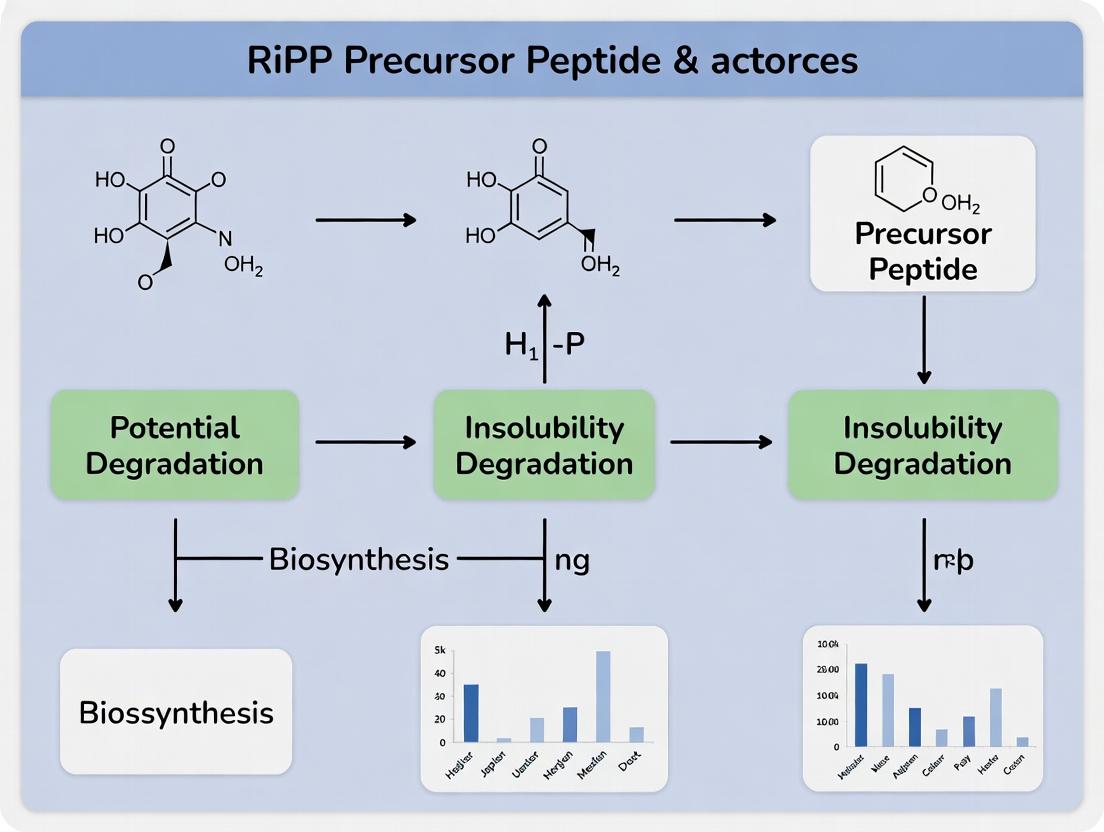
This comprehensive guide addresses the critical bottlenecks of ribosomal-synthesized and post-translationally modified peptide (RiPP) precursor peptide insolubility and degradation, which hinder in vitro characterization, enzyme engineering, and drug development.
Strategies for Solving RiPP Precursor Peptide Instability: Overcoming Solubility and Degradation Challenges in Natural Product Research
Abstract
This comprehensive guide addresses the critical bottlenecks of ribosomal-synthesized and post-translationally modified peptide (RiPP) precursor peptide insolubility and degradation, which hinder in vitro characterization, enzyme engineering, and drug development. Tailored for researchers, scientists, and drug development professionals, the article explores the fundamental causes of these issues, presents a toolkit of methodological solutions for expression, purification, and stabilization, provides advanced troubleshooting protocols, and evaluates validation techniques to compare strategy efficacy. The synthesis of these four intents provides a practical roadmap to rescue challenging RiPP projects and accelerate the discovery of novel bioactive compounds.
Understanding the Core Challenge: Why RiPP Precursor Peptides Become Insoluble and Unstable
The RiPP Biosynthetic Pathway and the Central Role of the Core Peptide
Troubleshooting Guides & FAQs for RiPP Precursor Peptide Experiments
FAQ 1: Handling Insolubility of RiPP Precursor Peptides
Q1: My core peptide-containing precursor peptide is insoluble in standard aqueous buffers. What are my first steps? A: This is a common issue due to hydrophobic core sequences or misfolding.
- Initial Troubleshooting Steps:
- Buffer Screening: Systematically test different buffers (e.g., phosphate, Tris, HEPES) across a pH range of 6.0-8.5.
- Additive Screening: Include additives like chaotropic agents (urea, guanidine HCl at 1-2 M), detergents (CHAPS, DDM at 0.1-1%), or organic co-solvents (glycerol at 5-10%, DMSO at ≤5%).
- Temperature: Test solubility at 4°C vs. room temperature.
- Concentration: Avoid high initial concentrations; dilute and gradually concentrate.
Q2: How can I prevent proteolytic degradation of my precursor peptide during expression and purification? A: Degradation often occurs due to host cell proteases or unstable peptide folds.
- Recommended Actions:
- Host Strain: Use E. coli protease-deficient strains like BL21(DE3) ompT lon or similar.
- Temperature & Time: Reduce expression temperature to 18-25°C and shorten post-induction time.
- Lysis Conditions: Always include protease inhibitor cocktails (targeting serine, cysteine, metalloproteases) in lysis buffer. Perform lysis at 4°C.
- Purification Speed: Use fast purification methods like IMAC with high stringency wash buffers (e.g., containing 20-50 mM imidazole) to remove contaminating proteases.
- Tag Strategy: Consider N-terminal tags, as the leader peptide is often cleaved off.
Q3: My modifying enzyme does not recognize or process my synthetic core peptide. What could be wrong? A: The leader peptide is typically essential for enzyme recognition.
- Checklist:
- Leader Presence: Ensure you are using the full-length precursor (leader + core) or a validated leader-core fusion construct.
- Leader Sequence Integrity: Verify the leader peptide sequence matches the wild-type sequence for your RiPP class (e.g., LanM, Cyp, P450).
- Enzyme Cofactors: Confirm all necessary cofactors (e.g., ATP for kinases, NADPH for oxidoreductases, Fe²⁺/α-KG for hydroxylases) are present in the reaction buffer.
Experimental Protocol: Assessing Precursor Peptide Solubility & Stability
Title: Protocol for Systematic Solubility and Stability Analysis of RiPP Precursor Peptides.
Objective: To quantitatively determine the optimal buffer conditions for solubilizing and stabilizing a core peptide-containing precursor peptide.
Materials:
- Lyophilized or pelleted precursor peptide.
- Buffer stock solutions (see Table 1).
- Microcentrifuge tubes.
- Tabletop centrifuge.
- UV-Vis spectrophotometer or NanoDrop.
- SDS-PAGE gel apparatus.
Method:
- Buffer Preparation: Prepare 500 µL of each test buffer from Table 1.
- Solubilization Attempt: Add a fixed mass (e.g., 100 µg) of peptide to each buffer. Vortex thoroughly for 30 seconds.
- Incubation: Incubate samples on a rotary mixer at 4°C for 1 hour.
- Clarification: Centrifuge at 16,000 x g for 15 minutes at 4°C.
- Quantification (Solubility): Carefully transfer the supernatant to a new tube. Measure the absorbance at 280 nm (A280) and calculate the concentration. Pellet can be analyzed by SDS-PAGE.
- Stability Assay: Take the clarified soluble fraction from the best buffer(s). Aliquot and incubate at 4°C and 25°C.
- Time-Course Analysis: At time points (0, 6, 24, 48 h), analyze aliquots by SDS-PAGE and/or HPLC to detect degradation.
Table 1: Solubility Screening Buffer Matrix
| Buffer System | pH | Key Additives | Observed Solubility* (mg/mL) | Stability at 24h (4°C) |
|---|---|---|---|---|
| 50 mM Sodium Phosphate | 7.4 | None | 0.2 | ++ |
| 50 mM Tris-HCl | 8.0 | 150 mM NaCl | 0.5 | +++ |
| 50 mM HEPES | 7.5 | 1 M Urea, 5% Glycerol | 2.1 | ++++ |
| 50 mM Ammonium Bicarbonate | 7.8 | 0.1% CHAPS | 1.8 | +++ |
| 20 mM Sodium Acetate | 5.5 | 500 mM Arg-HCl, 2% DMSO | 3.5 | ++ |
Hypothetical data for illustration. *Stability: + (major degradation) to ++++ (no degradation).
The Scientist's Toolkit: Key Research Reagent Solutions
Table 2: Essential Reagents for RiPP Precursor Peptide Research
| Item | Function | Example/Note |
|---|---|---|
| Protease-Deficient E. coli Strains | Minimizes degradation during heterologous expression. | BL21(DE3), C43(DE3), Lemo21(DE3). |
| C-Terminal His-tag Vectors | Allows purification via IMAC while keeping leader peptide (often N-terminal) free. | pET series with C-terminal 6xHis. |
| Protease Inhibitor Cocktail (Serine/Cysteine/Metallo) | Protects peptide during cell lysis and initial purification. | Commercially available tablets or solutions. |
| Chaotropic Agents | Aids in solubilizing aggregated peptides. | Urea (1-4 M), Guanidine HCl (0.5-2 M). |
| Mild Detergents | Helps solubilize hydrophobic peptides. | CHAPS (0.1-1%), DDM (0.05-0.2%). |
| Compatible Organic Solvents | Can improve solubility of highly hydrophobic cores. | DMSO (≤5%), Glycerol (5-10%), Ethanol (≤2%). |
| Stability Additives | Reduces aggregation and surface adsorption. | L-Arginine (0.5 M), Sucrose (10%), BSA (0.1 mg/mL). |
| Reducing Agents | Maintains cysteine residues in reduced state for enzymes like LanM. | TCEP (1-5 mM), DTT (1-5 mM). |
Visualization: RiPP Biosynthesis Workflow & Solubility Optimization
Title: RiPP Biosynthesis and Insolubility Troubleshooting Path
Title: Decision Tree for Precursor Peptide Insolubility
Troubleshooting Guide & FAQs
Q1: My expressed RiPP precursor peptide is entirely in the insoluble fraction after cell lysis. What are the first structural elements I should investigate? A: A high proportion of hydrophobic residues is a primary driver. Calculate the grand average of hydropathy (GRAVY) score; a positive value (>+0.5) strongly predicts insolubility. Additionally, scan for contiguous stretches of 5+ hydrophobic residues (e.g., A, I, L, F, V, W, M). These regions can mediate non-specific aggregation during expression.
Q2: I suspect my peptide is forming non-covalent aggregates. How can I confirm this and what are my initial mitigation strategies? A: Use analytical size-exclusion chromatography (SEC) or dynamic light scattering (DLS) on a solubilized sample to confirm high molecular weight species. Initial strategies include:
- Lowering expression temperature (e.g., 18-25°C).
- Using a lower-copy number or tightly regulated expression vector.
- Co-expressing with molecular chaperones (e.g., GroEL/ES, DnaK/DnaJ-GrpE, TF).
- Testing solubility-enhancing fusion tags (e.g., MBP, GST, SUMO).
Q3: My peptide appears degraded on SDS-PAGE. What are common causes and solutions for proteolytic degradation? A: Degradation indicates susceptibility to host proteases. Solutions include:
- Using protease-deficient E. coli strains (e.g., BL21(DE3) lon and ompT proteases deficient).
- Adding a cocktail of protease inhibitors to the lysis buffer.
- Incorporating a cleavable N-terminal fusion tag to shield the peptide.
- Testing faster purification protocols and immediate processing at 4°C.
- Adjusting the pH of buffers away from the optimum of common proteases.
Q4: How can I distinguish between misfolding-driven aggregation and simple hydrophobicity-driven precipitation? A: Key diagnostic experiments:
- SEC-MALS: Misfolded aggregates are often heterogeneous and may show irreversible column binding. Simple precipitates may not enter the column.
- Circular Dichroism (CD): Compare the spectra of a solubilized, refolded sample versus one kept in a denatured state. Misfolding is indicated by non-native secondary structure.
- Dye Binding (Thioflavin T, ANS): Thioflavin T binding suggests amyloid-like structures, while ANS binds exposed hydrophobic clusters common in misfolded intermediates.
Key Experimental Protocols
Protocol 1: Assessing Solubility and Aggregation State
Objective: Determine the fraction of soluble peptide and its oligomeric state.
- Lysis: Lyse cells in a mild, non-denaturing buffer (e.g., 50 mM Tris-HCl, 150 mM NaCl, pH 8.0, + protease inhibitors) using sonication or French press. Keep samples at 4°C.
- Separation: Centrifuge lysate at 20,000 x g for 30 min at 4°C. Carefully separate supernatant (soluble fraction).
- Analysis:
- Solubility: Analyze equal percentage volumes of total lysate, supernatant, and resuspended pellet by SDS-PAGE.
- Aggregation State: Filter supernatant (0.22 µm) and inject onto an analytical SEC column (e.g., Superdex 75 Increase) equilibrated in lysis buffer. Monitor absorbance at 280 nm.
Protocol 2: Fusion Tag Cleavage and Refolding Screening
Objective: Screen conditions for releasing the target peptide from a solubility tag while maintaining solubility.
- Purification: Purify the fusion protein via affinity chromatography (e.g., Ni-NTA for His-tag).
- Cleavage: Dialyze into optimal cleavage buffer for your protease (e.g., TEV, HRV 3C). Add protease (typically 1:50 w/w ratio) and incubate at 4°C for 16-20 hours.
- Refolding Screen: Post-cleavage, add aliquots to a 96-well plate containing different refolding buffers varying in:
- pH (6.0-9.0)
- Salt type/concentration (0-500 mM NaCl, arginine)
- Chaotropes (0-1 M urea, 0-0.5 M guanidine HCl)
- Detergents (0.01-0.1% CHAPS, DDM)
- Redox agents (GSH/GSSG for disulfide bonds)
- Analysis: After 24h incubation at 4°C, centrifuge plates and assess supernatant for soluble peptide via Bradford assay or HPLC.
Table 1: Common Solubility-Enhancing Fusion Tags
| Tag | Avg. Size (kDa) | Elution Method | Key Advantage | Potential Drawback |
|---|---|---|---|---|
| Maltose-Binding Protein (MBP) | 42.5 | Affinity (Amylose) | Strong solubilizer, aids folding | Large size may interfere with function |
| Glutathione-S-Transferase (GST) | 26 | Affinity (Glutathione) | Good solubility, easy detection | Can form dimers |
| Small Ubiquitin-like Modifier (SUMO) | ~11 | Affinity (His-tag) & Cleavage | Enhances expr./solub., precise cleavage | Requires specific protease (Ulp1) |
| Thioredoxin (Trx) | 12 | Heat Stability, IMAC | Stabilizes peptides, reduces inclusion bodies | Moderate solubilization power |
| N-utilization substance A (NsjA) | 15 | Affinity (His-tag) | Highly effective for difficult peptides | Less commonly used, fewer vectors |
Table 2: Impact of Expression Parameters on Solubility
| Parameter | Typical Test Range | Effect on Solubility | Recommended Tool/Strain |
|---|---|---|---|
| Temperature | 16°C, 25°C, 37°C | Lower temp slows folding, reduces aggregation | Any standard expression strain |
| Induction OD600 | 0.4 - 0.8 (log), >3.0 (stationary) | Lower cell density at induction often improves folding | Auto-induction media for screening |
| Induction Time | 2 - 20 hours | Shorter time may reduce accumulation of aggregates | Monitor by small-scale test expressions |
| Chaperone Co-expression | pG-KJE8, pGro7, pTf16 plasmids | Directly assists in proper folding | BL21(DE3) strains compatible with plasmid systems |
| Strain | BL21(DE3), Origami, SHuffle | Alters redox state, protease levels, folding machinery | SHuffle for disulfide bonds, Origami for cytoplasmic disulfides |
The Scientist's Toolkit: Research Reagent Solutions
| Item | Function in Addressing Insolubility/Degradation |
|---|---|
| pET-32 or pMAL Vector | Provides Trx or MBP fusion tags for enhanced solubility and expression. |
| BL21(DE3) lon/ompT | Standard protease-deficient E. coli host to minimize peptide degradation. |
| Terrific Broth (TB) Auto-induction Media | Allows high-density expression with gradual induction, often improving folding. |
| Protease Inhibitor Cocktail (EDTA-free) | Protects peptide from endogenous proteases during cell lysis and purification. |
| Ni-NTA or Glutathione Agarose | For affinity purification of His- or GST-tagged fusion constructs. |
| TEV or HRV 3C Protease | Highly specific proteases for cleaving fusion tags to release native peptide. |
| Arginine Hydrochloride | Additive in lysis/refolding buffers (0.5-1 M) to suppress aggregation. |
| Detergents (CHAPS, DDM) | Mild detergents to solubilize membrane-associated or hydrophobic aggregates. |
| Size-Exclusion Chromatography (SEC) Columns | For analyzing aggregation state and purifying monodisperse peptide. |
| Thioflavin T Dye | Fluorescent dye to detect amyloid-like fibrillar aggregates. |
Visualizations
Diagram 1: RiPP Precursor Insolubility Pathways
Diagram 2: Solubility Optimization Workflow
Technical Support & Troubleshooting Center
FAQs & Troubleshooting Guides
Q1: My recombinant E. coli culture shows dramatically reduced growth rate or cell lysis after induction. What could be causing this, and how can I confirm it?
A: This is a classic sign of cellular stress or toxicity from the expressed heterologous protein, common with RiPP precursor peptides. To confirm and diagnose:
- Monitor Growth (OD600): Compare induced vs. uninduced culture growth curves. A plateau or drop post-induction indicates burden.
- Check Morphology: Use phase-contrast microscopy. Filamentation, "ghost" cells (lysis), or blebbing are stress indicators.
- Assess Membrane Integrity: Perform a Live/Dead stain (e.g., propidium iodide/SYTO9) and analyze via flow cytometry or fluorescence microscopy.
- Measure Stress Reporters: Use a plasmid with a stress-responsive promoter (e.g., ibpA, groEL) fused to GFP to quantify the burden.
Q2: I suspect my target peptide is forming inclusion bodies. How can I visualize and characterize them?
A: Inclusion bodies are dense, refractile aggregates of misfolded protein.
- Visualization: Harvest cells 2-4 hours post-induction.
- Lyse cells via sonication or lysozyme treatment.
- Centrifuge lysate at low speed (e.g., 5,000 x g) to remove intact cells.
- Centrifuge the supernatant at high speed (15,000 x g, 20 min).
- Resuspend the pellet (inclusion body fraction) and the saved supernatant (soluble fraction) in equal volumes.
- Analyze both fractions by SDS-PAGE. A dominant band in the pellet fraction confirms aggregation.
- Microscopy: Use brightfield microscopy on whole cells; inclusion bodies appear as bright, intracellular spots.
Q3: For RiPP precursor peptides, what specific strategies can I use to improve solubility and reduce degradation?
A: RiPP precursors are often prone to degradation (by host proteases) and insolubility. Implement a tiered strategy:
| Strategy | Rationale | Example Protocol/Approach |
|---|---|---|
| Lower Induction Temperature | Slows protein synthesis, favors proper folding. | Induce with 0.1-0.5 mM IPTG at 18-25°C for 16-20 hours. |
| Weaker Promoter / Tune Expression | Reduces metabolic burden and aggregation kinetics. | Use pBAD (arabinose-inducible) or autoinduction media for gradual expression. |
| Fusion Tags | Enhances solubility, provides protease shield, and aids purification. | Fuse peptide to SUMO, Trx, or MBP. Include a cleavage site (e.g., TEV protease) for tag removal. |
| Co-express Chaperones | Augments host folding machinery. | Use plasmids expressing GroEL/GroES or DnaK/DnaJ/GrpE sets. |
| Use Protease-Deficient Strains | Minimizes precursor degradation. | Use E. coli strains like BL21(DE3) ΔompT Δlon or BL21(DE3) pLysS (inhibits T7 polymerase basal activity). |
| Adjust Media & Lysis Conditions | Optimizes redox environment; gentle lysis prevents shear. | Use rich media (2xYT/TB); include additives like 1% glucose or 0.5 M sorbitol; use mild detergents (CHAPS) in lysis buffer. |
Q4: How do I quantify cellular stress responses to compare different expression conditions?
A: Key metrics can be tabulated for comparison across experiments:
| Stress Parameter | Assay Method | Quantitative Readout | Interpretation |
|---|---|---|---|
| Heat Shock Response | qRT-PCR of ibpA or dnaK mRNA | Fold-change vs. uninduced control | >10-fold increase indicates severe proteotoxic stress. |
| ROS Production | Fluorescence probe (H2DCFDA) | Fluorescence units per OD600 | Higher values indicate oxidative stress. |
| Metabolic Activity | Resazurin reduction assay | Rate of fluorescence increase | Lower rate indicates metabolic burden/toxicity. |
| Membrane Potential | Dye JC-10 or DiOC2(3) | Fluorescence ratio (aggregate/monomer) | Depolarization indicates loss of fitness. |
Experimental Protocol: Evaluating Insolubility & Degradation of a RiPP Precursor
Objective: To systematically assess the solubility and stability of a recombinant RiPP precursor peptide under different expression conditions.
Materials:
- E. coli BL21(DE3) strains harboring the precursor gene in a pET vector (with optional fusion tag).
- Test conditions: 37°C vs. 20°C induction; 0.5 mM vs. 0.1 mM IPTG; ± co-expression chaperone plasmid.
- Lysis Buffer: 50 mM Tris-HCl pH 8.0, 150 mM NaCl, 1 mM PMSF, 1 mg/mL lysozyme, 1% Triton X-100.
- SDS-PAGE equipment, centrifugation capable of 15,000 x g.
Procedure:
- Parallel Expression: Inoculate 10 mL cultures for each condition. Grow to OD600 ~0.6. Induce according to your test matrix. Incubate for 4 hours (37°C) or 16 hours (20°C).
- Harvesting: Pellet 1 mL of each culture (5,000 x g, 10 min, 4°C). Decant supernatant.
- Lysis: Resuspend pellets in 200 µL Lysis Buffer. Incubate on ice for 30 min. Sonicate on ice (3x 10 sec pulses, 30% amplitude). Keep samples cold.
- Fractionation: Centrifuge the total lysate at 15,000 x g for 20 min at 4°C. Carefully transfer the supernatant (soluble fraction) to a new tube.
- Wash & Solubilize Pellet: Resuspend the pellet (insoluble fraction) in 200 µL of lysis buffer with 2% SDS (or 8M Urea) to solubilize aggregates.
- Analysis: Load equal percentages (e.g., 10%) of the total, soluble, and insoluble fractions for each condition on an SDS-PAGE gel. Stain with Coomassie Blue or perform a Western blot if specific detection is needed.
- Quantification: Use densitometry software on gel/blot images to calculate the percentage of target protein in the soluble fraction:
%Solubility = (Band Intensity in Soluble Fraction) / (Band Intensity in Soluble + Insoluble Fractions) * 100.
Pathway & Workflow Visualizations
Title: Cellular Stress Response to Recombinant Protein Expression
Title: Systematic Troubleshooting Flow for RiPP Precursor Issues
The Scientist's Toolkit: Key Research Reagent Solutions
| Reagent/Material | Primary Function | Application in RiPP Precursor Research |
|---|---|---|
| SUMO Fusion Tag | Highly soluble tag that enhances folding and stability. Often increases yield of soluble protein. | Fused to RiPP precursor N-terminus to improve solubility and reduce degradation. Cleavable by SUMO protease. |
| BL21(DE3) ΔompT Δlon | E. coli strain deficient in outer membrane protease OmpT and cytosolic protease Lon. | Host strain to minimize proteolytic degradation of susceptible precursor peptides during expression. |
| Chaperone Plasmid Sets (e.g., pG-KJE8) | Plasmid co-expressing multiple chaperone systems (DnaK/DnaJ/GrpE + GroEL/GroES). | Co-transformed with expression vector to augment cellular folding capacity and combat aggregation. |
| Autoinduction Media | Media formulated to induce protein expression automatically at high cell density. | Allows gradual induction, often reducing stress and improving solubility of difficult peptides vs. IPTG shock. |
| TEV or HRV 3C Protease | Highly specific proteases for cleaving affinity tags. | Used to remove solubility-enhancing fusion tags from the purified RiPP precursor under native conditions. |
| Urea & Guanidine HCl | Chaotropic agents that disrupt non-covalent bonds. | Used at high concentrations (6-8M) to solubilize inclusion bodies for refolding studies or purification. |
| H2DCFDA (DCFH-DA) | Cell-permeable fluorescent probe for reactive oxygen species (ROS). | Quantifies oxidative stress levels in cells under different expression conditions. |
A Practical Toolkit: Proven Methods to Enhance Solubility and Prevent Degradation
Troubleshooting Guides & FAQs
Q1: My fusion protein (e.g., MBP-RiPP precursor) remains insoluble despite using a solubility tag. What are the primary causes and solutions?
A: Insolubility persists due to inherent peptide hydrophobicity, aggregation-prone regions, or suboptimal expression conditions.
- Troubleshooting Steps:
- Verify Construct Design: Ensure the tag is at the N-terminus. For RiPP precursors, an N-terminal tag is often essential for recognition by processing enzymes. Consider adding a short, flexible linker (e.g., GGGGS) between tag and peptide.
- Optimize Expression: Lower expression temperature (e.g., 18-25°C), reduce inducer concentration (e.g., 0.1-0.5 mM IPTG), or use a weaker promoter.
- Co-express Chaperones: Use E. coli strains or plasmids that co-express chaperone proteins (GroEL/ES, DnaK/DnaJ).
- Screen Lysis/Buffer Conditions: Increase salt concentration (e.g., 500 mM NaCl), add non-ionic detergents (e.g., 1% Triton X-100), or include arginine (0.5-1 M) in the lysis buffer.
- Try a Different Tag: If MBP fails, test SUMO, which often provides superior solubility and folding.
Q2: I observe significant degradation of my RiPP precursor fusion protein during purification. How can I minimize proteolysis?
A: Degradation indicates susceptibility to host proteases. RiPP precursors, being small and unstructured, are particularly vulnerable.
- Troubleshooting Steps:
- Use Protease-Deficient Strains: Employ E. coli strains like BL21(DE3) or its derivatives (e.g., BL21 Star) with reduced protease activity.
- Include Protease Inhibitors: Always add a cocktail of inhibitors (see Table 1) to lysis and purification buffers. EDTA is critical for metalloproteases.
- Work Rapidly at Low Temperatures: Keep samples on ice or at 4°C throughout purification.
- Alter Expression Timing: Harvest cells earlier (e.g., 3-4 hours post-induction) to avoid protease accumulation during stationary phase.
- Consider an Intein System: For highly sensitive peptides, use an intein-based purification system (e.g., IMPACT) that avoids enzymatic cleavage.
Q3: Cleavage efficiency with thrombin or TEV protease is low for my GST or MBP fusion. What factors should I check?
A: Low cleavage efficiency stems from inaccessibility of the cleavage site.
- Troubleshooting Steps:
- Confirm Site Accessibility: Ensure the cleavage site is not buried within the protein structure or bound to the affinity resin. Elute the protein before cleavage if on-column cleavage fails.
- Optimize Reaction Conditions: Refer to enzyme-specific requirements (Table 2). For TEV protease, ensure adequate reducing agent (DTT) is present.
- Extend Incubation Time & Ratio: Increase protease:substrate ratio (e.g., from 1:100 to 1:20 w/w) and incubation time (e.g., overnight at 4°C).
- Check for Tags Interfering with Folding: The fusion partner may cause misfolding that buries the site. Test cleavage after gentle denaturation/renaturation.
- Validate Enzyme Activity: Run a control cleavage reaction with a known, good substrate.
Q4: After cleavage and tag removal, my target RiPP peptide precipitates. How can I recover soluble peptide?
A: The tag was conferring solubility; its removal exposes the hydrophobic core of the peptide.
- Troubleshooting Steps:
- Optimize Cleavage Buffer: Perform cleavage in a buffer compatible with the target peptide. Include chaotropes (urea, guanidine HCl) or arginine, then dialyze post-cleavage.
- Change Cleavage Site: If using a system like SUMO, the cleavage enzyme (SUMO protease) recognizes the folded structure of the SUMO tag, allowing cleavage in denaturing conditions (e.g., 6 M guanidine HCl) to keep the peptide soluble.
- Immediate Reverse-Phase Capture: After cleavage, directly load the mixture onto a reverse-phase HPLC column to separate the peptide from the tag and buffers in an organic solvent system.
- Test Alternative Tags: Some tags like NusA or Trx may offer superior solubility enhancement for difficult peptides.
Data Presentation
Table 1: Common Fusion Tags: Properties & Applications for RiPP Research
| Tag | Size (kDa) | Key Feature | Pros for RiPP Precursors | Cons for RiPP Precursors | Common Cleavage Protease |
|---|---|---|---|---|---|
| MBP | ~40 | Enhances solubility & folding | Excellent solubility enhancer; can promote correct disulfide bonding. | Large size may dilute specific activity; potential for immunogenicity. | Factor Xa, Thrombin, TEV |
| SUMO | ~11 | Native-like folding & protection | High solubility; efficient, specific cleavage; works in denaturing buffers. | More expensive protease; may not prevent all aggregation. | SUMO Protease (Ulp1) |
| GST | ~26 | Dimerization & easy purification | Simple, high-yield purification via glutathione resin. | Dimerization can complicate analysis; less effective for solubility. | Thrombin, PreScission, TEV |
Table 2: Common Cleavage Protease Conditions
| Protease | Recognition Sequence | Optimal Buffer | Typical Temperature/Time | Notes for RiPP Precursors |
|---|---|---|---|---|
| TEV | ENLYFQ*G | 50 mM Tris-HCl, 0.5 mM EDTA, 1 mM DTT, pH 8.0 | 4°C, overnight (16-18 hrs) | High specificity; DTT is essential. Add to lysis buffer to inhibit unwanted cleavage. |
| Thrombin | LVPR*GS | 20 mM Tris-HCl, 150 mM NaCl, 2.5 mM CaCl₂, pH 8.4 | 22-25°C, 2-16 hrs | Ca²⁺ required. Risk of non-specific cleavage; remove promptly post-reaction. |
| SUMO Protease | SUMO protein structure | Broad tolerance (Tris or PBS), works in 0.1-1 M urea/guanidine | 4°C or 30°C, 1-4 hrs | Cleavage is based on SUMO fold, not linear sequence. Ideal for insoluble precursors. |
| Factor Xa | IEGR* | 20 mM Tris-HCl, 100 mM NaCl, 2 mM CaCl₂, pH 8.0 | 4°C, overnight | Can cleave at secondary sites; test specificity for your sequence. |
Experimental Protocols
Protocol 1: Expression and Purification of a SUMO-RiPP Precursor Fusion with Cleavage in Denaturing Conditions This protocol is designed for challenging, aggregation-prone RiPP precursors.
- Cloning & Transformation: Clone the RiPP precursor gene into a pET vector containing an N-terminal His₆-SUMO tag. Transform into BL21(DE3) competent cells.
- Expression: Grow culture in LB+antibiotic at 37°C to OD₆₀₀ ~0.6. Induce with 0.5 mM IPTG. Shift temperature to 18°C and incubate for 16-20 hours.
- Harvest & Lysis: Pellet cells. Resuspend in Lysis Buffer (20 mM Tris, 500 mM NaCl, 6 M Guanidine HCl, 20 mM Imidazole, pH 8.0). Lyse by sonication on ice. Centrifuge at 15,000 x g for 30 min to clarify.
- Purification under Denaturing Conditions: Load supernatant onto a Ni-NTA column pre-equilibrated with Lysis Buffer. Wash with 10 column volumes (CV) of Wash Buffer (20 mM Tris, 500 mM NaCl, 6 M Urea, 40 mM Imidazole, pH 8.0).
- On-Column Refolding & Cleavage: Wash with 10 CV of Cleavage-Compatible Buffer (20 mM Tris, 150 mM NaCl, 1 mM DTT, pH 8.0) to remove denaturant. Incubate column with SUMO protease (1:100 w/w ratio) in cleavage buffer for 4 hours at room temperature or overnight at 4°C.
- Elution: The cleaved target peptide (without tag) will flow through. Wash column with 5 CV of cleavage buffer to collect all peptide. The His₆-SUMO tag and protease remain bound to the Ni-NTA resin.
Protocol 2: Troubleshooting On-Column vs. Off-Column TEV Cleavage for GST Fusions This protocol helps determine the best cleavage strategy.
- On-Column Cleavage:
- Purify the GST-fusion protein on a glutathione agarose column as per standard protocol.
- Wash the resin-bound protein with 10 CV of TEV Cleavage Buffer (50 mM Tris-HCl, 150 mM NaCl, 1 mM EDTA, 1 mM DTT, pH 8.0).
- Add TEV protease directly to the resin slurry (1:50 ratio). Incubate with gentle mixing overnight at 4°C.
- Collect the flow-through containing the cleaved peptide. Analyze by SDS-PAGE.
- Off-Column Cleavage (if On-Column Fails):
- Purify and elute the GST-fusion protein using standard reduced glutathione elution buffer.
- Dialyze the eluted protein into TEV Cleavage Buffer to remove glutathione.
- Add TEV protease (1:50 ratio). Incubate overnight at 4°C.
- To remove the cleaved GST tag and TEV protease, pass the mixture over a regenerated glutathione agarose column. The flow-through contains the purified peptide.
Diagrams
Fusion Tag Strategy Workflow for RiPP Precursors
Key Components in Lysis Buffer for RiPP Fusions
The Scientist's Toolkit: Research Reagent Solutions
| Item | Function & Relevance to RiPP Fusion Work |
|---|---|
| His₆-SUMO Tag Vectors | Standardized plasmids (e.g., pET SUMO) for high-level expression and purification. SUMO enhances solubility and allows cleavage in harsh conditions. |
| TEV Protease | Highly specific serine protease for tag removal. Minimizes unwanted cleavage of sensitive RiPP precursor sequences. |
| SUMO Protease (Ulp1) | Protease that recognizes the tertiary structure of the SUMO tag, enabling cleavage under denaturing conditions to solubilize targets. |
| Ni-NTA Resin | Immobilized metal-affinity chromatography resin for purifying His₆-tagged fusion proteins. High binding capacity. |
| Glutathione Agarose | Affinity resin for purifying GST-tagged fusion proteins via binding to glutathione. |
| Protease Inhibitor Cocktail (EDTA-free) | A mixture of inhibitors targeting serine, cysteine, and aspartic proteases. Essential for preventing degradation of unstable precursors. |
| Dithiothreitol (DTT) | Reducing agent critical for maintaining TEV protease activity and preventing disulfide-mediated aggregation. |
| Guanidine Hydrochloride | Strong chaotropic denaturant. Used in lysis buffers to solubilize inclusion bodies or in SUMO cleavage protocols. |
| BL21(DE3) E. coli Strain | Common protease-deficient host for recombinant protein expression, reducing precursor degradation. |
| Pre-cast Gradient Gels (4-20% Tris-Glycine) | Essential for high-resolution SDS-PAGE analysis to check fusion protein expression, purity, and cleavage efficiency. |
Troubleshooting Guides & FAQs
FAQ: Common Issues in RiPP Precursor Peptide Expression
Q1: My recombinant precursor peptide is entirely insoluble when expressed in E. coli. What are my first-step optimization strategies? A: Initial strategies should focus on modifying the construct itself. First, implement N- or C-terminal truncations of the core peptide region to remove potentially aggregation-prone sequences. Second, fuse a solubility-enhancing leader peptide (e.g., MBP, GST, Sumo, Thioredoxin) to the N-terminus. Use a protease-cleavable linker (e.g., TEV, HRV-3C site) between the leader and your peptide for later removal. Co-express with molecular chaperones (e.g., GroEL/ES, Trigger Factor) as a parallel approach.
Q2: I observe significant degradation of my peptide on SDS-PAGE, resulting in multiple lower molecular weight bands. How can I address this? A: Degradation indicates proteolytic susceptibility. Troubleshoot by: 1) Using protease-deficient E. coli strains (e.g., BL21(DE3) OmpT-/Lon-). 2) Including a cocktail of protease inhibitors in all lysis buffers. 3) Testing expression at lower temperatures (18-25°C) to slow both expression and protease activity. 4) Shortening induction and post-induction times. 5) Fusing your peptide to a large solubility tag, which can shield it.
Q3: Solubility tags improve yield but hinder downstream activity assays. What are effective cleavage and removal options? A: Choose a tag with a specific, high-efficiency protease site. Common systems are detailed below. After cleavage, remove the tag via affinity chromatography: if using a His-tag on the leader, pass the cleaved mixture over a Ni-NTA column; the untagged peptide will flow through while the leader binds.
Q4: Co-expression with chaperones did not improve my peptide solubility. What could have gone wrong? A: Key failure points include: Timing: Chaperone genes must be expressed before or concurrently with the target. Use a dual-plasmid system with the chaperone under constitutive or earlier induction. Stoichiometry: The ratio of chaperone to target is critical; titrate the inducer concentration for the chaperone plasmid. Chaperone Specificity: Not all chaperones handle all clients. Test different chaperone systems (e.g., DnaK/DnaJ/GrpE vs. GroEL/ES).
Q5: How do I decide between N-terminal truncations, C-terminal truncations, or internal deletions? A: Start with bioinformatic analysis. Use algorithms like AGGRESCAN or TANGO to predict aggregation-prone regions (APRs). Prioritize truncations that remove predicted APRs while conserving residues known to be essential for post-translational modification (PTM) or bioactivity. Validate through a systematic series of constructs.
Data Presentation
Table 1: Comparison of Solubility-Enhancing Fusion Tags
| Tag | Approx. Size (kDa) | Common Protease for Removal | Elution Condition | Key Advantage |
|---|---|---|---|---|
| MBP | 40 | Factor Xa, TEV | Maltose | Often achieves high solubility, has affinity purification. |
| GST | 26 | Thrombin, PreScission | Reduced Glutathione | Easy purification and detection. |
| Sumo | 12 | Sumo Protease | N/A (cleaved off) | Often enhances expression/folding, highly specific cleavage. |
| Thioredoxin (Trx) | 12 | Enterokinase | N/A | Reduces cytoplasmic disulfide bonds. |
| Table 2: Efficacy of Optimization Strategies on Model RiPP Precursor Peptide "X" | ||||
| Strategy | Soluble Yield (mg/L) | Purity (%) | Retention of Activity (%) | |
| :--- | :--- | :--- | :--- | |
| Native Expression | <0.5 | N/A | N/A | |
| Trx Fusion | 4.2 | 85 | 95 | |
| MBP Fusion | 8.7 | 90 | 98* | |
| MBP Fusion + Chaperone Co-exp. | 12.1 | 88 | 98* | |
| *After tag cleavage. |
Experimental Protocols
Protocol 1: Construct Design for Truncation Analysis
- Design Primers: Design forward and reverse primers to amplify desired fragments of your precursor peptide gene. For N-terminal truncations, vary the forward primer start codon. Include appropriate restriction sites for cloning.
- PCR Amplification: Perform PCR using high-fidelity polymerase to generate truncation variants.
- Cloning: Digest both PCR product and expression vector with restriction enzymes. Ligate and transform into cloning strain (e.g., DH5α). Sequence confirm plasmids.
- Screening: Transform confirmed plasmids into expression host (e.g., BL21(DE3)). Express in small-scale culture (5 mL), lyse via sonication, and separate soluble/insoluble fractions by centrifugation. Analyze by SDS-PAGE.
Protocol 2: Co-expression with Chaperone Plasmids
- Transform: Co-transform the expression vector for your peptide and the chaperone plasmid (e.g., pG-KJE8 for DnaK/DnaJ/GrpE and GroEL/ES) into the expression strain. Select on plates with antibiotics for both plasmids.
- Induction of Chaperones: Inoculate a single colony into dual-antibiotic medium. Grow to mid-log phase. Add L-arabinose (e.g., 0.5 mg/mL) and/or tetracycline (e.g., 10 ng/mL) to induce chaperone expression. Incubate for 1 hour.
- Induction of Target Peptide: Add IPTG (e.g., 0.1-0.5 mM) to induce your peptide. Continue incubation at a lower temperature (e.g., 18°C) for 16-20 hours.
- Analysis: Harvest cells, lyse, and analyze soluble expression as in Protocol 1.
Visualization
Title: RiPP Precursor Solubility Optimization Workflow
Title: Chaperone Plasmid and Target Co-expression Logic
The Scientist's Toolkit
Research Reagent Solutions for RiPP Precursor Optimization
| Reagent/Material | Function in Experiment |
|---|---|
| pET Series Vectors | Common T7-driven expression vectors for high-level protein production in E. coli. |
| BL21(DE3) ompT lon | Protease-deficient E. coli strain to minimize precursor peptide degradation. |
| Chaperone Plasmids (e.g., pG-KJE8, pGro7) | Plasmids encoding sets of molecular chaperones for co-expression to aid folding. |
| MBP/His-Tag Fusion Vector | Vector for creating N-terminal MBP fusions with a His-tag for purification and solubility enhancement. |
| TEV Protease | Highly specific protease for removing fusion tags after purification, leaving a native sequence. |
| Ni-NTA Agarose Resin | Affinity resin for purifying His-tagged fusion proteins or capturing tags after cleavage. |
| Protease Inhibitor Cocktail (EDTA-free) | Added to lysis buffers to inhibit endogenous proteases during cell disruption. |
| L-Arabinose & Tetracycline | Inducers for specific chaperone plasmid systems (e.g., pG-KJE8). |
| IPTG | Standard inducer for T7/lac-based expression vectors. |
| BugBuster Master Mix | Commercial reagent for gentle, non-sonication cell lysis and soluble/insoluble fraction separation. |
Technical Support Center: Troubleshooting RiPP Precursor Peptide Production
Frequently Asked Questions (FAQs)
Q1: My RiPP precursor peptide is forming inclusion bodies in BL21(DE3). How can I improve solubility? A: This is a common issue due to high expression rates and hydrophobic regions. Implement the following protocol:
- Reduce Expression: Lower induction temperature to 18-25°C, use a lower IPTG concentration (e.g., 0.1 mM), or use auto-induction media.
- Fusion Tags: Clone your peptide gene downstream of a solubility-enhancing fusion tag (e.g., MBP, Trx, SUMO) with a cleavable linker.
- Strain Selection: Switch to a strain engineered for disulfide bond formation (SHuffle T7) if applicable, or to an E. coli C43(DE3) strain, which is better for membrane/insoluble proteins.
- Co-expression: Co-express with molecular chaperones (e.g., GroEL/ES, DnaK/DnaJ/GrpE plasmids like pG-KJE8).
- Lysis Buffer: Use lysis buffers containing non-denaturing detergents (e.g., 1% Triton X-100) or chaotropic agents (e.g., 1-2 M Urea).
Q2: I suspect my precursor peptide is being degraded by host proteases. What can I do? A: Degradation is a major hurdle in RiPP research. Follow this troubleshooting guide:
- Use Protease-Deficient Strains: Immediately switch to strains like E. coli BL21(DE3) lon/ompT deficient (e.g., BL21 Star(DE3)) or add htrA/degP deficiency (available in some strains).
- Add Protease Inhibitors: Include a cocktail of inhibitors in your lysis buffer (e.g., PMSF, Pepstatin A, Leupeptin). For serine proteases, 1 mM PMSF is essential.
- Rapid Processing: Chill cells on ice immediately post-harvest, perform lysis quickly at 4°C, and use fast purification methods (e.g., affinity tag purification).
- Alternative Host: Consider a Bacillus subtilis or Lactococcus lactis host, which may have a less aggressive protease profile for your specific peptide.
Q3: When should I consider a cell-free system over a live E. coli host? A: Cell-free protein synthesis (CFPS) is advantageous when:
- Toxicity: The peptide is toxic to living cells.
- Rapid Screening: You need to test many variants quickly (hours vs. days).
- Incorporation of Non-canonical Amino Acids (ncAAs): Requires a simplified, open system.
- Insolubility/Degradation Persists: CFPS allows direct control over the redox environment and protease activity.
Q4: My peptide requires post-translational modification (PTM). Which host should I prioritize? A: The choice depends on the PTM. Use this decision guide:
- Simple Lanthipeptides (requires LanBC enzymes): Use an E. coli co-expression system with the modification enzymes and a cognate leader peptide.
- Complex Glycosylation: Consider Streptomyces or engineered Pseudomonas putida hosts.
- Multiple Disulfide Bonds: Use SHuffle E. coli or eukaryotic systems like Pichia pastoris.
- Unusual PTMs from native host: Strongly consider using the native producer strain (if culturable) or a closely related heterologous host.
Detailed Experimental Protocols
Protocol 1: Testing Solubility with Fusion Tags and Different E. coli Strains Objective: Compare soluble yield of a problematic RiPP precursor peptide. Materials: Expression vectors with MBP/Trx/SUMO fusions, Chemically competent cells: BL21(DE3), C43(DE3), SHuffle T7. Method:
- Transform each plasmid into each strain. Plate on selective agar. Incubate at 37°C overnight.
- Inoculate 5 mL starter cultures in LB+antibiotic. Grow at 37°C, 220 rpm overnight.
- Dilute 1:100 into 50 mL fresh medium in 250 mL flasks. Grow at 37°C to OD600 ~0.6.
- Induce with 0.1 mM IPTG. Split each culture: incubate one flask at 37°C, another at 18°C for 16-20 hours.
- Harvest cells by centrifugation (4,000 x g, 20 min, 4°C). Resuspend pellet in 5 mL Lysis Buffer (20 mM Tris-HCl pH 8.0, 200 mM NaCl, 1 mM PMSF, 1 mg/mL Lysozyme).
- Lyse by sonication on ice (10 cycles of 30 sec on, 30 sec off). Centrifuge at 20,000 x g for 30 min at 4°C.
- Collect supernatant (soluble fraction). Resuspend pellet in 5 mL of the same buffer with 8 M Urea (insoluble fraction).
- Analyze 20 µL of each fraction by SDS-PAGE. Compare band intensity corresponding to your fusion protein.
Protocol 2: Producing RiPP Precursor Peptide using E. coli-based CFPS Objective: Express peptide in a protease-controlled, open environment. Materials: PURExpress In Vitro Protein Synthesis Kit (NEB), DNA template (PCR product or plasmid with T7 promoter), 1M DTT, Protease Inhibitor Cocktail. Method:
- Reaction Setup (on ice): In a 1.5 mL tube, assemble a 50 µL PURExpress reaction as per kit instructions.
- Additives: Supplement the reaction with: 1 µL 1M DTT (final 20 mM), 1 µL protease inhibitor cocktail, and any required ncAAs.
- Add Template: Add 10-20 ng of purified plasmid DNA or 5-10 µL of PCR product.
- Incubate: Incubate the reaction at 30°C for 4-6 hours.
- Analysis: Use a portion (5 µL) directly for SDS-PAGE or mass spec analysis. For purification, stop the reaction by placing on ice and proceed with affinity purification (if tag is present) or acid precipitation.
Data Presentation
Table 1: Comparison of Microbial Hosts for RiPP Precursor Production
| Host Organism | Typical Soluble Yield* | Key Advantages | Key Limitations | Best For |
|---|---|---|---|---|
| E. coli BL21(DE3) | Variable (10-50 mg/L) | Fast growth, high yield, extensive toolkit | Inclusion bodies, protease activity | Initial screening, non-toxic peptides |
| E. coli SHuffle | Moderate (5-20 mg/L) | Cytosolic disulfide bond formation | Slower growth, lower yield | Lanthipeptides, disulfide-rich peptides |
| B. subtilis | Low-Moderate (1-15 mg/L) | Generally regarded as safe (GRAS), secretion | Complex genetics, lower yield | Peptides for food/medical applications |
| P. pastoris | Moderate-High (10-100 mg/L) | Eukaryotic secretion, scalable fermentation | Slower than bacteria, glycosylation | Peptides requiring eukaryotic PTMs |
| Cell-Free (E. coli lysate) | Very Low-High (0.1-5 mg/mL) | No viability constraints, fast, open | High cost per mg, scale-up challenging | Toxic peptides, ncAA incorporation, rapid prototyping |
*Yields are highly dependent on the specific peptide and optimization. Values are indicative from literature surveys.
Diagrams
Title: RiPP Precursor Production Troubleshooting Guide
Title: Cell-Free Protein Synthesis (CFPS) Workflow
The Scientist's Toolkit: Research Reagent Solutions
Table 2: Essential Reagents for RiPP Host Selection Experiments
| Reagent / Material | Function / Application | Example Product / Note |
|---|---|---|
| E. coli BL21(DE3) Competent Cells | Standard workhorse for high-yield cytoplasmic expression. | NEB #C2527I, Thermo Fisher C600003 |
| E. coli SHuffle T7 Competent Cells | Enables cytoplasmic disulfide bond formation for peptides requiring correct folding. | NEB #C3029J |
| pMAL or pETM Series Vectors | Vectors for MBP or other fusion tags to enhance solubility and purification. | pMAL-c5X (NEB), pETM series (EMBL) |
| PURExpress In Vitro Synthesis Kit | Reconstituted E. coli CFPS system for toxic peptides or ncAA incorporation. | NEB #E6800 |
| Protease Inhibitor Cocktail (EDTA-free) | Added to lysis buffers to minimize degradation during extraction. | Roche cOmplete #05056489001 |
| Lysozyme | Enzymatically lyses bacterial cell walls, part of gentle lysis for soluble proteins. | Sigma-Aldrich #L6876 |
| Imidazole | For elution during His-tag purification; optimize concentration to reduce co-elution. | MilliporeSigma #56749 |
| Precision Protease or TEV Protease | For cleaving off solubility fusion tags after purification to obtain native peptide. | Thermo Fisher #88946 (PreScission) |
Technical Support Center: Troubleshooting Guide & FAQs
Context: This support center is designed within the framework of thesis research focused on resolving solubility and stability challenges in the purification of Ribosomally synthesized and post-translationally modified Peptide (RiPP) precursor peptides, which are prone to aggregation and proteolytic degradation.
FAQ 1: Lysis & Solubilization
Q1: My target RiPP precursor peptide forms insoluble aggregates upon cell lysis. What are my primary options? A: The choice depends on whether your downstream analysis requires a native, folded state. For RiPP precursors, denaturing conditions are often necessary initially to recover aggregated material.
- For Refolding Studies: Use strong denaturants like 6-8 M Guanidine HCl or 8 M Urea in the lysis buffer. This solubilizes aggregates and inactivates proteases.
- For Native Purification (if soluble): Use mild, non-ionic detergents (e.g., 1% Triton X-100, 0.1-1% DDM) and include protease inhibitor cocktails. Physical methods like sonication or high-pressure homogenization are crucial.
Q2: How do I select a detergent for solubilizing membrane-associated or aggregated RiPP precursors? A: Select based on the downstream step and strength required.
- Strong Denaturing: SDS (1-2%) effectively solubilizes but is incompatible with native chromatography.
- Mild/Non-denaturing: For membrane proteins or mild extraction, use DDM, CHAPS, or Triton X-100. These maintain protein-protein interactions and are compatible with size-exclusion chromatography (SEC).
Table 1: Common Detergents for RiPP Precursor Solubilization
| Detergent | Type | Critical Micelle Concentration (CMC) | Use Case for RiPP Precursors | Compatible with Native MS/Assays? |
|---|---|---|---|---|
| Sodium Dodecyl Sulfate (SDS) | Ionic, Denaturing | 0.23% (8.2 mM) | Complete solubilization of aggregates; diagnostic SDS-PAGE | No |
| n-Dodecyl-β-D-Maltoside (DDM) | Non-ionic, Mild | 0.0087% (0.17 mM) | Solubilizing membrane-associated precursors; maintaining native state | Yes |
| CHAPS | Zwitterionic, Mild | 0.49% (8-10 mM) | Solubilizing hydrophobic peptides without significant denaturation | Yes |
| Triton X-100 | Non-ionic, Mild | 0.02% (0.24 mM) | General cell lysis, extracting peripheral membrane proteins | Caution (UV absorption) |
FAQ 2: Chromatography Strategy
Q3: I have solubilized my peptide under denaturing conditions. How do I purify it, and can I refold it? A: Immobilized Metal Affinity Chromatography (IMAC) under denaturing conditions is standard for His-tagged precursors.
- Protocol: Denaturing IMAC Purification
- Lysis: Lyse cells in Buffer A (Denaturing): 6 M GuHCl, 100 mM NaH₂PO₄, 10 mM Tris-HCl, pH 8.0.
- Binding: Incubate clarified lysate with Ni-NTA resin for 60 minutes.
- Wash: Wash with Buffer A at pH 6.3 to reduce contaminant binding.
- Elute: Elute with Buffer A at pH 4.5 or with 250 mM imidazole.
- Refolding: Dilute or dialyze the eluted peptide into a refolding buffer (e.g., low denaturant, redox couples, arginine) slowly. Test small-scale refolding first.
Q4: My natively purified peptide shows degradation or multiple peaks on SEC. What’s wrong? A: This indicates residual protease activity or instability.
- Troubleshooting Steps:
- Enhance Inhibition: Add fresh, broad-spectrum protease inhibitors (e.g., EDTA, PMSF, Pepstatin, Leupeptin) to all buffers.
- Work Cold: Perform all steps at 4°C.
- Increase Stringency: Add 500 mM NaCl to wash buffers to disrupt weak, non-specific interactions.
- Analyze: Run an SDS-PAGE of the SEC peaks. Multiple peaks may indicate oligomerization; a smear suggests degradation.
Table 2: Chromatography Modes: Denaturing vs. Native
| Parameter | Denaturing State Purification | Native State Purification |
|---|---|---|
| Primary Goal | Recover insoluble aggregates, inactivate proteases | Maintain biological activity & complexes |
| Lysis Condition | 6-8 M Urea or Guanidine HCl | Mild detergents, osmotic shock, benzonase |
| Affinity Chromatography | Robust (IMAC works well in 6 M GuHCl) | Standard protocols apply |
| Ion Exchange (IEX) | Not applicable | High resolution; optimize pH/conductivity |
| Size Exclusion (SEC) | Requires refolding first | Critical: Assess monodispersity & oligomeric state |
| Key Challenge for RiPPs | In vitro refolding efficiency | Precursor instability & degradation |
The Scientist's Toolkit: Research Reagent Solutions
| Reagent/Material | Function in RiPP Precursor Purification |
|---|---|
| Guanidine Hydrochloride (GuHCl) | Strong chaotrope; solubilizes inclusion bodies, denatures proteases. |
| Protease Inhibitor Cocktail (EDTA-free) | Inhibits metalloproteases and other proteases without interfering with IMAC. |
| Ni-NTA or Co²⁺ Resin | Affinity resin for capturing polyhistidine-tagged precursor peptides. |
| n-Dodecyl-β-D-Maltoside (DDM) | Mild detergent for solubilizing membrane-bound precursors natively. |
| L-ArgHCl | Additive in refolding buffers to suppress aggregation during renaturation. |
| Pre-cast SDS-PAGE Gels (4-20%) | For rapid analysis of purity, degradation, and solubility at each step. |
| HiLoad Superdex 75 SEC Column | Industry-standard for high-resolution native size-exclusion chromatography. |
| PD-10 Desalting Columns | For rapid buffer exchange to remove imidazole, salts, or detergents. |
Visualization: Experimental Workflow Diagrams
Title: Purification Workflow for Challenging RiPP Precursors
Title: Problem-Solving Logic for RiPP Precursor Issues
Troubleshooting Guides & FAQs
Q1: My RiPP precursor peptide forms an insoluble precipitate upon thawing from -80°C storage. What are the primary buffer optimization strategies?
A: Insolubility post-thaw often indicates inadequate buffering capacity or inappropriate pH. For RiPP peptides prone to aggregation:
- Increase Buffer Strength: Use 20-50 mM concentrations of common buffers (e.g., Tris, phosphate). Avoid concentrations below 10 mM.
- Optimize pH: Store at a pH 0.5-1.0 units away from the peptide's predicted isoelectric point (pI) to enhance charge repulsion. For example, if pI is 8.5, store at pH 7.4 or 9.5.
- Add Chaotropic Agents: Include low concentrations of urea (0.5-1 M) or guanidine HCl (0.1-0.5 M) to disrupt non-covalent aggregation.
- Include Detergents: Non-ionic detergents like n-Dodecyl β-D-maltoside (DDM) at 0.01-0.1% (w/v) can improve solubility.
Q2: What cryoprotectants are most effective for preventing RiPP peptide degradation during freeze-thaw cycles, and at what concentrations?
A: Cryoprotectants stabilize by vitrification and preferential exclusion. Effectiveness varies by peptide; empirical testing is required. Common agents and typical working concentrations:
Table 1: Cryoprotectants for RiPP Peptide Stabilization
| Cryoprotectant | Typical Working Concentration | Primary Mechanism | Notes for RiPPs |
|---|---|---|---|
| Sucrose | 5-20% (w/v) | Preferential exclusion, forms glassy state | Inert, good for downstream MS analysis. |
| Glycerol | 10-25% (v/v) | Preferential exclusion, lowers freezing point | Can interfere with some assays; high viscosity. |
| Trehalose | 5-15% (w/v) | Water replacement, glass formation | Excellent for long-term storage; may require filter sterilization. |
| Polyethylene Glycol (PEG 3350) | 5-15% (w/v) | Molecular crowding, steric inhibition of aggregation | Can promote precipitation at high concentrations; test carefully. |
Q3: Our lyophilized RiPP peptide shows poor recovery and low activity. What are the critical parameters for successful lyophilization?
A: Poor recovery often stems from incomplete lyoprotection or residual moisture issues. Follow this protocol:
Protocol: Lyophilization of RiPP Precursor Peptides
- Formulation: Dialyze or dilute the purified peptide into a lyophilization buffer containing 5-10% (w/v) of a bulking agent (mannitol, glycine) AND a lyoprotectant (trehalose, sucrose). The total solid content should be >2%.
- Freezing: Rapidly freeze the solution in a thin film using a dry ice/ethanol bath or liquid nitrogen. This forms small ice crystals.
- Primary Drying: Load onto a pre-cooled lyophilizer shelf (-40°C to -50°C). Apply vacuum (50-100 mTorr) and slowly increase shelf temperature (e.g., 0.5°C/hour) to -20°C for 24-48 hours to sublime ice.
- Secondary Drying: Gradually raise shelf temperature to +20-25°C over 8-12 hours under high vacuum (<50 mTorr) to remove bound water.
- Storage: Seal vials under inert gas (argon, nitrogen) immediately. The optimal residual moisture is <1%.
Q4: How can I quantify and compare the degradation of my peptide across different storage formulations?
A: Use a combination of analytical techniques to assess stability quantitatively.
Table 2: Analytical Methods for Stability Assessment
| Method | What it Measures | Stability Indicator |
|---|---|---|
| Reverse-Phase HPLC | Purity, chemical degradation products (oxidation, deamidation). | Reduction in main peak area; appearance of new peaks. |
| Size-Exclusion Chromatography (SEC) | Soluble aggregates (oligomers). | Increase in high-molecular-weight peak area. |
| Dynamic Light Scattering (DLS) | Hydrodynamic radius, presence of sub-visible particles/aggregates. | Polydispersity Index (PDI) >0.2 indicates heterogeneity. |
| Mass Spectrometry (LC-MS) | Exact mass changes from modifications (hydrolysis, adducts). | Shift from theoretical mass; presence of multiple mass peaks. |
| Activity/Binding Assay | Functional integrity (if applicable). | Decrease in specific activity or binding affinity. |
Experimental Workflow for Stability Screening
Title: Stability Screening Workflow for RiPP Peptides
Pathway of Peptide Degradation and Stabilization
Title: Degradation Pathways and Stabilization Interventions
The Scientist's Toolkit: Research Reagent Solutions
Table 3: Essential Reagents for RiPP Stabilization Studies
| Reagent/Category | Example Products | Function in Stabilization |
|---|---|---|
| Buffering Agents | Tris-HCl, Sodium Phosphate, HEPES | Maintain pH during storage, preventing charge-driven aggregation. |
| Chaotropic Agents | Urea, Guanidine HCl | Low concentrations disrupt hydrophobic interactions leading to insolubility. |
| Non-Ionic Detergents | n-Dodecyl β-D-maltoside (DDM), Tween-20 | Solubilize hydrophobic patches, prevent interfacial denaturation. |
| Sugars (Cryo-/Lyoprotectants) | Trehalose, Sucrose, Mannitol | Form hydrogen bonds, vitrify, replace water shell, provide cake structure. |
| Polyols (Cryoprotectants) | Glycerol, Sorbitol | Preferentially excluded, stabilize hydration shell, depress freezing point. |
| Antioxidants | Dithiothreitol (DTT), TCEP, Methionine | Reduce oxidation of methionine, cysteine, or other susceptible residues. |
| Protease Inhibitors | PMSF, EDTA, Protease Inhibitor Cocktails | Inhibit trace protease activity that causes hydrolysis during processing. |
| Lyophilization Bulking Agents | Glycine, Mannitol | Provide structural matrix for the cake, prevent blow-out. |
Advanced Troubleshooting: Diagnosing and Solving Persistent Instability Issues
Troubleshooting Guides & FAQs
FAQ 1: My purified RiPP precursor peptide sample shows a high molecular weight band on non-reducing SDS-PAGE that disappears under reducing conditions. What does this indicate? This strongly indicates non-covalent aggregation, likely through disulfide bridge formation or hydrophobic interactions. The reduction of disulfide bonds under reducing conditions dissociates the aggregates. For RiPP precursors, misformed disulfides in the core peptide region are a common cause.
FAQ 2: I observe multiple lower molecular weight bands on my SDS-PAGE gel, both with and without DTT. What is the most likely cause? This pattern suggests proteolytic degradation. Proteolysis cleaves the peptide backbone, generating stable, smaller fragments that persist regardless of reducing conditions. This is a major issue during the expression and purification of susceptible RiPP precursor peptides.
FAQ 3: My mass spectrometry analysis shows a peak at the expected mass, but also peaks at +16 Da or +32 Da. What type of degradation is this? This is indicative of chemical degradation, specifically oxidation. Methionine and tryptophan residues are common sites. For RiPP precursors, oxidation can alter structure and function before the enzymatic maturation process.
FAQ 4: My peptide solution becomes turbid upon storage at 4°C. Is this aggregation or precipitation of something else? Turbidity is a classic sign of physical aggregation and precipitation. This can be due to partial unfolding, exposure of hydrophobic patches, or changes in solution conditions (pH, ionic strength). It is distinct from proteolysis or chemical modification.
FAQ 5: How can I quickly distinguish between these degradation pathways in my initial screening? A combination of SEC (Size Exclusion Chromatography) and SDS-PAGE under reducing vs. non-reducing conditions provides a powerful initial diagnostic. SEC identifies soluble oligomers/aggregates, while SDS-PAGE patterns pinpoint covalent vs. non-covalent changes.
Diagnostic Assay Protocols
Protocol 1: Orthogonal Analysis by SEC and SDS-PAGE
Purpose: To differentiate soluble aggregates from proteolytic fragments. Materials: HPLC/FPLC system with SEC column (e.g., Superdex 75 Increase), SDS-PAGE setup, sample buffer with and without DTT/β-mercaptoethanol. Procedure:
- Centrifuge your peptide sample at 16,000 x g for 10 minutes to remove insoluble material.
- Inject the supernatant onto the pre-equilibrated SEC column. Use an isocratic mobile phase (e.g., PBS, pH 7.4). Monitor absorbance at 214 nm and 280 nm.
- Collect the major eluting peaks.
- Prepare two sets of samples from the original solution and each SEC peak: one with standard Laemmli buffer and one with buffer containing 100 mM DTT.
- Heat at 95°C for 5 minutes (non-reducing samples should not be heated if checking for disulfide aggregates, as heat can induce them).
- Run all samples on a high-percentage Tris-Tricine or Bis-Tris SDS-PAGE gel.
- Silver stain or Coomassie stain the gel.
Protocol 2: Mass Spectrometry for Chemical Modifications
Purpose: To identify specific chemical degradation products (oxidation, deamidation, hydrolysis). Materials: LC-MS/MS system, C18 reverse-phase column, 0.1% formic acid in water and acetonitrile. Procedure:
- Desalt peptide sample using a C18 ZipTip or spin column.
- Inject onto the LC-MS/MS. Use a gradient from 2% to 98% acetonitrile over 30 minutes.
- Acquire data in full-scan MS mode (high resolution) to obtain accurate mass.
- Analyze the deconvoluted mass spectrum for peaks corresponding to expected mass +/- modifications (see Table 1).
- For identification, perform data-dependent MS/MS fragmentation on parent ions.
Protocol 3: Protease Inhibition & Stability Assay
Purpose: To confirm and characterize proteolytic degradation. Materials: Broad-spectrum protease inhibitor cocktail (without EDTA), EDTA, AEBSF, E-64, Pepstatin A. Procedure:
- Prepare four aliquots of your peptide in storage buffer.
- Aliquot 1: Add only vehicle (control).
- Aliquot 2: Add 1x concentration of a broad-spectrum protease inhibitor cocktail.
- Aliquot 3: Add 5 mM EDTA (inhibits metalloproteases).
- Aliquot 4: Add specific inhibitors (e.g., 1 mM AEBSF for serine proteases).
- Incubate all aliquots at 4°C and 25°C.
- At time points (0, 6, 24, 48 hrs), remove samples and immediately freeze or boil in SDS-PAGE buffer.
- Analyze by SDS-PAGE to compare degradation band intensity.
Table 1: Key Diagnostic Signatures for Degradation Types
| Degradation Type | SDS-PAGE (Non-Red) | SDS-PAGE (Red) | SEC Profile | Intact Mass MS | Sample Appearance |
|---|---|---|---|---|---|
| Aggregation | High MW smear/band | Monomer band | Early elution peak(s) | Expected mass | Turbidity, precipitate |
| Proteolysis | Multiple lower MW bands | Multiple lower MW bands | Later eluting peaks | Lower mass fragments | Clear (usually) |
| Chemical (Oxidation) | Diffuse band at expected MW | Same as non-red | Same as native | Peaks at +16, +32 Da | Clear |
| Chemical (Deamidation) | Slightly shifted band | Slightly shifted band | Similar to native | Peaks at +1 Da (Asn) or no change (Iso-Asp formation) | Clear |
Table 2: Recommended Inhibitors for Troubleshooting RiPP Precursor Degradation
| Reagent | Target | Working Concentration | Purpose in Diagnostic Assay |
|---|---|---|---|
| EDTA (pH 8.0) | Metalloproteases | 1-10 mM | Stabilize sample if degradation is metal-ion dependent. |
| AEBSF | Serine Proteases | 0.1-1 mM | Halt serine protease activity during purification/storage. |
| Pepstatin A | Aspartic Proteases | 1 µM | Inhibit acidic proteases. |
| DTT/TCEP | Disulfide bonds | 1-10 mM (DTT), 0.5-5 mM (TCEP) | Determine if aggregates are disulfide-linked. |
| GdnHCl/Urea | Non-covalent interactions | 1-6 M | Solubilize aggregates for analysis; use denaturing SEC. |
Visualizations
Title: Diagnostic Workflow for Degradation Types
Title: RiPP Precursor Degradation Causes & Assays
The Scientist's Toolkit: Research Reagent Solutions
| Reagent/Material | Primary Function | Application in Diagnosis |
|---|---|---|
| Size Exclusion Columns | Separates molecules based on hydrodynamic radius. | Identifying soluble oligomers and aggregates (early elution) vs. fragments (late elution). |
| Tris-Tricine Gels | Provides superior resolution of small peptides (<30 kDa). | Clear visualization of low molecular weight proteolytic fragments of RiPP precursors. |
| TCEP (vs. DTT) | Strong, odorless, and stable reducing agent. | More reliably reduces disulfide bonds for assessing covalent aggregation, especially in storage. |
| Protease Inhibitor Cocktails (EDTA-free) | Broad-spectrum inhibition of serine, cysteine, aspartic proteases. | Added during lysis and purification to prevent artifactual proteolysis of susceptible peptides. |
| LC-MS Grade Solvents | High purity solvents for mass spectrometry. | Essential for accurate intact mass analysis to detect chemical modifications. |
| Chaotropic Agents (GdnHCl, Urea) | Disrupt hydrogen bonding and hydrophobic interactions. | Solubilize aggregates for analysis and differentiate non-covalent from covalent aggregation. |
| Analytical HPLC with C18 Column | High-resolution separation based on hydrophobicity. | Purity assessment and detection of degradation product peaks prior to MS. |
| Dynamic Light Scattering (DLS) Instrument | Measures particle size distribution in solution. | Rapid assessment of monodispersity vs. aggregation in native, non-denaturing conditions. |
Troubleshooting Guides & FAQs
Q1: My recombinant RiPP precursor peptide is entirely insoluble after induction. What should I optimize first? A: Temperature is the most critical factor for solubility, especially for hydrophobic or aggregation-prone peptides like many RiPP precursors. A primary troubleshooting step is to reduce the induction temperature. Shift from 37°C to lower temperatures (e.g., 25°C, 18°C, or even 16°C) immediately before adding IPTG. Lower temperatures slow protein synthesis, allowing more time for proper folding and reducing inclusion body formation. This is often the first variable to test.
Q2: I see a low yield of soluble peptide, but also significant degradation products on my gel. How can I reduce proteolysis? A: Degradation often occurs due to host cell protease activity. Optimize two parameters concurrently:
- Induction Time: Shorten the post-induction time (e.g., from overnight to 2-4 hours). Prolonged induction leads to cell lysis and release of proteases.
- Temperature: Combine shorter induction times with lower temperatures (e.g., 18°C for 4 hours). Use protease-deficient E. coli strains (e.g., BL21(DE3) ompT lon). Adding a generic protease inhibitor cocktail to the lysis buffer is also essential.
Q3: I get good solubility at low temperature, but the yield is very low. How can I increase expression without causing insolubility? A: Titrate the IPTG concentration. High IPTG concentrations (e.g., 1 mM) can overload the folding machinery. Perform a small-scale test with a range of IPTG concentrations (e.g., 0.01, 0.05, 0.1, 0.5 mM) at your optimal low temperature. Often, much lower inducer concentrations than the standard 0.5-1 mM are sufficient for RiPP precursors and improve soluble yield.
Q4: What is the systematic approach to find the best combination of conditions for my specific peptide? A: Conduct a factorial optimization experiment. Independently vary Temperature, IPTG Concentration, and Induction Time in a structured matrix. Analyze both total expression (pellet) and soluble fraction (supernatant) by SDS-PAGE. See the protocol and data presentation table below.
Q5: My peptide contains toxic motifs or causes growth arrest. How should I induce? A: For toxic peptides, use very low IPTG concentrations (0.01-0.05 mM) and induce at low optical density (OD600 ~0.4-0.6) to minimize the metabolic burden. Monitor growth after induction; a severe stall indicates toxicity. Auto-induction media, which triggers expression automatically at high cell density, can sometimes yield better results for toxic proteins by allowing robust growth first.
Experimental Protocol: Factorial Optimization of Induction Conditions
Objective: To systematically determine the optimal combination of induction temperature, IPTG concentration, and time for the soluble expression of a target RiPP precursor peptide.
Materials:
- E. coli expression strain (e.g., BL21(DE3)) harboring the expression plasmid.
- LB or TB media with appropriate antibiotics.
- IPTG stock solutions (e.g., 1M, 100mM, 10mM).
- Shaking incubators set at 37°C, 25°C, 18°C.
- Lysis buffer (e.g., 50 mM Tris-HCl pH 8.0, 150 mM NaCl) with protease inhibitors.
Method:
- Inoculate 5 mL overnight cultures from a single colony.
- Dilute overnight cultures 1:100 into fresh, pre-warmed medium (e.g., 5 mL aliquots in 50 mL tubes/flasks).
- Grow at 37°C with shaking until OD600 reaches ~0.6.
- Temperature Split: Split each culture into three pre-cooled/warmed flasks. Place them in incubators set at 37°C, 25°C, and 18°C. Allow to equilibrate for 30 minutes.
- IPTG Induction: Add IPTG to each flask to achieve the desired final concentrations (e.g., 0.01 mM, 0.1 mM, 0.5 mM). Include an uninduced control for each temperature.
- Time Course Induction: For each temperature/IPTG combination, incubate for the specified times (e.g., 3 hours, 6 hours, overnight ~16 hours).
- Harvest: Pellet cells by centrifugation (4,000 x g, 20 min, 4°C).
- Lysis & Fractionation: Resuspend pellets in lysis buffer. Lyse cells by sonication or lysozyme treatment. Centrifuge at high speed (15,000 x g, 30 min, 4°C) to separate soluble (supernatant) and insoluble (pellet) fractions.
- Analysis: Analyze equal proportions of total, soluble, and insoluble fractions by SDS-PAGE. Use densitometry of bands to quantify yield and solubility.
Data Presentation: Optimization Matrix Results
Table 1: Soluble Yield of RiPP Precursor Peptide Under Varied Conditions Yield scored semi-quantitatively via SDS-PAGE band intensity: - (none), + (low), ++ (moderate), +++ (high).
| Temperature (°C) | IPTG (mM) | Induction Time | Total Expression | Soluble Fraction | Notes |
|---|---|---|---|---|---|
| 37 | 0.5 | 4 hr | +++ | - | All insoluble, inclusion bodies |
| 37 | 0.1 | 4 hr | ++ | + | Moderate solubility |
| 25 | 0.5 | 6 hr | ++ | + | Improved over 37°C |
| 25 | 0.1 | 6 hr | ++ | ++ | Good balance |
| 18 | 0.1 | 16 hr | +++ | +++ | Optimal: High soluble yield |
| 18 | 0.5 | 16 hr | +++ | ++ | High yield, some insolubility |
| 18 | 0.01 | 16 hr | + | + | Low expression |
| 18 | 0.1 | 4 hr | ++ | ++ | Good for shorter time |
Visualization: Induction Optimization Workflow
Title: Systematic Workflow for Induction Condition Optimization
Title: Common Causes of Peptide Insolubility and Degradation
The Scientist's Toolkit: Research Reagent Solutions
Table 2: Essential Materials for RiPP Precursor Expression Optimization
| Item | Function & Rationale |
|---|---|
| BL21(DE3) ompT lon | E. coli expression host lacking key outer membrane (ompT) and cytosolic (lon) proteases, crucial for reducing peptide degradation. |
| Terrific Broth (TB) Media | Nutrient-rich media for achieving high cell densities, potentially increasing yield when solubility is managed. |
| Auto-induction Media | Media containing lactose/glucose; induces expression automatically at high density. Useful for screening or expressing toxic proteins. |
| Protease Inhibitor Cocktail (EDTA-free) | Added to lysis buffer to immediately inhibit a broad spectrum of metallo-, serine, and cysteine proteases upon cell disruption. |
| Lysozyme & Benzonase | Lysozyme digests the bacterial cell wall. Benzonase degrades nucleic acids, reducing viscosity of lysate for easier handling. |
| Nickel-NTA or Cobalt Resin | For affinity purification of His-tagged precursor peptides from the soluble fraction after optimization. |
| Urea or Guanidine HCl | Chaotropic agents for denaturing and solubilizing inclusion bodies if refolding strategies are required. |
| Portable OD600 Meter | For accurate and rapid measurement of culture density to ensure consistent induction points. |
This technical support center is framed within a thesis addressing the insolubility and degradation challenges of Ribosomally synthesized and post-translationally modified peptide (RiPP) precursor peptides. Refolding from inclusion bodies is a critical step in producing bioactive RiPPs for therapeutic development.
Troubleshooting Guides & FAQs
Q1: After rapid dilution, my protein forms aggregates instead of refolding. What could be the cause? A: This is often due to an incorrect dilution rate or refolding buffer composition. The protein concentration during dilution is critical; too high a concentration leads to intermolecular aggregation. Ensure your final protein concentration is typically between 10-100 µg/mL. Also, verify that your refolding buffer contains a redox pair (e.g., 1-5 mM reduced and 0.1-1 mM oxidized glutathione) to facilitate proper disulfide bond formation and arginine (0.5-1 M) to suppress aggregation.
Q2: During gradient dialysis, my protein precipitates out. How can I optimize the process? A: Precipitation during dialysis usually indicates a too-rapid removal of denaturant or a suboptimal dialysis buffer. Implement a more gradual gradient. Use at least 3-4 dialysis steps with decreasing urea or guanidine HCl concentrations (e.g., 6 M, 4 M, 2 M, 0 M). Ensure each step has sufficient time (4-8 hours) and is performed at 4°C. Including non-denaturing chaotropes like 0.5-1 M arginine in the lower denaturant steps can improve solubility.
Q3: How do I choose between gradient dialysis and rapid dilution for my RiPP precursor peptide? A: The choice depends on peptide properties and scale. Rapid Dilution is faster, works well for peptides that refold quickly, and is suitable for smaller scales (<50 mL refolding volume). Gradient Dialysis offers more controlled denaturant removal, is better for peptides prone to aggregation, and is easier to scale up for larger volumes. For sensitive RiPP precursors with complex disulfide patterns, gradient dialysis is often preferred.
Q4: My refolded protein shows low biological activity. What troubleshooting steps should I take? A: Low activity suggests improper folding. First, analyze the product via Non-Reducucing vs. Reducing SDS-PAGE to check for correct oligomerization or disulfide bonding. Use analytical size-exclusion chromatography to assess monomericity versus aggregation. Check the redox buffer pH; the thiol-disulfide exchange reaction is optimal at pH 8.0-8.5. Consider screening different additives (e.g., metal ions, co-factors specific to your RiPP class) in the refolding buffer.
Q5: How can I minimize proteolytic degradation during the refolding process? A: Always include protease inhibitors (e.g., PMSF, EDTA, protease inhibitor cocktails) in all buffers. Maintain the process at 4°C to slow down both degradation and aggregation kinetics. Keep the process time as short as feasible; rapid dilution is typically faster than dialysis. Purify the inclusion bodies thoroughly to remove contaminating proteases before solubilization.
Table 1: Typical Refolding Buffer Components and Concentrations
| Component | Typical Concentration Range | Primary Function |
|---|---|---|
| Tris-HCl or Phosphate Buffer | 20-100 mM, pH 8.0-8.5 | Maintains optimal pH for disulfide shuffling. |
| Urea/Guanidine HCl | 0-0.5 M (in final refold) | Lowers initial denaturant post-dilution/dialysis. |
| Arginine | 0.5-1.0 M | Suppresses aggregation by weak binding to folding intermediates. |
| Reduced Glutathione (GSH) | 1-5 mM | Provides reducing equivalents for thiol-disulfide exchange. |
| Oxidized Glutathione (GSSG) | 0.1-1.0 mM | Introduces correct disulfide bonds; GSH/GSSG ratio is key. |
| NaCl or KCl | 50-150 mM | Provides ionic strength. |
| EDTA | 1-5 mM | Chelates metal ions, inhibits metalloproteases. |
Table 2: Comparison of Rapid Dilution vs. Gradient Dialysis
| Parameter | Rapid Dilution | Gradient Dialysis |
|---|---|---|
| Speed | Very Fast (seconds-minutes) | Slow (12-48 hours) |
| Control | Low (single-step) | High (step-wise gradient) |
| Optimal Protein Conc. | Low (10-50 µg/mL) | Can be higher (50-200 µg/mL) |
| Buffer Volume | Very Large (50-100 fold dilution) | Moderate (20-50 fold exchange) |
| Suitability for Scale-up | Challenging for large volumes | Straightforward |
| Best For | Proteins resistant to aggregation, small scale. | Aggregation-prone proteins, complex disulfides. |
Experimental Protocols
Protocol 1: Rapid Dilution Refolding
- Solubilization: Dissolve purified inclusion body pellet in solubilization buffer (6-8 M GuHCl or Urea, 100 mM Tris-HCl pH 8.0, 10 mM DTT). Incubate for 1 hour at room temperature with gentle stirring.
- Clarification: Centrifuge at 15,000 x g for 20 minutes at 4°C to remove any insoluble material.
- Dilution: Rapidly dilute the solubilized protein 50-100 fold into pre-chilled (4°C) refolding buffer (100 mM Tris-HCl pH 8.5, 0.5 M L-Arg, 1 mM EDTA, 2 mM GSH, 0.2 mM GSSG). Use a magnetic stirrer for rapid mixing.
- Incubation: Stir gently for 12-24 hours at 4°C.
- Concentration & Buffer Exchange: Concentrate the refolding mixture using tangential flow filtration or centrifugal concentrators. Exchange into a suitable storage or further purification buffer.
Protocol 2: Gradient Dialysis Refolding
- Solubilization: As per Protocol 1, Step 1.
- Clarification: As per Protocol 1, Step 2.
- Initial Dialysis: Load the clarified, solubilized protein into a dialysis membrane (MWCO < 1/3 of protein MW). Dialyze against 100 volumes of Buffer A (4 M Urea, 50 mM Tris-HCl pH 8.0, 0.5 M L-Arg, 0.5 mM GSH, 0.05 mM GSSG, 1 mM EDTA) for 6 hours at 4°C.
- Step-wise Dialysis: Transfer the dialysis bag sequentially to the following buffers, each for 6-8 hours at 4°C: Buffer B (2 M Urea, other components as Buffer A), Buffer C (1 M Urea, other components as Buffer A), Buffer D (No Urea, 50 mM Tris-HCl pH 8.0, 150 mM NaCl, 0.25 M L-Arg, 0.2 mM GSH, 0.02 mM GSSG).
- Final Dialysis: Dialyze overnight against the final storage/purification buffer without redox agents or arginine.
Visualization
Diagram Title: Rapid Dilution Refolding Workflow
Diagram Title: Gradient Dialysis Refolding Workflow
The Scientist's Toolkit
Table 3: Essential Research Reagent Solutions for Refolding
| Reagent / Material | Function & Importance |
|---|---|
| High-Purity Urea or Guanidine HCl | Strong chaotrope for complete denaturation and solubilization of inclusion bodies. Purity is critical to prevent carbamylation (urea) or cyanate formation. |
| L-Arginine Hydrochloride | "Magic reagent" in refolding. Acts as a chemical chaperone, suppresses aggregation of folding intermediates without inhibiting folding itself. |
| Redox Pair (GSH/GSSG) | Creates a redox buffer system to facilitate the shuffling of disulfide bonds towards their native, thermodynamically stable configuration. |
| Protease Inhibitor Cocktail (EDTA-free) | Essential for preventing co-purified protease degradation of the target peptide, especially critical for sensitive RiPP precursors. |
| Wide MWCO Dialysis Tubing | For gradient dialysis. The Molecular Weight Cut-Off (MWCO) must be significantly smaller than the protein to prevent loss. |
| Tangential Flow Filtration (TFF) System | For efficiently concentrating large, dilute volumes from rapid dilution refolding and exchanging buffers with minimal shear stress. |
| Analytical Size-Exclusion Chromatography (SEC) Column | Critical for assessing refolding success by distinguishing monomeric, correctly folded protein from aggregates or misfolded species. |
Technical Support Center: Troubleshooting & FAQs
Frequently Asked Questions
Q1: My RiPP precursor peptide shows multiple lower molecular weight peaks in LC-MS analysis, suggesting in-source or in-solution degradation. What is my first step? A: First, confirm the degradation source. Collect a sample directly from the source and inject immediately (time-zero sample) and compare with a sample incubated in your storage buffer for 1-2 hours at 4°C. If degradation is present in the time-zero sample, in-source degradation in the MS (e.g., from high declustering potential, heat) is likely. If degradation increases over time in the incubated sample, in-solution degradation is occurring. For in-solution issues, immediately add a broad-spectrum protease inhibitor cocktail and a reducing agent like TCEP to your handling buffer.
Q2: I've added PMSF, but my peptide is still degrading. Why? A: Phenylmethylsulfonyl fluoride (PMSF) is a serine protease inhibitor with a very short half-life in aqueous solutions (~30-60 minutes). It is also ineffective against cysteine, aspartic, or metalloproteases. For RiPP precursors, which can be susceptible to a wide range of proteases, use a broader-spectrum, stabilized cocktail. Consider a combination of AEBSF (serine), Bestatin (aminopeptidases), E-64 (cysteine), and EDTA (metalloproteases).
Q3: What concentration of reducing agent should I use to prevent disulfide-mediated aggregation without harming my peptide? A: For dithiothreitol (DTT) or dithioerythritol (DTE), a 1-5 mM concentration is standard. For the more stable tris(2-carboxyethyl)phosphine (TCEP), 0.5-2 mM is sufficient. TCEP is preferred for long-term storage as it does not form mixed disulfides and works effectively at a wider pH range (pH 1.5-8.5). See Table 1 for comparison.
Q4: How do I choose the correct pH for my storage or assay buffer? A: The optimal pH is often 1-2 units away from the peptide's predicted isoelectric point (pI) to enhance solubility through net charge. For most RiPP precursors, a slightly acidic pH (5.0-6.5) can inhibit asparagine/glutamine deamidation and aspartic acid isomerization, while a slightly basic pH (7.5-8.5) might help if oxidation is the main concern. Always check peptide stability empirically. Use volatile buffers like ammonium acetate (pH 4-6) or ammonium bicarbonate (pH ~7.8) for MS compatibility.
Q5: My peptide is insoluble in aqueous buffers. How can I solubilize it without causing degradation? A: Start with mild solubilizing agents: 2-4 M urea or guanidine hydrochloride, which can be dialyzed away. Alternatively, use up to 20% (v/v) acetonitrile or DMSO. Incorporate these with a stabilizing buffer: 20 mM sodium phosphate, 150 mM NaCl, 2 mM TCEP, 10% glycerol, pH 7.4. Sonication in an ice-water bath for 30-second pulses can also help. Avoid high heat and prolonged exposure to organic solvents.
Q6: What MS instrument parameters should I adjust to minimize in-source degradation? A: Lower the source temperature and the declustering potential (or cone voltage). Increase the speed of sample introduction (shorter injection/analysis time). For ESI-MS, use a lower capillary voltage and desolvation temperature. These steps reduce the thermal and collisional energy the analyte is exposed to before detection.
Key Experimental Protocols
Protocol 1: Empirical Stability Screen for Buffer Optimization
- Prepare a 100 µM stock of your purified RiPP precursor peptide in a minimal volume of 6 M guanidine-HCl.
- Dilute this stock 1:20 into five different test buffers (final guanidine-HCl conc. = 0.3 M) in low-protein-binding tubes:
- Buffer A: 50 mM ammonium acetate, pH 5.0
- Buffer B: 50 mM ammonium acetate, pH 6.0
- Buffer C: 50 mM phosphate buffer, 2 mM TCEP, pH 7.2
- Buffer D: 50 mM Tris-HCl, 2 mM EDTA, pH 8.0
- Buffer E: Buffer C + 1x commercial protease inhibitor cocktail (without EDTA if using EDTA buffers).
- Incubate all samples at 4°C and room temperature (22°C).
- At time points 0, 2, 8, 24, and 48 hours, analyze 10 µL by reverse-phase HPLC or LC-MS.
- Measure the peak area of the intact peptide. The buffer showing >90% intact peptide after 24h at 4°C is optimal.
Protocol 2: Quick Test for Redox-Mediated Aggregation
- Prepare two samples of your peptide in your standard buffer (e.g., 50 mM Tris, pH 8.0) at 50 µM.
- To Sample 1, add TCEP to 5 mM final concentration.
- To Sample 2, add no additive (control).
- Incubate for 1 hour at room temperature.
- Centrifuge both samples at 16,000 x g for 15 minutes.
- Measure the absorbance of the supernatant at 280 nm (A280). Compare to the A280 of the untreated sample before centrifugation.
- A significantly higher A280 in the TCEP-treated supernatant indicates that aggregation was caused by intermolecular disulfide formation.
Data Presentation
Table 1: Comparison of Common Reducing Agents for RiPP Precursor Stabilization
| Reagent | Typical Working Concentration | Mechanism | Key Advantages | Key Disadvantages | Half-life in pH 7 Buffer at 25°C |
|---|---|---|---|---|---|
| DTT | 1-5 mM | Thiol-disulfide exchange, reduces to a cyclic disulfide. | Strong reducing power, inexpensive. | Air-oxidized easily, can form mixed disulfides, optimal pH 7-9. | ~10 hours |
| TCEP | 0.5-2 mM | Phosphine-based, reduces to TCEP oxide. | Stable to air oxidation, no mixed disulfides, effective at pH 1.5-8.5. | More expensive, can interfere with some assays (e.g., phosphoprotein analysis). | >48 hours |
| β-Mercaptoethanol | 5-50 mM | Thiol-disulfide exchange. | Inexpensive, volatile. | Less effective than DTT/TCEP, highly volatile and toxic. | ~4 hours |
Table 2: Protease Inhibitor Selection Guide for Bacterial RiPP Extracts
| Inhibitor Class | Target Protease(s) | Example Reagent(s) | Recommended Conc. | Notes for RiPP Work |
|---|---|---|---|---|
| Serine Protease | Trypsin, Chymotrypsin, Subtilisin | PMSF, AEBSF | 0.1-1 mM | PMSF is labile; use AEBSF (stable in water) for long incubations. |
| Cysteine Protease | Papain, Caspases | E-64, Leupeptin | 1-10 µM | E-64 is irreversible and highly specific. |
| Metalloprotease | Thermolysin, Aminopeptidases M | EDTA, EGTA, 1,10-Phenanthroline | 1-10 mM | EDTA is broad; use phenanthroline for stronger chelation if needed. |
| Aspartic Protease | Pepsin, Cathepsin D | Pepstatin A | 1 µM | Effective at low concentrations, requires DMSO/ethanol for solubilization. |
| Aminopeptidases | Leucine Aminopeptidase | Bestatin | 1-100 µM | Useful as many RiPPs have N-terminal modifications. |
The Scientist's Toolkit: Research Reagent Solutions
| Item | Function & Relevance to RiPP Stability |
|---|---|
| TCEP-HCl | A stable, odorless reducing agent that keeps cysteine residues reduced, preventing aggregation via disulfide scrambling. |
| AEBSF-HCl | A water-stable, broad-spectrum serine protease inhibitor that replaces unstable PMSF. |
| EDTA, Disodium Salt | Chelates divalent cations (Mg2+, Zn2+), inhibiting metalloprotease activity and preventing metal-catalyzed oxidation. |
| Complete Mini Protease Inhibitor Cocktail (EDTA-free) | A commercial tablet-based cocktail for rapid protection against a wide range of proteases; EDTA-free version allows for metal-dependent studies. |
| Guanidine Hydrochloride | A chaotropic agent at high concentrations (6 M) for denaturation and solubilization; at low concentrations (0.1-1 M), can help prevent aggregation. |
| Sodium Phosphate Buffer | A common buffering system for pH 7-8; less prone to microbial growth than Tris and does not contain reactive amines. |
| Low Protein-Bind Microcentrifuge Tubes | Minimizes nonspecific adsorption of precious, often hydrophobic, RiPP precursor peptides to tube walls. |
| Mass Spectrometry Grade Water/Solvents | Essential for LC-MS work to minimize contaminants that can cause adducts or background noise, complicating degradation analysis. |
Visualizations
Troubleshooting Degradation Source Workflow (Max Width: 760px)
Mechanisms of Degradation and Stabilization (Max Width: 760px)
Technical Support Center
Troubleshooting Guides & FAQs
Q1: Our predicted aggregation-prone region (APR) in a RiPP precursor peptide is very long (>15 residues). Should we mutate the entire region? A: Not necessarily. Long, hydrophobic APRs can be central to peptide structure or function. First, use tools like TANGO or AGGRESCAN to identify the 3-5 residue "hot spot" core within the APR. Perform in silico saturation mutagenesis on just these core residues, prioritizing substitutions with similar size but increased charge (e.g., Leu → Arg, Phe → Asp). Experimental validation via a small-scale solubility assay (see Protocol 1) is crucial before full construct modification.
Q2: The bioinformatics tool (e.g., CamSol, SOLpro) predicts our peptide to be soluble, but it consistently aggregates during E. coli expression. What are the likely causes? A: This common discrepancy arises from factors beyond innate peptide sequence:
- Cellular Environment: High local concentration during translation and rapid folding can drive aggregation despite innate solubility. Consider fusion tags (MBP, SUMO) or lower expression temperatures (18-25°C).
- Post-Translational Modifications (PTMs): RiPP precursors often undergo PTMs. Unmodified core peptides may be unstable. Co-express with the modifying enzyme(s) or use a host optimized for the specific RiPP class.
- Tool Limitation: Most tools are trained on globular proteins, not linear peptides. Use RiPP-specific predictors like RiPP-PRISM or RODEO for context, and cross-reference multiple tools (see Table 1).
Q3: We are designing mutations to improve solubility, but how do we avoid disrupting essential recognition elements for the biosynthetic enzymes? A: This is a critical constraint in RiPP engineering.
- Conserved Motif Analysis: Align homologous precursor sequences. Absolutely conserved residues likely belong to the recognition sequence (leader peptide) or enzyme substrate motif—avoid mutating these.
- Spatial Mapping: If a structure or homology model exists, map the APR. Mutate residues pointing away from the putative enzyme binding interface.
- Proline/Glycine Scanning: Introduce Proline (breaks β-sheets) or Glycine (increases flexibility) at non-conserved positions within the APR; these are less likely to disrupt specific side-chain recognition than charged residues.
Q4: After solubility improvements, our modified RiPP precursor is no longer recognized by its modifying enzyme. What troubleshooting steps should we take? A: This indicates disruption of the enzyme recognition motif.
- Reverse the Mutation(s): Systematically revert solubility mutations (especially those near the leader-core junction or known recognition sites) to identify the culprit.
- Leader-Core Fusion Strategy: Express the native leader peptide fused to the mutated core peptide in trans to test if recognition is recoverable.
- In Vitro Modification Assay: Purify the modifying enzyme and test activity on your mutant vs. wild-type peptide in vitro to confirm the defect is direct.
Data Presentation
Table 1: Comparison of Key Predictive Tools for Aggregation & Solubility
| Tool Name | Primary Purpose | Algorithm Basis | Key Output Metric | RiPP-Specific Considerations |
|---|---|---|---|---|
| TANGO | APR Prediction | Statistical mechanics (β-sheet propensity) | Aggregation propensity score per residue | Can over-predict in natively disordered regions like leader peptides. |
| AGGRESCAN | APR Prediction | Amino acid aggregation propensity database | Average Aggregation Propensity (AAP) | Uses short windows; good for identifying "hot spots." |
| CamSol | Solubility Prediction | Physicochemical properties & structure | Intrinsic solubility score (pH-dependent) | Performs well on both structured and disordered peptides. |
| SOLpro | Solubility Prediction | Machine learning (SVM) on protein datasets | Probability of solubility (0 to 1) | Trained on recombinant proteins; may be less accurate for short peptides. |
| DeepSol | Solubility Prediction | Deep Neural Network (1D CNN) | Binary classification (Soluble/Insoluble) | High accuracy reported; requires careful interpretation of peptide-length inputs. |
| PeSTo | Stability Prediction (ΔΔG) | Structure-based Transformer model | ΔΔG of folding upon mutation | Requires a 3D model; excellent for evaluating point mutation stability. |
Experimental Protocols
Protocol 1: Small-Scale Solubility Assay for RiPP Precursor Variants
Purpose: To rapidly compare the solubility of wild-type and mutant RiPP precursor peptides expressed in E. coli.
Materials: See "Research Reagent Solutions" table.
Method:
- Cloning & Expression: Clone gene variants into expression vectors. Transform into appropriate E. coli strain (e.g., BL21(DE3)).
- Induction: Inoculate 5 mL cultures, grow to OD600 ~0.6-0.8 at 37°C. Induce with appropriate agent (e.g., 0.5 mM IPTG). Shift to lower temperature (e.g., 25°C) and express for 4-16 hours.
- Harvesting & Lysis: Pellet cells (4,000 x g, 10 min). Resuspend in 500 μL Lysis Buffer. Lyse via sonication (3 x 10 sec pulses, 30% amplitude) on ice.
- Fractionation: Centrifuge lysate at 16,000 x g for 20 min at 4°C. Carefully transfer supernatant (soluble fraction) to a new tube.
- Wash & Solubilize Pellet: Resuspend pellet in 500 μL Wash Buffer. Centrifuge again (16,000 x g, 10 min). Discard supernatant. Solubilize the final pellet (insoluble fraction) in 500 μL Solubilization Buffer by vortexing and incubating at 37°C for 30 min.
- Analysis: Load equal volume percentages (e.g., 10% of total for each fraction) of soluble, wash, and insoluble fractions on SDS-PAGE gel. Analyze via Western blot (if antibody is available) or Coomassie stain.
Protocol 2: In Silico Saturation Mutagenesis and Solubility Prediction Workflow
Purpose: To systematically design solubility-enhancing mutations in an APR while considering structural constraints.
Method:
- Input: Obtain wild-type peptide sequence in FASTA format.
- APR Identification: Run sequence through TANGO and AGGRESCAN. Define consensus APR region(s).
- Generate Mutants: Use a tool like FoldX or a custom Python script (Biopython) to generate all possible single-point mutants within the APR.
- Solubility Prediction: Submit wild-type and all mutant sequences to CamSol and DeepSol. Record scores.
- Stability Prediction (if structure exists): For mutants showing improved solubility scores, model them onto a 3D structure (homology or AlphaFold2 model). Use FoldX or PeSTo to calculate the change in folding free energy (ΔΔG). Filter out mutants with highly destabilizing ΔΔG (> 2-3 kcal/mol).
- Conservation Check: Perform multiple sequence alignment of homologs. Flag mutations at >90% conserved positions as high-risk.
- Prioritization: Rank mutants based on: (i) greatest improvement in solubility score, (ii) minimal destabilization (ΔΔG), and (iii) location in non-conserved residues.
Mandatory Visualizations
Title: Solubility Engineering Workflow for RiPP Precursors
Title: Experimental Fractionation for Solubility Assay
The Scientist's Toolkit
Table 2: Research Reagent Solutions for RiPP Solubility Experiments
| Reagent / Material | Function / Purpose in Protocol |
|---|---|
| Lysis Buffer (e.g., 50 mM Tris-HCl pH 8.0, 150 mM NaCl, 1 mM EDTA, 1 mg/mL Lysozyme, protease inhibitors) | Breaks bacterial cell wall and inhibits proteases to release peptide without degradation. |
| Wash Buffer (e.g., Lysis Buffer + 0.1% Triton X-100) | Removes loosely associated or peripherally aggregated proteins from the insoluble pellet. |
| Solubilization Buffer (e.g., 8M Urea or 6M Guanidine HCl in Lysis Buffer) | Denatures and solubilizes proteins from inclusion bodies for complete analysis of insoluble fraction. |
| His-tag Purification Resin (Ni-NTA or Cobalt) | Rapidly captures His-tagged fusion proteins or peptides for purification under native or denaturing conditions. |
| Protease Inhibitor Cocktail (EDTA-free) | Essential for preventing degradation of unstable RiPP precursors during cell lysis and purification. |
| Solubility-Enhancing Fusion Tags (MBP, SUMO, GST, Trx) | Genetic fusions that improve solubility and expression of the target peptide; often include a cleavage site for removal. |
| BL21(DE3) pLysS E. coli Strain | Reduces basal expression before induction, beneficial for toxic or unstable peptides. |
| IPTG (Isopropyl β-D-1-thiogalactopyranoside) | Standard inducer for T7/lac-based expression vectors to control peptide production timing. |
Benchmarking Success: How to Validate and Compare Different Stabilization Strategies
Technical Support Center
Troubleshooting Guides
Issue: Low Yield of Soluble RiPP Precursor Peptide
- Potential Cause 1: Inclusion body formation during recombinant expression in E. coli.
- Solution: Reduce expression temperature (e.g., to 18-25°C), use a lower inducer concentration (e.g., 0.1-0.5 mM IPTG), or employ a strain with chaperone plasmids (e.g., pG-KJE8).
- Potential Cause 2: Proteolytic degradation.
- Solution: Use protease-deficient host strains (e.g., E. coli BL21(DE3) OmpT-/Lon-), add protease inhibitor cocktails during lysis, and work at 4°C.
- Potential Cause 3: Poor solubility at physiological pH.
- Solution: Screen lysis and purification buffers with different pH (6.0-8.5), add mild chaotropes (e.g., 0.5-1 M Urea), or include non-denaturing detergents (e.g., 0.1-0.5% CHAPS).
Issue: Poor Purity After Affinity Chromatography
- Potential Cause 1: Incomplete elution or non-specific binding.
- Solution: Perform a gradient elution (e.g., 0-500 mM imidazole over 20 CV) instead of step elution. Include 0.5 M NaCl in wash and binding buffers to reduce ionic interactions. For tags like GST, use precise, fresh reduced glutathione.
- Potential Cause 2: Protease contamination or peptide degradation during purification.
- Solution: Include EDTA (1-5 mM) in buffers to inhibit metalloproteases. Purify at 4°C and use fast protein liquid chromatography (FPLC) systems to minimize process time.
Issue: Aggregation (Loss of Monomeric State)
- Potential Cause 1: Concentration-dependent aggregation.
- Solution: Keep the peptide concentration low (<1 mg/mL) during storage. Use size-exclusion chromatography (SEC) as a final polishing step immediately before analysis or use.
- Potential Cause 2: Removal of solubilizing agents causing precipitation.
- Solution: Dialyze or dilute gradually into the final storage buffer. Include stabilizing additives like 150-300 mM arginine, 10% glycerol, or 0.01% polysorbate 20.
Issue: Lack of Functional Activity in Modified RiPP
- Potential Cause 1: Inefficient enzymatic modification by partner synthase.
- Solution: Optimize the in vitro reconstitution conditions: adjust enzyme:precursor ratio, cofactor concentration (Mg2+, ATP), temperature, and reaction time. Verify enzyme activity independently.
- Potential Cause 2: Incorrect folding or oxidation state.
- Solution: For peptides containing disulfides, screen redox buffers (e.g., glutathione or cysteine/cystamine ratios). Assess folding via circular dichroism (CD) spectroscopy.
Frequently Asked Questions (FAQs)
Q1: What is the most critical metric to prioritize when optimizing a challenging RiPP precursor peptide? A: For insoluble/degradation-prone RiPP precursors, Yield of soluble monomer is often the primary bottleneck. Without sufficient soluble material, assessing purity, monomeric state, and function is impossible. Focus on expression and solubilization conditions first.
Q2: How do I quickly assess monomeric state if I don't have access to SEC-MALS? A: Analytical Size-Exclusion Chromatography (SEC) with a UV/Vis detector, using a column calibrated with standard proteins, provides a good estimate. A single, symmetric peak at the expected elution volume suggests a monodisperse sample. Dynamic Light Scattering (DLS) is another rapid, low-volume method to assess aggregation.
Q3: My peptide is pure and monomeric but inactive. What should I check? A: First, verify the functional activity of the modifying enzyme(s) using a known positive control substrate. Second, confirm the integrity of the peptide's recognition sequence (leader/core) via mass spectrometry. Third, ensure the final assay buffer conditions (pH, salts, reducing agents) are compatible with activity.
Q4: Can high purity sometimes correlate with low yield or activity loss? A: Yes. Overly stringent purification (e.g., very low pH elution, harsh detergents) can denature the peptide, leading to a pure but inactive or aggregated sample. Always balance purity with the preservation of native structure and function.
Data Presentation
Table 1: Impact of Expression Conditions on Soluble Yield of a Model RiPP Precursor Peptide
| Condition | Temperature (°C) | IPTG (mM) | Host Strain | Average Soluble Yield (mg/L culture) | Primary Aggregation State |
|---|---|---|---|---|---|
| Standard | 37 | 1.0 | BL21(DE3) | 2.1 | >80% Inclusion Bodies |
| Optimized | 18 | 0.2 | BL21(DE3) | 15.7 | ~30% Inclusion Bodies |
| Chaperone-assisted | 25 | 0.1 | BL21(DE3) pG-KJE8 | 22.3 | ~15% Inclusion Bodies |
Table 2: Key Metrics Through a Standard RiPP Precursor Purification Workflow
| Purification Step | Total Protein (mg) | Target Purity (%) | Monomer (%) | Functional Activity (IC50 nM)* |
|---|---|---|---|---|
| Crude Lysate | 180.0 | <5% | ND | ND |
| Affinity Elution | 12.5 | ~85% | ~60% | >10,000 |
| SEC Pool | 8.1 | >95% | >95% | 25.5 |
*Example data from a lanthipeptide antimicrobial activity assay.
Experimental Protocols
Protocol 1: Small-Scale Solubility Screening for E. coli-Expressed Precursor Peptides
- Expression: Transform expression plasmid into suitable E. coli strains (e.g., BL21(DE3), Origami B). Grow in 5 mL deep-well plates.
- Induction: Induce at mid-log phase (OD600 ~0.6-0.8) with varying IPTG concentrations (0.1, 0.5, 1.0 mM) at different temperatures (37°C, 25°C, 18°C) for 16-20 hours.
- Lysis: Pellet cells, resuspend in 500 µL lysis buffer (e.g., 50 mM Tris-HCl pH 8.0, 300 mM NaCl, 1 mg/mL lysozyme, protease inhibitors). Freeze-thaw, then sonicate or use lytic enzymes.
- Fractionation: Centrifuge at 15,000 x g for 20 min. Separate supernatant (soluble) and pellet (insoluble) fractions.
- Analysis: Analyze equal proportions of both fractions by SDS-PAGE to visualize soluble vs. insoluble target peptide.
Protocol 2: Analytical Size-Exclusion Chromatography for Monomeric State Assessment
- Equipment: Use an HPLC or FPLC system with a calibrated analytical SEC column (e.g., Superdex 75 Increase 5/150 GL).
- Buffer: Use a compatible, non-denaturing buffer (e.g., 50 mM HEPES pH 7.4, 150 mM NaCl, 0.5 mM TCEP). Filter and degas.
- Sample Preparation: Clarify the sample by centrifugation (16,000 x g, 10 min, 4°C). Load 10-50 µL of sample (0.5-2 mg/mL protein concentration).
- Run: Isocratic elution at 0.2-0.5 mL/min, monitoring absorbance at 220 nm and/or 280 nm.
- Analysis: Compare elution volume to a standard curve. A single, sharp peak indicates a monodisperse sample.
Mandatory Visualization
Title: RiPP Precursor Purification and Analysis Workflow
Title: Thesis Strategy: From Solubility Problem to Key Metrics
The Scientist's Toolkit: Research Reagent Solutions
| Reagent / Material | Primary Function in RiPP Precursor Research |
|---|---|
| BL21(DE3) OmpT-/Lon- | Protease-deficient E. coli expression host to minimize peptide degradation. |
| pG-KJE8 Chaperone Plasmid | Co-expresses GroEL/GroES and DnaK/DnaJ/GrpE chaperone systems to aid soluble folding. |
| Imidazole | Competitive eluent for purifying His-tagged precursor peptides via immobilized metal affinity chromatography (IMAC). |
| HEPES Buffer (pH 7.0-8.0) | A non-coordinating, stable buffering agent for maintaining pH during purification and activity assays. |
| TCEP (Tris(2-carboxyethyl)phosphine) | A stable, odorless reducing agent to maintain cysteine residues in a reduced state and prevent disulfide-mediated aggregation. |
| Superdex 75 Increase SEC Column | High-resolution size-exclusion column for separating monomeric peptides from aggregates and impurities. |
| Arginine Hydrochloride | A chemical chaperone additive (150-500 mM) in lysis or storage buffers to suppress aggregation and improve solubility. |
| CHAPS Detergent (0.1-0.5%) | A zwitterionic, non-denaturing detergent used to solubilize membrane-associated or hydrophobic peptides without denaturation. |
Technical Support Center: Troubleshooting Guides & FAQs
FAQ: General Construct Design
Q1: Which fusion tag is most effective for improving solubility of lanthipeptide precursor peptides? A: Based on current literature, solubility enhancement tags rank in this order of general effectiveness for lanthipeptides: SUMO > MBP > GST > Trx > His-tag alone. The SUMO tag often provides the highest solubility and has the advantage of cleavability with specific proteases like Ulp1, leaving no residual amino acids.
Q2: My fusion protein is soluble but the peptide is degraded after protease cleavage. How can I prevent this? A: Degradation post-cleavage is common. Mitigation strategies include:
- Using a tandem fusion tag (e.g., His-SUMO) for improved purification before cleavage.
- Performing cleavage in the presence of protease inhibitors compatible with your specific cleavage enzyme.
- Switching to an intein-based cleavage system instead of protease-based, which can sometimes reduce exposure to proteolytic activity.
- Adding chaotropic agents (like low urea concentrations) or organic solvents (like 2-5% DMSO) to the cleavage buffer to alter precursor peptide conformation and reduce protease accessibility.
FAQ: Expression & Solubility Issues
Q3: My lanthipeptide precursor construct expresses entirely in the insoluble fraction. What are my first steps? A: Follow this systematic troubleshooting workflow:
| Step | Action | Rationale |
|---|---|---|
| 1 | Reduce expression temperature to 16-18°C and/or use lower inducer concentration (e.g., 0.1 mM IPTG). | Slows protein synthesis, allowing time for proper folding. |
| 2 | Change host strain to one designed for difficult proteins (e.g., E. coli Origami 2, BL21(DE3)pLysS, or SHuffle). | Enhances disulfide bond formation or provides chaperones. |
| 3 | Switch fusion tag. If using GST, test MBP or SUMO. | Different tags have varying solubility-enhancing capabilities. |
| 4 | Test co-expression with molecular chaperone plasmids (e.g., pG-KJE8, pGro7). | Provides folding assistance in trans. |
| 5 | Add solubility-enhancing agents to the medium (e.g., 1 M arginine, 10% sucrose). | Acts as a chemical chaperone. |
Q4: I get high soluble expression, but purification yield is low. What could be the cause? A: This often indicates instability or degradation. Solutions include:
- Add protease inhibitor cocktails immediately upon cell lysis.
- Shorten purification time by using faster methods (e.g., gravity columns instead of FPLC for initial trials).
- Purify at 4°C consistently.
- Check if the linker between tag and peptide is too short or susceptible to host proteases; consider changing the linker sequence (e.g., from (GGGGS)₂ to (EAAAK)₃).
FAQ: Cleavage & Final Peptide Recovery
Q5: Protease cleavage efficiency is low (<50%). How can I optimize it? A: Cleavage efficiency is highly condition-dependent. Create an optimization matrix:
| Factor | Test Range | Recommended Starting Point for TEV/Ulp1 |
|---|---|---|
| Enzyme:Substrate Ratio | 1:5 to 1:100 (w/w) | 1:20 |
| Temperature | 4°C, 16°C, 25°C | 16°C |
| Time | 2 h to 16 h (O/N) | 4 h |
| Buffer pH | 6.0, 7.0, 7.5, 8.0, 8.5 | 7.5 for TEV, 8.0 for Ulp1 |
| Additives | None, 1 mM DTT, 0.01% Tween-20 | 1 mM DTT for TEV |
| Salt (NaCl) | 0 mM, 150 mM, 500 mM | 150 mM |
Q6: After tag cleavage and removal, my target peptide precipitates. How can I recover it? A: Precipitation indicates the peptide is insoluble without its fusion partner.
- Modify the final buffer: Screen different buffers (Citrate, Phosphate, Tris, HEPES) across a pH range (5.5-8.5).
- Add solubilizing agents: Test low concentrations of chaotropes (0.5-1 M urea, 0.5-1 M guanidine HCl) or detergents (0.1% CHAPS, 0.01% DDM).
- Use organic solvent: For hydrophobic lanthipeptides, resuspend pellet in 50% acetonitrile/water with 0.1% TFA for HPLC purification.
- Re-evaluate construct: Consider a truncation construct if the native leader peptide is suspected of causing aggregation post-modification.
Experimental Protocols
Protocol 1: Tandem Affinity Purification for His-SUMO-Lanthipeptide Constructs
Objective: To purify a fusion construct while minimizing degradation. Materials: Cell pellet, Lysis Buffer (50 mM Tris pH 8.0, 300 mM NaCl, 10 mM Imidazole, 1 mM PMSF, 1 mg/mL Lysozyme), Ni-NTA resin, Wash Buffer (50 mM Tris pH 8.0, 300 mM NaCl, 25 mM Imidazole), Elution Buffer (50 mM Tris pH 8.0, 300 mM NaCl, 250 mM Imidazole). Method:
- Resuspend cell pellet in 5 mL/g Lysis Buffer. Incubate on ice for 30 min.
- Sonicate on ice (5x 30 sec pulses, 30 sec rest). Centrifuge at 15,000 x g for 30 min at 4°C.
- Incubate cleared lysate with 1 mL pre-equilibrated Ni-NTA resin for 1 h at 4°C with gentle mixing.
- Load resin into a column. Wash with 10 column volumes (CV) of Wash Buffer.
- Elute with 5 CV of Elution Buffer. Collect 1 mL fractions.
- Analyze fractions by SDS-PAGE. Pool pure fractions and dialyze into cleavage buffer.
Protocol 2: Ulp1 Protease Cleavage of SUMO Fusion
Objective: To cleave the SUMO tag and liberate the target peptide. Materials: Purified fusion protein, Ulp1 protease (commercial or purified), Cleavage Buffer (50 mM Tris pH 8.0, 150 mM NaCl, 1 mM DTT). Method:
- Dialyze pooled elution fractions into Cleavage Buffer.
- Determine protein concentration via A₂₈₀ or Bradford assay.
- Add Ulp1 protease at a 1:20 (w/w) enzyme-to-substrate ratio.
- Incubate reaction at 16°C for 4 hours. Monitor cleavage by analytical SDS-PAGE.
- To separate cleaved tag/peptide: pass reaction over Ni-NTA resin again. The His-SUMO tag and any uncleaved fusion will bind; the target peptide will be in the flow-through.
- Concentrate the flow-through and purify further via RP-HPLC if needed.
Data Presentation
Table 1: Comparison of Fusion Tag Performance for Model Lanthipeptide "LanA"
| Fusion Tag | Avg. Soluble Yield (mg/L culture) | Cleavage Efficiency (%) | Final Peptide Purity After Cleavage (%) | Key Advantage | Key Disadvantage |
|---|---|---|---|---|---|
| 6xHis | 2.5 | N/A | < 20 | Simple purification | Low solubility, no folding aid |
| GST | 15.2 | 85 (PreScission) | 65 | High initial solubility | Large tag, can dimerize |
| MBP | 22.1 | 80 (Factor Xa) | 70 | Excellent solubility enhancer | Inefficient proteases, large tag |
| SUMO | 18.7 | 95 (Ulp1) | 90 | High solubility, precise cleavage | More expensive protease |
| Trx-6xHis | 10.5 | 70 (Enterokinase) | 50 | Good for disulfide-rich peptides | Cleavage specificity issues |
| Intein (CBD) | 8.3 | >98 (Thiol-induced) | 85 | No protease needed, clean cleavage | Lower initial soluble yield |
Table 2: Troubleshooting Matrix for Common Problems
| Problem | Possible Cause | Solution A | Solution B |
|---|---|---|---|
| No Expression | Toxic gene, poor codon usage | Use tighter promoter (e.g., pET with pLysS) | Optimize codons for expression host |
| Insoluble Inclusion Bodies | Aggregation during synthesis | Lower growth temperature (16-18°C) | Co-express with chaperones (GroEL/ES) |
| Degradation During Lysis | Host protease activity | Use broader protease inhibitor cocktail | Switch to protease-deficient strain (e.g., E. coli BL21) |
| Low Binding to Affinity Resin | Tag inaccessible | Test under denaturing conditions (6 M GuHCl) | Add mild detergent (1% Triton X-100) to lysis buffer |
| Poor Cleavage | Incorrect buffer/conditions | Optimize pH, temperature, and ratio (see Table FAQ Q5) | Extend cleavage time to overnight at 4°C |
| Peptide Loss Post-Cleavage | Adsorption to surfaces or precipitation | Add carrier protein (0.1 mg/mL BSA) or mild chaotrope | Change final buffer to acidic (0.1% TFA) for HPLC |
Diagrams
Title: Troubleshooting Workflow for Peptide Solubility
Title: Optimal Fusion Construct Architecture
The Scientist's Toolkit: Research Reagent Solutions
| Item | Function in Lanthipeptide Research |
|---|---|
| SUMO Protease (Ulp1) | Highly specific protease for cleaving SUMO fusions; leaves no residual amino acids on target peptide. |
| TEV Protease | Common, less expensive site-specific protease; requires optimization to prevent non-specific cleavage. |
| Chitin Beads | Affinity resin for intein-mediated purification and cleavage (IMPACT system). |
| Ni-NTA Agarose | Standard resin for immobilizing polyhistidine-tagged fusion proteins. |
| Protease Inhibitor Cocktail (EDTA-free) | Essential for preventing degradation of susceptible precursor peptides during lysis and purification. |
| Molecular Chaperone Plasmids (pGro7, pTf16) | For co-expression to improve folding and solubility of difficult constructs in E. coli. |
| Detergents (DDM, CHAPS) | Mild detergents used to solubilize membrane-associated or highly hydrophobic peptides. |
| Reverse-Phase HPLC (C18 Column) | Critical final purification step to separate the target lanthipeptide from cleaved tags and impurities. |
Troubleshooting Guides & FAQs
Q1: During in vitro reconstitution, my precursor peptide is not being modified by the enzymes, even though controls work. What could be wrong? A: This is a common issue in RiPP research, often stemming from peptide insolubility or misfolding. The peptide may form aggregates that bury the recognition motif. First, check peptide solubility via a quick centrifugation and SDS-PAGE of the supernatant. Consider adding compatible solubilizing tags (e.g., SUMO, GB1), using chaotropic agents (urea, guanidine HCl) followed by refolding, or switching the buffer system (e.g., to phosphate or HEPES with mild detergents like 0.01% DDM). Ensure the redox potential (presence/absence of DTT) matches the disulfide state required for your precursor.
Q2: I observe degradation of my precursor peptide in the reconstitution assay. How can I stabilize it? A: Degradation indicates proteolytic cleavage, often by contaminating proteases from enzyme preparations or inherent instability. Implement the following steps in order: 1) Include a broad-spectrum protease inhibitor cocktail (without agents that inhibit your modification enzymes, e.g., avoid EDTA if metalloenzymes are crucial). 2) Lower the assay temperature to 25°C or 4°C. 3) Shorten the reaction time and take time-point samples. 4) Express and purify your precursor peptide with a fusion tag, cleave it on-column immediately before the assay, and use it directly. 5) Test if your modification enzymes themselves have proteolytic activity via a control with enzymes but no cofactors.
Q3: My modification enzymes appear inactive in the in vitro assay. How do I troubleshoot this? A: Enzyme inactivity can be due to lack of essential cofactors, improper folding, or loss of activity during purification. Verify the following:
- Cofactors: Confirm all necessary cofactors (e.g., ATP, SAM, metal ions like Fe²⁺, Mg²⁺, Zn²⁺) are present at optimal concentrations. See Table 1 for common requirements.
- Enzyme Folding: Check for precipitation. Use CD spectroscopy or limited proteolysis to assess folding state.
- Positive Control: Always run a parallel reaction with a known substrate (e.g., a short, soluble core peptide if available) to validate enzyme activity.
- Storage Conditions: Ensure enzymes were not stored in incompatible buffers; some may require glycerol, specific pH, or reducing agents.
Q4: How can I optimize the buffer conditions for a multi-enzyme reconstitution system? A: Reconstituting a full pathway requires balancing the needs of all components. Start with the minimal buffer required for the least stable enzyme. Then, titrate key variables sequentially while monitoring modification efficiency via LC-MS. Use a design-of-experiment (DoE) approach for multiple factors. Critical parameters to optimize are listed in Table 2.
Data Presentation
Table 1: Common Cofactors for RiPP Modification Enzymes
| Enzyme Class | Essential Cofactor(s) | Typical Working Concentration | Notes |
|---|---|---|---|
| LanM (Lanthipeptide Synthetase) | ATP (5 mM), Mg²⁺/Mn²⁺ (2-10 mM), DTT (1-5 mM) | ATP: 1-5 mM; Divalent Cations: 2-10 mM | Reducing environment critical for dehydration. |
| Cytochrome P450 (Oxidation) | Heme, NAD(P)H (1 mM), O₂ | NAD(P)H: 0.5-2 mM | Often requires a redox partner protein. Anoxic setup may be needed. |
| Radical SAM Enzymes | S-adenosylmethionine (SAM) (0.5-2 mM), [4Fe-4S] cluster, Dithionite (1-5 mM) | SAM: 0.1-1 mM; Dithionite: 1-5 mM | Strict anaerobic conditions are mandatory. |
| YcaO (Cyclodehydratase) | ATP (5 mM), Mg²⁺ (5 mM) | ATP: 2-10 mM; Mg²⁺: 2-10 mM | Often functions with a partner protein (e.g., TfuA). |
Table 2: Buffer Condition Optimization for In Vitro Reconstitution
| Parameter | Typical Range Tested | Analysis Method | Goal for Insoluble Precursors |
|---|---|---|---|
| pH | 6.0 - 8.5 | LC-MS, Modification Yield | Find isoelectric point (pI) to maximize solubility. |
| Ionic Strength (NaCl/KCl) | 0 - 500 mM | LC-MS, Solubility Assay | Reduce non-specific aggregation. |
| Chaotropic Agent (Urea) | 0 - 2 M | LC-MS, CD Spectroscopy | Maintain peptide in soluble, unfolded state without denaturing enzymes. |
| Detergent (DDM, CHAPS) | 0 - 0.1% | LC-MS, Activity Assay | Solubilize peptide aggregates; use below CMC to avoid enzyme inhibition. |
| Temperature | 4°C - 37°C | LC-MS, Time-course | Lower temp to reduce degradation; may slow kinetics. |
| Incubation Time | 10 min - 24 hrs | LC-MS, Time-point sampling | Find balance between complete modification and degradation. |
Experimental Protocols
Protocol 1: Basic In Vitro Reconstitution Assay for RiPP Modification Objective: To test the activity of a single modification enzyme on a purified precursor peptide. Materials: Purified enzyme, purified precursor peptide, assay buffer (e.g., 50 mM HEPES pH 7.5, 100 mM NaCl, 10 mM MgCl₂), required cofactors (e.g., ATP, SAM), stop solution (1% formic acid or SDS-PAGE loading buffer). Procedure:
- Setup: On ice, prepare a 50 µL reaction mix in assay buffer containing: precursor peptide (10-100 µM), all necessary cofactors (see Table 1), and the modification enzyme (1-5 µM, enzyme:substrate ratio ~1:10 to 1:50).
- Control: Prepare an identical reaction without the enzyme (substrate control) and one without cofactors (enzyme control).
- Incubation: Transfer reactions to a thermomixer and incubate at the optimal temperature (e.g., 30°C) for 1-2 hours.
- Quenching: Stop the reaction by adding 5 µL of 1% formic acid (for LC-MS) or 50 µL of 2X SDS-PAGE loading buffer (for gel analysis).
- Analysis: Analyze by LC-MS to detect mass shifts corresponding to modifications, or by Tris-Tricine SDS-PAGE to observe mobility shifts.
Protocol 2: Assessing Peptide Solubility for Reconstitution Assays Objective: To determine the fraction of soluble precursor peptide under assay conditions. Materials: Peptide stock, proposed assay buffer, ultracentrifuge or micro-centrifuge filter (100 kDa MWCO). Procedure:
- Sample Preparation: Dilute the peptide stock into the target assay buffer to the final concentration intended for the reconstitution assay (e.g., 50 µM). Incubate on ice for 30 min.
- Separation: Centrifuge at 100,000 x g for 30 min at 4°C, or filter through a 100 kDa MWCO centrifugal filter at 14,000 x g for 10 min.
- Quantification: Carefully remove the supernatant/filtrate. Measure the peptide concentration in the supernatant/filtrate and the original solution using a UV spectrophotometer (A280) or a quantitative amino acid analysis assay.
- Calculation: % Solubility = (Concentrationsupernatant / Concentrationoriginal) x 100. Use only batches with >90% solubility for reliable assays.
Mandatory Visualization
Title: Troubleshooting Workflow for RiPP Reconstitution
Title: Core RiPP Modification Pathway & Failure Points
The Scientist's Toolkit
Table 3: Research Reagent Solutions for RiPP Reconstitution Assays
| Reagent/Material | Function | Example Product/Note |
|---|---|---|
| Solubilizing Fusion Tags | Enhances precursor peptide solubility and expression yield during purification. Removed via specific proteolysis before assay. | His-SUMO, MBP, GST, GB1 domain. Use TEV or PreScission protease for cleavage. |
| Protease Inhibitor Cocktails (Cofactor-Compatible) | Inhibits contaminating proteases without chelating metals or interfering with essential cofactors. | EDTA-free cocktails (e.g., Roche cOmplete EDTA-free). |
| Chaotropic Agents | Disrupts non-covalent interactions, solubilizing aggregated peptides. Must be optimized to not denature enzymes. | Urea (0.5-2 M), Guanidine HCl (0.1-0.5 M). |
| Mild Detergents | Disrupts hydrophobic interactions leading to aggregation, useful for membrane-associated precursors. | n-Dodecyl β-D-maltoside (DDM, 0.01-0.05%), CHAPS (0.1-0.5%). |
| Anaerobic Chamber/Sealed Vials | Essential for oxygen-sensitive enzymes (e.g., Radical SAM, certain P450s). Maintains anoxic atmosphere. | Coy Lab Products chamber, or use sealed vials with septum for degassing/flushing. |
| LC-MS System with Intact Protein Mode | Critical analytical tool for detecting precise mass shifts from modifications (dehydration, cyclization, oxidation). | Requires high-resolution mass spectrometer (e.g., Q-TOF, Orbitrap). |
Technical Support Center
Troubleshooting Guides & FAQs
Q1: During heterologous expression in E. coli, my modified RiPP precursor peptide is entirely insoluble, forming inclusion bodies. What are my primary troubleshooting steps?
A: This is a common issue. Follow this systematic protocol:
- Reduce Expression Temperature & Inducer Concentration: Immediately lower the post-induction temperature to 16-18°C and reduce IPTG concentration to 0.1-0.5 mM. This slows protein synthesis, allowing proper folding.
- Co-express Chaperones: Transform your expression strain with a plasmid encoding chaperone systems like GroEL/GroES or DnaK/DnaJ/GrpE.
- Test Fusion Tags: Subclone your peptide gene into a vector with an N-terminal solubility tag (e.g., MBP, GST, SUMO). Use a cleavable linker for later tag removal.
- Modify Media & Lysis: Add 1-2% ethanol or sorbitol to the growth medium to act as a chemical chaperone. Ensure your lysis buffer contains 0.1-1% N-Lauroylsarcosine or 2M Urea to help solubilize mild aggregates.
Q2: My purified RiPP precursor is degrading during in vitro enzymatic modification assays. How can I stabilize it?
A: Degradation often stems from residual protease activity or peptide instability.
- Protease Inhibition: Add a broader-spectrum protease inhibitor cocktail (e.g., cOmplete, EDTA-free) to all buffers. Include 1-2 mM EDTA or EGTA to chelate metal-dependent protease cofactors.
- Optimize Buffer Conditions: Increase ionic strength (e.g., 300-500 mM NaCl) and/or add stabilizing agents like 10% (v/v) glycerol, 0.1% (v/v) Triton X-100, or 1-2 mM DTT/TCEP (if disulfides aren't critical).
- Lower Assay Temperature: Perform the enzymatic reaction at 4°C or on ice if kinetics allow.
- Verify Peptide Purity: Run an SDS-PAGE and LC-MS immediately before the assay to confirm the substrate is intact.
Q3: High-throughput screening of peptide solubility mutants is too slow with standard purification. How can I increase throughput?
A: Move to a microplate-based, tag-centric purification workflow.
- Implement 96-well Expression: Use deep-well blocks for small-scale culture growth and expression.
- Adopt Immobilized Metal Affinity (IMAC) in Plates: If using a His-tag, use 96-well filter plates pre-filled with nickel-chelate resin. Perform binding, washing, and elution via vacuum manifold or centrifugation.
- Use Solubility Screening Reporters: Fuse peptide variants to a reporter enzyme (e.g., β-lactamase, GFP). Colony activity correlates with fusion protein solubility.
- Leverage CLEAN-BSD: This biosensor technique uses a split-protein system where solubility of the peptide fusion directly dictates fluorescence, enabling rapid FACS-based sorting of soluble variants.
Q4: My solubilized peptide loses bioactivity after scale-up from 1L to 10L fermentation. What scalability factors should I investigate?
A: Scale-up effects often relate to dissolved oxygen, pH control, and harvest timing.
- Monitor & Control Dissolved Oxygen (DO): Ensure DO does not drop below 20-30% saturation during the growth phase. Oxygen limitation increases stress responses and inclusion body formation.
- Check pH Stability: Maintain constant pH (±0.1) throughout fermentation. Use a controlled feed of glucose or glycerol to prevent organic acid (acetate) buildup, which lowers pH and inhibits proper folding.
- Optimize Induction Point: Induce at a lower OD600 (e.g., 0.6-0.8) in scaled-up processes to avoid nutrient depletion during the protein production phase.
- Rapid Harvest & Processing: Implement rapid cooling and immediate centrifugation post-fermentation to halt metabolism and prevent proteolysis.
Table 1: Solubilization Strategy Efficacy for RiPP Precursors
| Strategy | Typical Solubility Increase | Throughput (Prep Time) | Downstream Compatibility (for Enzymatic Tailoring) | Cost Impact |
|---|---|---|---|---|
| Low-Temp Expression | 2-5 fold | High (No extra steps) | Excellent | Low |
| Chaperone Co-expression | 3-10 fold | Medium (Additional plasmid) | Good (may require removal) | Medium |
| Fusion Tags (MBP/GST) | 5-50 fold | Low (Requires cleavage) | Poor unless cleaved | Medium-High |
| Denaturation & Refolding | Variable (<5 fold) | Very Low (Multi-day process) | Poor (often inactive) | High |
Table 2: High-Throughput Solubility Screening Platform Comparison
| Platform | Throughput (Variants/week) | Key Measurement | Capital Cost | Suitability for In Vivo Modification |
|---|---|---|---|---|
| Microplate IMAC + UV | 500-1,000 | Purified yield/concentration | Low | Low |
| GFP Fusion & FACS | >10^7 | Fluorescence in cells | High | High |
| CLEAN-BSD Biosensor | >10^8 | Fluorescence via complementation | High | High |
| LC-MS of Lysates | 100-200 | Direct peptide detection | Very High | Medium |
Experimental Protocols
Protocol: Microplate-Based IMAC for Solubility Screening of His-Tagged Peptide Variants
- Expression: Inoculate 1 mL of TB/antibiotic media in a 96-deep well plate. Grow at 37°C, 900 rpm to OD600 ~0.6. Induce with 0.2 mM IPTG. Express at 18°C for 16-20 hrs.
- Lysis: Pellet cells by centrifugation (4000 x g, 15 min). Resuspend in 200 µL Lysis/Binding Buffer (50 mM Tris-HCl pH 8.0, 300 mM NaCl, 10 mM Imidazole, 1 mg/mL Lysozyme, 0.1% Triton X-100). Freeze-thaw once, then shake for 60 min at 4°C.
- Clarification: Centrifuge plate at 4000 x g for 30 min at 4°C. Carefully transfer 150 µL of supernatant to a fresh 96-well plate.
- IMAC Binding: Transfer clarified lysate to a 96-well filter plate pre-equilibrated with 100 µL of Ni-NTA resin. Incubate with shaking for 45 min at 4°C.
- Wash & Elution: Apply vacuum. Wash twice with 200 µL Wash Buffer (50 mM Tris-HCl pH 8.0, 300 mM NaCl, 25 mM Imidazole). Elute with 100 µL Elution Buffer (50 mM Tris-HCl pH 8.0, 300 mM NaCl, 250 mM Imidazole) into a collection plate.
- Analysis: Measure eluate absorbance at 280 nm to estimate yield. Analyze 10 µL by SDS-PAGE.
Protocol: CLEAN-BSD Assay for FACS-Based Solubility Screening
- Construct Generation: Fuse your RiPP precursor peptide gene in-frame to the C-terminal fragment (CC) of the BSD resistance protein in the provided vector. Co-express the N-terminal fragment (CN) separately.
- Library Transformation: Transform the library of peptide-CC fusions into the E. coli strain expressing the CN fragment.
- Growth & Sorting: Grow cells to mid-log phase. Harvest, wash, and resuspend in PBS. Sort using FACS, gating for the top 1-5% of cells exhibiting fluorescence from BSD complementation.
- Recovery & Validation: Collect sorted cells, plate on low-concentration blasticidin agar to enrich for soluble clones. Isolate plasmids and retest for solubility and peptide integrity.
Diagrams
Diagram 1: RiPP Precursor Solubility Optimization Workflow
Diagram 2: CLEAN-BSD Solubility Biosensor Mechanism
The Scientist's Toolkit: Research Reagent Solutions
Table 3: Essential Reagents for RiPP Precursor Solubility & Stability Research
| Item | Function & Rationale | Example Product/Catalog |
|---|---|---|
| pMAL or pGEX Vectors | Provides strong, inducible expression with MBP or GST solubility fusion tags. Facilitates purification via amylose/glutathione resin. | NEB pMAL-c5X, Cytiva pGEX-6P-1 |
| Chaperone Plasmid Sets | Co-expression plasmids for GroEL/ES or DnaK/J/E systems to assist in vivo folding and reduce aggregation. | Takara Chaperone Plasmid Set |
| cOmplete, EDTA-free Protease Inhibitor | Broad-spectrum inhibitor cocktail to prevent proteolytic degradation during purification and storage. | Roche, 11873580001 |
| Ni-NTA Magnetic Beads | Enable rapid, small-scale IMAC purification for screening without centrifugation or columns. | Qiagen, 36113 |
| SUMO Protease / TEV Protease | High-specificity, high-activity enzymes for cleaving off solubility fusion tags without damaging the target peptide. | Lifesensors, UL-400; NEB, P8112S |
| Blasticidin S HCl | Selective antibiotic used in the CLEAN-BSD and related biosensor systems to link solubility to survival. | Thermo Fisher, A1113903 |
| Octet BLI System Sensors (Ni-NTA) | For label-free, real-time analysis of His-tagged peptide yield and solubility in crude lysates, accelerating quantitation. | Sartorius, 18-5120 |
| Size-Exclusion Columns (Superdex 75 Increase) | Critical analytical step to separate monomeric, soluble peptide from aggregates or degradation products post-purification. | Cytiva, 29148721 |
Conclusion
Effectively managing RiPP precursor peptide instability requires a multi-faceted approach that moves from understanding fundamental biophysical and biological causes to implementing a tiered suite of practical methodologies. As summarized from our exploration, success is often found in the iterative combination of intelligent construct design, tailored expression and purification protocols, and rigorous validation. The future of RiPP research and drug discovery hinges on the development of more robust, standardized, and potentially universal platforms—such as engineered orthogonal leader peptides or hyper-stable chassis precursors—that can bypass these historical hurdles. Mastering these challenges not only rescues individual projects but also unlocks the vast, underexplored chemical diversity of RiPPs for the development of next-generation therapeutics.