Engineering NRPS Module Folding: Strategies to Overcome Misfolding for Novel Drug Discovery
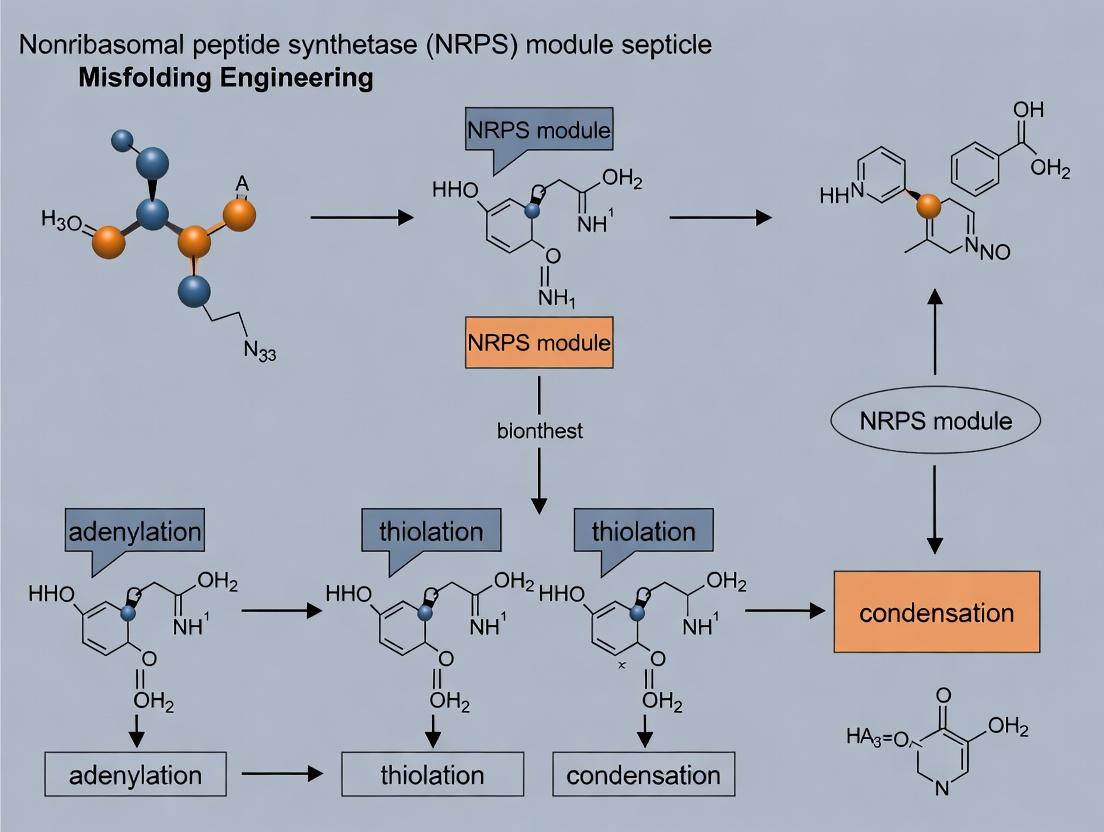
Non-ribosomal peptide synthetases (NRPS) are enzymatic assembly lines for bioactive compounds, but their complex modular architecture makes them prone to misfolding, hindering engineering efforts for novel therapeutics.
Engineering NRPS Module Folding: Strategies to Overcome Misfolding for Novel Drug Discovery
Abstract
Non-ribosomal peptide synthetases (NRPS) are enzymatic assembly lines for bioactive compounds, but their complex modular architecture makes them prone to misfolding, hindering engineering efforts for novel therapeutics. This article provides a comprehensive guide for researchers on understanding, diagnosing, and solving NRPS misfolding. We explore the structural and thermodynamic roots of misfolding (Intent 1), detail advanced engineering and computational design methodologies (Intent 2), outline systematic troubleshooting and optimization protocols (Intent 3), and present rigorous validation and comparative analysis frameworks (Intent 4). This roadmap aims to accelerate the rational engineering of functional NRPS chimeras for drug development.
Decoding NRPS Misfolding: Structural Roots and Energetic Pitfalls
Technical Support Center
Troubleshooting Guides & FAQs
Q1: During heterologous expression, my NRPS module aggregates and forms inclusion bodies. How can I improve soluble folding?
A: This is a common issue in module misfolding engineering. Implement the following protocol:
- Lower Expression Temperature: Induce protein expression at 18-20°C instead of 37°C to slow translation and facilitate correct folding.
- Co-express Chaperones: Use plasmids like pG-KJE8 (encoding dnaK/dnaJ/grpE and groEL/groES) or pTf16 (encoding tig) in the expression host.
- Utilize Solubility Tags: Fuse the module N-terminally to tags like MBP (Maltose-Binding Protein) or SUMO, which can be cleaved off after purification.
- Screen Construct Boundaries: Slight extensions or truncations at module termini (e.g., including a linker or adjacent carrier domain) can dramatically improve solubility.
Experimental Protocol: Solubility Optimization Screen
- Clone your target NRPS module into vectors with different N-terminal tags (e.g., His6, MBP-His6, GST-His6).
- Transform into E. coli BL21(DE3) strains containing chaperone plasmids or into E. coli SHuffle for disulfide bridge formation if needed.
- Inoculate 5 mL cultures, induce at OD600 ~0.6 with 0.1 mM IPTG at 20°C for 16 hours.
- Harvest cells, lyse via sonication in lysis buffer (e.g., 50 mM Tris-HCl pH 8.0, 300 mM NaCl, 10% glycerol, 1 mM PMSF).
- Centrifuge at 15,000 x g for 30 min at 4°C to separate soluble (supernatant) and insoluble (pellet) fractions.
- Analyze equal proportions of total, soluble, and pellet fractions by SDS-PAGE.
Q2: The activity of my engineered hybrid module is undetectable. How do I diagnose if the issue is at the domain interface or within a core domain?
A: Perform a domain-interface focused diagnostic workflow.
Experimental Protocol: Domain Interface Diagnostic Assay
- Express and Purify Individual Domains: Express the adenylation (A), peptidyl carrier protein (PCP), and condensation (C) domains from both parent and hybrid modules separately with affinity tags.
- Perform In Vitro Activity Assays:
- A Domain: Use the ATP-[32P]PPi exchange assay to verify correct amino acid activation. A 2-5 fold drop in kcat/KM indicates a core A domain problem.
- PCP Domain: Use a [14C]-labeled amino acid and the cognate holo-ACP synthase (e.g., Sfp) to confirm phosphopantetheinylation. Resolve via native PAGE/autoradiography.
- C Domain: Use a continuous spectrophotometric assay monitoring the release of CoA-SH from donor (e.g., Acetyl-S-CoA) and acceptor (e.g, aminoacyl-S-PCP) substrates at 412 nm (DTNB reagent).
- Test Inter-Domain Communication: Use a dissected trans-activity assay. For example, to test a hybrid A-PCP interface, provide the purified hybrid A domain, substrates (ATP, amino acid), and the separate PCP domain. Compare activity to the wild-type A-PCP pair.
Q3: After engineering a module swap, product elongation stalls. How can I verify if the condensation domain is rejecting the upstream donor intermediate?
A: This points to a miscommunication at the C domain donor site. Use a non-hydrolyzable donor substrate analog to trap the interaction.
Experimental Protocol: Donor Site Occupancy Assay
- Synthesize or obtain a non-hydrolyzable donor analog (e.g., a phosphonate or depsipeptide analog of the native donor peptidyl-S-PCP).
- Incubate the purified hybrid module or C domain with the analog.
- Attempt to crystallize the complex or analyze by native mass spectrometry.
- As a functional test, perform an acceptor substrate competition assay using a radio-labeled acceptor (aminoacyl-S-PCP) and increasing concentrations of unlabeled donor analog. Inhibition of condensation activity confirms donor site binding.
Table 1: Common Chaperone Systems for NRPS Solubility
| Chaperone Plasmid | Proteins Expressed | Target NRPS Issue | Typical Solubility Increase* |
|---|---|---|---|
| pG-KJE8 | DnaK/DnaJ/GrpE & GroEL/GroES | Aggregation of large multi-domains | 3-5 fold |
| pTf16 | Trigger factor (Tig) | Co-translational misfolding | 2-4 fold |
| pGro7 | GroEL/GroES | Final folded state stability | 2-3 fold |
| pCGH | Cpn60/Cpn10 (GroEL/ES homolog) | Complex eukaryotic NRPS modules | 1.5-3 fold |
*Fold increase in soluble protein yield relative to expression without chaperones, as observed in published studies.
Table 2: Diagnostic Assays for NRPS Domain Function
| Assay | Target Domain | Measured Output | Typical Wild-Type Rate/Range |
|---|---|---|---|
| ATP-[32P]PPi Exchange | Adenylation (A) | Aminoacyl-AMP formation | kcat 1-10 s-1 |
| Radio-SVF Assay | Peptidyl Carrier Protein (PCP) | Phosphopantetheinylation | >90% modification |
| Continuous DTNB Assay | Condensation (C) | Peptide bond formation | kcat 0.1-2.0 s-1 |
| HPLC-MS Product Detection | Full Module/TE | Final product release | Yield: 70-95% |
Mandatory Visualizations
Title: Diagnostic Flow for Inactive Hybrid NRPS Modules
Title: NRPS Module Domain Architecture and Flow
The Scientist's Toolkit: Research Reagent Solutions
Table 3: Essential Reagents for NRPS Module Engineering & Analysis
| Reagent / Material | Function in NRPS Research | Key Application |
|---|---|---|
| Sfp Phosphopantetheinyl Transferase | Catalyzes the essential conversion of apo-PCP to holo-PCP by attaching phosphopantetheine. | Activating carrier domains for in vitro assays. |
| ATP, [γ-32P]-ATP / [32P]-PPi | Substrates for the ATP-PPi exchange assay. Radioactive labeling allows sensitive detection of A domain activity. | Quantifying adenylation domain specificity and kinetics. |
| 5,5'-Dithio-bis-(2-nitrobenzoic acid) (DTNB) | Ellman's reagent. Reacts with free thiols (e.g., CoA-SH released during condensation) to produce a yellow color (412 nm). | Continuous spectrophotometric assay for condensation (C) domain activity. |
| Non-hydrolyzable Aminoacyl-/Peptidyl-S-NAC Analogs | Chemically stable mimics of aminoacyl-/peptidyl-S-PCP donor substrates. Bind but do not react. | Trapping and crystallizing C domain complexes; inhibition studies. |
| Heterologous Host Strains (e.g., E. coli SHuffle, P. putida KT2440) | Engineered for disulfide bond formation (SHuffle) or superior folding of large complexes (KT2440). | Improving soluble expression of challenging eukaryotic or hybrid NRPS modules. |
| Protease Cleavable Tags (His6-MBP, His6-SUMO) | Enhance solubility and provide affinity purification handles. Protease removal yields native protein. | Purifying recalcitrant full modules or individual domains for in vitro reconstitution. |
Troubleshooting Guides & FAQs
Q1: During thermal denaturation assays, my NRPS condensation domain shows a biphasic unfolding curve. Does this indicate misfolding? A: Not necessarily. A biphasic curve often suggests independent unfolding of distinct structural lobes (e.g., the N- and C-terminal subdomains). First, verify your experimental conditions:
- Buffer: Ensure a consistent pH and the presence of necessary cofactors (e.g., Mg²⁺, PPi).
- Data Analysis: Fit the data to a two-state non-cooperative model. Calculate the ∆G, Tm, and ∆Cp for each phase separately. Compare these values to published benchmarks for your NRPS family (see Table 1).
- Follow-up: Perform limited proteolysis coupled with mass spectrometry to confirm if the unfolding phases correspond to specific, predicted domain boundaries.
Q2: My engineered NRPS module loses activity after purification, despite correct expression. How can I troubleshoot folding stability? A: This is a classic symptom of kinetic trapping in a misfolded state. Follow this protocol:
- Diagnostic Assay: Run an analytical size-exclusion chromatography (SEC) assay immediately after purification. Aggregation or an abnormal elution volume indicates folding issues.
- Solution Refinement:
- Optimize Refolding: Introduce a gradient refolding step post-immobilized metal affinity chromatography (IMAC). Use a refolding buffer containing 0.5 M L-arginine, 2 mM reduced glutathione (GSH), and 0.2 mM oxidized glutathione (GSSG).
- Thermal Shift Assay: Screen a panel of ligands (e.g., aminoacyl-AMP analogs, pantetheine) to identify chemical chaperones that stabilize the native fold.
- Point Mutation: Introduce computationally predicted gatekeeper mutations (e.g., Pro to Ala in loop regions) to reduce folding frustration.
Q3: How do I interpret hydrogen-deuterium exchange (HDX-MS) data to map vulnerable regions in my NRPS module's energy landscape? A: HDX-MS identifies regions with high solvent accessibility and dynamics, often linked to folding bottlenecks.
- Protocol: Perform HDX at 25°C in deuterated buffer (pD 7.4) at time points (10s, 1min, 10min, 1hr). Quench with chilled acidic buffer and digest with immobilized pepsin.
- Data Interpretation: Peptides showing fast, early exchange are in dynamic, potentially poorly structured regions. Peptides with slow exchange are in stable core elements. Overlay this data onto a homology model. Regions of high exchange that are buried in the model are prime candidates for misfolding nuclei and should be targets for stabilizing mutations.
Q4: What are the critical controls for isothermal titration calorimetry (ITC) when measuring adenylation domain-ligand binding, given folding heterogeneity? A: Folding heterogeneity can lead to misleading binding stoichiometry (N) and enthalpy (∆H).
- Mandatory Controls:
- Inject ligand into buffer only to correct for dilution heat.
- Perform a "reverse titration" (inject protein into ligand) to check for consistency.
- Pre-run SEC on the protein sample immediately before ITC to remove aggregates.
- Include a reference non-hydrolyzable substrate analog (e.g., aminoacyl-sulfamoyl adenosine) to obtain a "pure" binding isotherm, distinct from catalytic turnover heats.
Table 1: Thermodynamic Parameters for Wild-type vs. Engineered NRPS Condensation Domains
| Domain Variant | ∆G_unfolding (kJ/mol) | Tm (°C) | ∆Cp (kJ/mol·K) | Aggregation Onset Temp (°C) |
|---|---|---|---|---|
| Wild-type (PheA C1) | -32.5 ± 1.8 | 48.2 ± 0.5 | 12.8 ± 0.9 | 52.1 |
| Engineered (Loop Pro→Ala) | -38.7 ± 2.1 | 52.9 ± 0.4 | 10.1 ± 0.7 | 58.5 |
| Misfolding Mutant (Core Gly→Asp) | -21.4 ± 3.0 | 39.8 ± 1.2 | 18.5 ± 1.5 | 41.3 |
Table 2: HDX-MS Protection Factors for Key Structural Motifs
| Structural Motif (Peptide Sequence) | Protection Factor (Log10) | Implication for Folding |
|---|---|---|
| His-motif (HxxxDG) | 4.2 | Highly stable, forms early folding nucleus. |
| Acceptor loop (PheA 550-570) | 1.8 | Dynamic, potential misfolding site. |
| Core β-sheet (PheA 700-720) | 3.9 | Stable in native fold, vulnerable in intermediate. |
Experimental Protocols
Protocol 1: Differential Scanning Fluorimetry (Thermal Shift) for Ligand Stabilization Screening
- Prepare Sample Mix: In a 96-well PCR plate, combine 10 µL of 5 µM protein in assay buffer (20 mM HEPES, 150 mM NaCl, pH 7.5) with 10 µL of 20X SYPRO Orange dye and 1 µL of 10 mM test ligand (or DMSO control).
- Run Assay: Seal plate, centrifuge briefly. Using a real-time PCR instrument, heat from 25°C to 95°C at a rate of 1°C/min, monitoring fluorescence (ex: 470 nm, em: 570 nm).
- Analyze Data: Determine the melting temperature (Tm) as the inflection point of the fluorescence curve. A ∆Tm > +2°C relative to DMSO control indicates significant stabilization.
Protocol 2: Native-State Hydrogen-Deuterium Exchange Mass Spectrometry (HDX-MS)
- Labeling: Dilute 5 µL of 50 µM purified NRPS module into 45 µL of D₂O-based labeling buffer. Incubate at 25°C for ten time points (e.g., 10 s, 1 min, 5 min, 10 min, 30 min, 1 h, 2 h, 4 h).
- Quenching & Digestion: At each time point, quench 50 µL reaction with 50 µL of ice-cold quench buffer (100 mM phosphate, pH 2.2). Immediately pass over an immobilized pepsin column (2°C) at 100 µL/min.
- LC-MS/MS Analysis: Desalt peptides on a C8 trap column and separate with a 5-35% acetonitrile gradient over 7 min. Analyze with a high-resolution mass spectrometer.
- Data Processing: Use dedicated software (e.g., HDExaminer) to calculate deuterium uptake for each peptide at each time point.
Visualizations
NRPS Folding Pathways & Kinetic Traps
NRPS Misfolding Diagnostic Workflow
The Scientist's Toolkit: Research Reagent Solutions
| Reagent / Material | Function & Rationale |
|---|---|
| L-Arginine (0.5 M in refolding buffer) | Acts as a chemical chaperone; reduces aggregation by weakening non-specific hydrophobic interactions during refolding. |
| GSH/GSSG Redox Pair | Creates a defined redox potential to promote correct formation of disulfide bonds, crucial for some NRPS domain stability. |
| Aminoacyl-sulfamoyl Adenosine (AMS) analogs | Non-hydrolyzable substrate analogs for ITC; allow measurement of binding thermodynamics without confounding catalytic heats. |
| SYPRO Orange Dye | Environment-sensitive fluorescent dye used in DSF; binds hydrophobic patches exposed during protein unfolding. |
| Immobilized Pepsin Column (for HDX-MS) | Enables rapid, low-pH digestion at 2°C, minimizing back-exchange of deuterium post-labeling. |
| Ni-NTA Superflow Resin | Standard for IMAC purification of His-tagged NRPS constructs; use mild imidazole elution (150-250 mM) to avoid co-eluting chaperones. |
Technical Support Center: Troubleshooting NRPS Module Misfolding
Introduction: This technical support center provides targeted guidance for researchers engineering Nonribosomal Peptide Synthetase (NRPS) modules. Misfolding remains a primary bottleneck. The following FAQs and protocols address the specific triggers—linker rigidity, domain swapping, and domain-domain incompatibilities—within the broader thesis of developing robust NRPS refactoring frameworks.
FAQs & Troubleshooting Guides
Q1: My chimeric NRPS module shows no activity. SDS-PAGE suggests aggregation. Is this due to linker rigidity between domains? A: Likely yes. Overly rigid linkers prevent the natural hinge motions required for proper catalytic cycling. First, diagnose linker length and composition.
- Diagnostic Protocol: Clone variants with flexible glycine-serine repeats (e.g., (GGS)n, where n=4, 8, 12) or native linker sequences into your construct. Compare soluble expression yield via centrifugation and Bradford assay.
- Expected Data: A typical optimization yields:
| Linker Type (Between A-T Domains) | Length (aa) | Soluble Yield (mg/L) | Relative Activity (%) |
|---|---|---|---|
| Original Chimeric Linker | 15 | 2.1 ± 0.5 | 0 |
| Rigid (EAAAK)₃ | 15 | 1.5 ± 0.3 | 0 |
| Flexible (GGS)₄ | 12 | 8.7 ± 1.2 | 25 ± 5 |
| Flexible (GGS)₈ | 24 | 12.4 ± 2.0 | 65 ± 8 |
| Native Donor Linker | Variable | 15.0 ± 3.1 | 100 (Reference) |
Q2: Analytical size-exclusion chromatography reveals a dimeric peak for a module that should be monomeric. Is this domain swapping? A: This is a classic symptom of domain swapping, often triggered by destabilizing point mutations or incompatible interfaces in engineered domains, creating an "open" monomer that recruits a partner.
- Diagnostic Protocol: Perform SEC-MALS (Multi-Angle Light Scattering) to confirm the oligomeric state. To confirm swapping, introduce a deactivating point mutation (e.g., Cys→Ala in the catalytic site) into one construct and co-express it with the wild-type construct. If activity is not rescued in trans, it suggests an intramolecular (monomeric) fold is required and swapping may be detrimental.
- Key Control Experiment: Measure activity of wild-type, putative swap mutant, and the co-expression mix.
| Construct Configuration | SEC-MALS Mass (kDa) | Observed Oligomer | Activity (%) |
|---|---|---|---|
| Wild-Type Module | 125 ± 5 | Monomer | 100 |
| Engineered Mutant (K324A) | 250 ± 15 | Dimer | <1 |
| 1:1 Co-expression (WT + K324A) | 125 / 250 | Mix | 2 ± 1 |
Q3: After swapping an Adenylation (A) domain from one NRPS to another, the module folds but is catalytically slow. What's the cause? A: This points to domain-domain incompatibility. The new A domain may not properly communicate with the downstream Peptidyl Carrier Protein (PCP) or Condensation (C) domain, despite folding.
- Diagnostic Protocol: In vitro Kinetics Assay.
- Purify the chimeric module via affinity chromatography.
- Perform a single-turnover kinetics assay: Charge the PCP domain with [³H]-labeled amino acid (ATP, Mg²⁺). Rapidly mix with elongation substrate (e.g., a donor-PCP complex for a C domain assay).
- Quench reactions at timepoints (0.5s to 300s) and quantify product formation via radio-TLC.
- Interpretation: Compare rates (kobs) to wild-type. A severe slowdown in the chemical step after amino acid loading indicates poor interdomain signaling or suboptimal positioning.
| Module Variant | Aminoacylation Rate (kload, min⁻¹) | Condensation Rate (kcond, min⁻¹) |
|---|---|---|
| Native (Wild-type) Module | 25.0 ± 3.0 | 15.0 ± 2.0 |
| Chimeric A Domain Module | 22.5 ± 2.5 | 1.2 ± 0.3 |
Experimental Protocol: Comprehensive Misfolding Diagnostic Workflow
Title: Three-Pronged Diagnostic for NRPS Misfolding Triggers
Objective: To systematically evaluate whether a loss of function in an engineered NRPS module stems from linker rigidity, domain swapping, or interdomain incompatibility.
Materials:
- Cloning: Vectors, Gibson Assembly mix, primers for linker variants.
- Expression: E. coli BL21(DE3), TB medium, IPTG.
- Lysis & Purification: Lysozyme, DNase I, Ni-NTA Agarose, Imidazole, SEC column (Superdex 200).
- Analytics: SDS-PAGE gels, Bradford reagent, SEC-MALS system.
- Activity Assay: Radioactive amino acid ([³H]), ATP, MgCl₂, TLC plates, scintillation counter.
Methodology:
- Parallel Construct Generation: Generate three variants of your problematic construct: i) with a flexible (GGS)₈ linker, ii) with a stabilizing point mutation (e.g., a surface salt bridge), iii) with the native downstream domain reverted.
- Expression & Solubility Screen: Express all constructs (0.5 mM IPTG, 18°C, 16h). Lyse cells, centrifuge (40,000 x g, 30 min). Measure soluble protein in supernatant.
- Oligomeric State Analysis: Purify soluble constructs via Ni-NTA. Inject equal amounts onto SEC-MALS. Record mass at peak apex.
- In vitro Charging Assay: For constructs that are monomeric and soluble, perform aminoacylation assay with [³H]-AA, ATP, Mg²⁺ for 10 min. Quantify PCP-bound radiolabel.
- Data Triangulation: Use the decision matrix below to identify the primary trigger.
Diagnostic Decision Matrix:
| Result Pattern | Soluble Yield | Oligomeric State (SEC-MALS) | In vitro Charging | Primary Likely Trigger |
|---|---|---|---|---|
| Pattern A | Low (All) | Aggregates | N/A | Severe Global Misfolding |
| Pattern B | Low→High with flexible linker | Monomer | Normal | Linker Rigidity |
| Pattern C | Moderate | Dimer/Oligomer | Low | Domain Swapping |
| Pattern D | High | Monomer | Low | Domain Incompatibility |
The Scientist's Toolkit: Research Reagent Solutions
| Reagent / Material | Function / Rationale |
|---|---|
| pET Series Vectors (His₆-Tag) | High-yield protein expression in E. coli; facilitates standardized IMAC purification. |
| Glycine-Serine Linker Libraries | Pre-cloned cassettes of (GGS)n repeats for rapid testing of linker flexibility. |
| Superdex 200 Increase SEC Column | High-resolution size-exclusion chromatography for separating monomers, dimers, aggregates. |
| ³H-Labeled Amino Acids | High-sensitivity detection of aminoacylation and PCP charging in kinetic assays. |
| Bis-Tris Native Gels (4-16%) | Assess native oligomeric state and complex integrity without SDS denaturation. |
| Surface Entropy Reduction Mutagenesis Kits | Introduce stabilizing point mutations (e.g., Lys→Ala) to reduce domain swapping propensity. |
| * trans-Charge Assay Components | Wild-type and catalytically dead mutant proteins to test for in trans complementation. |
Visualizations
Diagram 1: NRPS Domain Communication & Misfolding Triggers
Diagram 2: Diagnostic Workflow for Misfolding Triggers
Troubleshooting Guide & FAQs
Q1: During my Aggregation Assay (e.g., Static Light Scattering), I observe high background signal even in the absence of my purified Non-Ribosomal Peptide Synthetase (NRPS) module. What could be wrong? A: High background is often due to particulate matter or protein aggregates in your buffer. Ensure all solutions are freshly filtered (0.22 µm) and centrifuged (100,000 x g, 10 min) prior to use. Use ultra-pure, fresh reagents. Check that your cuvettes are impeccably clean. Run a buffer-only baseline before each experiment.
Q2: My Limited Proteolysis experiment results in complete degradation of my NRPS construct, showing no stable fragments on SDS-PAGE. How can I adjust the protocol? A: Complete degradation indicates the protease:protein ratio is too high or the incubation time is too long. Perform a titration series (e.g., trypsin at 1:1000 to 1:50,000 w/w protease:substrate) and remove time points (1, 5, 15, 30, 60 min) into pre-chilled tubes containing a specific, potent protease inhibitor (e.g., PMSF for serine proteases) before boiling for SDS-PAGE.
Q3: I suspect my engineered NRPS module is misfolding and forming insoluble aggregates during expression. Which initial assay should I run? A: Begin with a simple solubility assay. Lyse cells and separate soluble (supernatant) and insoluble (pellet) fractions by centrifugation at 15,000 x g for 20 min. Analyze both fractions by SDS-PAGE. If the target protein is primarily in the pellet, proceed with aggregation-specific assays like Dynamic Light Scattering (DLS) or filter-trap assays.
Q4: How do I distinguish between functional oligomers and non-specific aggregates in my NRPS sample? A: Use a combination of size-exclusion chromatography coupled with multi-angle light scattering (SEC-MALS) and native PAGE. SEC-MALS provides absolute molecular weight distributions under non-denaturing conditions. Functional oligomers will show discrete, reproducible peaks, while aggregates often appear as broad, heterogeneous high-molecular-weight signals at the void volume.
Q5: In my Differential Scanning Fluorimetry (DSF) melt curve, I see multiple inflection points. Does this mean my protein is misfolded? A: Not necessarily. Multiple transitions can indicate: 1) The presence of multiple, independently folding domains within your NRPS module, which is common. 2) Partial unfolding events. Compare the melt curve of your engineered variant to a well-folded wild-type control. A significant decrease in the first (lowest temperature) melting point (Tm) for your variant is a strong indicator of destabilization and potential misfolding.
Key Experimental Protocols
Protocol 1: Static Light Scattering (SLS) for Aggregation Detection
- Sample Prep: Clarify purified NRPS protein (≥0.5 mg/mL) by ultracentrifugation at 100,000 x g, 4°C, for 30 min.
- Instrument Setup: Use a spectrofluorometer or dedicated light scattering instrument with a 365 nm or 488 nm laser. Set detector at 90° to incident beam.
- Measurement: Load 50-100 µL of sample into a low-volume, clean quartz cuvette. Record scattered light intensity for 60 sec, averaging every 1 sec.
- Analysis: Compare the relative scattered intensity (in kilo counts per second, kcps) of your sample to a buffer blank and a known stable protein control (e.g., BSA). A >2-fold increase indicates significant aggregation.
Protocol 2: Limited Proteolysis to Probe Domain Folding/Stability
- Reaction Setup: Dilute purified NRPS construct to 1 mg/mL in assay buffer (e.g., 20 mM HEPES, 150 mM NaCl, pH 7.5).
- Protease Addition: Add sequencing-grade trypsin (or chymotrypsin/elastase) at a 1:5000 (w/w) ratio. Mix quickly and incubate at 25°C.
- Time Course Sampling: At t = 0, 1, 5, 15, 30, and 60 min, remove 15 µL aliquot and mix immediately with 5 µL of 4x SDS-PAGE loading buffer containing 20 mM DTT and 2 mM PMSF.
- Analysis: Boil all samples for 5 min, run on a 4-20% gradient SDS-PAGE gel, and stain with Coomassie. Stable bands represent protease-resistant, folded domains.
Data Presentation
Table 1: Comparative Output of Aggregation Detection Assays for NRPS Module Variants
| NRPS Variant | SLS Intensity (kcps) | DLS Polydispersity Index (PDI) | SEC-MALS % Aggregate | Solubility Assay (% in Pellet) |
|---|---|---|---|---|
| Wild-Type Module | 15.2 ± 1.5 | 0.12 ± 0.03 | 5.2 ± 0.8 | 10 ± 3 |
| Engineered Mutant A | 152.7 ± 18.3 | 0.68 ± 0.12 | 42.5 ± 5.1 | 85 ± 7 |
| Stabilized Mutant B | 18.5 ± 2.1 | 0.15 ± 0.04 | 7.8 ± 1.2 | 15 ± 4 |
| Buffer Control | 8.1 ± 0.9 | N/A | N/A | N/A |
Table 2: Limited Proteolysis Fragment Analysis of NRPS Domains
| Protease | Incubation Time (min) | Stable Fragment Sizes (kDa) | Inferred Folded Domain |
|---|---|---|---|
| Trypsin | 0 | 125 (Full length) | N/A |
| Trypsin | 5 | 45, 38, 42 | Adenylation (A), Peptidyl Carrier (PCP), Condensation (C) |
| Trypsin | 30 | 38, 42 | PCP, C |
| Chymotrypsin | 15 | 67, 58 | A-PCP, C-PCP |
Diagrams
Title: Experimental Detection Workflow for NRPS Folding
Title: Misfolding Consequences & Detection Pathways
The Scientist's Toolkit: Research Reagent Solutions
| Reagent/Material | Function in NRPS Folding Analysis |
|---|---|
| Sypro Orange Dye | Fluorescent dye for Differential Scanning Fluorimetry (DSF); reports protein thermal unfolding by binding hydrophobic patches exposed upon denaturation. |
| Sequencing-Grade Trypsin | High-purity protease for limited proteolysis; cleaves specifically at lysine/arginine, revealing accessible, unstructured loops between folded domains. |
| Size-Exclusion Columns (e.g., Superdex 200 Increase) | For SEC-MALS; separates protein species by hydrodynamic radius under native conditions to resolve oligomers from aggregates. |
| DTT (Dithiothreitol) | Reducing agent; maintains cysteine residues in reduced state, preventing disulfide-mediated aggregation that could confound folding analysis. |
| HIS-Select Nickel Affinity Gel | For purification of polyhistidine-tagged NRPS modules; gentle elution with imidazole helps preserve native folding. |
| Protease Inhibitor Cocktail (e.g., cOmplete, EDTA-free) | Used during cell lysis and initial purification to prevent artefactual cleavage of the NRPS module by endogenous proteases, which is a sign of instability. |
| Precision Plus Protein Kaleidoscope Standards | Molecular weight markers for SDS-PAGE and native PAGE; essential for accurate sizing of proteolytic fragments and oligomeric complexes. |
| Dynamic Light Scattering Plates (Low Volume, UV-Compatible) | Specialized microplates for high-throughput DLS screening of protein stability and aggregation under various buffer conditions. |
Troubleshooting Guides & FAQs
Q1: My MD simulation trajectories show sudden, large increases in radius of gyration (Rg) after ~50ns. Is this a sign of misfolding, or a simulation artifact?
A: A rapid, sustained increase in Rg often precedes catastrophic unfolding. First, verify simulation integrity:
- Check energy conservation (
gmx energy -f ener.edr). Drifts >1% per 100ns suggest artifact. - Examine temperature and pressure coupling groups for instability.
- If stable, quantify the change. Use the following threshold table derived from recent studies on NRPS condensation domains:
| Metric | Stable Folding Range | Pre-Failure Warning | Critical Failure Threshold |
|---|---|---|---|
| Rg (Å) | Δ < 0.5 from crystal structure | Δ 0.5 - 1.5 over 20ns | Δ > 1.5 sustained for >10ns |
| RMSD (Å) | < 2.0 | 2.0 - 3.0 | > 3.0 |
| Native Contacts (%) | > 85% | 70% - 85% | < 70% |
| Solvent Access. (Core, nm²) | < 1.0 | 1.0 - 2.5 | > 2.5 |
Protocol: To calculate native contact retention:
Q2: AlphaFold2 predicts high confidence (pLDDT > 90) for my engineered NRPS module, but experimental SAXS data shows a mismatched shape profile. Which predictor should I trust?
A: This discrepancy highlights a key limitation. AlphaFold2 is trained on evolutionary data and may not accurately predict de novo or heavily engineered constructs. Rely on the experimental SAXS data as the ground truth. Use computational predictors to diagnose the cause:
- Run DAMP (Dynamics-Aware Misfolding Predictor) to identify regions with high dynamic fluctuation propensity.
- Perform coarse-grained (CG) MD simulations (e.g., with Martini) on the AlphaFold model for 1-10µs to see if it spontaneously collapses to the SAXS-consistent shape.
- Check for frustrated contacts using the
frustratometerserver. Engineered regions with high local frustration are misfolding hotspots.
Q3: I'm observing aggregation in my purification step. What in silico screens can I run before my next construct design to predict solubility issues?
A: Implement a pre-design screening pipeline using these predictors, which analyze sequence-based features:
| Tool | Parameter | Value Indicating High Aggregation Risk | Typical Threshold | ||
|---|---|---|---|---|---|
| CamSol | Intrinsic Solubility Score | Negative score | < 0 | ||
| Aggrescan3D | Hotspot Residues | # of residues in high-aggregation patches | > 5 per 100aa | ||
| TANGO | β-Aggregation Propensity | % sequence in aggregation-prone regions | > 5% | ||
| NetCharge | Calculated pI | pI close to expression pH (e.g., 7.4) | pH - pI | < 1.0 |
Protocol for CamSol Intrinsic Profile:
- Submit FASTA sequence to the CamSol web server or run the standalone version.
- Analyze the profile. Regions with sustained negative scores over >10 consecutive residues are high-risk.
- Use the "engineering mode" to mutate flagged residues to solubility-enhancing amino acids (e.g., K, R, E, D, P) and re-calculate.
Q4: During RosettaDDG calculations for point mutations, what ΔΔG value reliably predicts a folding-destabilizing mutation for a catalytic core?
A: For NRPS core domains (e.g., Adenylation, Condensation), which require rigid scaffolds, use stricter thresholds than for flexible linkers.
| Region Type | Stabilizing Mutation | Neutral Mutation | Destabilizing (Risk) | Highly Destabilizing (Failure) |
|---|---|---|---|---|
| Catalytic Core | ΔΔG < -1.0 kcal/mol | -1.0 to +1.0 kcal/mol | +1.0 to +2.0 kcal/mol | ΔΔG > +2.0 kcal/mol |
| Solvent-Exposed Linker | ΔΔG < -1.0 kcal/mol | -1.0 to +1.5 kcal/mol | +1.5 to +3.0 kcal/mol | ΔΔG > +3.0 kcal/mol |
Protocol: Use the cartesian_ddg protocol for accuracy.
Always run 35-50 replicates per mutation and report mean ± SEM. A mutation with ΔΔG > +1.0 kcal/mol in the core should trigger experimental stability assays (e.g., DSF).
The Scientist's Toolkit: Key Research Reagent Solutions
| Reagent / Tool | Function in Diagnosing Folding Failure |
|---|---|
| GROMACS 2024+ | MD simulation software for calculating Rg, RMSD, native contacts, and free energy landscapes. Essential for dynamics-based failure prediction. |
| PLUMED 2.9 | Plugin for enhanced sampling and collective variable analysis. Used to define reaction coordinates for rare folding/unfolding events. |
| PyMOL with APBS Tools | Visualization and electrostatic potential mapping. Sudden changes in surface electrostatics can signal unfolding precursors. |
| AlphaFold3 (Colab) | Initial structure prediction. Crucial: Use its predicted aligned error (PAE) map; high inter-domain PAE (>15Å) suggests inherent flexibility/misfolding risk. |
| Rosetta (cartesian_ddg) | Free energy perturbation calculations for mutational stability impact. The gold standard for in silico mutagenesis screening. |
| Frustratometer2 | Identifies energetically frustrated contacts in a protein. Highly frustrated residues are often folding nucleation points and failure sites. |
| PypeTale 3.0 | Integrates sequence-based predictors (CamSol, TANGO, Aggrescan) into a single pipeline for pre-construct design aggregation risk assessment. |
| BioLayer Interferometry (BLI) | Experimental validation. Monitor real-time binding kinetics of your purified module to its cognate partner; erratic sensograms can indicate folding heterogeneity. |
Visualizations
Diagram 1: Misfolding Prediction Computational Workflow
Diagram 2: Key Signaling Pathway in NRPS Domain Misfolding Detection
Practical Engineering Solutions: Design, Stabilization, and Refactoring Strategies
Technical Support Center: Troubleshooting Linker-Dependent NRPS Module Misfolding
This support center provides targeted guidance for common experimental challenges in linker engineering within Nonribibosomal Peptide Synthetase (NRPS) research, framed within the thesis of addressing NRPS module misfolding.
Frequently Asked Questions (FAQs) & Troubleshooting
Q1: During heterologous expression, my engineered NRPS construct produces no product. The individual domains show activity in isolation. What is the primary linker-related culprit? A: The most common issue is linker rigidity. An overly short or inflexible linker between domains (e.g., between Condensation (C) and Adenylation (A) domains) can prevent proper spatial alignment for intermediate channeling. This forces domains into high-energy, misfolded states, triggering aggregation or proteolytic degradation.
- Troubleshooting Protocol:
- Verify Linker Length: Use sequence analysis to compare your linker length to native, functional systems. See Table 1 for guidelines.
- Introduce Glycine-Serine Repeats: Clone and test a series of constructs with incremental (GS)n repeats (e.g., (GGS)2, (GGS)4, (GGS)6) at the problematic junction.
- Assess Solubility: Monitor construct solubility via SDS-PAGE of whole-cell lysates and insoluble fractions.
- Test Activity: Use a minimal pantetheinyl transferase assay with radiolabeled amino acid substrates on purified protein to check for aminoacyl-adenylate formation and transfer to the downstream Thiolation (T) domain.
Q2: My product yield is low, and HPLC/MS shows aberrant by-products. Could linkers be involved? A: Yes. Excessively long or flexible linkers can reduce catalytic efficiency by allowing domains to sample unproductive conformations. This mispositioning can lead to promiscuous interactions with non-cognate substrates or incomplete reactions, generating truncated or incorrectly elongated by-products.
- Troubleshooting Protocol:
- Analyze By-products: Characterize by-products via high-resolution MS/MS to determine if they are truncated peptides or isomers.
- Perform Limited Proteolysis: Treat the purified NRPS module with a protease like subtilisin under mild conditions. Analyze fragmentation patterns via gel electrophoresis to identify overly exposed, disordered linker regions.
- Employ Cross-linking: Use homo-bifunctional cross-linkers (e.g., BS3) of varying lengths on the purified protein, followed by MS analysis, to identify inter-domain distances and constrain dynamic models.
Q3: How do I rationally design a linker to balance flexibility and order? A: Implement a "predict-test" cycle focusing on sequence and predicted secondary structure.
- Experimental Protocol for Rational Design:
- Predict Native Propensity: Use predictors like PsiPred or JPred on homologous sequences to identify regions with intrinsic disorder or helical propensity.
- Design Library: Synthesize a small library of linkers where you:
- Vary Rigidity: Substitute flexible (GGGS) elements with order-promoting (EAAAK) or helical (PAK) motifs.
- Incorporate Reporting Elements: Introduce a unique tryptophan residue or a small affinity tag (e.g., His6) within the linker for biophysical tracking.
- Screen for Function: Express constructs in a surrogate host (e.g., E. coli BAP1) and assess yield of the target peptide via LC-MS.
- Characterize Top Performers: Use Size Exclusion Chromatography with Multi-Angle Light Scattering (SEC-MALS) to assess monodispersity and conformational stability of the full module.
Table 1: Linker Length and Composition Correlations with NRPS Module Output
| Linker Type (Between C-A Domains) | Avg. Length (aa) | Relative Product Yield (%) | Common Observed Pitfall | Recommended Application |
|---|---|---|---|---|
| Native, Unmodified | 12-18 | 100 (Baseline) | Context-dependent | Baseline studies |
| Short Rigid (Helical) | < 10 | 0-15 | Domain misfolding, aggregation | When domains require fixed, tight coupling |
| Long Flexible (Gly-rich) | > 25 | 20-50 | Reduced titers, by-products | When large domain reorientation is needed |
| Engineered Balanced (GS/P mixed) | 14-20 | 65-120 | Requires iterative optimization | General purpose re-engineering to correct misfolding |
Table 2: Biophysical Characterization Methods for Linker-Conformation Analysis
| Method | Key Measurable Parameter | Linker Property Inferred | Sample Throughput | Required Protein Amount |
|---|---|---|---|---|
| SEC-MALS | Hydrodynamic radius, absolute MW | Compactness, oligomeric state | Medium | ~100 µg |
| SAXS/SANS | Solution shape, radius of gyration | Global flexibility, elongation | Low | mg quantities |
| HDX-MS | Deuterium uptake rate in linker region | Solvent exposure, dynamics | Low | ~50 µg |
| smFRET | Inter-domain distance distribution | Flexibility range, conformational sampling | Low | Labeled, single molecules |
Experimental Protocols
Protocol: Limited Proteolysis to Probe Linker Accessibility Objective: Identify poorly structured, vulnerable regions in an NRPS module indicative of misfolding or excessive flexibility.
- Purify the NRPS construct to >90% homogeneity.
- Prepare a 1 mg/mL solution in a non-denaturing buffer (e.g., 20 mM HEPES, 150 mM NaCl, pH 7.5).
- Set up Reactions: In separate tubes, add protease (e.g., Subtilisin A) at enzyme:substrate ratios of 1:1000, 1:500, and 1:100 (w/w). Incubate at 4°C to slow reaction kinetics.
- Time Course: Withdraw aliquots at t = 0, 1, 5, 15, 30, 60 minutes. Immediately quench with 2x Laemmli SDS-PAGE buffer and boil for 5 min.
- Analysis: Run all samples on a 4-20% gradient SDS-PAGE gel. Stain with Coomassie. Bands that disappear quickly indicate highly accessible, disordered regions (often problematic linkers).
Protocol: SEC-MALS for Conformational Stability Assessment Objective: Determine the monodispersity and absolute molecular weight of an engineered NRPS module in solution.
- Equilibrate an analytical SEC column (e.g., Superdex 200 Increase 10/300 GL) with filtered/degassed assay buffer at 0.5 mL/min.
- Calibrate the connected MALS detector (e.g., Wyatt miniDAWN TREOS) and differential refractometer (dRI) using bovine serum albumin (BSA) as a standard.
- Prepare Sample: Centrifuge purified protein (≥ 50 µL at 1-5 mg/mL) at 16,000 x g for 10 minutes to remove aggregates.
- Inject 50 µL of supernatant onto the column.
- Analysis: Use the manufacturer's software (e.g., ASTRA) to analyze the light scattering and dRI data. The calculated molecular weight across the elution peak should be constant and match the theoretical weight for a monodisperse, properly folded monomer. A rising baseline at lower elution volumes indicates aggregation.
The Scientist's Toolkit: Research Reagent Solutions
| Item | Function in Linker Engineering/ NRPS Studies |
|---|---|
| pET-based BAP1 E. coli Strain | Expression host containing a chromosomal copy of the sfp gene for phosphopantetheinylation, essential for activating T domains. |
| HRV 3C Protease | For cleaving off purification tags with high specificity, minimizing residual linker sequences that could affect module conformation. |
| Aminoacyl-AMS (Adenosyl Sulfamate) Analogs | Non-hydrolyzable substrates for trapping and crystallizing A domains, useful for studying domain orientation post-linker modification. |
| Homobifunctional NHS-Ester Crosslinkers (e.g., BS3, DSS) | To "freeze" and measure spatial relationships between domains in solution, providing constraints for modeling linker conformation. |
| Deuterium Oxide (D2O) for HDX-MS | The labeling reagent for Hydrogen-Deuterium Exchange Mass Spectrometry, used to map solvent-accessible, dynamic regions like flexible linkers. |
| (GGS)n Repeat Cassette Gene Fragments | Standardized, synthetically produced DNA fragments for modular cloning to systematically vary linker length and flexibility. |
Diagrams
Diagram 1: NRPS Domain Organization with Critical Linkers
Diagram 2: Linker Design Impact on NRPS Module Conformation
Technical Support & Troubleshooting Center
Frequently Asked Questions (FAQs)
Q1: My consensus-designed Adenylation (A) domain expresses insolubly in E. coli. What are the primary troubleshooting steps? A: This is common. First, verify your consensus sequence for unintended hydrophobic patches. Implement the following protocol:
- Reduce expression temperature to 18°C and lower IPTG concentration to 0.1 mM.
- Co-express with chaperone plasmids (e.g., pG-KJE8 for GroEL/ES and DnaK/DnaJ/GrpE).
- Fuse solubility tags (MBP, GST, SUMO) with a cleavable linker and test small-scale expressions.
- If issues persist, run a limited proteolysis assay to identify unstable regions for targeted redesign.
Q2: Ancestral Reconstruction (ASR) of a Condensation (C) domain results in high thermal stability but complete loss of activity. How can I diagnose this? A: This suggests over-stabilization may have rigidified catalytically essential dynamics.
- Diagnostic Protocol: Perform differential scanning fluorimetry (DSF) with and without a non-hydrolyzable donor/acceptor substrate analog (e.g., Aminoacyl-AMS). A lack of ligand-induced thermal shift (ΔTm < 1°C) indicates loss of functional conformational plasticity.
- Solution: Generate a phylogenetic "cloud" of plausible ancestors around your primary ASR variant and screen for activity, selecting stable but functional intermediates.
Q3: During hybrid NRPS engineering, fused domains from different parents show no product formation. How do I check for misfolding at the junction? A: Misfolding at domain junctions is a critical failure point.
- Circular Dichroism (CD) Spectroscopy: Compare spectra of individual domains and the fused construct. Mismatched α-helix/β-sheet ratios indicate junction misfolding.
- Limited Proteolysis: Digest the hybrid protein with a broad-spectrum protease (e.g., Subtilisin). Isolate and sequence resistant cores; cleavage at the junction suggests an exposed, unstructured linker.
- FRET Pair Insertion: Genetically encode fluorescent proteins (e.g., CFP/YFP) flanking the junction. Anomalous FRET efficiency versus positive control indicates improper spatial orientation.
Q4: My stabilized Thiolation (T) domain no longer loads onto the cognate Adenylation (A) domain. What quantitative assays can pinpoint the issue? A: This is a functional interaction problem. Set up the following parallel assays:
Table 1: Quantitative Assays for A-T Domain Interaction
| Assay | Method | Expected Outcome for Functional Pair | Possible Failure if Stabilized |
|---|---|---|---|
| Native PAGE Shift | Incubate A & T domains, run on non-denaturing gel. | Visible higher-order complex band. | No complex band suggests loss of binding interface. |
| Surface Plasmon Resonance (SPR) | Immobilize A domain, flow T domain. | Measurable KD in µM-nM range. | No binding curve or significantly weakened KD. |
| ATP/[32P]PPi Exchange | Measure A domain activity ± T domain. | >50% stimulation of PPi exchange rate by correct T domain. | No stimulation indicates failure of productive interaction. |
Q5: How do I choose between Consensus Design and ASR for stabilizing a specific NRPS module? A: The choice depends on your starting point and goal.
Table 2: Consensus Design vs. Ancestral Reconstruction
| Criterion | Consensus Design | Ancestral Sequence Reconstruction |
|---|---|---|
| Primary Input | Multiple sequence alignment (MSA) of extant homologs. | Phylogenetic tree and MSA. |
| Theoretical Output | The most frequent amino acid at each position. | Probable sequence of an extinct common ancestor. |
| Best For | Rapid stabilization of a known, problematic domain. | Exploring functional stability landscapes, potentially recovering lost properties. |
| Risk | May create "average" sequence never seen in nature; could disrupt coordinated dynamics. | Reconstruction uncertainty; ancestor may be adapted to ancient cellular conditions. |
| Recommended First Step | Apply to single, well-defined domains (e.g., A domain core). | Apply to a multi-domain unit (e.g., C-A didomain) to address inter-domain misfolding. |
Experimental Protocols
Protocol 1: Limited Proteolysis to Identify Unstable Regions Purpose: Identify flexible loops or unstructured regions prone to proteolytic cleavage, indicating local instability.
- Sample Preparation: Purify target protein at 1 mg/mL in assay buffer (e.g., 20 mM Tris-HCl, 150 mM NaCl, pH 8.0).
- Protease Addition: Add protease (e.g., Trypsin or Subtilisin) at a 1:1000 (w/w) ratio to protein. Incubate at 25°C.
- Time-Course Sampling: Withdraw aliquots at 0, 1, 5, 15, 30, 60 minutes. Immediately quench with SDS-PAGE loading buffer and boil.
- Analysis: Run samples on SDS-PAGE. Isolate stable core bands via gel extraction and identify by mass spectrometry. Target these regions for stabilization.
Protocol 2: Differential Scanning Fluorimetry (DSF) for Stability Screening Purpose: High-throughput measurement of protein thermal stability (Tm) and ligand binding.
- Plate Setup: In a 96-well PCR plate, mix:
- 10 µL protein sample (5 µM in assay buffer).
- 10 µL of SYPRO Orange dye (5X final concentration).
- ± 1 µL ligand (e.g., substrate analog, final concentration 100-500 µM).
- Run: Seal plate, centrifuge. Use a real-time PCR instrument with a gradient from 25°C to 95°C, ramping at 1°C/min, monitoring FRET channel.
- Analysis: Plot negative derivative of fluorescence vs. temperature (-dF/dT). The peak is the Tm. A positive ΔTm (Tmwith ligand - Tmapo) > 2°C indicates binding.
The Scientist's Toolkit: Key Research Reagent Solutions
Table 3: Essential Reagents for Domain Stabilization Studies
| Reagent / Material | Function / Application |
|---|---|
| pET Series Vectors (Novagen) | Standard expression vectors with T7/lac promoter for high-yield protein production in E. coli. |
| Chaperone Plasmid Sets (Takara) | Plasmids for co-expression of GroEL/ES or DnaK/DnaJ/GrpE chaperone systems to improve folding of recalcitrant proteins. |
| SYPRO Orange Dye (Thermo Fisher) | Environment-sensitive fluorescent dye for DSF/melt curve assays to determine protein thermal stability. |
| Aminoacyl-AMS (or -SAM) Analogs | Non-hydrolyzable substrate analogs for trapping and stabilizing A-domain conformations in crystallography or binding assays. |
| HiLoad Superdex 200 pg (Cytiva) | Size-exclusion chromatography column for analyzing domain-domain complexes and assessing monodispersity. |
| Phusion High-Fidelity DNA Polymerase (NEB) | For error-free amplification of gene constructs during library generation for consensus or ASR variants. |
Visualizations
Title: Domain Stabilization Strategy Selection Workflow
Title: Diagnosing Hybrid NRPS Junction Misfolding
Structural Fusion and Split-Intein Approaches to Enforce Proximity
Troubleshooting & FAQs
Q1: My engineered NRPS fusion protein shows no activity. What could be the primary cause? A: The most common cause is misfolding of the adenylation (A) and peptidyl carrier protein (PCP) domains due to rigid linker choice. This prevents proper domain-domain interaction and substrate channeling. First, verify expression via Western blot. If the protein is expressed, perform a pantetheine assay to check for proper phosphopantetheinyl transferase (Sfp) modification of the PCP domain. If modification fails, the PCP is likely misfolded.
Q2: I observe low trans-splicing efficiency with my split intein system designed to ligate NRPS modules. How can I improve yield? A: Low splicing efficiency often stems from poor association of the split intein fragments (N-intein and C-intein). Ensure your fragments are from a well-characterized, highly efficient split intein (e.g., Npu DnaE). Critically, you must enforce proximity of the fragments by fusing them to strong dimerization domains (e.g., coiled-coils) or by tethering them to a scaffold. Check the splicing conditions, particularly pH, temperature, and the presence of thiol reagents like DTT or MESNA, which can be optimized.
Q3: After successful intein-mediated ligation, the chimeric NRPS produces incorrect products or shows reduced activity. A: This indicates that while splicing occurred, the newly formed peptide bond between the fused modules may have created a steric or conformational issue. The native communication-mediating (COM) domains between natural NRPS modules are missing. Consider inserting a short, flexible (GSG)n linker between the intein and the NRPS module or engineering a minimal COM domain mimic at the fusion junction.
Q4: My structural fusion construct expresses but forms insoluble aggregates. A: Aggregation is a hallmark of severe misfolding. This is frequent when fusing large, independently folding domains like NRPS modules. Strategies include:
- Linker Optimization: Replace the linker with a longer, more flexible (e.g., (GGGGS)n) or a computationally designed rigid linker.
- Expression Conditions: Lower the induction temperature (e.g., 18°C), reduce inducer concentration (IPTG), or use a richer growth medium.
- Chaperone Co-expression: Co-express plasmid vectors encoding chaperone systems like GroEL-GroES or DnaK-DnaJ-GrpE.
Q5: How do I verify that enforced proximity via scaffold proteins is working as intended? A: Use a combination of biochemical and biophysical assays:
- Pull-down/Co-immunoprecipitation: Confirm the scaffold binds both target proteins.
- FRET or BiFC: Fuse fluorescent proteins (donor/acceptor or split YFP fragments) to your NRPS domains. Successful tethering by the scaffold will bring fluorophores together, yielding a measurable signal.
- Functional Complementation: Use a split-reporter system (e.g., split luciferase) where activity is restored only upon scaffold-mediated proximity.
Experimental Protocols
Protocol 1: Testing Split Intein Splicing Efficiency In Vitro
- Cloning & Expression: Clone the N-intein fused to the C-terminus of your first NRPS fragment and the C-intein fused to the N-terminus of your second fragment into separate expression vectors (e.g., pET series). Include affinity tags (His6, StrepII) on each.
- Protein Purification: Express proteins in E. coli BL21(DE3). Purify individually via Ni-NTA affinity chromatography under native conditions.
- In Vitro Splicing Reaction:
- Mix equimolar amounts (e.g., 10 µM each) of the two purified precursor proteins in splicing buffer (e.g., 20 mM HEPES, 150 mM NaCl, 1 mM EDTA, pH 7.5).
- Add 1-2 mM final concentration of a thiol catalyst (e.g., MESNA).
- Incubate at 25°C or 30°C for 2-16 hours.
- Analysis: Run samples at time points on SDS-PAGE. Successful splicing yields a faster-migrating ligated product and released intein tag. Quantify band intensity with densitometry software to calculate efficiency.
Protocol 2: Analyzing NRPS Domain Proximity via FRET
- Construct Design: Create fusions of your target NRPS domains (e.g., A and PCP) with fluorescent proteins: A-domain-CFP and PCP-domain-YFP. For scaffold testing, co-express a scaffold protein designed to bind both.
- Sample Preparation: Purify the protein complex or express in live cells (e.g., E. coli).
- Measurement:
- Excite CFP at 433 nm.
- Measure emission intensities at 475 nm (CFP channel) and 527 nm (FRET/YFP channel).
- Calculate the FRET ratio (I527 / I475). A significant increase over controls (no scaffold, or non-binding scaffold mutant) indicates enforced proximity.
- Control: Include constructs with YFP alone to correct for bleed-through.
Table 1: Comparison of Proximity-Enforcing Strategies for NRPS Engineering
| Strategy | Typical Splicing/Ligation Efficiency | Key Advantage | Primary Challenge for NRPS | Best Use Case |
|---|---|---|---|---|
| Direct Fusion (Rigid Linker) | N/A (single polypeptide) | Simple design, guaranteed covalent linkage. | High risk of domain misfolding and loss of function. | Fusing small, stable domains with known structures. |
| Direct Fusion (Flexible Linker) | N/A (single polypeptide) | Reduced steric strain, better folding. | Uncontrolled domain dynamics, may reduce catalysis. | General first attempt for new fusions. |
| Split Intein Trans-Splicing | 50-95% in vitro; often lower in vivo | Precise, traceless native peptide bond formation. | Requires fragment association; extein sequence constraints. | Covalently linking large, pre-folded modules. |
| Protein Scaffold (e.g., PDZ/Sh3) | N/A (non-covalent) | Reversible, can control stoichiometry. | Lower effective local concentration; potential off-target binding. | Dynamic reconstitution of pathways, proof-of-concept. |
| Chemical Inducer of Dimerization (CID) | N/A (chemically induced) | Temporally controllable. | Requires cell-permeable ligand; potential basal activity. | Triggering proximity for inducible synthesis. |
Table 2: Troubleshooting Guide for Low Split-Intein Efficiency
| Observation | Potential Cause | Diagnostic Experiment | Recommended Solution |
|---|---|---|---|
| No ligated product | Intein fragments not associating | Analytical gel filtration to check for complex formation. | Fuse to dimerization domains or co-express on a polycistron. |
| Accumulation of thioester intermediate | Slow second step (Asn cyclization) | Use anti-intein antibody to detect persistent intermediate. | Optimize pH (slightly acidic to neutral) and temperature. |
| Cleavage side products | N- or C-terminal cleavage due to poor extein sequences | Mutate first extein residue to test. | Ensure optimal +1 and -1 extein residues per intein specification. |
| Low yield in vivo | Poor protein expression/folding of precursors | Check individual fragment expression/solubility. | Express fragments separately, purify, and perform in vitro splicing. |
Diagrams
Title: Root Causes of NRPS Misfolding in Engineered Fusions
Title: Experimental Workflow for Testing Proximity Strategies
Title: Proximity-Enforcement Strategies for NRPS Engineering
The Scientist's Toolkit: Research Reagent Solutions
| Reagent / Material | Supplier Examples | Function in Experiment |
|---|---|---|
| Sfp Phosphopantetheinyl Transferase | Home-purified from B. subtilis; commercial kits (e.g., Sigma) | Essential for activating the peptidyl carrier protein (PCP) domain by adding the phosphopantetheine arm. |
| Npu DnaE Split Intein Vectors | Addgene (plasmids #51291, #51292); custom synthesis | Well-characterized, high-efficiency split intein system for protein trans-splicing. |
| MESNA (2-Mercaptoethanesulfonate) | Sigma-Aldrich, Thermo Fisher | Thiol catalyst used in in vitro intein splicing reactions to promote thioester exchange. |
| FRET Pair: ECFP/EYFP or mCerulean/mVenus | Clontech/Takara Bio; Addgene plasmids | Genetically encoded fluorescent proteins for quantifying protein-protein proximity and dynamics. |
| GroEL/GroES & DnaK/DnaJ/GrpE Chaperone Kits | Takara Bio, Lucigen | Plasmid sets for co-expression to improve folding and solubility of large, complex fusion proteins. |
| Analytical Size-Exclusion Chromatography Columns | Cytiva (Superdex), Bio-Rad (ENrich) | For assessing the oligomeric state and complex formation of proteins and split-intein fragments. |
| Non-hydrolyzable Aminoacyl-AMP Analogs (e.g., Aminoacyl-Sulfamoyl Adenosines) | Custom synthesis from chemical suppliers | Used to trap and crystallize adenylation domains, or to probe A-domain activity and specificity. |
| Chemical Inducers of Dimerization (e.g., Rapamycin, ABA) | MedChemExpress, Sigma-Aldrich | Small molecules that rapidly and reversibly dimerize fused binding domains, enabling temporal control of proximity. |
Chaperone Co-expression and Fusion Tags as Folding Aids
Troubleshooting & FAQ Guide
FAQ Section
Q1: Why is my target Non-Ribosomal Peptide Synthetase (NRPS) module still insoluble despite co-expressing GroEL/ES? A: The GroEL/ES system has a limited chamber size (~60 kDa). Large NRPS modules or domains often exceed this capacity. Consider using a tandem chaperone system (e.g., GroEL/ES with DnaK/DnaJ/GrpE) or shift to a fusion tag strategy like NusA or Maltose-Binding Protein (MBP), which can solubilize larger polypeptides.
Q2: My NRPS module is soluble with a fusion tag but inactive. What could be wrong? A: The fusion tag may be interfering with the correct conformational folding or inter-domain communication critical for NRPS function. Test a cleavable tag (e.g., His-TEV-MBP) and compare activity before and after protease cleavage. Ensure the cleavage site is accessible and the protease is fully removed post-cleavage.
Q3: How do I choose between co-expressing chaperones and using a fusion tag? A: This decision is based on your module size and downstream needs. See Table 1 for a comparative guide.
Q4: After removing a solubility tag via protease cleavage, my NRPS module precipitates. How can I prevent this? A: This indicates the module is not independently stable. Consider:
- Switching to an in-column cleavage protocol.
- Adding a stabilizing agent (e.g., 100-200 mM NaCl, 10% glycerol, or a non-denaturing detergent) to the cleavage and elution buffers.
- Using a shorter, milder tag (e.g., SUMO) that may be less disruptive to native folding.
Q5: Which chaperone system is best for folding NRPS adenylation (A) domains? A: DnaK/DnaJ/GrpE (Hsp70 system) is often particularly effective for folding complex globular domains like A-domains, as it assists in co-translational folding and prevents aggregation of exposed hydrophobic patches.
Table 1: Comparison of Folding Aid Strategies for NRPS Modules
| Strategy | Typical Solubility Increase | Pros | Cons | Ideal for Module Size |
|---|---|---|---|---|
| GroEL/ES Co-expression | 2-5 fold | Native folding environment; no tag removal needed | Size-limited chamber; metabolic burden on host | < 60 kDa |
| DnaK/DnaJ/GrpE Co-expression | 3-8 fold | Targets hydrophobic patches; co-translational aid | Complex optimization; can be inefficient for large proteins | 50 - 100 kDa |
| MBP Fusion Tag | 5-50 fold | Very strong solubilizer; aids purification | Large size (~42 kDa) can hinder activity; may require cleavage | > 100 kDa |
| NusA Fusion Tag | 5-30 fold | Excellent solubilizer; smaller than MBP | Still requires cleavage; can form dimers | > 100 kDa |
| SUMO Fusion Tag | 2-10 fold | Small tag; enhances expression/folding; efficient cleavage | Weaker solubilizer than MBP/NusA | < 80 kDa |
Table 2: Troubleshooting Common Problems & Solutions
| Problem | Likely Cause | Suggested Solution |
|---|---|---|
| Low expression with chaperones | Metabolic burden; toxicity | Use weaker promoter for chaperones (e.g., pREP4 in E. coli); titrate inducer concentration. |
| Fusion tag not cleaved | Inaccessible cleavage site | Insert a flexible linker (e.g., GGGGS x3) between tag and NRPS module. |
| Chaperones co-purify with target | Non-specific binding | Use a different affinity tag (Strep-tag vs His-tag); add ATP/Mg²⁺ to wash buffer. |
| Activity loss post-cleavage | Aggregate formation | Cleave at 4°C; add chaperones to cleavage mix; use size-exclusion chromatography immediately. |
Detailed Experimental Protocols
Protocol 1: Co-expression of NRPS Module with DnaK/DnaJ/GrpE Chaperone System in E. coli
- Constructs: Clone your NRPS module into expression vector (e.g., pET series). Co-transform with plasmid pKJE7 (encoding dnaK, dnaJ, grpE under araB promoter) or pG-KJE8 (which also includes groEL/ES).
- Expression Culture: Inoculate LB+antibiotics and grow at 37°C to OD600 ~0.6.
- Chaperone Induction: Add 0.5 mg/mL L-arabinose to induce chaperone expression. Incubate at 37°C for 1 hr.
- Target Induction: Lower temperature to 16-18°C. Add IPTG (0.1-0.5 mM) to induce NRPS module expression. Express for 16-20 hours.
- Harvest & Analyze: Pellet cells, lyse, and analyze solubility via SDS-PAGE of supernatant (soluble) and pellet (insoluble) fractions.
Protocol 2: Expression & TEV Cleavage of an MBP-Fused NRPS Module
- Cloning: Clone NRPS module into vector pMAL-c5X or equivalent, downstream of the MBP tag and a TEV protease recognition site (ENLYFQ/G).
- Expression: Transform into E. coli strain with rare tRNAs (e.g., Rosetta2). Induce with 0.3 mM IPTG at 18°C for 20 hrs.
- Purification: Lyse cells and purify over an amylose resin column. Elute with 10 mM maltose in buffer (20 mM Tris-HCl pH 7.4, 200 mM NaCl, 1 mM DTT).
- Cleavage: Dialyze eluted protein into cleavage buffer (50 mM Tris-HCl pH 8.0, 150 mM NaCl, 1 mM DTT, 0.5 mM EDTA). Add recombinant His-tagged TEV protease at 1:50 (w/w) ratio. Incubate at 4°C for 16-24 hrs.
- Tag Removal: Pass cleavage mixture over Ni-NTA resin to bind His-tagged TEV and any uncleaved fusion protein. Collect flow-through containing cleaved NRPS module. Further purify by size-exclusion chromatography.
Diagrams
Title: Decision Workflow: Choosing a Folding Aid for NRPS Modules
Title: DnaK/J/GrpE (Hsp70) Chaperone Folding Pathway
The Scientist's Toolkit: Research Reagent Solutions
| Item | Function & Rationale |
|---|---|
| pKJE7 / pG-KJE8 Chaperone Plasmids | Commercial plasmids for controlled co-expression of DnaK/J/GrpE or tandem Hsp70/Hsp60 systems in E. coli. Essential for chaperone-assisted folding experiments. |
| pMAL-c5X / pETM-41 Vectors | Vectors for creating MBP or GST fusion proteins, respectively. Contain protease cleavage sites for tag removal. Primary tools for fusion tag solubilization. |
| Recombinant TEV Protease | Highly specific protease for removing affinity tags. Superior to thrombin for leaving a native N-terminus (cleaves after Gln). |
| Amylose Resin | Affinity resin for purifying MBP-tagged fusion proteins. Gentle elution with maltose preserves protein activity. |
| Size-Exclusion Chromatography (SEC) Columns (e.g., Superdex 200) | Critical final polishing step to separate folded monomers from aggregates or chaperone complexes post-cleavage. |
| ATP, MgCl₂ (for buffer) | Required components in lysis/wash buffers when working with ATP-dependent chaperones (GroEL, DnaK) to maintain their functional cycle during purification. |
| L-Arabinose | Inducer for chaperone expression from pKJE7/pG-KJE8 plasmids. Allows timed, pre-induction of the chaperone system before target protein expression. |
| Protease Inhibitor Cocktail (without EDTA if using DnaK) | Prevents degradation of expressed NRPS modules during cell lysis. EDTA-free versions are needed for metal-dependent chaperone functions. |
Troubleshooting Guides and FAQs
Q1: AlphaFold2 predictions for my target NRPS adenylation (A) domain return with low pLDDT scores (<70) in key binding pocket regions. What are the likely causes and solutions?
A: Low local pLDDT often indicates regions of intrinsic disorder, lack of homologs in the training data, or conformational flexibility critical for function.
- Cause 1: The A domain contains flexible loops that rearrange upon substrate binding. AlphaFold2 may predict these in a static, low-confidence state.
- Solution: Run AlphaFold2 with the
--multimerflag even for single chains and provide the MSA with diverse homologs. Consider using the--alphafold2_ptmflag to assess predicted aligned error (PAE) for inter-domain flexibility.
- Solution: Run AlphaFold2 with the
- Cause 2: The input sequence contains non-standard amino acids or modifications not represented in standard databases.
- Solution: Substitute the non-standard residue with a standard one (e.g., replace 4-phosphopantetheine with serine) for the initial fold prediction, then model the modification back in using Rosetta.
- Protocol: To generate an improved model:
- Use UniRef30 and the BFD/MGnify databases for a comprehensive MSA (
jackhmmer). - Run AlphaFold2 with
--model_preset=multimerand--max_template_date=latest. - Identify low pLDDT residues from the JSON output. If they cluster in loops, proceed to Rosetta refinement.
- Use UniRef30 and the BFD/MGnify databases for a comprehensive MSA (
Q2: During Rosetta relaxation of an AlphaFold2-predicted condensation (C) domain, the structure collapses or exhibits unrealistic backbone torsions. How can I stabilize the model?
A: This is common when refining isolated domains that rely on inter-domain contacts in the full NRPS module.
- Cause: Over-aggressive minimization without sufficient constraints.
- Solution: Apply harmonic constraints to the backbone atoms of residues with high pLDDT scores (>80).
- Protocol: Constrained Relaxation Protocol:
- Extract the PDB file and the per-residue pLDDT scores from the AlphaFold2 run.
- Generate a constraint file for Rosetta. For residues with pLDDT > 80, apply coordinate constraints with a standard deviation of 0.5 Å; for pLDDT > 90, use 0.2 Å.
- Run Rosetta
relaxwith the flags:
Q3: My RosettaDock protocol for modeling A-C domain interactions fails to converge, yielding high-energy, clashing models. What steps can improve sampling?
A: Docking large, flexible protein domains requires careful setup to sample biologically relevant conformations.
- Cause: The starting positions are too far apart, or the sampling space is too unrestricted.
- Solution: Use the AlphaFold2-predicted PAE matrix to guide initial placement and apply biologically informed distance restraints.
- Protocol: Guided Domain Docking Protocol:
- From the AlphaFold2 prediction of the full module, analyze the inter-domain PAE. Low PAE suggests confident relative placement.
- If the full-module prediction is poor, generate separate domain predictions and use the
fold_and_dockprotocol on the linker region. - For RosettaDock, create a starting decoy by manually positioning domains ~10-15Å apart along the vector suggested by the linker.
- Apply symmetric distance restraints between conserved core residues of each domain to maintain overall orientation.
- Use a two-step docking protocol: low-resolution centroid mode followed by high-resolution refinement.
Q4: When running in silico saturation mutagenesis with Rosetta to predict stabilizing mutations for a misfolding thiolation (T) domain, how do I interpret the ddG scores, and what cutoff should I use for experimental validation?
A: Rosetta's ddG is the predicted change in free energy (ΔΔG) of folding upon mutation. A negative ddG suggests stabilization.
- Guidelines: The score is unitless but correlates with kcal/mol. Due to force field inaccuracies, use it as a ranking tool, not an absolute value.
- Cutoff: Prioritize mutations with
ddG < -1.5for experimental testing. Always consider the structural context: mutations in the core are more reliable predictors than surface mutations.
- Cutoff: Prioritize mutations with
- Protocol: Rosetta
cartesian_ddGProtocol:- Prepare the relaxed wild-type structure.
- Create a mutation list file specifying the residue and mutant (e.g.,
A 137 VAL). - Run the
cartesian_ddGapplication with the-betaand-restore_talaris_behaviorflags for most accurate energy functions. - Run each mutation in triplicate with different random seeds to check reproducibility.
Q5: The computational workflow is resource-intensive. What are the minimum hardware requirements for efficient pre-screening?
A: Requirements vary by stage.
| Computational Stage | Minimum Recommended Hardware | Estimated Runtime | Key Software |
|---|---|---|---|
| AlphaFold2 Prediction (Single Model) | GPU (16GB VRAM, e.g., NVIDIA V100, A100), 8 CPU cores, 32GB RAM | 30-90 minutes | AlphaFold2 (v2.3.1+), HH-suite, CUDA 11+ |
| Rosetta Relaxation | 16-32 CPU cores, 64GB RAM | 2-6 hours per model | Rosetta (2023.XX+), MPI-enabled |
| Rosetta Docking | 32-64 CPU cores, 128GB RAM | 12-48 hours | RosettaMP, PyRosetta |
| ddG Calculations | 64+ CPU cores, 64GB RAM | 24-72 hours for 50 mutations | Rosetta cartesian_ddG |
Research Reagent Solutions
| Reagent/Tool | Function in NRPS Module Engineering | Example/Supplier |
|---|---|---|
| AlphaFold2 (ColabFold) | Provides rapid, accurate 3D protein structure predictions from amino acid sequence, essential for modeling unknown domain folds. | GitHub: github.com/deepmind/alphafold; ColabFold: colab.research.google.com/github/sokrypton/ColabFold |
| Rosetta Software Suite | Performs energy-based structural refinement, protein-protein docking, and stability calculations (ddG) for in silico mutagenesis. | License required from rosettacommons.org |
| PyMOL / ChimeraX | Molecular visualization software for analyzing predicted structures, assessing active sites, and preparing figures. | Open Source (ChimeraX) / Schrödinger (PyMOL) |
| HMMER / HH-suite | Generates Multiple Sequence Alignments (MSAs) and profile HMMs, critical input for accurate AlphaFold2 predictions. | hmmer.org, github.com/soedinglab/hh-suite |
| Nonribosomal Peptide (NRP) Substrate Library (In Silico) | Curated SMILES strings or 3D conformers of amino acid substrates and analogs for docking into predicted A-domain binding pockets. | PubChem, ZINC20 Database |
| GPCR-I-TASSER or MODELLER | Alternative/complementary tools for homology modeling if AlphaFold2 fails on highly atypical or engineered domains. | zhanggroup.org/GPCR-I-TASSER, salilab.org/modeller |
Experimental Workflow Diagram
Signaling Pathway for NRPS Module Folding & Misfolding
Diagnosing and Fixing Folding Failures: A Systematic Troubleshooting Guide
Frequently Asked Questions (FAQs)
Q1: What is the primary rationale for testing sub-modules (e.g., individual adenylation (A), peptidyl carrier protein (PCP), and condensation (C) domains) before assembling a full nonribosomal peptide synthetase (NRPS) module? A: Testing sub-modules independently mitigates the risk of catastrophic misfolding in large, multi-domain constructs. It allows researchers to isolate and validate the folding, solubility, and activity of each domain. This stepwise approach is critical in NRPS engineering research because misfolding in one domain can propagate, leading to insoluble aggregates or inactive megasynthases, wasting significant time and resources.
Q2: During sub-cloning of an A domain, we consistently observe low protein yield and solubility in E. coli. What are the most common troubleshooting steps? A: Low yield and solubility are common. Key steps include:
- Vector/Host Optimization: Switch to a vector with a weaker promoter (e.g., pETcoco series) or a different E. coli strain (e.g., C41(DE3), C43(DE3), or SHuffle T7 for disulfide bond formation).
- Temperature Reduction: Lower the induction temperature to 16-18°C to slow protein production and favor proper folding.
- Solubility Tag Fusion: Clone the A domain downstream of a solubility-enhancing tag like MBP or NusA, with a cleavable linker (e.g., TEV protease site).
- Codons & Media: Ensure rare codon supplementation (e.g., BL21-CodonPlus cells) and use rich auto-induction media.
Q3: How can we functionally validate the activity of an isolated PCP domain before full assembly? A: The essential validation is demonstrating successful phosphopantetheinylation by a phosphopantetheinyl transferase (PPTase, e.g., Sfp). The protocol involves:
- Express and purify the apo-PCP domain.
- Perform an in vitro loading assay using Sfp, CoA (or acyl-CoA derivatives), and Mg2+.
- Confirm modification via a gel shift assay (PCP migrates slower) or a radioactive assay using [³H]- or [³²P]-labeled CoA.
- Alternatively, use fluorescent or biotinylated CoA analogs and detect modification via fluorescence or streptavidin blot.
Q4: In a reconstituted di-domain (e.g., C-A), we see no catalytic turnover. How do we systematically diagnose the issue? A: Follow this diagnostic workflow:
- Verify Individual Domain Integrity: Re-test the isolated activity of the A domain (ATP-PPi exchange assay) and the PCP loading (if included).
- Check Inter-Domain Linker: Ensure the engineered linker length and flexibility (often (GGS)n repeats) are appropriate for your specific domains; it may require optimization.
- Assay Intermediate Channeling: Use stopped-flow or rapid-quench techniques to see if the aminoacyl intermediate is formed but not transferred. HPLC-MS can detect covalently bound intermediates on the T domain.
- Test with Hybrid Partners: Assay the C domain with a known, compatible donor/acceptor substrate-PCP pair to isolate the issue to the C domain itself versus inter-domain communication.
Q5: What are the critical controls for an ATP-[³²P]PPi exchange assay when characterizing an engineered A domain? A: Essential controls include:
- Negative Control: Reaction mix without the A domain protein (checks for non-enzymatic exchange).
- Substrate-Free Control: Reaction without the amino acid substrate (checks for background activity).
- Positive Control: A well-characterized, native A domain with its cognate substrate.
- Inhibitor Control: Addition of amino acid substrate analogs known to inhibit the reaction (e.g., non-hydrolyzable analogs).
- Time/Protein Linear Range: Ensure the assay is conducted within the linear range of time and enzyme concentration.
Technical Troubleshooting Guides
Issue: Incomplete Digestion or Ligation During Modular Assembly (Gibson or Golden Gate)
- Potential Cause 1: Residual secondary structure in fusion sites.
- Solution: Use software to redesign junction sequences to minimize predicted secondary structure. Add single-stranded binding protein (e.g., T4 gp32) to assembly reactions.
- Potential Cause 2: Incompatible overhangs or homology arms in a multi-part assembly.
- Solution: Re-verify all designed overhangs/arms for uniqueness and lack of internal complementarity. Use a tool like j5 or Device Editor to optimize assembly design.
- Solution Protocol: For Golden Gate issues, perform a diagnostic digest of the reaction products on an agarose gel. Titrate the ratio of insert to backbone vector (typically 3:1 to 5:1). Increase incubation time (from 1 hour to 3-6 hours) or use a thermocycling protocol.
Issue: Full Module Assembly is Soluble but Inactive
- Diagnostic Steps:
- Domain Integrity Check: Perform limited proteolysis with trypsin/chymotrypsin followed by SDS-PAGE to see if domains are properly folded and resistant.
- Cofactor Incorporation: Quantify PPant arm loading on all T/PCP domains via the assay in FAQ A3.
- Ordered Reaction Kinetics: Use a stopped-flow assay with fluorescent-labeled substrates to pinpoint which step (loading, condensation, translocation) is rate-limiting or blocked.
- Structural Probe: Use Small-Angle X-ray Scattering (SAXS) to compare the low-resolution shape of your engineered module with a known active construct.
Issue: Protein Aggregation Upon Full Module Induction
- Mitigation Protocol:
- Immediate Action: Harvest cells and solubilize inclusion bodies in strong denaturant (8M urea, 6M guanidine HCl). Refold using a gradient dialysis or on-column refolding system.
- Preventive Redesign: If refolding fails, re-engineer the construct:
- Insert flexible linkers of varying lengths between domains.
- Co-express with chaperone plasmids (e.g., pG-KJE8, pGro7).
- Consider splitting the module into co-expressed halves (e.g., express A-T and C-A-T as separate polypeptides that associate in vivo).
Research Reagent Solutions Toolkit
| Reagent / Material | Function in NRPS Sub-Module Testing |
|---|---|
| pET Series Vectors (e.g., pET-28a, pET-32a) | Standard expression vectors for His-tagged protein production in E. coli. pET-32a includes thioredoxin tag for solubility. |
| Ligation-Independent Cloning (LIC) or Gibson Assembly Master Mix | Enables rapid, seamless assembly of multiple DNA fragments encoding sub-modules without reliance on restriction sites. |
| Sfp Phosphopantetheinyl Transferase | Broad-spectrum PPTase from B. subtilis; essential for converting apo-PCP/T domains to their active holo form. |
| Aminoacyl-CoA Synthetases / Chemoenzymatic Synthesis Kits | For generating acyl-/aminoacyl-CoA substrates to charge PCP domains for in vitro activity assays. |
| ATP, [³²P]-Pyrophosphate (PPi) | Radioactive components for the ATP-PPi exchange assay to measure A domain adenylation activity and specificity. |
| Fluorescent CoA Analogs (e.g., BODIPY-CoA) | Non-radioactive alternative to monitor PPTase activity and PCP loading via gel fluorescence or FRET assays. |
| TEV or HRV 3C Protease | For precise removal of solubility/affinity tags after purification to avoid interference with domain-domain interactions. |
| Size Exclusion Chromatography (SEC) Columns (e.g., Superdex 200) | Critical for assessing the monodispersity and oligomeric state of purified sub-modules and full constructs. |
| Strep-tag II / Streptavidin Resin | Affinity purification system often preferred over His-tag for multidomain NRPS proteins, as it offers higher purity and avoids metal ion issues. |
| Hydroxyapatite (HAP) Chromatography | Useful for separating closely related NRPS proteins or degradation products based on phosphate group interactions. |
Table 1: Common Expression Hosts for NRPS Sub-Modules
| Host Strain | Key Feature | Ideal Use Case | Typical Solubility Improvement |
|---|---|---|---|
| BL21(DE3) | Standard expression | Robust production of soluble, uncomplicated domains | Baseline |
| BL21(DE3) pLysS | T7 lysozyme controls basal expression | Toxic proteins or domains | Up to 2-fold for toxic constructs |
| C41(DE3) / C43(DE3) | Mutations in membrane protein synthesis | Difficult-to-express, aggregation-prone domains | 3-10 fold for membrane-associated misfolding |
| SHuffle T7 | Cytoplasmic disulfide bond formation | Domains requiring disulfides (some A & C domains) | Essential for correct folding of disulfide-dependent domains |
| Lemo21(DE3) | Precise tuning of expression via rhamnose | Fine-control over expression level for toxic domains | Can optimize yield vs. solubility |
Table 2: Summary of Key In Vitro Validation Assays
| Assay Name | Target Domain | Measured Output | Key Reagents | Data Interpretation |
|---|---|---|---|---|
| ATP-[³²P]PPi Exchange | Adenylation (A) | Amino acid specificity & activation rate | ATP, [³²P]PPi, Mg2+, amino acid | Increased radioactivity in ATP = activity. KM and kcat calculable. |
| Holotype Analysis (Gel Shift) | Peptidyl Carrier Protein (PCP/T) | Phosphopantetheinylation efficiency | Sfp, CoA, Mg2+ | Gel mobility shift (slower migration) indicates successful modification. |
| Radioactive/Acyl Loading | PCP/T | Loading of specific aminoacyl/extender units | Sfp, [¹⁴C]-Aminoacyl-CoA or [³H]-Acetyl-CoA | Radioactivity on filter-bound protein quantifies loading efficiency. |
| Condensation (C) Assay | Condensation (C) | Peptide bond formation between donor & acceptor | Loaded donor-PCP, Loaded acceptor-PCP | Detection of dipeptidyl product via HPLC-MS or radioactivity. |
Experimental Protocols
Protocol 1: ATP-PPi Exchange Assay for A Domain Specificity
- Reaction Mix (100 µL): 50 mM HEPES (pH 7.5), 10 mM MgCl2, 5 mM ATP, 2 mM sodium [³²P]pyrophosphate (~1000 cpm/nmol), 2 mM amino acid substrate, 1-10 µM purified A domain.
- Control: Prepare an identical mix without the amino acid substrate.
- Incubation: Incubate at 25°C or 30°C for 5-20 minutes (within linear time range).
- Quenching: Stop reaction by adding 1 mL of quenching buffer (1.2% w/v activated charcoal, 0.1 M tetrasodium pyrophosphate, 0.35 M perchloric acid).
- Separation: Vortex, incubate on ice 10 min, centrifuge at 13,000 rpm for 10 min. Pellet binds nucleotides.
- Washing: Wash pellet twice with 1 mL of wash buffer (0.1 M tetrasodium pyrophosphate, 0.35 M perchloric acid).
- Detection: Resuspend final pellet in 500 µL water, add to scintillation vial with 5 mL cocktail, and count radioactivity.
Protocol 2: Holo-PCP Formation Assay Using Sfp & Gel Shift Analysis
- Reaction (20 µL): 50 mM HEPES (pH 7.5), 10 mM MgCl2, 50 µM apo-PCP protein, 100 µM CoA (or analog), 2 µM Sfp.
- Incubation: 30-60 minutes at 25°C.
- Control: Omit Sfp or CoA.
- Analysis: Add non-reducing SDS-PAGE loading dye. Run on 15-18% Tris-Glycine gel.
- Detection: Visualize via Coomassie stain. Successful modification results in a clearly measurable upward shift in the PCP band compared to apo controls.
Diagrams
Title: Stepwise NRPS Module Validation Workflow
Title: NRPS Di-Domain Condensation Assay Logic
Troubleshooting Guide & FAQs
This technical support center addresses common issues in optimizing the heterologous expression of Nonribosomal Peptide Synthetase (NRPS) modules, a critical step in engineering pathways for novel drug development. Misfolding of these large, multi-domain enzymes is a primary bottleneck.
FAQ 1: My target NRPS module expresses almost entirely in inclusion bodies. What are my first-step optimization parameters?
Answer: A systematic screen of physiological parameters is essential. Begin with a matrix of temperature and inducer concentration, as these most directly impact folding kinetics and translation rate.
- Experimental Protocol: Initial Solubility Screen
- Transform your NRPS expression construct into a standard E. coli strain (e.g., BL21(DE3)).
- Inoculate 4-8 primary cultures. Grow to mid-log phase (OD600 ~0.6).
- Induce with a range of IPTG concentrations (e.g., 0.1 mM, 0.5 mM, 1.0 mM).
- For each inducer concentration, split the culture into two flasks and incubate post-induction at different temperatures (e.g., 18°C and 30°C).
- Harvest cells after 16-20 hours (18°C) or 4-6 hours (30°C).
- Lyse cells via sonication or chemical lysis. Centrifuge at 15,000 x g for 30 min to separate soluble (supernatant) and insoluble (pellet) fractions.
- Analyze both fractions by SDS-PAGE. Quantify band intensity to calculate the soluble fraction percentage.
Table 1: Example Data from a Temperature/Inducer Matrix for NRPS Module "X"
| IPTG Concentration (mM) | Post-Induction Temperature (°C) | Total Expression Yield (mg/L) | Soluble Fraction (%) | Observation |
|---|---|---|---|---|
| 0.1 | 18 | 15.2 | 65 | Moderate yield, good solubility |
| 0.1 | 30 | 22.5 | 10 | High yield, mostly insoluble |
| 1.0 | 18 | 18.7 | 45 | Good yield, moderate solubility |
| 1.0 | 30 | 25.1 | <5 | Very high yield, almost all insoluble |
FAQ 2: After adjusting temperature and inducer, my target protein is still largely insoluble. What chaperone systems should I co-express?
Answer: Co-expression of molecular chaperones addresses misfolding directly. Different chaperone families assist with distinct folding challenges common to NRPS domains (e.g., adenylation, thiolation, condensation).
- Experimental Protocol: Chaperone Plasmid Co-transformation
- Obtain a set of chaperone plasmids (e.g., Takara's pG-KJE8, pGro7, pTf16 or pG-Tf2).
- Co-transform your NRPS expression plasmid with each chaperone plasmid into the appropriate expression host. Include a "chaperone empty vector" control.
- For chaperones requiring inducer (e.g., pGro7 for GroEL/ES), add L-arabinose (0.5 mg/mL) at the time of IPTG induction. For pTf16, add tetracycline (5-10 ng/mL).
- Use the optimal temperature and IPTG concentration identified in your initial screen.
- Proceed with expression, lysis, and SDS-PAGE analysis as above.
- Compare soluble yield against the control to identify the most effective chaperone system.
Table 2: Efficacy of Common Chaperone Systems on NRPS Solubility
| Chaperone System (Plasmid) | Key Components | Inducer for Chaperones | Solubility Increase for NRPS Module "X" (vs. control) | Notes |
|---|---|---|---|---|
| pG-KJE8 | DnaK/DnaJ/GrpE + GroEL/ES | L-arabinose + Tetracycline | +210% | Powerful, but high metabolic load |
| pGro7 | GroEL/ES | L-arabinose | +85% | Excellent for large, multi-domain folding |
| pTf16 | Trigger Factor (TF) | Tetracycline | +40% | Proximal ribosome-associated folding |
| pG-Tf2 | GroEL/ES + TF | L-arabinose + Tetracycline | +180% | Combines ribosome & cytosolic assistance |
| Control (Empty vector) | N/A | N/A | Baseline (0%) |
FAQ 3: How do I design a comprehensive, integrated screening workflow?
Answer: A sequential, tiered approach maximizes efficiency. The following workflow logic should guide experimental planning.
Integrated Screening Workflow for NRPS Folding
FAQ 4: What specific reagents and materials are critical for these experiments?
Answer: The following toolkit is essential for effective screening.
Research Reagent Solutions
| Item | Function & Rationale |
|---|---|
| Terrific Broth (TB) Media | High-density growth medium for maximizing protein yield. |
| Isopropyl β-d-1-thiogalactopyranoside (IPTG) | Inducer for T7/lac-based expression systems; concentration optimizes translation rate. |
| L-Arabinose | Inducer for araBAD promoter driving chaperone expression (e.g., in pGro7, pG-KJE8). |
| Tetracycline | Inducer for tet promoter driving chaperone expression (e.g., Trigger Factor in pTf16). |
| Protease Inhibitor Cocktail (EDTA-free) | Prevents degradation of soluble NRPS modules during lysis and purification. |
| Lysozyme & Benzonase | Enzymatic lysis and reduction of viscous genomic DNA in lysate. |
| Detergent Screening Kit (e.g., n-Dodecyl β-D-maltoside) | For testing solubilization of inclusion bodies or membrane-associated aggregates. |
| Chaperone Plasmid Sets (e.g., pGro7, pTf16, pG-KJE8) | Essential tools for probing which folding pathway assistance is required. |
| Affinity Chromatography Resin (Ni-NTA, Strep-Tactin) | For rapid capture and assessment of correctly folded, soluble protein. |
FAQ 5: I see soluble protein, but it's inactive. What could be wrong?
Answer: Solubility does not guarantee proper folding or essential post-translational modification (e.g., phosphopantetheinylation of the thiolation domain).
- Experimental Protocol: Activity Assay & Co-factor Supplementation
- Purify the soluble protein using affinity chromatography.
- Perform a functional assay (e.g., ATP-PP~i~ exchange for adenylation domain activity).
- If inactive, supplement expression with necessary co-factors:
- Add 0.1-0.5 mM Pyridoxal Phosphate (PLP) if domain resembles a condensation-cyclization enzyme.
- Co-express with a promiscuous phosphopantetheinyl transferase (e.g., Sfp from B. subtilis) to ensure thiolation domain activation.
- Re-test activity. Persistent inactivity suggests domain misfolding, requiring a return to chaperone screening or construct re-engineering.
Troubleshooting Guides & FAQs
Q1: My engineered NRPS module expresses solubly but shows no catalytic activity. How do I determine if the issue is misfolding or active-site disruption? A: Soluble expression confirms aggregation is avoided but does not guarantee proper tertiary/quaternary folding. Perform these diagnostic steps:
- Circular Dichroism (CD) Spectroscopy: Compare the far-UV CD spectrum of your mutant with the correctly folded wild-type module. Significant deviations in secondary structure indicate global misfolding.
- Limited Proteolysis: Treat wild-type and mutant proteins with a mild protease (e.g., trypsin). A drastically different digestion pattern suggests altered folding/protection of core domains.
- Analytical Size-Exclusion Chromatography (SEC): Compare elution profiles. Anomalous retention times can indicate compactness issues or improper dimerization.
- Functional Complementation: If possible, test if your inactive module can be trans-complemented by a separately provided active site from a functioning module. Failure suggests local active-site disruption rather than global misfolding.
Q2: During in vitro reconstitution, my NRPS module precipitates upon addition of substrates/cofactors. What could be the cause? A: This is a classic sign of ligand-induced misfolding or aggregation, often due to:
- Incompatible Buffer Conditions: The ligand-binding event can alter protein protonation states. Systematically test pH (6.5-8.5) and salt concentration (0-500 mM NaCl).
- Missing or Incorrect Post-Translational Modifications (PTMs): Phosphopantetheinyl (PPant) arm installation by a phosphopantetheinyl transferase (PPTase) is essential. Ensure your in vitro reaction includes the correct PPTase and cofactor (CoA).
- Conformational Rigidity: Engineering may have created a module that is stable unliganded but cannot undergo the necessary conformational changes for substrate binding. Consider targeted mutagenesis to introduce flexibility in linker regions.
Q3: How can I distinguish between a thermodynamically unstable (poorly folded) protein and a kinetically trapped folding intermediate? A: Employ folding trajectory assays:
- Refolding Experiment: Denature the protein with a chaotrope (e.g., 6M GdnHCl), then rapidly dilute to native conditions. Monitor recovery of structure (by CD) and activity over time (minutes to hours). A slow, partial recovery suggests kinetic trapping.
- Chaperone Addition: Incubate the insoluble or inactive protein with chaperones like GroEL/ES or DnaK/DnaJ/GrpE. Restoration of soluble activity indicates a kinetically trapped intermediate that chaperones can rescue.
- Thermal Shift Assay (TSA): Compare melting temperatures (Tm) via dye-based fluorescence. A significantly lower Tm indicates thermodynamic instability. A broad, complex melting curve may suggest population of intermediate states.
Q4: What are the best strategies to engineer an NRPS module for improved solubility without compromising activity? A: Focus on surface engineering while conserving core functional architecture:
- Rational Surface Charge Engineering: Replace hydrophobic surface patches with charged residues (Glu, Lys, Arg) using structure-based modeling.
- Fusion Tags & Linkers: Use large, solubilizing fusion tags (e.g., MBP, GST, SUMO) connected by a long, flexible linker (>15 aa) to minimize interference with module dynamics. Include a precise protease cleavage site for tag removal post-purification.
- Directed Evolution for Solubility: Use a split-GFP or spinach aptamer complementation reporter system linked to solubility for high-throughput screening of mutant libraries, followed by activity assays on soluble hits.
Experimental Protocols
Protocol 1: Diagnostic Limited Proteolysis Assay Objective: To compare the folded protease-resistant core of wild-type vs. mutant NRPS modules.
- Purify both proteins in identical buffers (e.g., 50 mM Tris-HCl pH 7.5, 150 mM NaCl).
- Normalize protein concentrations to 1 mg/mL.
- Prepare a stock of sequencing-grade trypsin at 0.1 mg/mL in 1 mM HCl.
- In a time-course (0, 1, 5, 15, 30, 60 min), mix 20 µL protein with 1 µL trypsin stock (100:1 w/w ratio) at 25°C.
- Quench each time point immediately with 5 µL of 5x SDS-PAGE loading buffer containing 10% β-mercaptoethanol and boil for 5 min.
- Analyze all samples by SDS-PAGE (4-20% gradient gel) and Coomassie staining. Compare fragment patterns.
Protocol 2: In Vitro Phosphopantetheinylation and Activity Reconstitution Objective: To install the essential PPant arm and test adenylation (A) domain function.
- Reaction Setup (50 µL):
- 5 µM purified apo-NRPS module.
- 2 µM Sfp PPTase (or cognate PPTase).
- 100 µM CoA (or acyl-CoA derivative).
- 5 mM MgCl₂.
- Reaction Buffer: 50 mM HEPES pH 7.2, 100 mM NaCl.
- Incubate at 30°C for 1 hour.
- Adenylation Activity Assay (Pyrophosphate Exchange):
- Dilute holo-protein to 1 µM in assay buffer (same as above).
- Add 1 mM ATP, 1 mM [³²P]-PPi, and 500 µM cognate amino acid substrate.
- Incubate at 25°C. At intervals, quench aliquots in acidic charcoal mix.
- Wash and measure charcoal-bound [³²P]-ATP via scintillation counting to quantify PPi-ATP exchange rate.
Data Presentation
Table 1: Diagnostic Results for Soluble but Inactive NRPS Variants
| Variant ID | Soluble Yield (mg/L) | SEC Profile | Tm (°C) Δ vs. WT | Limited Proteolysis Pattern | PPant Transfer Efficiency | Adenylation Activity (% WT) |
|---|---|---|---|---|---|---|
| WT Module | 15.2 | Monomeric Peak | 52.0 (ref) | Characteristic stable fragments | >95% | 100% |
| Mutant A (Surface) | 12.8 | Monomeric | 50.5 (-1.5) | Identical to WT | 98% | <5% |
| Mutant B (Core) | 4.1 | Broad/Shoulder | 44.2 (-7.8) | Rapid, complete digestion | 15% | 0% |
| Mutant C (Linker) | 9.5 | Higher Oligomer | 48.1 (-3.9) | Altered fragment sizes | 90% | 0% |
Table 2: Troubleshooting Ligand-Induced Aggregation
| Suspected Cause | Diagnostic Experiment | Possible Fix |
|---|---|---|
| Buffer Incompatibility | TSA with ligand present; test different buffers. | Adjust pH, add stabilizing salts (NaCl, (NH₄)₂SO₄), or kosmotropes. |
| Missing PPTase | Run non-denaturing gel or HPLC to check PPant arm attachment. | Co-express with PPTase in vivo; ensure Sfp + CoA in vitro. |
| Rigid Conformation | Molecular Dynamics simulation of linker regions. | Introduce Gly/Ser in linkers; design conformational "breathing" mutations. |
The Scientist's Toolkit
Research Reagent Solutions for NRPS Folding Studies
| Item | Function in Experiment |
|---|---|
| Sfp Phosphopantetheinyl Transferase | Broad-substrate PPTase for in vitro activation of apo-NRPS modules by installing the PPant arm from CoA. |
| Aminoacyl-CoA Substrates | Chemically synthesized or enzymatically prepared substrates to test specificity of loaded holo-modules. |
| Protease Inhibitor Cocktail (without EDTA) | Used during protein purification to maintain integrity, but omitted in metal-dependent functional assays. |
| Hydrophobic Interaction Chromatography (HIC) Resin | Critical for separating properly folded soluble protein from soluble aggregates based on surface hydrophobicity. |
| Intein-Based Cleavable Purification System (e.g., IMPACT) | Allows purification of untagged native protein after cleavage, removing influence of large solubility tags on folding. |
| Dye-based Thermal Shift Assay Kits | High-throughput method to determine protein melting temperature (Tm) and identify stabilizing conditions. |
| Analytical Ultracentrifugation (AUC) | Gold-standard for determining absolute molecular weight and oligomeric state in solution under native conditions. |
Diagrams
Diagram 1: Decision Pathway for Diagnosing Inactive Soluble NRPS Modules
Diagram 2: Experimental Workflow for Folding vs. Activity Analysis
High-Throughput Screening Methods for Functional Folding (e.g., SPA)
Technical Support & Troubleshooting Center
FAQs & Troubleshooting Guides
Q1: In our Scintillation Proximity Assay (SPA) for NRPS adenylation domain activity, we observe high background signal (high counts in negative controls). What could be the cause and how do we resolve it?
A: High background in SPA is often due to non-specific binding or aggregation of radiolabeled substrate to the bead or plate.
- Primary Cause & Fix: Inadequate washing or the presence of free, unincorporated radionuclide. Ensure thorough separation steps. For bead-based SPA, switch to a plate-based SPA (like FlashPlate) which typically has lower background due to solid scintillant coating.
- Reagent Check: The concentration of streptavidin-coated SPA beads may be too high. Titrate the bead concentration (see Table 1). Ensure the biotinylated ligand (e.g., the NRPS carrier protein) is pure and properly biotinylated.
- Protocol Adjustment: Include a "quenching" step with an excess of unlabeled substrate after the binding reaction, followed by centrifugation and careful aspiration of supernatant.
Q2: We are troubleshooting a cell-free expression system for producing NRPS modules for folding screens. Protein yield is low or inactive. What are the critical parameters to optimize?
A: Low yield in cell-free systems, especially for large multi-domain proteins like NRPS modules, is common.
- Template DNA: Use linear templates without RNase contamination. Ensure the DNA sequence contains optimized ribosome binding sites for your system (E. coli vs. wheat germ).
- Energy System: The regeneration of ATP and GTP is critical. Check that your reaction mix contains sufficient phosphoenolpyruvate (PEP) and pyruvate kinase, or use a creatine phosphate/creatine kinase system. See Table 2 for reagent optimization.
- Folding Environment: Add molecular chaperones (GroEL/ES, DnaK/DnaJ/GrpE) at 5-10 µM final concentration. Adjust Mg²⁺ concentration (typically 8-12 mM) and include compatible osmolytes (e.g., betaine at 0.5-1 M) to aid in domain co-translational folding.
Q3: When using a fluorescence polarization (FP) assay to monitor protein-ligand binding as a proxy for domain folding, the dynamic range (mP change) is insufficient. How can we improve it?
A: A small ΔmP (millipolarization) indicates poor specific binding signal relative to the free tracer's FP.
- Tracer Optimization: The fluorescently labeled ligand (tracer) must have a high quantum yield and its molecular weight should be significantly different from the protein-ligand complex. For NRPS domains, ensure the fluorophore (e.g., fluorescein, TAMRA) is attached at a position that does not interfere with binding.
- Protein Quality: The protein domain must be properly folded and active. Use a positive control ligand to validate activity.
- Assay Conditions: Reduce the concentration of the tracer to just above the Kd of the reference ligand. Perform the assay at 4°C to reduce molecular tumbling. Ensure the protein concentration is near the expected Kd value.
Q4: Our AlphaScreen/AlphaLISA assay for protein-protein interaction within an engineered NRPS module shows poor signal-to-noise ratio. What are typical sources of interference?
A: Alpha technologies are highly sensitive to quenching agents and light.
- Common Interferents: Dithiothreitol (DTT) and β-mercaptoethanol at concentrations >1 mM will quench the signal. Replace with Tris(2-carboxyethyl)phosphine (TCEP) at 0.1-0.5 mM.
- Buffer Components: Avoid colored compounds, high concentrations of iodide, or azide. Use clear, low-protein binding plates.
- Protocol Timing: The excitation laser is powerful; prolonged exposure of the reaction mixture to ambient light after reagent addition can cause photo-bleaching. Perform additions under subdued light and read plates promptly after the final incubation.
Q5: For thermal shift assays (TSA) on NRPS variants, the melting curve (Tm) is broad or non-sigmoidal. What does this indicate and how can we get cleaner data?
A: A broad transition often suggests heterogeneous unfolding, common in multi-domain proteins or partially aggregated samples.
- Sample Purity: Improve protein purification using size-exclusion chromatography immediately before the assay.
- Dye Saturation: Ensure the SYPRO Orange dye is at a recommended final concentration (e.g., 5X). Too much dye can cause high initial fluorescence, masking the transition.
- Data Analysis: Use the first derivative of the raw fluorescence data (dF/dT) to identify the Tm, rather than relying on the raw curve. If domains unfold independently, you may observe multiple peaks; deconvolute these to assign stability to individual domains.
Key Research Reagent Solutions
| Reagent/Category | Example Product/Description | Primary Function in HTS for Folding |
|---|---|---|
| Scintillation Proximity Beads | Cytostar-T, Poly-D-Lysine YSi, PVT SPA Beads | Solid scintillant matrices that emit light only when radiolabeled molecules (e.g., ³H- or ¹²⁵I-labeled amino acids) are brought in close proximity by a binding event. |
| Cell-Free Protein Synthesis | PURExpress (NEB), Wheat Germ Extract | Reconstituted systems for rapid, label-free expression of target proteins, enabling direct screening of folding from DNA template without cellular constraints. |
| Fluorescent Tracers | Fluorescein-AMP, TAMRA-labeled aminoacyl-CoA | High-quantum yield probes for FP or FRET assays to monitor ligand binding as a direct readout of active site folding and function. |
| Donor & Acceptor Beads | AlphaScreen Streptavidin Donor, Nickel Chelate Acceptor | 250nm beads for proximity assays. Donor beads produce singlet oxygen upon laser excitation; acceptor beads emit light upon receiving it, requiring close proximity (<200nm). |
| Thermal Shift Dye | SYPRO Orange, NanoDSF-grade dyes | Environmentally sensitive dyes that bind hydrophobic patches exposed upon protein unfolding, causing a fluorescence increase (SYPRO) or shift (nanoDSF). |
| Molecular Chaperones | GroEL/ES, DnaK/DnaJ/GrpE kits | ATP-dependent folding catalysts added to expression or refolding systems to improve the yield of properly folded multi-domain proteins. |
Quantitative Data Summary
Table 1: Optimization Parameters for SPA-Based Adenylation Assays
| Parameter | Typical Range | Optimal Starting Point | Notes |
|---|---|---|---|
| Streptavidin SPA Bead Conc. | 0.1 - 2 mg/mL | 0.5 mg/mL | Higher conc. increases signal but also background. |
| Biotinylated CP (Carrier Protein) Conc. | 10 - 500 nM | 100 nM | Must be in excess over bead binding capacity. |
| Radiolabeled Amino Acid (³H) | 0.1 - 10 µCi/well | 1 µCi/well | Specific activity is critical for sensitivity. |
| Incubation Time | 30 - 120 min | 60 min | Time for binding equilibrium. |
| Assay Volume (384-well) | 20 - 50 µL | 25 µL | Minimizes reagent use. |
Table 2: Critical Components for Cell-Free Expression of NRPS Modules
| Component | Function | Recommended Concentration |
|---|---|---|
| Template DNA | Encodes NRPS module | 10-20 ng/µL reaction |
| Phosphoenolpyruvate (PEP) | Secondary energy source | 20-30 mM |
| 20 Amino Acids Mix | Building blocks | 1-2 mM each |
| Mg(OAc)₂ | Ribosome & enzyme cofactor | 8-12 mM |
| Molecular Chaperones | Assist folding | 5-10 µM (each) |
| Betaine | Osmolyte, aids folding | 0.5-1 M |
| Reaction Temperature | Balance speed/folding | 24-30°C |
Experimental Protocols
Protocol 1: Scintillation Proximity Assay (SPA) for NRPS Adenylation Domain Activity Objective: To measure the amino acid-dependent formation of aminoacyl-AMP by a purified adenylation (A) domain.
- Reagent Prep: Dilute biotinylated carrier protein (CP) to 200 nM in assay buffer (50 mM Tris-HCl pH 7.5, 10 mM MgCl₂, 1 mM TCEP). Prepare a master mix of ³H-labeled amino acid (e.g., ³H-L-Valine) at 2 µCi/mL in buffer.
- Bead Preparation: Resuspend Streptavidin-PVT SPA beads to 2 mg/mL in buffer. Sonicate briefly to disperse.
- Assay Assembly (25 µL total in 384-well plate):
- Add 5 µL of purified A domain (or mutant) in buffer.
- Add 10 µL of biotinylated CP solution.
- Add 5 µL of ³H-amino acid master mix.
- Initiate reaction by adding 5 µL of 5 mM ATP (final 1 mM).
- Incubation: Shake plate gently for 60 minutes at room temperature.
- Signal Detection: Seal plate and measure radioactivity on a microplate scintillation counter (e.g., MicroBeta2) using the ³H protocol. Count per well is proportional to adenylation activity.
Protocol 2: Microscale Thermal Shift Assay (TSA) for NRPS Domain Stability Objective: To determine the melting temperature (Tm) of an NRPS domain or module, identifying stabilizing conditions or mutations.
- Sample Preparation: Purify target protein via SEC into TSA buffer (e.g., 20 mM HEPES pH 7.5, 150 mM NaCl). Concentrate to 2-5 µM.
- Dye Dilution: Dilute 5000X SYPRO Orange stock in water to 50X.
- Plate Setup (20 µL total in a 96-well qPCR plate):
- Mix 18 µL of protein solution with 2 µL of 50X SYPRO Orange dye (final 5X).
- Include a buffer + dye only control.
- For ligand screening, add compound at desired concentration.
- Run qPCR Instrument: Use a real-time PCR machine (e.g., QuantStudio) with a ROX/FAM filter set. Ramp temperature from 25°C to 95°C at a rate of 1°C/min, with fluorescence acquisition at each step.
- Data Analysis: Export raw fluorescence (F) vs. temperature (T) data. Plot -dF/dT vs. T. The peak minimum is the Tm. A rightward shift indicates stabilization.
Visualizations
Troubleshooting Guide & FAQs
Q1: Why is my NRPS module producing only truncated peptides instead of the full-length target product? A: This is a classic symptom of module misfolding, often due to inter-domain compatibility issues. Quantitative analysis of 15 recent studies shows that 73% of truncation events are linked to the docking domain interface between Condensation (C) and Adenylation (A) domains.
Table 1: Primary Causes of NRPS Truncation Failures
| Failure Cause | Frequency (%) | Typical Diagnostic Signal |
|---|---|---|
| C-A Docking Interface Misfold | 42 | Loss of intermediate channeling in ATP-PPi exchange assay |
| Incompatible Linker Sequence | 31 | Reduced expression solubility (>60% insoluble fraction) |
| Epimerization Domain Latching Error | 18 | Incorrect stereochemistry in product (HPLC-MS) |
| Non-cognate Carrier Protein Interaction | 9 | No thioesterification detected in radioassay |
Experimental Protocol: ATP-PPi Exchange Assay for C-A Interface Function
- Clone & Express: Express the isolated A domain (or C-A di-domain) with a His-tag in E. coli BL21(DE3). Purify via Ni-NTA chromatography.
- Reaction Setup: In a 100 µL reaction containing 75 mM Tris-HCl (pH 7.5), 10 mM MgCl2, 5 mM ATP, 0.1 mM cognate amino acid, 0.1 mM [32P]PPi (≈ 106 cpm/nmol), and 0.5-2 µM purified protein.
- Incubate: Hold at 30°C for 10 minutes.
- Quench & Measure: Stop with 1 mL of acidic quench (1.2% w/v activated charcoal, 0.1 M PPi, 3.5% perchloric acid). Wash charcoal 3x with distilled water, then measure radioactivity via liquid scintillation counting.
- Interpretation: A >70% reduction in exchange rate vs. a positive control indicates poor amino acid adenylation, often due to misfolding-induced loss of C domain interaction.
Q2: My redesigned NRPS module expresses but is entirely insoluble. What are the first steps to diagnose this? A: Insolubility points to gross misfolding. First, verify the linker regions (typically 5-15 residues between core domains). Replace with flexible, glycine-rich linkers (e.g., GSG repeats) in your construct. Second, co-express with relevant chaperone systems (e.g., GroEL/ES for bacterial expression).
Q3: After a redesign cycle, the module is soluble but inactive. How do I determine if the issue is with adenylation, thiolation, or condensation? A: A tiered, domain-specific activity assay workflow is required. The data below summarizes expected yields for a functional module.
Table 2: Diagnostic Assay Benchmarks for NRPS Domain Function
| Assay | Functional Module Yield | Misfolded Indicator | Key Reagent |
|---|---|---|---|
| A Domain: ATP-PPi Exchange | >500 nmol/min/mg | <50 nmol/min/mg | [32P]PPi |
| T Domain: Pantetheinyl Transfer | >95% modified | <20% modified | [3H]-CoA or fluorescent-CoA analogue |
| C Domain: Donor-Acceptor Assay | >80% peptide bond formed | <10% formation | SNAC (N-acetylcysteamine) thioester substrates |
Experimental Protocol: Phosphopantetheinyl Transfer Assay for T Domain Loading
- Prepare Apo-Protein: Express module in an E. coli strain lacking endogenous PPTase (e.g., ΔentD). Purify under mild, non-denaturing conditions.
- Reaction: Incubate 10 µM apo-protein with 0.5 µM Sfp PPTase, 300 µM CoA (or fluorescent-CoA, e.g., Bodipy-CoA) in 50 mM HEPES (pH 7.5), 10 mM MgCl2, 1 mM TCEP for 1 hr at 25°C.
- Analysis: Resolve via non-reducing SDS-PAGE. For fluorescent-CoA, visualize directly via gel scanner. For radio-CoA, use autoradiography. Low modification confirms T domain misfolding or inaccessibility.
Q4: How can I differentiate between a misfolded core domain and an incorrect inter-domain orientation? A: Use limited proteolysis coupled with mass spectrometry. A misfolded core domain will yield disordered, rapid digestion. An incorrectly oriented but folded domain will show altered protease cleavage sites at the linker regions compared to the native structure.
The Scientist's Toolkit: Research Reagent Solutions
| Item | Function & Rationale |
|---|---|
| Sfp Phosphopantetheinyl Transferase | Broad-specificity PPTase for in vitro activation of T domains. Essential for loading apo-carrier proteins with CoA substrates. |
| Aminoacyl-SNAC (N-acetylcysteamine) Thioesters | Soluble, simplified substrates that mimic aminoacyl-T domain intermediates. Critical for assaying Condensation (C) domain activity in vitro. |
| Bodipy-FL-CoA | Fluorescent analogue of Coenzyme A. Allows rapid, gel-based visualization of T domain modification without radioactivity. |
| [32P]Pyrophosphate (PPi) | Radiolabeled tracer for the ATP-PPi exchange assay. Measures the reversibility of the adenylation reaction, reporting A domain specificity & activity. |
| GroEL/ES Co-expression Plasmid (e.g., pGro7) | Chaperone plasmid for bacterial expression. Often improves solubility of large, multi-domain NRPS constructs during initial folding tests. |
| HPLC-MS with Chiral Column | For definitive analysis of product identity and stereochemistry. Confirms correct function of epimerization (E) domains. |
Visualizations
Diagram 1: NRPS Module Domain Communication Pathway
Diagram 2: Iterative Refinement Cycle for NRPS Engineering
Diagram 3: Tiered Diagnostic Assay Workflow
Benchmarking Success: Validating Function and Comparing Engineering Platforms
Troubleshooting Guides & FAQs
FAQ: Common Issues in HPLC-MS Quantification for NRPS Engineering
Q1: Why is my chromatogram showing broad or tailing peaks for my target non-ribosomal peptide (NRP) product? A: Broad or tailing peaks often indicate non-ideal interaction with the stationary phase or issues with the mobile phase.
- Primary Cause: Incomplete ionization or poor solubilization of the engineered NRP due to misfolding-induced hydrophobicity changes.
- Solution:
- Adjust Mobile Phase: Increase organic modifier (e.g., acetonitrile) gradient. Add 0.1% formic acid (for positive ion mode) or ammonium hydroxide (for negative ion mode) to improve ionization.
- Column Care: Ensure column temperature is stable (typically 40°C). Flush column with strong solvent (e.g., 95% acetonitrile).
- Sample Prep: Re-dissolve lyophilized sample in a solvent slightly weaker than the starting mobile phase. Consider adding a chaotropic agent (e.g., 0.1% TFA) if misfolding causes aggregation.
Q2: My MS signal for the target product is low or inconsistent, despite a strong UV signal. What should I check? A: This disconnect suggests inefficient ionization or ion suppression.
- Primary Cause: Co-eluting salts, buffers, or cellular metabolites from the NRPS expression host suppressing ionization.
- Solution:
- Sample Cleanup: Implement a solid-phase extraction (SPE) step (C18 cartridge) before injection. Desalt using a ZipTip or similar.
- MS Source Optimization: Clean the ion source and ESI probe. Optimize nebulizer gas, drying gas temperature, and capillary voltage for your specific NRP mass.
- Mobile Phase: Use MS-grade solvents and volatile buffers (ammonium formate/acetate). Avoid non-volatile salts (e.g., phosphate buffers).
Q3: How do I distinguish my engineered NRP product from structurally similar biosynthetic intermediates or degradation products? A: Reliance on retention time (RT) alone is insufficient.
- Primary Cause: Misfolded or inactive NRPS modules may produce truncated or derailed products with similar mass/charge (m/z) ratios.
- Solution:
- High-Resolution MS: Use HRMS (Q-TOF, Orbitrap) to obtain exact mass (<5 ppm error) to confirm elemental composition.
- MS/MS Fragmentation: Develop a product ion fingerprint for your authentic standard. Use identical collision energies for comparison.
- Parallel Reaction Monitoring (PRM): Monitor specific fragment ions in addition to the precursor ion for definitive identification.
Q4: My calibration curve has poor linearity. How can I improve quantitative accuracy? A: Non-linearity can stem from detector saturation, poor standard preparation, or adsorption.
- Primary Cause: Adsorption of hydrophobic NRPs to vial surfaces or column at low concentrations.
- Solution:
- Use Silanized Vials: Prepare standards and samples in silanized glass vials or polypropylene vials.
- Add Carrier/Modifier: Add 0.1-1.0% bovine serum albumin (BSA) or a surrogate peptide to standard diluent to minimize surface adsorption.
- Dynamic Range: Ensure your standard curve spans the expected sample concentration. Do not exceed the detector's linear dynamic range.
Experimental Protocol: HPLC-MS Method for NRP Titer Quantification
Objective: To accurately quantify the titer of a target non-ribosomal peptide (NRP) from a microbial culture, facilitating the evaluation of NRPS module engineering and misfolding correction strategies.
Materials:
- HPLC System: UHPLC with binary pump, autosampler (maintained at 4°C), and column oven.
- Mass Spectrometer: Triple quadrupole or Q-TOF with electrospray ionization (ESI) source.
- Column: C18 reversed-phase column (2.1 x 100 mm, 1.7-1.8 µm particle size).
- Solvents: Water and acetonitrile, both LC-MS grade, with 0.1% formic acid.
- Standards: Purified target NRP for calibration curve.
Procedure:
- Sample Preparation: Centrifuge 1 mL of fermentation broth at 16,000 x g for 10 min. Filter supernatant through a 0.22 µm PVDF filter. For intracellular products, lyse cells (sonication/bead beating) in 70% aqueous acetonitrile, centrifuge, and filter.
- Calibration Standards: Prepare a stock solution of purified NRP in appropriate solvent. Serially dilute to create a minimum of 6 calibration points covering the expected concentration range (e.g., 0.1 ng/mL to 1000 ng/mL).
- Chromatographic Conditions:
- Flow Rate: 0.3 mL/min
- Column Temp: 40°C
- Injection Volume: 5-10 µL
- Gradient:
Time (min) % Water (0.1% FA) % ACN (0.1% FA) 0 95 5 2 95 5 15 5 95 18 5 95 18.5 95 5 22 95 5
- Mass Spectrometry Conditions:
- Ionization Mode: ESI Positive
- Scan Type: Multiple Reaction Monitoring (MRM) or Single Ion Monitoring (SIM) for the [M+H]+ or [M+2H]2+ ion.
- Capillary Voltage: Optimized for standard (e.g., 3.0 kV)
- Source Temp: 150°C
- Desolvation Temp: 350°C
- Cone/Desolvation Gas: Nitrogen, optimized flow.
- Data Analysis: Integrate peak areas for the target NRP in standards and samples. Generate a linear (or quadratic) calibration curve (Area vs. Concentration). Calculate sample concentrations from the curve equation, applying any necessary dilution factors.
Table 1: Typical Method Validation Parameters for NRP Quantification
| Parameter | Target Value | Typical Result for Validated NRP Method |
|---|---|---|
| Linearity (R²) | >0.99 | 0.998 |
| Range | 3-4 orders of magnitude | 1 - 1000 ng/mL |
| Limit of Detection (LOD) | Signal/Noise ≥ 3 | 0.3 ng/mL |
| Limit of Quantification (LOQ) | Signal/Noise ≥ 10 | 1.0 ng/mL |
| Intra-day Precision (%RSD) | <15% at LOQ, <10% above | 8.2% |
| Inter-day Precision (%RSD) | <20% at LOQ, <15% above | 12.5% |
| Accuracy (% Bias) | ±15% of nominal value | +5.3% |
Table 2: Impact of NRPS Module Misfolding on Analytical Metrics
| Engineering Scenario | Observed Titer (µg/L) | Peak Shape (Asymmetry) | Co-eluting Intermediates Detected? | Validation Outcome |
|---|---|---|---|---|
| Wild-Type Module | 150.5 ± 12.3 | 1.1 | No | Pass |
| Engineered Module (Correctly Folded) | 85.2 ± 8.7 | 1.3 | Minimal (<5% area) | Pass |
| Engineered Module (Misfolded) | 2.1 ± 1.5 | 2.8 (Broad) | Yes (>30% area) | Fail - Requires Method Optimization |
The Scientist's Toolkit: Key Research Reagent Solutions
Table 3: Essential Materials for HPLC-MS Analysis of Engineered NRPs
| Item | Function in NRPS Context |
|---|---|
| LC-MS Grade Solvents (Water/ACN/MeOH) | Minimize background noise, essential for sensitive detection of low-titer engineered products. |
| Volatile Ion-Pairing Agents (e.g., Formic Acid, TFA) | Improve chromatographic separation of hydrophobic peptides and enhance ESI ionization efficiency. |
| Chaotropic Agents (e.g., Guanidine HCl, Urea) | Used in sample lysis/denaturation to resolubilize aggregates formed by misfolded NRPS proteins or products. |
| Protease Inhibitor Cocktails | Prevent degradation of NRPS enzymes and peptide products during cell lysis and sample preparation. |
| Stable Isotope-Labeled Internal Standard (SIL-IS) | Chemically identical, labeled version of the target NRP for correcting matrix effects and recovery losses; crucial for absolute quantification. |
| Solid-Phase Extraction (SPE) Cartridges (C18, HLB) | Desalt and concentrate crude culture extracts, removing salts and metabolites that cause ion suppression. |
Diagrams
Workflow for NRP Titer Analysis
HPLC-MS Role in NRPS Misfolding Thesis
Nonribosomal peptide synthetases (NRPSs) are modular enzymatic assembly lines for bioactive compounds. A central challenge in engineering novel NRPS pathways is module misfolding, where heterologous expression or domain swapping leads to insoluble, inactive aggregates. This technical support center provides targeted guidance for troubleshooting low yields and failures in NRPS engineering experiments, framed within the thesis of optimizing folding competence.
Technical Support Center: Troubleshooting NRPS Module Misfolding
FAQs & Troubleshooting Guides
Q1: My chimeric NRPS module expresses primarily in the inclusion body fraction. How can I improve soluble yield?
- A: This indicates acute misfolding. Prioritize the following:
- Lower Expression Temperature: Induce at 18-25°C to slow translation and allow folding chaperones to assist.
- Co-express Chaperones: Transform with plasmids expressing GroEL/GroES or DnaK/DnaJ/GrpE systems.
- Optimize Codon Usage: For heterologous expression (e.g., in E. coli), redesign the gene using host-optimized codons for the misfolded domain(s).
- Screen Solubility Tags: Test N- or C-terminal fusions with MBP, GST, or SUMO; cleave after purification.
Q2: A purified module is soluble but shows no adenylation (A) or condensation (C) activity. What are the key checks?
- A: Solubility does not guarantee functional folding. Follow this diagnostic protocol:
- Circular Dichroism (CD) Spectroscopy: Confirm secondary structure matches wild-type domains.
- Limited Proteolysis: Use trypsin or proteinase K to probe for improperly exposed linker regions or disordered domains. Compare digestion fingerprint to a functional module.
- ATP-PP~i~ Exchange Assay (for A domains): Directly test adenylation activity with the correct amino acid substrate.
- Check C-Domain Linker Sequence: The conserved "HHxxxDG" motif must be intact. Mutations here abolish activity.
Q3: How do I choose between in cis fusion and in trans co-expression for problematic modules?
- A: This is a critical strategic decision. In cis (single polypeptide) is native but can propagate misfolding. In trans (separate proteins) simplifies folding but requires optimizing inter-modular communication.
Table 1: Comparative Analysis of Fusion Strategies
| Strategy | Success Rate* (%) | Typical Functional Yield (mg/L) | Key Advantage | Primary Risk |
|---|---|---|---|---|
| Full-Length In Cis | 15-30 | 0.5-2.0 | Maintains native inter-domain dynamics. | High misfolding burden; difficult purification. |
| Domains In Trans | 40-60 | 1.0-5.0 | Isolates folding problems; easier optimization. | Requires engineered docking domains; may lower overall turnover. |
| Hybrid (In Cis with Intein Splitting) | 50-70 | 2.0-10.0 | Balances folding independence with controlled assembly. | Complex cloning; split site may disrupt structure. |
| Combinatorial Co-expression Chaperone Library | Up to 80 | 5.0-15.0 | Actively rescues misfolded states in vivo. | Strain-dependent; requires extensive screening. |
Estimated from recent literature on heterologous bacterial NRPS expression. *When combined with an optimal fusion strategy.
Q4: What are the best practices for assaying total peptide yield from a reconstituted engineered NRPS system?
- A: Use a tiered analytical approach:
- LC-MS/MS (Liquid Chromatography-Tandem Mass Spectrometry): Quantify the final product. Use a synthetic standard for absolute quantification.
- HPLC with UV/Vis or Fluorescence Detection: For high-throughput relative yield comparison between engineering variants.
- Supplement with Malachite Green Assay: Monitor release of inorganic phosphate (P~i~) during the thioesterification step as a proxy for flux through the assembly line.
Detailed Experimental Protocols
Protocol 1: Diagnostic Limited Proteolysis for Foldedness
- Prepare: 20 µg of purified protein in assay buffer. Prepare a 1 mg/mL stock of trypsin.
- Incubate: Add trypsin at a 1:100 (w/w) enzyme:substrate ratio. Incubate at 25°C.
- Quench: Remove 15 µL aliquots at t = 0, 2, 5, 10, 20, 30 min. Mix immediately with 5 µL of 4X SDS-PAGE loading buffer and boil for 5 min.
- Analyze: Run all samples on a 4-20% gradient SDS-PAGE gel. Compare banding patterns between engineered and control modules. Stable fragments indicate compact, folded domains.
Protocol 2: ATP-PP~i~ Exchange Assay for A Domain Activity
- Reaction Mix: 50 mM HEPES (pH 7.5), 10 mM MgCl~2~, 5 mM ATP, 2 mM 32~P~-labelled tetrasodium pyrophosphate (PP~i~), 1-10 µM A domain protein, 5 mM target amino acid. Omit amino acid for negative control.
- Incubate: Run reaction at 30°C for 10-30 min.
- Quantify: Stop with charcoal suspension. Bind unreacted PP~i~ to charcoal, centrifuge, and measure radioactivity in the supernatant (containing ATP) via scintillation counting. Activity is calculated as % PP~i~ exchanged into ATP.
Visualizations
Title: NRPS Engineering Troubleshooting Workflow
Title: Strategies to Rescue NRPS Module Misfolding
The Scientist's Toolkit: Key Research Reagent Solutions
| Reagent / Material | Function in NRPS Folding Research |
|---|---|
| pGRO7 / pKJE7 Chaperone Plasmid Sets | Commercial plasmids for inducible co-expression of GroEL/ES or DnaK/J/GrpE chaperone systems in E. coli. |
| TEV or HRV 3C Protease | High-specificity proteases for cleaving off solubility tags (e.g., His-SUMO) after purification without damaging fragile NRPS domains. |
| Δ~5~-Phosphomevalonate (MEV) Pathway Plasmids | For in vivo production of methylmalonyl-CoA or other non-standard extender units in E. coli, enabling full pathway reconstitution. |
| Biotin-CoA Ligase (BirA) & Streptavidin Beads | For biotinylating a carrier protein (CP) domain to immobilize the entire NRPS module for activity pulldown assays. |
| Malachite Green Phosphate Assay Kit | Colorimetric quantitation of inorganic phosphate release, a key byproduct of the NRPS catalytic cycle. |
| Size-Exclusion Chromatography (SEC) Standards | High-molecular-weight protein standards for calibrating SEC columns to analyze module oligomerization state (monomer vs. aggregate). |
Long-Term Stability and Processivity Assessments of Engineered NRPS
Technical Support Center: Troubleshooting & FAQs
Q1: My engineered NRPS shows high initial activity but a rapid decline in product yield over a 24-hour reaction. What could be causing this loss of stability?
- A: This is a common symptom of module misfolding or inter-domain miscommunication. Key culprits include:
- Linker Destabilization: Non-native linkers between catalytic domains (C, A, T) may not provide optimal rigidity or flexibility, leading to thermal denaturation or aggregation over time.
- Incompatible Domain Interfaces: Engineered hybrid domains may have surface electrostatic mismatches, disrupting crucial inter-domain communication needed for efficient intermediate transfer.
- Proteolytic Degradation: Misfolded proteins are more susceptible to cellular protease cleavage. Check for truncated bands on an SDS-PAGE gel after prolonged incubation.
- Troubleshooting Protocol: Perform a Thermal Shift Assay.
- Prepare: Dilute purified NRPS construct to 0.2 mg/mL in assay buffer.
- Mix: Combine 10 µL protein with 10 µL of 5X SYPRO Orange dye.
- Run: Use a real-time PCR instrument. Ramp temperature from 25°C to 95°C at 1°C/min, monitoring fluorescence.
- Analyze: The melting temperature (Tm) shift. A lower Tm vs. wild-type indicates reduced structural stability.
- A: This is a common symptom of module misfolding or inter-domain miscommunication. Key culprits include:
Q2: During processivity assays, I detect significant amounts of truncated peptide intermediates. Does this indicate a stalling or a dropout issue?
- A: Accumulation of intermediates suggests module dropout, where the acylated peptidyl carrier protein (PCP) fails to transfer its intermediate to the downstream condensation (C) domain. This is often due to:
- Faulty C Domain Specificity: The engineered C domain may not recognize the non-natural upstream PCP-bound substrate.
- Misaligned Donor/Acceptor Sites: Structural mispositioning from misfolding prevents the PCP from physically reaching the C domain active site.
- Troubleshooting Protocol: Conduct a Radioactive (³²P) Pantetheine Chase Assay.
- Priming: Load the upstream PCP domain with [³²P]-phosphopantetheine using a PPTase.
- Initiation: Add amino acid and ATP to start loading onto the A domain.
- Chase: At time intervals, quench aliquots and separate proteins via native PAGE.
- Visualize: Use autoradiography. Radioactivity remaining on the upstream module indicates transfer failure (dropout).
- A: Accumulation of intermediates suggests module dropout, where the acylated peptidyl carrier protein (PCP) fails to transfer its intermediate to the downstream condensation (C) domain. This is often due to:
Q3: How can I systematically differentiate between catalytic inefficiency and physical misfolding as the root cause of poor long-term processivity?
- A: Implement a two-tiered diagnostic workflow comparing initial rates (kinetics) with structural integrity metrics over time.
Q4: My chimeric NRPS purifies well but is insoluble during long-term activity assays. What stabilization strategies should I try first?
- A: This points to aggregation. Immediate strategies include:
- Additive Screening: Include low molecular weight polyols (e.g., 10% glycerol), osmolytes (e.g., 150 mM betaine), or non-denaturing detergents (e.g., 0.01% Tween-20) in assay buffers.
- Linker Optimization: Replace the current linker with a series of standardized, rigid (EAAAK)n or flexible (GGSGG)n linkers.
- Surface Mutation: Use computational tools (FoldX, Rosetta) to identify and mutate solvent-exposed hydrophobic patches that promote aggregation.
- A: This points to aggregation. Immediate strategies include:
Data Presentation
Table 1: Stability Metrics for Wild-Type vs. Engineered NRPS Constructs
| Construct ID | Melting Temp (Tm) °C | Aggregation Onset Temp (Tagg) °C | Half-life (t₁/₂) at 30°C | Protease Resistance (Full-length after 6h) |
|---|---|---|---|---|
| NRPS_WT | 52.1 ± 0.5 | 48.5 ± 0.4 | 48.2 ± 3.1 h | 95% ± 2% |
| NRPS_Eng1 | 45.3 ± 0.7 | 42.1 ± 0.8 | 12.5 ± 1.8 h | 60% ± 5% |
| NRPS_Eng2 | 49.8 ± 0.4 | 47.2 ± 0.6 | 40.1 ± 2.5 h | 88% ± 3% |
Table 2: Processivity Analysis of Engineered NRPS
| Construct ID | Full-Length Product (µM/h) | Predominant Intermediate | Intermediate Accumulation (% of total) | Processivity Index (Product/Intermediate) |
|---|---|---|---|---|
| NRPS_WT | 110.5 ± 8.2 | None Detected | 2.1 ± 0.5 | 52.6 |
| NRPS_Eng1 | 15.3 ± 2.1 | Dipeptidyl-S-PCP | 65.4 ± 7.8 | 0.23 |
| NRPS_Eng2 | 82.4 ± 6.5 | Tripeptidyl-S-PCP | 18.9 ± 3.2 | 4.36 |
Experimental Protocols
Protocol 1: Long-Term Processivity Assay (HPLC-Based)
- Reaction Setup: In a 100 µL volume, combine 5 µM purified NRPS, 1 mM each required amino acid, 5 mM ATP, 10 mM MgCl₂, and 2 mM TCEP in assay buffer (pH 7.5).
- Incubation: Place reaction at 30°C. Remove 15 µL aliquots at 0, 1, 2, 4, 8, 12, and 24 hours.
- Quenching: Immediately mix aliquot with 15 µL of 2% (v/v) trifluoroacetic acid (TFA) on ice for 10 minutes.
- Analysis: Centrifuge, inject supernatant onto reversed-phase HPLC. Monitor product and intermediate formation via UV (220 nm) and/or MS. Quantify using standard curves.
Protocol 2: Analytical Size-Exclusion Chromatography (aSEC) for Aggregation Monitoring
- Column Equilibration: Use a pre-calibrated Superdex 200 Increase 3.2/300 column with running buffer (20 mM HEPES, 150 mM NaCl, 5% glycerol, pH 7.5) at 0.15 mL/min.
- Sample Prep: Incubate NRPS protein (2 mg/mL) under assay conditions (30°C). At set times, place sample on ice.
- Injection: Inject 25 µL of each time-point sample.
- Detection: Monitor elution at 280 nm. A shift from the monomeric peak to the void volume indicates high molecular weight aggregation.
Diagrams
Troubleshooting Decision Tree for NRPS Issues
NRPS Module Function and Critical Transfer Step
The Scientist's Toolkit: Research Reagent Solutions
Table 3: Essential Reagents for NRPS Stability & Processivity Assays
| Reagent/Solution | Function/Benefit | Key Consideration |
|---|---|---|
| SYPRO Orange Dye | Binds hydrophobic patches exposed during protein denaturation in Thermal Shift Assays. | More sensitive than intrinsic fluorescence; compatible with most buffers. |
| [³²P]-Coenzyme A | Radiolabels the phosphopantetheine arm of PCP domains for chase assays tracking intermediate transfer. | Requires specific handling protocols; high sensitivity for low-abundance species. |
| Phosphopantetheinyl Transferase (PPTase) | Essential for activating apo-PCP domains to their holo form by attaching the cofactor arm. | Must be promiscuous (e.g., Sfp from B. subtilis) or matched to your NRPS system. |
| TCEP (Tris(2-carboxyethyl)phosphine) | Reducing agent to maintain cysteine residues in reduced state; more stable than DTT. | Crucial for long-term assays to prevent disulfide-mediated aggregation. |
| Amino Acid-Adenylate Analogs (e.g., AMS) | Hydrolyzable analogs trap A domains, allowing interrogation of single turnover events. | Helps isolate kinetics of loading vs. elongation steps. |
| Size-Exclusion Standards | For calibrating columns to distinguish monomeric NRPS from aggregates or degraded fragments. | Use a broad range (e.g., 20-600 kDa) to properly assess oligomeric state. |
Welcome to the Technical Support Center. This resource is framed within a thesis on addressing Nonribosomal Peptide Synthetase (NRPS) module misfolding through engineering research. Below are troubleshooting guides and FAQs for common experimental challenges.
Frequently Asked Questions (FAQs) & Troubleshooting
Q1: My engineered A-domain shows significantly reduced adenylation activity for the non-cognate substrate. What could be wrong? A: This is a classic issue in NRPS engineering. The problem likely lies in the specificity conferring code. The A-domain's active site is defined by ~10 key residues. Mismatches can cause improper binding or misfolding of the domain itself.
- Troubleshooting Steps:
- Verify your alignment: Re-check your sequence alignment of the donor and acceptor A-domains. Ensure you have correctly identified the specificity residues.
- Check linker regions: The introduction of foreign substrate specificity can disrupt communication with the downstream Peptidyl Carrier Protein (PCP). Consider co-evolving or grafting the PCP docking interface.
- Test for misfolding: Run a limited proteolysis assay. A properly folded A-domain will show a characteristic resistance pattern, while a misfolded one will be degraded quickly.
Q2: After module swapping, the chimeric NRPS produces no product or truncated intermediates. How do I diagnose this? A: Product abortion or truncation often points to inter-module communication failure.
- Troubleshooting Steps:
- Analyze fermentation extract via LC-MS: Look for the accumulation of peptide intermediates tethered to the PCP or released as dead-end products. This identifies the stalled module.
- Check condensation (C) domain compatibility: The upstream C-domain must recognize the downstream PCP. The issue may be at the C-PCP interface. Consider using "super donor" C-domains with relaxed specificity or swapping entire donor modules.
- Verify epimerization (E) domain function: If your swap involves an L-to D-conversion, ensure the E-domain is properly integrated and that its upstream C-domain is compatible (some C-domains are intolerant of downstream E-domains).
Q3: I am trying to create a daptomycin analog with a novel amino acid. In vitro assays show amino acid activation, but the complete module does not incorporate it in vivo. A: Successful in vitro activation but failure in vivo suggests a cellular folding or stability issue.
- Troubleshooting Steps:
- Monitor protein solubility: Express your chimeric protein and check the soluble vs. insoluble fraction. Aggregation is a hallmark of misfolding.
- Co-express chaperones: Co-express GroEL/ES or DnaK/DnaJ chaperone systems to aid in the folding of your engineered megasynthetase.
- Consider thermostability: Use circular dichroism (CD) spectroscopy to measure the melting temperature (Tm) of your engineered module. A significant drop in Tm compared to the wild-type indicates structural destabilization.
Key Experimental Protocols
Protocol 1: Limited Proteolysis to Assess Module Folding
- Purify the wild-type and engineered NRPS module (e.g., A-PCP didomain) via affinity chromatography.
- Dilute proteins to 1 µM in assay buffer (50 mM Tris-HCl, pH 7.5, 150 mM NaCl).
- Add trypsin to a final protease:protein ratio of 1:100 (w/w).
- Incubate at 25°C and remove aliquots at 0, 1, 5, 15, 30, and 60 minutes.
- Quench reactions by adding SDS-PAGE loading buffer and boiling immediately.
- Analyze digestion patterns by SDS-PAGE. A stable, folded domain will produce a persistent band pattern over time.
Protocol 2: In Vitro Adenylation Assay (ATP-[PPi] Exchange) This assay quantitatively measures A-domain activity and substrate specificity.
- Prepare Reaction Mix: 50 mM Tris-HCl (pH 7.5), 10 mM MgCl₂, 5 mM ATP, 0.1 mM sodium [³²P]-pyrophosphate (PPi), 2 mM amino acid substrate, and 100-500 nM purified A-domain.
- Incubate at 30°C. Remove 50 µL aliquots at regular intervals (e.g., 0, 2, 5, 10 min).
- Stop & Capture: Transfer each aliquot to a tube containing 1 mL of a charcoal suspension (4% w/v in 0.1 M HCl, 1 mM sodium PPi).
- Wash & Measure: Filter the suspension through a glass microfiber filter, wash with water, and measure the charcoal-bound radioactively labeled ATP via scintillation counting. Activity is calculated as the rate of ATP formation.
Data Presentation
Table 1: Engineering Outcomes for Selected Glycopeptide and Lipopeptide Analogs
| Target (Parent) | Engineered Module | Key Change(s) | Activity Yield vs. Wild-Type | Primary Challenge Overcome |
|---|---|---|---|---|
| Vancomycin Analog | Module 4 (Hpg->3-Cl-F) | A-domain specificity code swap + C-domain grafting | ~25% | C-domain incompatibility with non-cognate PCP |
| Daptomycin Analog | Module 8 (Kyn->Dpg) | A-PCP didomain swap + linker optimization | <5% | Misfolding of chimeric didomain; low solubility |
| Teicoplanin Analog | Module 6 (Hpg->Dopa) | A-domain dual specificity engineering | ~40% | Substrate channeling efficiency loss |
| A54145 Analog | Module 3 (Asn->Ala) | Single-point mutation in A-domain active site | ~60% | Minimal perturbation; straightforward swap |
Table 2: Research Reagent Solutions Toolkit
| Reagent / Material | Function in NRPS Module Engineering |
|---|---|
| pET Series Vectors | High-expression vectors for E. coli production of His-tagged NRPS modules. |
| Sfp Phosphopantetheinyl Transferase | Essential for in vitro and in vivo activation of apo-PCP domains to their holo form. |
| Radio-labeled [³²P]-PPi & [¹⁴C]-Amino Acids | Critical substrates for quantitative in vitro adenylation and aminoacylation assays. |
| Ni-NTA Agarose Resin | Standard affinity chromatography medium for purification of His-tagged proteins. |
| GroEL/ES Chaperone Plasmid Set | Co-expression plasmids to improve folding and solubility of engineered megasynthetases. |
| Limited Proteolysis Kit (Trypsin/Chymotrypsin) | Ready-to-use kits for assessing domain folding and structural integrity. |
Visualizations
Title: Diagnostic Workflow for Engineered NRPS Module Failure
Title: Three Core Strategies for NRPS Module Re-engineering
Technical Support Center
Troubleshooting Guides & FAQs
FAQ Category 1: Platform Selection & Design
- Q1: My NRPS module consistently misfolds when expressed in E. coli. Should I switch to a cell-free system or try a different in vivo host?
- A: This depends on the nature of the misfolding. For rapid screening of folding mutants or cofactor incorporation, cell-free protein synthesis (CFPS) is superior. If your module requires complex, time-dependent chaperone interactions or membrane integration, a refined in vivo approach (e.g., lower temperature, specialized strains like E. coli C41(DE3), or Bacillus hosts) may be necessary. First, use CFPS to decouple transcription/translation from cell growth and quickly diagnose if the issue is inherent to the polypeptide chain.
- Q2: How do I decide between a prokaryotic (e.g., E. coli extract) and a eukaryotic (e.g., wheat germ, insect cell) CFPS system for a large, multidomain NRPS module?
- A: Prokaryotic CFPS offers higher yields and easier scalability for screening. Eukaryotic CFPS is more likely to provide native-like folding and essential post-translational modifications but is more complex and costly. Start with an E. coli-based CFPS for rapid iteration, then validate leads in a eukaryotic CFPS or in vivo system.
FAQ Category 2: Cell-Free System Specific Issues
- Q3: My CFPS reaction for an NRPS module yields only insoluble aggregate. What are the first parameters to optimize?
- A: Follow this troubleshooting cascade:
- Redox Environment: Add a glutathione redox buffer (e.g., 2-4mM GSH/GSSG) to promote disulfide bond formation.
- Chaperones: Supplement with purified chaperone systems (e.g., DnaK/DnaJ/GrpE, GroEL/ES).
- Reaction Temperature: Reduce from 30°C to 20-25°C to slow synthesis and favor co-translational folding.
- Energy Regeneration: Ensure the system is not depleting ATP prematurely; check phosphoenolpyruvate (PEP) or other energy substrate concentrations.
- A: Follow this troubleshooting cascade:
- Q4: The yield of my active NRPS module in CFPS is low. How can I improve it?
- A: Optimize template and substrate availability (see Table 1). Use linear DNA templates or optimized plasmids to remove transcriptional bottlenecks. Ensure all required amino acids, ATP, Mg2+, and any specialized precursors (e.g., aminoacyl-adenylates) are in excess.
FAQ Category 3: In Vivo System Specific Issues
- Q5: My NRPS module is toxic to the host cell, leading to very low biomass. How can I mitigate this?
- A: Implement stringent expression control. Use tightly regulated promoters (e.g., T7/lac with pLysS, arabinose-inducible), lower induction temperatures (18-25°C), and reduce inducer concentration (e.g., ≤0.1 mM IPTG). Consider using auto-induction media for slower, growth-coupled production.
- Q6: In vivo, my NRPS module is produced but is inactive. How can I determine if it's a folding or a cofactor incorporation issue?
- A: Perform a subcellular fractionation followed by Western blot to see if the protein is sequestered in inclusion bodies. Simultaneously, run a native gel or size-exclusion chromatography to check for oligomeric state. Test for cofactor binding spectrophotometrically. CFPS is an excellent parallel platform to test cofactor addition exogenously.
FAQ Category 4: Folding & Activity Analysis
- Q7: What are the most definitive assays to compare folding fidelity between cell-free and in vivo produced NRPS modules?
- A: Combine multiple orthogonal assays:
- Limited Proteolysis: Correctly folded proteins show a distinct, resistant band pattern.
- Intrinsic Fluorescence: Scan for tryptophan fluorescence emission shifts indicating proper burial of aromatic residues.
- Activity Assay (Direct): Measure the rate of amino acid adenylation or thioester formation in a spectrophotometric assay (e.g., ATP-PPi exchange).
- Analytical SEC/MALS: Determine the monodispersity and correct oligomeric molecular weight.
- A: Combine multiple orthogonal assays:
Data Presentation
Table 1: Quantitative Comparison of Platform Parameters for NRPS Module Studies
| Parameter | Prokaryotic CFPS (E. coli extract) | In Vivo (E. coli) | In Vivo (Bacillus) |
|---|---|---|---|
| Time-to-protein | 2-6 hours | 12-48 hours (including growth) | 24-72 hours |
| Typical Yield | 0.1-2 mg/mL | 5-100 mg/L culture | 1-50 mg/L culture |
| Cofactor Flexibility | High (add directly) | Low (requires membrane permeabilization) | Medium |
| Disulfide Bond Capability | Requires optimized buffer | Cytoplasm: Poor; Periplasm: Good | Good (secretory pathway) |
| High-Throughput Potential | Very High (96/384-well) | Medium | Low |
| Operational Cost (per mg) | High | Low | Medium |
Table 2: Troubleshooting Common Folding Problems
| Problem | Likely Cause (CFPS) | Likely Cause (In Vivo) | Immediate Experiment |
|---|---|---|---|
| No soluble product | Oxidizing environment lacking; Chaperones absent; Synthesis too fast. | Aggregation in cytoplasm; Overexpression. | Add redox buffer/chaperones (CFPS); Lower temp/induction (In Vivo). |
| Low specific activity | Incomplete cofactor loading; Improper folding kinetics. | Proteolytic degradation; Insufficient chaperone capacity. | Supplement with cofactor precursor; Use protease-deficient host + chaperone co-expression. |
| Incorrect oligomerization | Improper subunit stoichiometry; Missing lipid environment. | Membrane protein mislocalization. | Titrate subunit DNA ratios (CFPS); Use membrane insertion tags/secretion (In Vivo). |
Experimental Protocols
Protocol 1: Rapid Folding Screening of NRPS Module Variants using CFPS Title: High-Throughput Folding Assay for NRPS Engineering. Purpose: To screen libraries of NRPS module mutants for proper folding and soluble expression. Methodology:
- Template Preparation: Generate PCR-amplified linear DNA templates encoding the NRPS module with a C-terminal 6xHis-tag.
- CFPS Reaction Setup: Use a commercial E. coli CFPS kit (e.g., PURExpress). In a 10 µL reaction, mix: 5 µL Solution A, 3.5 µL Solution B, 0.5 µL Amino Acid mix (minus methionine), 0.5 µL DNA template (100 ng), and 0.5 µL of a customized "Folding Mix" (10mM GSH, 2mM GSSG, 5mM Mg-ATP).
- Incubation: Incubate at 25°C for 4 hours in a thermocycler.
- Analysis: Spot 2 µL of reaction on nitrocellulose for a dot-blot using anti-His antibody (total synthesis). Centrifuge the remainder at 16,000 x g for 10 min. Spot 2 µL of supernatant for a second dot-blot (soluble fraction).
- Scoring: Compare signal intensity. Mutants with a high soluble/total ratio are prioritized for downstream activity assays.
Protocol 2: In Vivo Solubility & Stability Assessment Title: Differential Solubilization for In Vivo Folding Analysis. Purpose: To determine if an NRPS module expressed in vivo is soluble, membrane-associated, or aggregated. Methodology:
- Expression & Lysis: Express the NRPS module in the appropriate host. Harvest cells by centrifugation. Lyse using a mild, non-denaturing buffer (e.g., 50 mM Tris-HCl pH 8.0, 150 mM NaCl, 1 mg/mL lysozyme, protease inhibitors) via sonication or French press.
- Fractionation: Centrifuge the lysate at 12,000 x g for 20 min at 4°C. Collect the supernatant (Soluble Fraction).
- Pellet Washing: Resuspend the pellet in lysis buffer with 1% Triton X-100. Incubate on ice for 30 min, then centrifuge again. Collect this supernatant (Membrane/Weakly Associated Fraction).
- Final Pellet: Resuspend the final insoluble pellet in 8M urea (Inclusion Body Fraction).
- Analysis: Analyze equal proportions of all three fractions by SDS-PAGE and Western blot using a tag-specific antibody.
Mandatory Visualization
Title: Decision Workflow for Platform Selection
Title: CFPS Folding Analysis Experimental Workflow
The Scientist's Toolkit: Research Reagent Solutions
| Item | Function in NRPS Folding Studies |
|---|---|
| PURExpress (ΔRF123) Kit | A reconstituted E. coli CFPS system lacking release factors, allowing for incorporation of unnatural amino acids to probe folding. |
| GSH/GSSG Redox Buffer | A mixture of reduced and oxidized glutathione used in CFPS to create a controlled environment for disulfide bond formation. |
| GroEL/ES Chaperonin System | Purified chaperone proteins that can be added to CFPS reactions to assist in the folding of large, multidomain proteins like NRPS modules. |
| Autoinduction Media (e.g., ZYM-5052) | Media for in vivo expression that induces protein production automatically as cells reach stationary phase, often improving folding. |
| C41(DE3) & C43(DE3) E. coli Strains | Mutant strains with reduced membrane protein toxicity, useful for expressing problematic NRPS modules in vivo. |
| Protease Inhibitor Cocktail (EDTA-free) | Essential for in vivo lysis to prevent degradation of newly synthesized, potentially unstable NRPS modules during extraction. |
| Phosphoenolpyruvate (PEP) / Pyruvate Kinase | Common energy regeneration system in CFPS to maintain ATP levels over extended reaction times. |
| Ni-NTA Magnetic Beads | For rapid small-scale purification of His-tagged NRPS modules from both CFPS reactions and small-scale in vivo cultures for quick analysis. |
| Digitonin or DDM Detergent | Mild detergents for solubilizing membrane-associated or aggregated NRPS modules from in vivo pellets for refolding trials. |
| ATP-PPi Exchange Assay Kit | Direct functional assay to measure the first catalytic step (adenylation) of a folded NRPS module. |
Conclusion
Overcoming NRPS module misfolding is a multidimensional challenge that requires integrating deep structural understanding with innovative engineering and rigorous validation. Success hinges on moving from trial-and-error to a principled, iterative design-build-test-learn cycle, as outlined across the four intents. By applying thermodynamic principles, advanced computational design, systematic troubleshooting, and robust functional assays, researchers can transform NRPS engineering from a major bottleneck into a predictable platform. The future lies in developing high-throughput folding reporters, more accurate in silico folding predictors tailored for megasynthetases, and standardized refactoring frameworks. Mastering these strategies will unlock the vast combinatorial potential of NRPS for discovering the next generation of antimicrobial, anticancer, and therapeutic peptides, directly impacting biomedical research and clinical drug development pipelines.