B-Factor Analysis Explained: A Complete Guide to Identifying Flexible Protein Regions for Drug Discovery
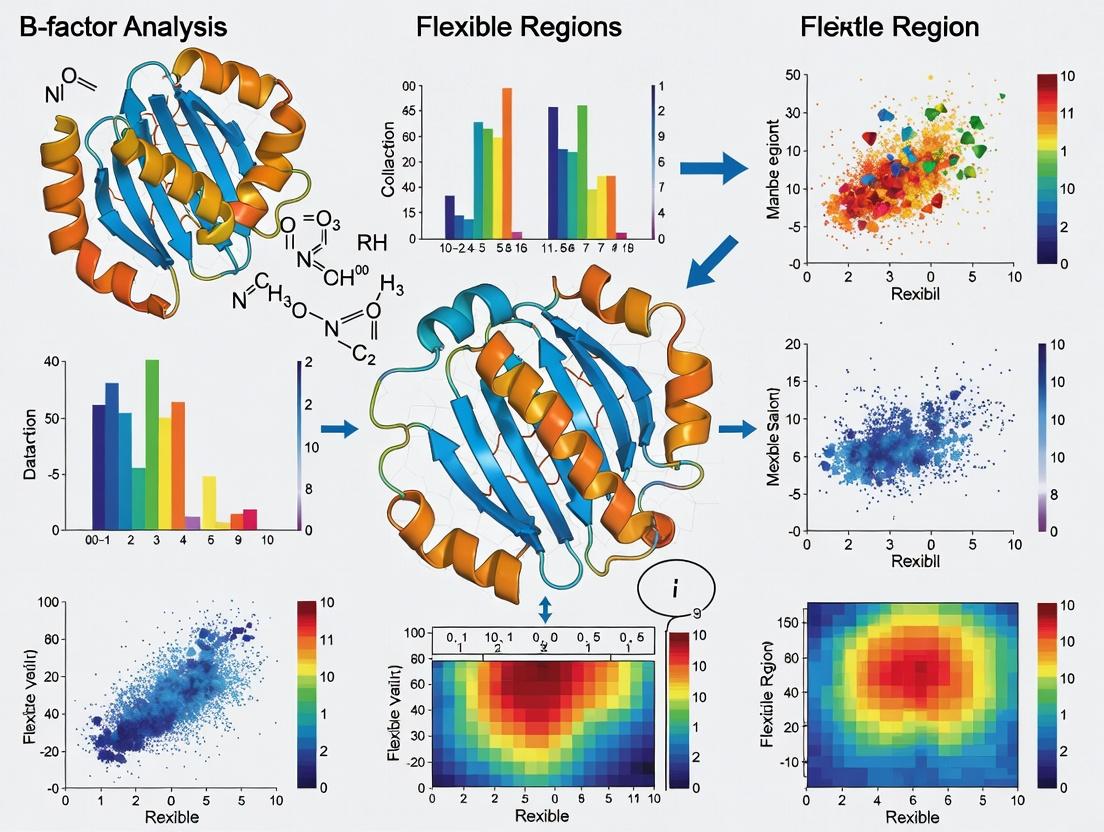
This comprehensive guide details B-factor (temperature factor) analysis as a critical tool in structural biology for quantifying protein flexibility from X-ray crystallography and cryo-EM data.
B-Factor Analysis Explained: A Complete Guide to Identifying Flexible Protein Regions for Drug Discovery
Abstract
This comprehensive guide details B-factor (temperature factor) analysis as a critical tool in structural biology for quantifying protein flexibility from X-ray crystallography and cryo-EM data. It provides researchers, scientists, and drug development professionals with foundational knowledge, step-by-step methodologies for identifying functionally important flexible regions like hinges and loops, and strategies for troubleshooting common data interpretation issues. The article compares B-factor analysis to complementary techniques like Molecular Dynamics and NMR, and discusses its validation and application in rational drug design, including targeting allosteric sites and understanding protein-ligand dynamics.
What Are B-Factors? Decoding the Atomic Temperature Factor in Protein Structures
Within a thesis exploring B-factor analysis for identifying flexible protein regions, this note details the definition, calculation, and interpretation of the B-factor (Atomic Displacement Parameter) across two primary structural biology techniques: X-ray crystallography and cryo-electron microscopy (cryo-EM). Understanding these parameters is critical for inferring dynamic properties from static structural models, a cornerstone for rational drug design targeting flexible sites.
Fundamental Definitions & Comparative Data
Table 1: Core Definitions & Representations of B-factors
| Aspect | X-ray Crystallography | Single-Particle Cryo-EM |
|---|---|---|
| Formal Name | Atomic Displacement Parameter (ADP) | B-factor / Resolution-dependent Blurring |
| Common Symbol | B (Ų) | B (Ų) |
| Isotropy Model | ( B = 8\pi^2 \langle u^2 \rangle ) | ( B = 8\pi^2 \langle u^2 \rangle ) |
| ( u^2 ): mean-square displacement | ||
| Anisotropy Model | Represented as a 3x3 tensor in the ADP | Less commonly refined; often modeled via local resolution |
| Primary Source | Thermal motion & static disorder | Conformational heterogeneity, flexible fitting, & instrument blur |
Table 2: Typical B-factor Ranges & Interpretation
| B-factor Range (Ų) | Interpretation in Well-Ordered Regions | Potential Implications for Flexibility |
|---|---|---|
| 10–20 | Very well ordered, low mobility/core regions | Structurally rigid, potential anchor points |
| 20–40 | Well ordered, average mobility | Stable secondary/tertiary structure |
| 40–60 | Moderately disordered, higher mobility | Flexible loops, solvent-exposed regions |
| >60 | Highly disordered | Potentially dynamic linkers, termini, or regions of conformational heterogeneity |
| >100 | Extremely high displacement | Often indicative of unresolved disorder or modeling uncertainty |
Key Protocols for B-factor Analysis
Protocol 3.1: B-factor Refinement in X-ray Crystallography
Objective: To obtain accurate per-atom B-factors from diffraction data. Materials:
- Refined structural model (PDB format)
- Structure factor file (MTZ or equivalent)
- Refinement software (e.g., PHENIX, REFMAC5, BUSTER)
Procedure:
- Initial Refinement: Perform rigid-body and positional refinement against the diffraction data.
- B-factor Refinement: Initiate B-factor refinement cycles. Two common modes are:
- Individual: Refines a B-factor for each atom. Used for high-resolution data (< ~1.8 Å).
- Group: Refines B-factors for groups of atoms (e.g., by residue). Used for lower resolution data to prevent overfitting.
- Restraints Application: Apply appropriate restraints (e.g., TLS - Translation, Libration, Screw-motion) to model concerted domain motions, especially at medium resolutions.
- Validation: After each cycle, validate using R-work/R-free. Ensure B-factors correlate reasonably with the electron density map and do not show extreme outliers without density support.
Protocol 3.2: Local Resolution and B-factor Estimation in Cryo-EM
Objective: To estimate resolution-dependent fall-off and local flexibility from a cryo-EM map. Materials:
- Final cryo-EM map (MRC/CCP4 format)
- Half-maps from gold-standard refinement
- Software (e.g., RELION, cryoSPARC, ResMap)
Procedure:
- Local Resolution Calculation:
- Using the two independent half-maps, calculate the Fourier Shell Correlation (FSC) in small, local regions (e.g., using a sliding window).
- Determine the resolution at which the local FSC drops below 0.143.
- Generate a local resolution map.
- Global B-factor Estimation:
- Plot the Guinier plot: ln(FSC-corrected amplitude) vs. spatial frequency² (s², where s=1/resolution).
- Fit a line to the linear region of the plot. The slope of this line is equal to -B/4.
- This global B-factor describes the overall fall-off of signal in the map.
- Local Flexibility Inference:
- Regions with persistently lower local resolution (blurrier) in an otherwise well-resolved map often correlate with higher flexibility.
- This can be qualitatively interpreted as having a higher effective local B-factor.
Protocol 3.3: B-factor Analysis for Flexible Region Identification (Thesis Core Protocol)
Objective: To systematically identify and rank flexible regions from a refined structural model. Materials:
- Refined PDB file with B-factor column populated.
- Analysis software (e.g., PyMOL, ChimeraX, B-factor analysis scripts in Python/R).
- (Optional) Aligned homologous structures for comparative analysis.
Procedure:
- Data Extraction: Extract per-residue B-factor values. Typically, use the average B-factor of all side-chain atoms, or just the Cα atom for backbone-focused analysis.
- Normalization: Normalize B-factors to a Z-score: ( Z = (B_i - μ) / σ ), where μ and σ are the mean and standard deviation of B-factors for the entire chain/model. This highlights relative flexibility.
- Thresholding & Segmentation: Define flexible regions.
- Apply a threshold (e.g., Z > 1.5 or B > 60 Ų).
- Cluster contiguous residues above the threshold into "flexible segments."
- Structural Mapping & Validation:
- Map segments onto the 3D structure. Color the structure from blue (low B) to red (high B).
- Visually validate if high-B regions correspond to:
- Loops, termini, or linker regions.
- Areas with weak or discontinuous electron density (X-ray) or blurred density (cryo-EM).
- Functional sites known for dynamics (e.g., active site gating loops).
- Comparative Analysis (Advanced):
- Align multiple structures of the same protein (e.g., apo vs. ligand-bound).
- Calculate per-residue B-factor differences (ΔB).
- Identify regions that become ordered (ΔB < 0) or disordered (ΔB > 0) upon ligand binding, providing direct clues for allosteric mechanisms or drug-induced stabilization.
Visualization: Pathways and Workflows
Diagram 1 Title: B-factor Derivation Pathways in X-ray & Cryo-EM
Diagram 2 Title: Workflow for B-factor Analysis of Flexibility
The Scientist's Toolkit: Research Reagent Solutions
Table 3: Essential Tools for B-factor Analysis
| Item / Software | Primary Function | Application Context |
|---|---|---|
| PHENIX | Comprehensive suite for crystallographic structure refinement, including TLS and individual B-factor refinement. | X-ray crystallography B-factor derivation. |
| REFMAC5 (CCP4) | Crystallographic refinement program with robust TLS parameterization. | X-ray B-factor refinement, especially with lower resolution data. |
| RELION | Cryo-EM image processing suite for 3D reconstruction, post-processing, and local resolution calculation. | Cryo-EM B-factor (global) estimation and local flexibility inference. |
| cryoSPARC | Integrated platform for cryo-EM processing, including non-uniform refinement for local variability. | Cryo-EM map sharpening and local heterogeneity analysis. |
| PyMOL/ChimeraX | Molecular visualization software with scripting capabilities. | Visualization, coloring by B-factor, and basic analysis (e.g., per-residue B averaging). |
| MD Simulation Software (e.g., GROMACS, AMBER) | Molecular dynamics simulation. | Generating theoretical B-factors from mean-square atomic fluctuations for validation against experimental values. |
| Bio3D (R Package) | Statistical analysis of protein structures, including comparative B-factor analysis across ensembles. | Quantitative, large-scale B-factor analysis for thesis research. |
| BALBES/MOLREP | Molecular replacement pipelines. | Provides initial models for refinement, where B-factors are later refined. |
| Coot | Model building and validation. | Manual inspection and correction of atoms with anomalous B-factors relative to electron density. |
Within the broader thesis on B-factor analysis for identifying flexible protein regions, understanding the physical basis of the B-factor (Debye-Waller factor) is paramount. The isotropic atomic displacement parameter (B-factor), derived from X-ray crystallography, is fundamentally related to the mean-square displacement (MSD) of an atom from its equilibrium position. This relationship bridges experimental observables and molecular dynamics.
The core equation is: [ B = 8\pi^2 \langle u^2 \rangle ] where ( B ) is the isotropic B-factor (in Ų) and ( \langle u^2 \rangle ) is the atomic mean-square displacement (in Ų). This assumes harmonic, isotropic atomic vibrations. For anisotropic motion, a more complex tensor is used.
Table 1: Relationship Between B-Factor and Atomic Displacement
| B-Factor (Ų) | Mean-Square Displacement, ⟨u²⟩ (Ų) | Root Mean-Square Displacement, RMSD (Å) | Interpretation |
|---|---|---|---|
| 20 | 0.253 | 0.50 | Very well-ordered atom (e.g., core). |
| 40 | 0.506 | 0.71 | Typical ordered region. |
| 60 | 0.759 | 0.87 | Moderately flexible loop. |
| 80 | 1.013 | 1.01 | Flexible surface residue. |
| 100 | 1.266 | 1.13 | Highly flexible/disordered region. |
Table 2: Comparison of B-Factors from Different Experimental Sources
| Method | Typical B-Factor Range (Ų) | Temporal Resolution | Notes on ⟨u²⟩ Calculation |
|---|---|---|---|
| X-ray Crystallography | 10-100+ | Time-averaged over crystal lifetime and all unit cells. | Directly provides B, assumes harmonic motion. |
| Cryo-Electron Microscopy | Often higher, map resolution-dependent. | Time-averaged, ensemble. | B-factors estimated from density map sharpening. |
| Molecular Dynamics (MD) Simulation | Calculated from trajectory MSD. | Femtosecond to microsecond timescale. | ⟨u²⟩ calculated directly from atomic coordinates over time. |
| Neutron Diffraction | Similar to X-ray. | Time-averaged. | Can provide hydrogen/deuterium B-factors. |
Application Notes & Protocols
Protocol 3.1: Calculating Experimental B-Factors from X-ray Crystallography Data
Objective: To extract per-atom isotropic B-factors from a refined protein crystal structure. Materials: Refined structural model file (PDB format), crystallography software (e.g., PHENIX, CCP4). Procedure:
- Data Refinement: Perform iterative cycles of refinement (e.g., with phenix.refine) against the structure factor data (MTZ file).
- B-Factor Modeling: Use restrained or TLS (Translation-Libration-Screw) refinement to model atomic displacement parameters.
- Validation: Check B-factor sanity using MolProbity; unrealistic values (e.g., >150 Ų) may indicate poor model fit.
- Extraction: Parse the final PDB file. The B-factor for each atom is listed in columns 61-66 of the ATOM record.
Protocol 3.2: Deriving Mean-Square Displacement from B-Factors
Objective: To convert experimental B-factors to atomic RMSD values for physical interpretation. Procedure:
- For each atom i, obtain the isotropic B-factor ( B_i ) from the PDB.
- Calculate the mean-square displacement: ( \langle ui^2 \rangle = Bi / (8\pi^2) ).
- Calculate the root mean-square displacement: ( RMSDi = \sqrt{\langle ui^2 \rangle} ).
- Note: This assumes isotropic, harmonic motion. High B-factors (>80 Ų) may indicate static disorder or anharmonic motion, complicating interpretation.
Protocol 3.3: Comparing Experimental B-Factors with MD Simulation MSD
Objective: To validate and interpret flexibility from simulations against experimental data. Materials: MD simulation trajectory of the protein, experimental PDB file. Procedure:
- Align Trajectory: Superpose all simulation frames to a reference (e.g., experimental structure) using backbone atoms to remove global rotation/translation.
- Calculate MSD: For each atom i, compute ( \langle ui^2 \rangle = \frac{1}{T} \sum{t=1}^{T} | \vec{r}i(t) - \vec{r}i^{ref} |^2 ), where ( T ) is the number of frames, ( \vec{r}i(t) ) is the atomic coordinate at time *t*, and ( \vec{r}i^{ref} ) is the reference coordinate.
- Convert to B-factor: Compute ( Bi^{MD} = 8\pi^2 \langle ui^2 \rangle ).
- Correlation Analysis: Plot ( Bi^{exp} ) vs. ( Bi^{MD} ) for all Cα atoms. Calculate Pearson correlation coefficient. High correlation validates the simulation's dynamical model.
Visualizations
Title: From X-Ray Data to Flexibility Interpretation
Title: B-Factor Validation with Molecular Dynamics
The Scientist's Toolkit
Table 3: Essential Research Reagent Solutions & Materials
| Item | Function in B-Factor/MSD Analysis |
|---|---|
| Protein Crystallization Kits (e.g., Hampton Research Screens) | Enable growth of diffraction-quality crystals for X-ray data collection. |
| Cryoprotectant Solution (e.g., 25% Glycerol, Paratone-N oil) | Protects crystals during flash-cooling for cryo-crystallography, reducing radiation damage. |
| PHENIX Software Suite | Integrates tools for crystallographic refinement, including B-factor and TLS parameterization. |
| GROMACS/AMBER | Molecular dynamics simulation packages to compute atomic trajectories and calculate MSD. |
| PyMOL/Molecular Dynamics Visualizer | Visualization software to map B-factors or RMSD values onto protein structures as color ramps. |
| High-Performance Computing (HPC) Cluster | Essential for running MD simulations of sufficient length (≥100 ns) to converge flexibility metrics. |
| Validation Server (e.g., PDB-REDO, MolProbity) | Online tools to assess the quality and realism of refined B-factors in structural models. |
Within the broader thesis on B-factor analysis for identifying flexible protein regions, effective visualization is paramount. This protocol details standardized methods in PyMOL and ChimeraX for translating B-factor and flexibility data into intuitive visual representations, enabling researchers to communicate dynamic structural insights critical for understanding protein function and drug discovery.
Core Color Schemes and Representations
Table 1: Standard Color Mapping Schemes for B-factor/Flexibility
| Software | Color Scheme Name | Color Progression (Low->High Flexibility) | Typical Application |
|---|---|---|---|
| PyMOL | spectrum |
Blue -> White -> Red | General B-factor visualization. |
| PyMOL | rainbow |
Blue -> Cyan -> Green -> Yellow -> Orange -> Red | Highlighting transition regions. |
| ChimeraX | b-factor |
Blue -> Green -> Yellow -> Orange -> Red | Default B-factor coloring. |
| ChimeraX | slate -> ruby |
Slate -> Sky -> Sea -> Forest -> Lime -> Gold -> Orange -> Ruby | High-detail comparative analysis. |
| Both | grayscale |
White -> Black | Publication-ready, monochrome figures. |
Table 2: Standard Representation Methods for Flexibility
| Representation | Software | Purpose | Key Parameter |
|---|---|---|---|
| Putty/Tube | PyMOL | Backbone thickness/radius scaled by B-factor. | cartoon putty |
| Worm/Thickness | ChimeraX | Backbone thickness scaled by B-factor. | style thickness |
| Sphere Scale | Both | Atom sphere radius scaled by B-factor. | sphere_scale (PyMOL), size (ChimeraX) |
| Surface Transparency | Both | Map flexibility onto molecular surface. | transparency |
Detailed Protocols
Protocol 1: B-factor Visualization in PyMOL
Materials:
- PyMOL software (version 2.5+).
- PDB file containing B-factor data (e.g., from X-ray crystallography).
- Pre-configured color scheme scripts (optional).
Procedure:
- Load Structure:
fetch 1xxxorload myprotein.pdb - Color by B-factor:
a.
spectrum b, rainbow, selection=allb. Alternatively, use GUI: Show -> As -> Cartoon, then Color -> Spectrum -> B-factors. - Apply Putty Representation:
a.
show cartoonb.cartoon puttyc.set cartoon_putty_scale, 2.0(adjust scaling factor). - Custom Color Ramp:
a.
set_color b_blue, [0,0,1]b.set_color b_red, [1,0,0]c.spectrum b, b_blue b_red, minimum=10, maximum=80 - Render Image:
ray 1200,1200followed bypng myimage.png, dpi=300
Protocol 2: Advanced Flexibility Mapping in ChimeraX
Materials:
- UCSF ChimeraX (version 1.6+).
- Structure file with B-factors or ensemble of structures (e.g., NMR models, MD trajectory).
- Comparative model set (optional).
Procedure:
- Load and Color Structure:
a.
open 1xxxb.color bfactor #1(colors chain by B-factor using default palette). - Adjust Color Range:
a.
range color #1 bfactor min 15 max 100b.colorkey #1 bfactor - Apply Worm/Thickness Representation:
a.
style #1 thicknessb. Adjust scaling:setattr a cartoonThickness 3(factor for scaling). - Visualize Ensemble RMSF:
a.
open ensemble.pdbb. Compute RMSF:measure rmsf #2c. Color by RMSF:color rmsf #2 palette slate:ruby - Create Composite Figure: Use Tools -> Viewing Controls -> Side View for multi-panel layout.
The Scientist's Toolkit
Table 3: Research Reagent Solutions & Essential Materials
| Item | Function/Application |
|---|---|
| PyMOL (Open-Source or Subscription) | Primary software for molecular graphics and B-factor visualization. |
| UCSF ChimeraX | Free, advanced visualization suite with integrated tools for ensemble and flexibility analysis. |
| PDB File with B-factor Column | Essential data source; B-factors are stored in the temperature factor column. |
| MD Trajectory File (e.g., .dcd, .xtc) | Source data for calculating RMSF from molecular dynamics simulations. |
| Custom Color Map Script (.py) | Enables application of non-standard, publication-specific color gradients. |
| High-Performance Workstation | Necessary for rendering complex scenes, especially with large ensembles or surfaces. |
| Reference Color Palette Chart | Ensures consistency in color meaning across research figures and presentations. |
Workflow and Relationship Diagrams
Title: Workflow for Visualizing Protein Flexibility
Title: Role of Visualization in B-factor Analysis Thesis
This application note is framed within a broader thesis on B-factor (temperature factor) analysis for identifying flexible protein regions. B-factors, derived from X-ray crystallography and cryo-EM data, quantify the displacement of atoms from their mean positions, serving as a direct experimental proxy for local flexibility and dynamics. Interpreting this range—from the low values of rigid secondary structures to the high values of flexible loops and termini—is critical for understanding protein function, allostery, and facilitating structure-based drug design.
Table 1: Typical B-Factor Ranges for Common Protein Structural Elements
| Protein Region / Element | Average B-Factor Range (Ų) | Interpretation & Functional Role |
|---|---|---|
| Core Beta-Sheets | 10 - 25 | Very low; indicates rigid, stable scaffolding. Essential for structural integrity. |
| Alpha-Helices | 15 - 30 | Low to moderate; stable but can exhibit collective motions. |
| Well-Ordered Loops | 25 - 45 | Moderate; some inherent flexibility for minor conformational adjustments. |
| Catalytic/Active Site Loops | 30 - 60 | Moderate to high; flexibility often required for substrate binding and catalysis. |
| Disordered Loops/Linkers | 45 - 100+ | High; high conformational entropy, enabling domain motions and signaling. |
| N/C-Terminal Tails | 50 - 150+ | Very high; often intrinsically disordered, key for post-translational modifications and protein-protein interactions. |
| Bound Ligand/Ion | Often matches binding site | Lower than surrounding solvent; indicates stabilization upon binding. |
Table 2: B-Factor Analysis Outputs and Their Implications
| Analysis Metric | Calculation/Description | Implication for Drug Development |
|---|---|---|
| Per-Residue Mean B | Average B-factor for all atoms in a residue. | Identifies localized flexibility "hotspots" and stable regions. |
| B-Factor Ratio (Loop/Sheet) | <B_loop> / <B_sheet> for a protein. |
Global flexibility index; high ratios suggest a dynamic protein. |
| Normalized B-Factor (Z-score) | (B_residue - μ_protein) / σ_protein |
Highlights residues with statistically significant deviation from mean flexibility. |
| B-Factor Correlation Map | Correlation of B-factor fluctuations between residue pairs. | Identifies allosterically coupled networks; useful for allosteric drug targeting. |
Experimental Protocols
Protocol 1: Extracting and Normalizing B-Factors from the PDB
Objective: To obtain and prepare B-factor data for comparative analysis. Materials: Protein Data Bank (PDB) file, molecular visualization software (PyMOL/ChimeraX), data processing script (Python/R). Procedure:
- Data Retrieval: Download the PDB file of interest from the RCSB PDB (www.rcsb.org).
- B-Factor Extraction:
- Using PyMOL: Execute
iterate (all), b_vals.append(b)in a Python script within PyMOL to extract atomic B-factors. - Using BioPython: Parse the PDB file and extract the
B_factorcolumn from ATOM records.
- Using PyMOL: Execute
- Calculate Per-Residue Averages: Group atomic B-factors by residue and compute the mean.
- Normalize B-Factors (Z-score):
- Compute the mean (μ) and standard deviation (σ) of all per-residue average B-factors.
- For each residue, calculate:
B_norm = (B_residue - μ) / σ.
- Output: Generate a table with columns:
Residue_Number, Residue_Type, B_raw, B_norm.
Protocol 2: Mapping Flexibility onto a 3D Structure for Functional Insight
Objective: To visualize flexible regions in the context of protein structure and function. Materials: PDB file, normalized B-factor data, visualization software (UCSP ChimeraX preferred). Procedure:
- Load Structure: Open the PDB file in ChimeraX.
- Apply B-Factor Coloring:
- Command:
color bfactor palette 1.0:blue,0.5:white,0.0:red(maps low B to blue, mid to white, high to red). - For normalized data: Assign colors based on the
B_normvalue (e.g., Z > 1.5 = red, Z < -1.5 = blue).
- Command:
- Identify Correlations:
- Visually inspect high B-factor regions (loops, tails). Are they near active sites, protein-protein interfaces, or mutation sites?
- Use the "Hide" and "Focus" commands to isolate regions of interest.
- Generate Figures: Render high-resolution images for publication, ensuring the color key (scale bar) is included.
Protocol 3: Comparative B-Factor Analysis for Ligand-Induced Rigidification
Objective: To quantify changes in flexibility upon ligand binding (e.g., drug candidate). Materials: Apo (unbound) and holo (bound) PDB structures of the same protein, analysis script. Procedure:
- Align Structures: Superimpose the holo structure onto the apo structure using Cα atoms of the rigid core (e.g., beta-sheets). Record the RMSD (should be low).
- Extract & Normalize B-Factors: Perform Protocol 1 for both structures.
- Calculate ΔB: For each equivalent residue, compute:
ΔB = B_apo - B_holo. A positive ΔB indicates rigidification upon binding. - Statistical Analysis: Perform a paired t-test on per-residue B-factors of the binding site region to determine if the rigidification is statistically significant (p < 0.05).
- Interpretation: Residues with significant positive ΔB are involved in induced-fit binding and are potential markers for successful ligand engagement.
Visualization Diagrams
Title: B-Factor Analysis Workflow for Flexibility Mapping
Title: Functional Roles of Flexible Protein Regions
The Scientist's Toolkit: Key Research Reagent Solutions
Table 3: Essential Materials for B-Factor Analysis and Flexibility Research
| Item / Reagent | Function & Application in Flexibility Research |
|---|---|
| High-Quality PDB Structures | Source of experimental B-factor data. Resolution < 2.5 Å and low R-free are critical for reliable analysis. |
| Molecular Dynamics (MD) Software (e.g., GROMACS, AMBER) | To simulate protein dynamics and validate/compare with experimental B-factors (calculated as RMSF). |
| Normal Mode Analysis (NMA) Tools (e.g., ElNemo, iMODS) | To predict large-scale, collective motions from a single structure, often correlating with B-factor patterns. |
| BioPython/ProDy Libraries | For scripting the automated extraction, processing, and analysis of B-factors from multiple structures. |
| Crystallography Reagents (PEGs, Salts, Cryo-Protectants) | For generating new high-resolution structures in-house to obtain experimental B-factors for novel proteins or complexes. |
| Hydrogen-Deuterium Exchange Mass Spectrometry (HDX-MS) | To experimentally probe protein backbone flexibility in solution, providing complementary data to crystallographic B-factors. |
| Fluorescent Anisotropy/Dye Kits | To measure changes in local flexibility or global rigidity upon ligand binding in solution-based assays. |
Within the context of a broader thesis on B-factor analysis for identifying flexible protein regions in drug development, the Protein Data Bank (PDB) is the fundamental resource. B-factors (temperature factors) quantify atomic displacement, serving as direct indicators of local flexibility and disorder, which are critical for understanding protein function, allostery, and ligand binding. This protocol details systematic methods for accessing, filtering, and extracting B-factor data from the PDB for downstream computational analysis.
Direct FTP Archive Access
The most comprehensive method for bulk data retrieval.
- Protocol: Access the PDB's FTP server at
ftp.wwpdb.org. Navigate to/pub/pdb/data/structures/divided/pdb/. The directory is organized by the middle two characters of the PDB ID (e.g., data for1abcis inab/pdb1abc.ent.gz). Download.entor.ciffiles. B-factors are stored in theATOMandHETATMrecords (columns 61-66 in PDB format) or as_atom_site.B_iso_or_equivin mmCIF format. - Scripting Example (bash):
Programmatic Access via APIs
For targeted queries and integration into analysis pipelines.
- RCSB PDB Data API Protocol:
- Base URL:
https://data.rcsb.org/rest/v1/core - Endpoint for Entry Data:
/entry/{PDB_ID} - Request Example (Python):
- Base URL:
- RCSB Search API for Filtering:
- Use the search service to filter structures based on B-factor-related properties.
- Example Query for High B-factors: Find structures with residues having average B-factor > 50.
Web Interface Filtering at RCSB.org
For interactive, non-programmatic filtering.
- Navigate to
https://www.rcsb.org. - Click "Advanced Search".
- Under "Experimental Attributes," set "Resolution" to a desired threshold (e.g., ≤ 2.0 Å).
- Use the "Sequence Motif" or "Chemical ID" tabs to target specific regions or ligands.
- Execute search. The results list can be downloaded as a CSV file containing PDB IDs and metadata.
- Use the "Biological Assembly" view and the "3D View" controls to visualize B-factors directly on the structure (color by "B-factor").
Table 1: Common B-factor Ranges and Interpretations
| B-factor Range (Ų) | Typical Interpretation | Relevance to Flexibility Analysis |
|---|---|---|
| < 20 | Well-ordered, rigid region | Core protein domains, stable secondary structure. |
| 20 - 40 | Moderately flexible | Surface loops, termini in well-resolved structures. |
| 40 - 60 | Highly flexible | Disordered loops, linker regions, dynamic domains. |
| > 60 | Very flexible/disordered | Often indicative of residues with poor electron density, potentially critical for function or drug binding. |
Table 2: Key PDB File Columns for B-factor Extraction (PDB Format)
| Column Numbers | Field Name | Content | Relevance to B-factor Protocol |
|---|---|---|---|
| 1-6 | Record Type | "ATOM" or "HETATM" | Identifies the line containing atomic data. |
| 23-26 | Residue Sequence Number | Integer | For mapping B-factors to specific residues. |
| 61-66 | Temperature factor (B-factor) | Real number (Ų) | The primary data of interest. |
| 77-78 | Element Symbol | e.g., C, N, O, S | Useful for filtering by atom type. |
Experimental Protocol for Comparative B-Factor Analysis
Objective: Compare flexibility profiles of a target protein in its apo and ligand-bound states.
Materials & Software:
- PDB IDs: Apo form (e.g.,
1ABC), Ligand-bound form (e.g.,1ABD). - Software:
BioPython(or similar),Pandas,Matplotlib(Python environment), orBiostructures(Julia). - Computational Environment: Standard desktop or HPC environment with internet access.
Step-by-Step Method:
- Data Retrieval:
- Programmatically download the PDB files for
1ABCand1ABDusing the RCSB PDB API orBioPython.PDBrepository list.
- Programmatically download the PDB files for
Data Parsing and Normalization:
- Parse the files, extract B-factors for alpha-carbon atoms only (to represent residue mobility).
- Normalize B-factors per structure to Z-scores to enable comparison across datasets:
Z = (B - μ) / σ, where μ and σ are the mean and standard deviation of all Cα B-factors in that structure.
Alignment and Mapping:
- Structurally align the two protein conformations using Cα coordinates.
- Map the normalized B-factors onto the aligned residue indices.
Analysis and Visualization:
- Calculate the difference in normalized B-factor (ΔZ) per residue:
ΔZ = Z(apo) - Z(bound). - Plot per-residue normalized B-factors or ΔZ. Peaks indicate regions where ligand binding alters flexibility (often allosteric or binding sites).
- Calculate the difference in normalized B-factor (ΔZ) per residue:
Experimental Workflow Diagram
Title: B-factor Analysis from PDB to Thesis Integration Workflow
The Scientist's Toolkit: Essential Research Reagent Solutions
Table 3: Key Computational Tools and Resources for B-factor Analysis
| Tool/Resource Name | Type | Primary Function in B-factor Analysis |
|---|---|---|
| RCSB PDB Website | Web Portal | Interactive search, filtering, and initial visualization of B-factors colored on 3D structures. |
| BioPython (PDB Module) | Python Library | Programmatic parsing of PDB files, extraction of B-factor data, and basic calculations. |
| PyMOL / ChimeraX | Molecular Viewer | Advanced visualization of B-factors as custom colormaps on molecular surfaces and cartoons. |
| RCSB PDB Data API | Programming Interface | Automated, large-scale retrieval of structural metadata and associated data. |
| PDB FTP Archive | Data Repository | Bulk download of all PDB coordinate files for large-scale analyses. |
| Pandas & NumPy (Python) | Data Analysis Libraries | Data manipulation, statistical normalization (Z-score), and comparative analysis of B-factor tables. |
| B-factor Normalization Scripts | Custom Code | Implementing normalization methods (e.g., Wilson plot, residue-specific) to compare across structures. |
Practical Guide: How to Calculate, Analyze, and Apply B-Factor Data
This protocol is a foundational component of a thesis investigating the relationship between protein flexibility, derived from B-factor analysis of crystallographic data, and biological function. The accurate identification of flexible regions is critical for understanding allostery, ligand binding, and protein-protein interactions, with direct applications in rational drug design targeting dynamic regions or cryptic pockets.
Key Research Reagent Solutions & Materials
| Item | Function in Workflow |
|---|---|
| PDB File | The primary input; contains 3D atomic coordinates and experimental B-factors (temperature factors). |
| BioPython/ProDy | Python libraries for parsing PDB files, handling structures, and performing normal mode analysis. |
| Pymol/ChimeraX | Visualization software to render the protein structure and color-code it by flexibility metrics. |
| Normal Mode Analysis (NMA) Server (e.g., ElNémo, WEBnm@) | Online tool for calculating theoretical flexibility from protein geometry. |
| Statistical Package (R/Pandas) | For data processing, calculating moving averages, and generating flexibility profiles. |
Detailed Experimental Protocol
Protocol A: Data Acquisition and Preprocessing
Objective: Obtain and prepare a clean protein structure file for analysis.
- Source Data: Download a protein structure file (format:
.pdbor.cif) from the Protein Data Bank (PDB). Ensure the structure is of high resolution (<2.5 Å) and contains minimal missing residues in the region of interest. - File Cleaning:
- Remove all non-protein atoms (water, ions, ligands, etc.) using a script or visualization tool, unless they are critical to the analysis.
- Retain only one model from NMR structures or one chain if studying a monomeric unit.
- Save the cleaned file as
protein_clean.pdb.
- B-Factor Extraction:
- Use a Python script with BioPython to parse
protein_clean.pdb. - Extract the B-factor for each Cα atom (or all atoms, as required).
- Record the residue number and its corresponding B-factor in a tab-delimited text file.
- Use a Python script with BioPython to parse
Protocol B: Generating and Normalizing the Flexibility Profile
Objective: Create a normalized, per-residue flexibility profile from experimental B-factors.
- Calculate Per-Residue Mean B-Factor:
- For each residue, average the B-factors of all its atoms, or use the Cα B-factor as a proxy.
- Normalization:
- Apply Z-score normalization: Z = (Bᵢ - μ) / σ, where Bᵢ is the residue B-factor, μ is the mean B-factor for the entire chain, and σ is the standard deviation.
- Alternative: Normalize relative to the maximum B-factor: Bnorm = Bᵢ / Bmax.
- Smoothing:
- Apply a sliding window average (window size: 5-10 residues) to reduce noise and highlight trends.
- Implement using Python (Pandas) or R.
Protocol C: Comparative Analysis with Theoretical Predictions
Objective: Validate and contrast experimental flexibility with computational predictions.
- Theoretical NMA Calculation:
- Submit
protein_clean.pdbto an online NMA server (e.g., ElNémo). - Request the calculation of slow modes (typically the first 10 non-trivial modes).
- Download the predicted mean square displacement (MSD) or B-factor profile for each residue.
- Submit
- Correlation Analysis:
- Align the experimental (normalized) and theoretical flexibility profiles by residue index.
- Compute the Pearson correlation coefficient (r) to quantify agreement.
- Plot both profiles on a dual-axis graph for visual comparison.
Table 1: Example Flexibility Analysis Output for Protein (PDB: 1ABC)
| Residue Range | Secondary Structure | Mean Exp. B-Factor (Ų) | Normalized Z-Score | NMA Predicted MSD (a.u.) | Flexibility Classification |
|---|---|---|---|---|---|
| 10-25 | α-Helix | 25.3 | -0.45 | 0.15 | Rigid |
| 45-60 | Loop | 62.1 | 1.85 | 0.82 | Highly Flexible |
| 75-90 | β-Strand | 30.1 | 0.12 | 0.21 | Moderately Rigid |
| 100-120 | Loop | 58.7 | 1.65 | 0.75 | Flexible |
| Overall Chain | N/A | 35.4 (σ=18.2) | 0.0 (σ=1.0) | 0.45 | N/A |
Pearson r (Exp. vs NMA): 0.78
Visualized Workflows
Title: Primary Workflow for B-Factor Flexibility Analysis
Title: Interpreting Flexibility for Thesis Research
This document, framed within a broader thesis on B-factor analysis for identifying flexible protein regions, provides application notes and protocols for characterizing key dynamic structural elements: hinges, active site loops, and linkers. These regions are critical for understanding protein function, allostery, and for informing rational drug and therapeutic protein design.
Table 1: Typical B-factor and Mobility Metrics for Flexible Regions
| Region Type | Avg. B-factor (Ų) Range* | Avg. RMSF (Å) Range* | Characteristic Dihedral Angle Variance | Common Length (residues) |
|---|---|---|---|---|
| Hinge | 60 - 120 | 1.5 - 4.0 | High in φ/ψ for 1-3 residues | 1 - 5 |
| Active Site Loop | 50 - 100 | 1.2 - 3.5 | Moderate-High, coupled to substrate | 4 - 12 |
| Linker | 40 - 90 | 1.0 - 3.0 | Variable, often high | 5 - 30 |
*Ranges derived from comparative analysis of PDB entries and MD simulations. B-factors are relative to the protein core (often 20-40 Ų).
Table 2: Experimental Techniques for Flexibility Analysis
| Technique | Temporal Resolution | Spatial Resolution | Best for Characterizing... |
|---|---|---|---|
| X-ray Crystallography | Static (B-factors infer motion) | Atomic | Hinges, Loop conformation diversity |
| NMR Spectroscopy | ps - ms | Atomic | Linker dynamics, Loop conformational ensembles |
| HDX-MS | ms - hours | Peptide-level (~5-20 residues) | Solvent accessibility changes in Loops/Linkers |
| Cryo-EM | Static (Flexibility via 3DVA) | Near-Atomic | Large-scale hinge motions in complexes |
| MD Simulations | fs - ms | Atomic | All regions (computational prediction) |
Experimental Protocols
Protocol 3.1: B-factor Analysis from PDB Files
Objective: Extract and normalize B-factors to identify hinges and flexible loops.
- Data Retrieval: Download PDB file(s) of interest from the RCSB PDB database.
- B-factor Extraction: Use
bio3d(R) orBiopython(Python) to parse per-atom B-factors. Calculate average B-factor per residue (mean of all atom B-factors for that residue). - Normalization: Calculate Z-score: ( Zi = (Bi - \mu{chain}) / \sigma{chain} ), where ( Bi ) is the residue's avg. B-factor, ( \mu{chain} ) and ( \sigma_{chain} ) are the mean and standard deviation for the entire chain.
- Identification: Residues with Z-score > 2.0 are considered flexible. Map contiguous flexible stretches onto the 3D structure:
- Hinge: Short (1-3 residue) flexible link between two rigid domains.
- Active Site Loop: Flexible region containing catalytic residues.
- Linker: Long, often unstructured loop connecting domains.
Protocol 3.2: Molecular Dynamics (MD) Simulation for Flexibility Profiling
Objective: Perform an all-atom MD simulation to characterize flexibility and conformational dynamics.
- System Preparation:
- Use PDB file. Add missing hydrogens and side chains with
CHARMM-GUIorPDBfixer. - Solvate the protein in a cubic TIP3P water box (≥10 Å padding). Add ions to neutralize charge (e.g., 0.15 M NaCl).
- Use PDB file. Add missing hydrogens and side chains with
- Simulation Run:
- Use
GROMACSorAMBER. Employ a force field (e.g., CHARMM36, AMBER ff19SB). - Minimize energy (steepest descent, 5000 steps).
- Equilibrate in NVT (100 ps) and NPT (100 ps) ensembles at 300 K, 1 bar.
- Run production simulation for 100 ns - 1 µs (save frames every 10 ps).
- Use
- Trajectory Analysis:
- Align trajectories to the protein backbone of the initial stable domain.
- Calculate per-residue Root Mean Square Fluctuation (RMSF) using
gmx rmsf. - Correlate high RMSF peaks with structural features (hinges, loops, linkers).
- Perform dihedral angle analysis on identified flexible regions.
Protocol 3.3: Hydrogen-Deuterium Exchange Mass Spectrometry (HDX-MS)
Objective: Probe solvent accessibility and flexibility dynamics of loop/linker regions.
- Labeling:
- Dilute purified protein into D₂O-based labeling buffer (pD 7.0, 25°C). Use multiple time points (e.g., 10 s, 1 min, 10 min, 1 h).
- Quench the reaction by lowering pH and temperature (to pH 2.5, 0°C).
- Digestion & Analysis:
- Pass quenched sample over an immobilized pepsin column for rapid digestion (≈1 min).
- Inject peptides onto a UPLC-MS system (kept at 0°C).
- Analyze via high-resolution mass spectrometry.
- Data Processing:
- Identify peptides from a non-deuterated control.
- Calculate deuterium uptake for each peptide at each time point.
- Map peptides with fast, high deuterium uptake onto the structure to identify highly solvent-accessible, dynamic linkers and loops.
Visualization: Workflows and Relationships
Title: Workflow for Identifying Flexible Protein Regions
Title: Structural Relationships of Flexible Regions
The Scientist's Toolkit: Research Reagent Solutions
Table 3: Essential Materials and Reagents
| Item | Function / Application | Example Product / Specification |
|---|---|---|
| Purified Protein Sample | Subject for HDX-MS, Crystallography, MD starting structure. | Recombinant, >95% purity, low endotoxin, in stable buffer. |
| Crystallization Screening Kits | To obtain crystals for high-resolution structure/B-factor determination. | Hampton Research Crystal Screen, MemGold. |
| Deuterium Oxide (D₂O) | Labeling solvent for HDX-MS experiments. | 99.9% D atom purity, LC-MS grade. |
| Immobilized Pepsin Column | For rapid, reproducible digestion in HDX-MS protocol. | Thermo Scientific Immobilized Pepsin (Pierce). |
| MD Simulation Software | For running and analyzing molecular dynamics trajectories. | GROMACS (open-source), AMBER, CHARMM. |
| Force Field Parameters | Defines atomic interactions for accurate MD simulations. | CHARMM36m, AMBER ff19SB, OPLS-AA/M. |
| Visualization & Analysis Software | For mapping B-factors/RMSF and visualizing flexible regions. | PyMOL (with B-factor coloring), ChimeraX, VMD. |
| Bioinformatics Toolkits | For scripting B-factor extraction, normalization, and analysis. | Bio3D (R), Biopython (Python), MDTraj (Python). |
| Size-Exclusion Chromatography (SEC) Column | To assess protein monodispersity and oligomeric state prior to experiments. | Superdex 200 Increase (Cytiva). |
Application Notes on B-Factor Analysis for Functional Flexibility
Thesis Context: Within the broader research on B-factor analysis for identifying flexible protein regions, this document details its application in elucidating three core functional mechanisms: allostery, enzyme catalysis, and protein-protein interactions (PPIs). B-factors (temperature factors) from X-ray crystallography serve as a primary experimental proxy for local atomic mobility, providing a quantitative map of flexibility that can be correlated with functional sites.
Key Quantitative Correlations
The following table summarizes established and emerging quantitative relationships between flexibility metrics (derived from B-factors) and functional parameters.
Table 1: Quantitative Correlations Between Flexibility Metrics and Functional Parameters
| Functional Mechanism | Key Flexibility Metric | Typical Range/Value Observed | Correlation with Function | Key Supporting References (Recent) |
|---|---|---|---|---|
| Allosteric Regulation | B-factor ratio (Allosteric site / Average) | 1.5 - 3.0 | Higher-than-average flexibility at allosteric site predisposes for conformational selection upon regulator binding. | Suárez et al., Nat Commun 2023; 14: 1285 |
| Root Mean Square Fluctuation (RMSF) of hinge regions | 1.2 - 2.5 Å | Peak flexibility in hinge regions enables domain closure/opening upon effector binding. | Liu et al., Sci Adv 2022; 8: eabq3856 | |
| Enzyme Catalysis | B-factor of catalytic loop | Often >60 Ų | High pre-organized flexibility in catalytic loops facilitates transition state stabilization and substrate dynamics. | Kamerlin et al., Chem Rev 2023; 123(9): 5225 |
| Correlation between B-factor and reaction coordinate | R² ~ 0.6-0.8 | Atoms with higher B-factors show greater displacement along the reaction path in QM/MM simulations. | Wang et al., PNAS 2021; 118(32): e2109230118 | |
| Protein-Protein Interactions | Average B-factor of interface residues | Lower than surface average by ~15-30% | Interface residues often exhibit rigidification upon binding; pre-binding flexibility is entropically costly. | Li et al., Nucleic Acids Res 2022; 50(D1): D527 |
| Flexibility index of PPI "hotspot" residues | Index < 0.15 (0=rigid, 1=flex) | Energetically critical hotspot residues tend to be pre-organized with moderate to low flexibility. | Zhang et al., Bioinformatics 2023; 39(1): btac787 |
Research Reagent Solutions Toolkit
Table 2: Essential Reagents and Materials for Flexibility-Function Studies
| Item | Function in Research |
|---|---|
| Recombinant Protein Expression System (e.g., E. coli BL21(DE3), baculovirus) | Produces high yields of pure, homogeneous protein for crystallization and biophysical assays. |
| Crystallization Screening Kits (e.g., from Hampton Research, Molecular Dimensions) | Enables identification of initial conditions for growing protein crystals suitable for high-resolution X-ray diffraction. |
| Deuterated Glucose/Glycerol & D₂O | Used for producing perdeuterated proteins for neutron crystallography, allowing visualization of H/D atoms to study flexibility in hydrogen bonding networks. |
| Site-Directed Mutagenesis Kit (e.g., Q5 from NEB) | Creates variants to stabilize or disrupt flexible regions (e.g., hinge proline substitutions, disulfide engineering) to test functional hypotheses. |
| Hydrogen-Deuterium Exchange (HDX) Mass Spectrometry Platform | Probes backbone solvent accessibility and dynamics in solution, complementary to crystallographic B-factors. |
| Double-Electron Electron Resonance (DEER) Spin Labeling Probes (e.g., MTSSL) | Measures distances and distributions between spin labels to quantify conformational flexibility and populations in solution. |
| Molecular Dynamics Simulation Software (e.g., GROMACS, AMBER) | Computes theoretical RMSF and flexibility profiles from trajectories, validating and extending static B-factor data. |
| B-Factor Analysis Software (e.g., Bsoft, MDAnalysis, custom Python/R scripts) | Processes PDB files, normalizes B-factors (B'-factor), and calculates flexibility indices for comparative analysis. |
Detailed Experimental Protocols
Protocol: Normalized B-Factor (B'-Factor) Analysis from PDB Files
Objective: To extract and normalize crystallographic B-factors to compare flexibility across different protein structures, removing scaling artifacts.
Materials:
- Protein Data Bank (PDB) file(s) of interest.
- Bioinformatics software environment (e.g., Python with Biopython, R).
- Visualization software (e.g., PyMOL, ChimeraX).
Procedure:
- Data Extraction: Use Biopython's
Bio.PDBmodule to parse the PDB file. Extract B-factors for all backbone atoms (N, Cα, C, O) for each residue. - Residue Averaging: Calculate the mean B-factor for the backbone atoms of each amino acid residue.
- Normalization (Z-score Calculation): a. Compute the overall mean (μ) and standard deviation (σ) of the per-residue average B-factors for the entire chain. b. Calculate the normalized B-factor (B') for each residue i: B'ᵢ = (Bᵢ - μ) / σ. This yields a Z-score where positive values indicate higher-than-average flexibility and negative values indicate rigidity.
- Visual Mapping: Map the B' values onto the protein structure in PyMOL using the
spectrumandramp_newcommands to create a color gradient (e.g., blue-rigid to red-flexible). - Region Identification: Identify contiguous regions with consistently high B' values (>1.5) as potential "flexible hotspots." Correlate these regions with known functional sites from literature or databases like CSA or UniProt.
Protocol: Correlating Flexibility with Catalytic Activity via Mutagenesis
Objective: To test the functional importance of a flexible loop identified by high B-factors in enzyme catalysis.
Materials:
- Wild-type (WT) expression plasmid for the target enzyme.
- Site-directed mutagenesis primers designed to rigidify the flexible loop (e.g., introduce proline, alanine, or a disulfide bond).
- Equipment for protein purification (FPLC, ÄKTA system) and kinetics (spectrophotometer/plate reader).
Procedure:
- Loop Identification: Identify a candidate flexible catalytic loop via B'-factor analysis (see Protocol 2.1). Typical candidates have average B' > 2.0 and contain known catalytic residues.
- Design Rigidifying Mutants:
- Proline Mutant: Replace a glycine or serine in the loop with proline to restrict backbone φ/ψ angles.
- Disulfide Mutant: Introduce two cysteine residues at flanking positions in the loop (via two-point mutation) to potentially form a constraining disulfide bridge under oxidizing conditions.
- Generate and Express Variants: Use a high-fidelity site-directed mutagenesis kit to create mutant constructs. Express and purify WT and mutant proteins identically.
- Assay Enzymatic Activity: Perform steady-state kinetic assays under saturating substrate conditions. Measure initial velocities (v₀) and determine k꜀ₐₜ and Kₘ.
- Analysis:
- Calculate Activity Loss: % Activity = (k꜀ₐₜ( mutant) / k꜀ₐₜ( WT)) * 100.
- A significant drop in k꜀ₐₜ (e.g., >70% loss) supports the hypothesis that native loop flexibility is crucial for catalytic efficiency.
- Monitor changes in Kₘ to assess impacts on substrate binding.
Protocol: Validating Allosteric Pathway Flexibility with HDX-MS
Objective: To use Hydrogen-Deuterium Exchange Mass Spectrometry (HDX-MS) to validate the solution-phase dynamics of a putative allosteric pathway identified by correlated B-factor patterns.
Materials:
- Purified target protein (>95% purity, 50-100 µM stock in appropriate buffer).
- Deuterium oxide (D₂O) HDX buffer (identical pH and ionic strength to protein buffer).
- Liquid chromatography-mass spectrometry (LC-MS) system with HDX automation (e.g., LEAP PAL, Waters UPLC, Synapt G2-Si).
Procedure:
- Define Allosteric Pathway: From B-factor analysis and literature, define a set of residues constituting the proposed path from allosteric to active site.
- HDX Labeling: Dilute protein 10-fold into D₂O buffer. Perform labeling at multiple time points (e.g., 10s, 1min, 10min, 1hr) at 25°C. Quench each time point with low-pH, cold buffer.
- Control Experiment: Perform identical labeling in H₂O buffer for a non-deuterated control.
- Peptide Analysis: Digest quenched samples online with an immobilized pepsin column. Separate peptides via UPLC and analyze with high-resolution MS.
- Data Processing: Use dedicated software (e.g., HDExaminer) to identify peptides, calculate deuterium uptake for each time point, and map uptake onto the protein structure.
- Correlation with B-factors:
- High Flexibility/High B-factor Validation: Residues with high B' should show fast, high-magnitude deuterium uptake, indicating solvent exposure and backbone mobility.
- Allosteric Communication Validation: Upon adding allosteric effector (repeat HDX with ligand), expect significant protection (reduced deuterium uptake) along the proposed pathway, indicating ligand-induced rigidification or conformational change.
Diagrams
Diagram 1: B-factor Analysis Workflow for Functional Insight
Diagram 2: Flexibility Roles in Core Protein Functions
Diagram 3: Experimental Validation Pipeline for a Flexible Catalytic Loop
Application Notes: B-Factor Analysis for Targeting Dynamic Protein Regions
Within the broader thesis on B-factor analysis for identifying flexible protein regions, the application to drug design represents a pivotal advancement. Traditional structure-based drug design (SBDD) often focuses on static, high-affinity binding to well-defined active sites. However, this approach can be limited by factors such as drug resistance and a lack of selectivity. Targeting dynamic pockets—regions that undergo conformational changes—and allosteric sites—regions distal from the active site—offers a powerful alternative. B-factor (temperature factor) values derived from Protein Data Bank (PDB) files provide a quantitative measure of atomic displacement, serving as a primary proxy for regional flexibility. High B-factor regions often correspond to loops, hinges, and termini, which can be critical for forming cryptic pockets or transmitting allosteric signals. This analysis enables the rational identification of novel, often more specific, drug targets.
Table 1: Quantitative Correlates of Protein Flexibility from B-Factor Analysis
| Metric | Typical Range/Value | Interpretation in Drug Design |
|---|---|---|
| Average B-factor (Ų) | 15-30 (well-ordered), 40-80+ (flexible) | Identifies overall rigid vs. flexible domains. |
| B-factor Ratio (Loop/Core) | Often 2:1 to 5:1 | Highlights potential hinge regions and dynamic loops amenable to induced-fit binding. |
| B-factor Z-score (per residue) | >2.0 standard deviations from mean | Statistically significant flexibility; prime candidates for cryptic pocket formation. |
| Root Mean Square Fluctuation (RMSF) from MD | 1-3 Å (correlates with B-factors) | Validates and simulates flexibility observed crystallographically. |
| Percentage of Residues with High B-factor | Varies by protein; >20% suggests high flexibility | Indicates proteins where allosteric targeting may be more successful than orthosteric. |
Table 2: Examples of Drugs Targeting Dynamic/Allosteric Sites
| Target Protein | Drug/Molecule | Site Type | Reported Selectivity/Advantage |
|---|---|---|---|
| BCR-ABL (Kinase) | Asciminib (ABL001) | Myristoyl pocket (allosteric) | Overcomes multiple ATP-site resistance mutations. |
| HIV-1 Integrase | Allosteric INSTIs (e.g., BI-224436) | LEDGF/p75 binding site | Novel mechanism, potential for improved resistance profiles. |
| KRAS (G12C) | Sotorasib, Adagrasib | Switch-II pocket (cryptic) | Targets previously "undruggable" oncoprotein. |
| EGFR (Kinase) | EAI045 (in research) | Allosteric site | Effective against T790M/C797S resistance mutations when combined with cetuximab. |
Experimental Protocols
Protocol: Computational Identification of Dynamic Pockets via B-Factor Analysis
Objective: To identify flexible regions and potential cryptic/allosteric pockets in a target protein using B-factor data.
Materials: Protein structure file (PDB format), computational software (PyMOL, BioPython, or similar).
Procedure:
- Data Acquisition & Parsing:
- Download the target protein's PDB file from the RCSB PDB database.
- Using a script (e.g., Python with BioPython), parse the PDB file to extract B-factor values for each Cα atom (or all atoms). Retain associated residue numbers and chain IDs.
- Normalization and Analysis:
- Calculate the average and standard deviation of B-factors for the entire structure or per chain.
- Compute a Z-score for each residue:
Z = (B_residue - B_mean) / B_stddev. - Classify residues with Z-score > 2.0 as "highly flexible."
- Visualization and Pocket Mapping:
- Visualize the structure in molecular graphics software (e.g., PyMOL).
- Color the structure by B-factor, typically using a spectrum (blue=rigid, white=medium, red=flexible).
- Cluster contiguous residues identified as highly flexible.
- On these flexible regions, perform computational pocket detection using algorithms (e.g., FPocket, POCASA, SiteMap) on both the static structure and, if available, molecular dynamics (MD) simulation snapshots.
- Prioritization:
- Prioritize pockets that are (a) located in high B-factor regions, (b) not the canonical active site, and (c) show evolutionarily conservation or evidence of functional relevance from literature.
Protocol: MD Simulation to Validate and Explore B-Factor-Based Predictions
Objective: To simulate the dynamics of a protein to confirm flexible regions predicted by B-factors and observe cryptic pocket opening.
Materials: Prepared protein structure (from PDB), solvation box, force field (e.g., CHARMM36, AMBER), MD software (GROMACS, NAMD, or Desmond).
Procedure:
- System Preparation:
- Use PDB2GMX or
tleapto add missing hydrogens and assign force field parameters. - Place the protein in a cubic or dodecahedral water box (e.g., TIP3P water model), ensuring a minimum 1.0 nm distance from the box edge.
- Add ions (e.g., Na⁺, Cl⁻) to neutralize the system charge and simulate physiological salt concentration (~0.15 M).
- Use PDB2GMX or
- Simulation Run:
- Minimize energy using steepest descent/conjugate gradient until maximum force < 1000 kJ/mol/nm.
- Perform equilibration in two phases: NVT (constant Number, Volume, Temperature) for 100 ps, then NPT (constant Number, Pressure, Temperature) for 100 ps.
- Run a production MD simulation for a minimum of 100 ns (longer for large conformational changes). Save trajectory frames every 10-100 ps.
- Trajectory Analysis:
- Calculate per-residue Root Mean Square Fluctuation (RMSF) for Cα atoms across the trajectory.
- Correlate RMSF peaks with high B-factor regions from the PDB file.
- Use clustering algorithms (e.g., GROMACS
cluster) on trajectory frames to identify major conformational states. - Analyze clustered states for the presence and morphology of pockets in dynamic regions using continuous pocket detection tools (e.g., MDpocket).
Visualizations
Diagram Title: B-factor Analysis & Dynamic Pocket Detection Workflow
Diagram Title: Allosteric Modulation Mechanism via Dynamic Sites
The Scientist's Toolkit
Table 3: Key Research Reagent Solutions & Materials
| Item/Category | Function/Description | Example Product/Software |
|---|---|---|
| Protein Structure Source | Provides atomic coordinates and experimental B-factors. | RCSB Protein Data Bank (PDB) |
| B-factor Analysis Software | Parses PDB files, calculates statistics, and visualizes flexibility. | PyMOL, UCSF Chimera, BioPython (Parsing Scripts) |
| Pocket Detection Algorithm | Identifies potential binding cavities on protein surfaces. | FPocket, POCASA, SiteMap (Schrödinger) |
| Molecular Dynamics Engine | Simulates atomic-level protein motion to validate and explore flexibility. | GROMACS, NAMD, Desmond (Schrödinger) |
| Force Field | Defines potential energy functions for atoms in MD simulations. | CHARMM36, AMBER ff19SB, OPLS-AA/M |
| Trajectory Analysis Tool | Analyzes MD output to compute RMSF, clustering, and dynamic pockets. | MDTraj, VMD, GROMACS analysis suite, MDpocket |
| Virtual Screening Suite | Docks compound libraries into identified dynamic pockets. | AutoDock Vina, Glide (Schrödinger), FRED (OpenEye) |
Application Notes
This case study demonstrates the application of B-factor (temperature factor) analysis to elucidate the relationship between protein flexibility and function within a broader thesis on identifying flexible protein regions. B-factors, derived from X-ray crystallography or cryo-EM data, quantify the atomic displacement within a protein structure, serving as a proxy for local flexibility. This analysis is critical for inferring mechanisms of action and identifying potential sites for intervention.
Enzyme Mechanism: Aspartic Protease (HIV-1 Protease)
In enzymatic studies, B-factor analysis helps identify flexible loops and hinges essential for substrate binding, catalysis, and product release. For HIV-1 protease, a key drug target, high B-factor values highlight the dynamic nature of its flap regions.
Table 1: B-Factor Analysis of HIV-1 Protease (PDB ID: 1HPV)
| Protein Region | Average B-Factor (Ų) | Functional Interpretation |
|---|---|---|
| Core Beta-Sheet | 15.2 | Rigid scaffold maintaining active site geometry. |
| Flap Tips (Residues 45-55) | 35.8 | High flexibility; opens/closes to allow substrate entry/exit. |
| Active Site (Asp25/Asp25') | 18.1 | Moderate flexibility; precise orientation crucial for catalysis. |
| Solvent-Exposed Loops | 28.4 | High flexibility; implicated in conformational sampling. |
Viral Spike Protein Dynamics: SARS-CoV-2 Spike (S) Glycoprotein
For viral entry proteins, flexibility is often linked to receptor binding and immune evasion. Analysis of the SARS-CoV-2 spike protein reveals key flexible regions governing the transition between pre-fusion and post-fusion states.
Table 2: B-Factor Analysis of SARS-CoV-2 Spike Trimer (PDB ID: 6VXX)
| Protein Region/Domain | Average B-Factor (Ų) | Functional Interpretation |
|---|---|---|
| Receptor Binding Domain (RBD) | 31.5 | High flexibility; "Up" and "Down" conformational switching for ACE2 binding. |
| RBD Hinge (Residues 330-380) | 42.1 | Very high flexibility; enables RBD articulation. |
| S2 Subunit Fusion Machinery | 22.4 | Moderate to low flexibility; maintains metastable pre-fusion state. |
| N-Terminal Domain (NTD) | 26.7 | Moderate flexibility; potential glycan shield movement. |
Experimental Protocols
Protocol 1: Extracting and Normalizing B-Factors from a PDB File
Objective: To obtain per-residue B-factor values from a protein structure for comparative analysis.
- Data Acquisition: Download the PDB file of interest from the RCSB Protein Data Bank (https://www.rcsb.org/).
- Data Parsing: Use a scripting tool (e.g., Python with Biopython) to parse the ATOM records.
- Normalization: Calculate the average B-factor per residue by averaging the B-factors of all its atoms. Z-score normalization relative to the entire structure is recommended for cross-structure comparison: ( Z = (B{residue} - μ{protein}) / σ_{protein} ).
- Visualization: Map normalized B-factors onto the molecular structure using visualization software (e.g., PyMOL, ChimeraX) with a blue(rigid)-white-yellow-red(flexible) color gradient.
Protocol 2: Comparative B-Factor Analysis for Conformational States
Objective: To compare flexibility changes between two functional states (e.g., ligand-bound vs. apo).
- Structure Alignment: Align the two protein structures (e.g., closed vs. open conformation) using a rigid core domain in PyMOL (
align state1, state2). - Data Extraction & Normalization: Extract and normalize per-residue B-factors for each state as in Protocol 1.
- Delta B-Factor Calculation: Compute the difference (ΔB) for each residue: ( ΔB = B{state2} - B{state1} ).
- Analysis: Identify residues with significant ΔB magnitudes (e.g., >20 Ų). Map these residues to functional regions (active site, binding interfaces, hinges).
- Statistical Validation: Perform a paired t-test on B-factors from equivalent residues in the two states to confirm significance of observed differences.
Diagrams
Title: B-Factor Analysis Workflow for Protein Flexibility
Title: Enzyme Mechanism Linked to B-Factor Dynamics
The Scientist's Toolkit: Research Reagent Solutions
Table 3: Essential Materials for B-Factor Analysis Studies
| Item | Function & Application |
|---|---|
| High-Quality Protein Structures (PDB Files) | Source data from X-ray crystallography or cryo-EM. Required for initial B-factor extraction. |
| BioPython Library | Python toolkit for parsing PDB files, extracting B-factors, and performing statistical analyses. |
| Molecular Visualization Software (PyMOL/ChimeraX) | For visualizing B-factor data mapped onto 3D structures and creating publication-quality figures. |
| Computational Scripts (Python/R) | Custom scripts for normalizing B-factors, calculating differences, and performing statistical tests. |
| Alignment Software (e.g., ClustalO, PyMOL align) | For structurally aligning different conformational states prior to comparative B-factor analysis. |
| Database Resources (RCSB PDB, PDBFlex) | For accessing multiple structures of the same protein in different states and comparing with flexibility databases. |
Overcoming Pitfalls: Troubleshooting B-Factor Interpretation and Data Quality
Within the broader thesis on B-factor (temperature factor) analysis for identifying flexible protein regions, a critical challenge is the differentiation of genuine conformational flexibility from artifacts arising from X-ray crystallography. High B-factors can indicate true dynamic motion but may also result from crystal packing constraints, static disorder, or limitations in data resolution and refinement. This document provides application notes and protocols to systematically distinguish these factors, ensuring accurate interpretation of flexibility for structural biology and drug discovery.
Table 1: Indicators of Real Flexibility vs. Common Artifacts
| Feature | Real Flexibility | Crystal Packing Artifact | Poor Resolution/Refinement Artifact |
|---|---|---|---|
| B-factor Pattern | Correlates with secondary structure (loops > helices > sheets). | High at buried, intermolecular contact sites; asymmetric at interface. | Randomly elevated; poorly correlated with structure; high overall Wilson B. |
| Electron Density | Well-defined, clear density for multiple conformers (if modeled). | Poor density due to static disorder from conflicting packing forces. | Weak, discontinuous, or "blobby" density; high map-model correlation issues. |
| Atomic Displacement | Directional, along plausible biological motion (e.g., hinge). | Directed towards crystal neighbor; no biological rationale. | Isotropic and isotropic; high in all directions. |
| Consistency (Multiple Copies/Structures) | Consistent across independent crystal forms (if available). | Varies dramatically with crystal form or space group. | Improves with higher resolution data collection. |
| Solvent Exposure | Often in solvent-exposed loops or termini. | Can be at buried or partially buried interfaces. | No specific correlation. |
| Rfree - Rwork Gap | Normal. | May be elevated if packing forces are poorly modeled. | Often elevated; refinement statistics generally poorer. |
Table 2: Key Metrics from a Live Search of Current PDB Statistics (Representative)
| Metric | Value (Average) | Interpretation for Flexibility Analysis |
|---|---|---|
| Median Resolution (All X-ray) | ~2.0 Å | Resolutions >3.0 Å require extreme caution in B-factor interpretation. |
| Structures with B-factors >80 Ų | ~15% | Flag for potential disorder or artifact. |
| Structures with TLS Refinement | ~85% | Anisotropic motion separation improves real flexibility identification. |
| Structures with Ensemble Models | ~5% | Direct modeling of discrete alternative conformations indicates flexibility. |
Experimental Protocols
Protocol 1: Systematic Analysis of B-factors in a Crystal Structure
Objective: To deconvolute the contributions of real dynamics, crystal packing, and data quality to observed B-factors. Materials: Protein crystal structure (PDB file), computational workstation, software: PyMOL, Coot, Phenix, B-factor analysis scripts. Duration: 1-2 days.
Data Acquisition & Validation:
- Retrieve structure from PDB. Note resolution, R-factors, refinement software, and the presence of TLS or ensemble modeling.
- Validate model geometry using MolProbity. High clash scores and poor rotamers correlate with refinement artifacts.
B-factor Visualization & Pattern Recognition:
- In PyMOL, color the structure by B-factor (spectrum: blue=low, white=medium, red=high).
- Identify regions with elevated B-factors (e.g., >60 Ų). Distinguish between contiguous segments (e.g., a loop) and scattered residues.
Crystal Contact Analysis:
- Use PDB analysis tools (e.g., PISA, CONTACT in CCP4) or PyMOL (
symexpcommand) to generate symmetry-related molecules within a 5-8 Å radius. - Map high B-factor residues onto crystal packing interfaces. If high B-factors are localized at contacts, suspect packing artifact.
- Use PDB analysis tools (e.g., PISA, CONTACT in CCP4) or PyMOL (
Electron Density Inspection:
- Load structure and 2mFo-DFc map into Coot.
- Visually inspect fit of high B-factor regions. Real flexibility may show clear density for alternate conformers. Poor density suggests disorder or artifact.
- Examine the mFo-DFc difference map for large peaks (>3σ), indicating modeling errors.
Comparative Analysis (If Multiple Structures Exist):
- Superpose all available structures of the protein (different crystal forms, mutants, ligands).
- Compare B-factor profiles. Genuinely flexible regions will show consistently elevated B-factors.
Quantitative Correlation:
- Calculate per-residue solvent accessibility (e.g., with DSSP).
- Plot B-factor vs. accessibility. Real flexibility often correlates with exposure. Deviations prompt investigation.
Protocol 2: Computational Validation Using Molecular Dynamics (MD) Simulations
Objective: To assess whether observed crystallographic B-factors correlate with dynamic motion in solution. Materials: PDB file, MD simulation software (e.g., GROMACS, AMBER), high-performance computing cluster. Duration: Several days to weeks (simulation dependent).
System Preparation:
- Prepare the protein structure in a solvated box with ions, using standard simulation parameters.
- Ensure protonation states match physiological pH.
Simulation Run:
- Perform energy minimization, equilibration (NVT and NPT), and a production MD run of at least 100 ns.
Trajectory Analysis:
- Calculate root-mean-square fluctuations (RMSF) of Cα atoms over the simulation trajectory.
- Align the MD-derived RMSF profile with the crystallographic B-factor profile (noting B-factors are proportional to mean-square displacements).
Correlation Assessment:
- Compute the correlation coefficient (Pearson's r) between RMSF and B-factors.
- A strong correlation (r > 0.6) supports genuine flexibility. A weak correlation suggests crystallographic artifacts dominate.
Visualizations
Title: Decision Workflow for Interpreting High B-factors
Title: Components of Crystallographic B-factors
The Scientist's Toolkit
Table 3: Essential Research Reagent Solutions & Materials
| Item | Function/Application |
|---|---|
| PyMOL | Molecular visualization for coloring by B-factor, symmetry generation, and crystal contact analysis. |
| Coot | Model building and electron density visualization to assess map quality and model fit in flexible regions. |
| Phenix Suite | Comprehensive crystallography software for validation, TLS refinement, and ensemble model generation. |
| MolProbity Server | Validates all-atom contacts and stereochemistry, identifying problematic regions that may skew B-factors. |
| PISA (PDBePISA) | Web-based tool for detailed analysis of crystal packing interfaces and oligomeric state. |
| GROMACS/AMBER | MD simulation packages to compute solution-phase dynamics for comparison with crystallographic B-factors. |
| Bio3D (R Package) | For comparative analysis of B-factors across multiple related PDB structures. |
| High-Resolution Diffraction-Grade Crystals | The fundamental material; obtaining crystals in multiple space groups is optimal for artifact discrimination. |
Application Notes: The Resolution-B-Factor Relationship
B-factors (temperature factors) in protein crystallography quantify atomic displacement and are a critical metric for inferring protein flexibility and dynamics. However, their reliability is intrinsically linked to the quality of the underlying experimental data, with crystallographic resolution being the primary confounding variable. High-resolution structures yield more precise and reliable B-factors, enabling accurate identification of flexible loops, hinge regions, and potential allosteric sites. Low-resolution data introduces noise, systematic errors, and model bias, making B-factor interpretation speculative. For drug development, mistaking data artifact for genuine flexibility can misdirect efforts to target or stabilize specific protein regions.
Table 1: Impact of Resolution on B-Factor Reliability Metrics
| Crystallographic Resolution (Å) | Average B-Factor Uncertainty | Correlation with Solution Dynamics (NMR/HDX) | Utility for Identifying Flexible Regions |
|---|---|---|---|
| < 1.5 Å | Low (± 1–2 Ų) | High (> 0.85) | Excellent: Reliable loop and side-chain mobility |
| 1.5 – 2.2 Å | Moderate (± 2–5 Ų) | Moderate (0.7 – 0.85) | Good: Reliable backbone flexibility, side-chain caution |
| 2.2 – 3.0 Å | High (± 5–10 Ų) | Low (0.5 – 0.7) | Limited: Only large-scale domain motions reliable |
| > 3.0 Å | Very High (± >10 Ų) | Very Low (< 0.5) | Poor: Artifacts dominate; quantitative use not recommended |
Table 2: Data Quality Checkpoints for B-Factor Analysis
| Parameter | Recommended Threshold | Purpose |
|---|---|---|
| Resolution | ≤ 2.2 Å | Minimize observational error in atomic positions |
| R-free | ≤ 0.25 (for ≤ 2.2 Å) | Ensure model is not overfit to noise |
| B-Factor Distribution (Wilson Plot) | Should match theoretical curve | Identify systematic scaling/isotropy issues |
| Real-Space Correlation Coefficient (RSCC) | ≥ 0.8 for residues of interest | Verify electron density supports modeled mobility |
| MolProbity Clashscore | Within percentile for resolution | Confirm steric sanity of high-B-factor regions |
Experimental Protocols
Protocol 1: Assessing B-Factor Reliability in a Crystallographic Dataset
Objective: To evaluate whether B-factors from a given PDB entry are reliable for flexibility analysis. Materials: Protein Data Bank (PDB) file, Coot, PyMOL/MoL*, REFMAC5 or Phenix suite. Procedure:
- Data Retrieval & Validation: Download structure and validation report from the PDB. Note the resolution, R-work, and R-free.
- Visual Inspection: Load the model into Coot. Visually inspect regions with B-factors > 80 Ų. Examine the 2mFo-DFc and mFo-DFc electron density maps. High B-factors paired with weak or missing density indicate potential disorder or modeling issues.
- Real-Space Analysis: In Phenix, run
phenix.real_space_refinewith thecorrelation=Trueflag to calculate RSCC per atom. Export per-residue RSCC values. - Comparative Analysis: Generate a plot of per-residue B-factor vs. RSCC. Reliable flexible regions will show high B-factors and high RSCC (>0.8). Low RSCC indicates the B-factor is likely compensating for poor density or model error.
- Contextual Check: Compare the B-factor profile to known biological properties (e.g., active site rigidity, flexible linkers).
Protocol 2: Cross-Validation with Solution Dynamics (HDX-MS)
Objective: To validate crystallographic B-factors using Hydrogen-Deuterium Exchange Mass Spectrometry (HDX-MS). Materials: Purified protein, Deuterium oxide buffer, HDX-MS liquid chromatography system, HDX analysis software (e.g., HDExaminer). Procedure:
- Sample Preparation: Buffer-exchange protein into HDX-compatible phosphate buffer (pH 7.0).
- Deuterium Labeling: Dilute protein 1:10 into D₂O buffer. Incubate at multiple timepoints (e.g., 10s, 1min, 10min, 1hr) at 4°C. Quench with low-pH, cold buffer.
- Mass Spectrometry Analysis: Digest quenched sample with immobilized pepsin, perform rapid LC-MS. Identify peptides and calculate deuteration level for each timepoint.
- Flexibility Mapping: Calculate relative exchange rates for each protein peptide. Peptides with fast exchange are considered flexible/solvent-accessible.
- Correlation with B-Factors: Map HDX peptides onto the crystal structure. Calculate the Spearman correlation coefficient between the average B-factor for backbone atoms in each peptide and its HDX rate. A strong positive correlation (ρ > 0.7) validates the B-factor data.
Visualization Diagrams
Title: Impact of Data Quality on B-Factor Application
Title: B-Factor Reliability Validation Workflow
The Scientist's Toolkit: Key Research Reagent Solutions
Table 3: Essential Materials for B-Factor Reliability Research
| Item | Function in Context | Example/Supplier |
|---|---|---|
| Crystallization Screening Kits | To obtain high-quality, high-resolution protein crystals. Essential for primary data quality. | Hampton Research Index, JCSG Core Suites |
| Cryoprotectants | To flash-freeze crystals without ice formation, preserving diffraction quality. | Ethylene glycol, glycerol, Paratone-N oil |
| HDX-MS Buffer Kit | For standardized preparation of deuterated and quench buffers in HDX-MS validation. | Waters HDX-MS Buffer Kit |
| Immobilized Pepsin Column | For rapid, reproducible digestion in HDX-MS protocols to map solution flexibility. | Pierce Immobilized Pepsin |
| Refinement & Validation Software | To process data, build models, refine B-factors, and perform critical validation checks. | Phenix, REFMAC5, BUSTER, MolProbity |
| High-Performance Computing Cluster | For computationally intensive refinements and molecular dynamics simulations to contextualize B-factors. | Local HPC or cloud (AWS, Google Cloud) |
Application Notes
Within the broader thesis on B-factor analysis for identifying flexible protein regions, direct comparison of B-factors from different X-ray crystallography structures is invalid without normalization. Raw B-factors are influenced by experimental resolution, refinement protocols, and overall crystal disorder, creating systematic biases. Normalization strategies transform B-factors into a common, comparable scale, enabling meta-analyses of flexibility across protein families, mutants, or ligand-bound states.
Key normalization strategies and their applications are summarized below:
Table 1: Comparison of B-Factor Normalization Strategies
| Strategy | Formula/Description | Primary Use Case | Advantages | Limitations |
|---|---|---|---|---|
| Z-Score Normalization | ( B{\text{norm}, i} = \frac{Bi - \mu{\text{chain}}}{\sigma{\text{chain}}} ) | Comparing relative flexibility within a single chain across multiple structures. | Removes global differences; outputs mean=0, SD=1. | Sensitive to outliers; assumes normal distribution. |
| B-Factor Ratio (B/B_avg) | ( B{\text{norm}, i} = \frac{Bi}{\mu_{\text{chain}}} ) | Quick assessment of residue flexibility relative to the chain average. | Intuitively simple; highlights hotspots. | Does not account for variance; skewed by very high B regions. |
| Quantile Normalization | Ranks residues by B-factor and maps to a target distribution (e.g., standard normal). | Comparing flexibility patterns across structures of different resolutions. | Robust to outliers; enforces identical distributions. | Obscures absolute magnitude of flexibility differences. |
| Resolution-Based Scaling | Scales B-factors by a function of resolution (e.g., dividing by SSRR). | Correcting for the inherent increase in B-factors with poorer resolution. | Addresses a major experimental confounder. | Requires high-quality refinement metadata; scaling model may be imperfect. |
Experimental Protocols
Protocol 1: Z-Score Normalization for Cross-Structure Comparison
Objective: To compare the relative flexibility of equivalent residues in two or more protein structures (e.g., apo and holo forms).
Materials: PDB files of refined X-ray crystal structures; computational environment (Python/R, BioPython/Bio3D libraries).
Procedure:
- Data Extraction: For each structure, parse the PDB file to extract B-factors for all atoms in the chain(s) of interest. Use the CA (alpha-carbon) atoms to represent each residue.
- Per-Chain Calculation: For each protein chain independently, calculate the mean (μ) and standard deviation (σ) of the CA B-factors.
- Z-Score Transformation: Apply the formula ( B{\text{Z}, i} = (Bi - \mu) / \sigma ) to each residue's CA B-factor.
- Alignment & Comparison: Structurally align the proteins. For each residue position in the alignment, compare the calculated Z-scores across structures. A residue with a Z-score > 2 is considered highly flexible relative to its own chain's distribution.
Protocol 2: Quantile Normalization Workflow
Objective: To align the B-factor distributions of multiple structures for pattern comparison.
Materials: As in Protocol 1.
Procedure:
- Ranking: For each structure, create a list of residue CA B-factors and sort them in ascending order.
- Target Distribution: Calculate the average B-factor for each rank position across all structures. This creates a target distribution.
- Replacement: Replace each original B-factor in a structure with the average B-factor from the target distribution that corresponds to its rank.
- Analysis: The resulting normalized B-factors now share the same distribution. Compare the normalized values for structurally equivalent residues to identify differential flexibility.
Mandatory Visualization
Title: B-Factor Normalization and Comparison Workflow
The Scientist's Toolkit
Table 2: Essential Research Reagent Solutions for B-Factor Analysis
| Item | Function in B-Factor Analysis |
|---|---|
| High-Quality PDB Files | Source of atomic coordinates and B-factors. Refinement method (e.g., Refmac5, phenix.refine) impacts raw B-values. |
| BioPython/Bio3D Packages | Python/R libraries for parsing PDB files, extracting B-factors, and performing statistical normalization. |
| Structural Alignment Software (e.g., PyMOL, ChimeraX) | To superimpose protein structures, ensuring equivalent residues are compared post-normalization. |
| Scripting Environment (Jupyter Notebook, RStudio) | For reproducible execution of normalization protocols and data visualization. |
| Validation Reports (MolProbity, PDB-REDO) | To assess structure quality and refinement, identifying structures unsuitable for comparison due to high clashscores or poor geometry. |
Application Notes and Protocols
Within the broader thesis of using B-factor analysis for identifying flexible protein regions in structural biology and drug discovery, averaging B-factors per residue or per chain provides a more interpretable, higher-level view of protein dynamics. This approach mitigates noise from individual atomic coordinates and highlights regions of functional flexibility or instability critical for understanding protein function and ligand binding.
Table 1: Comparative Analysis of B-Factor Averaging Methods
| Method | Granularity | Primary Use Case | Key Advantage | Common Software/Tool |
|---|---|---|---|---|
| Per-Atom | Single Atom | Refinement validation, identifying disordered side chains | Highest detail | Phenix, REFMAC |
| Per-Residue (Average) | Amino Acid | Identifying flexible loops, linker regions, hinge points | Balances detail & interpretability; standard for publication plots | PyMOL, BIOVIA DS, VMD, in-house scripts |
| Per-Chain (Average) | Polypeptide Chain | Comparing domain mobility, analyzing multi-chain complexes | Assesses overall chain stability & comparative flexibility | PDBj, PDBsum, CCP4mg |
Protocol 1: Calculating and Visualizing Averaged Per-Residue B-Factors
- Objective: To transform per-atom B-factor data from a PDB file into a per-residue averaged plot for identifying flexible regions.
- Materials & Software:
- Protein Data Bank (PDB) format file of the structure of interest.
- Computational environment (e.g., Python with Biopython/NumPy/Matplotlib, R with bio3d, or PyMOL).
- Procedure:
- Data Extraction: Parse the PDB file. For each atom, record its B-factor (
tempFactor) and its associated residue identifier (chain ID, residue number). - Averaging: Group all atoms by their unique residue identifier. For each residue group, calculate the mean of all atomic B-factors. Optional: Calculate the standard deviation to assess intra-residue variation.
- Normalization (Optional but Recommended): Convert averaged B-factors to Z-scores: ( Z = (B_{res} - \mu) / \sigma ), where ( \mu ) and ( \sigma ) are the mean and standard deviation of all per-residue averages. This facilitates comparison across different structures.
- Visualization: Generate a plot with residue number (or sequence position) on the x-axis and averaged (or Z-score) B-factor on the y-axis. Peaks indicate regions of high flexibility.
- Structural Mapping: Color the 3D protein structure using a gradient (e.g., blue-rigid to red-flexible) based on the calculated per-residue averages.
- Data Extraction: Parse the PDB file. For each atom, record its B-factor (
Protocol 2: Comparative Flexibility Analysis of Chains in a Multimeric Complex
- Objective: To determine if specific chains within a protein complex exhibit greater overall flexibility.
- Materials & Software: As in Protocol 1.
- Procedure:
- Chain-Specific Averaging: Following Protocol 1, calculate the mean B-factor for each residue, but maintain separation by chain ID (e.g., Chain A, B, C).
- Chain-Wide Summary: For each unique chain, compute the mean and standard deviation of its per-residue averaged B-factors. Do not average all atoms in a chain directly, as it biases against chains with more atoms.
- Statistical Comparison: Use an appropriate statistical test (e.g., Kruskal-Wallis test) to determine if the distributions of per-residue B-factors between chains are significantly different.
- Result Presentation: Create a table (see Table 2) and a box plot comparing the per-residue B-factor distributions across chains.
Table 2: Example Output of Per-Chain Flexibility Analysis (Hypothetical Dimer)
| Chain ID | Number of Residues | Mean of Per-Residue B-Factors (Ų) | Std Dev of Per-Residue B-Factors (Ų) | Interpretation |
|---|---|---|---|---|
| A | 155 | 45.2 | 12.5 | Moderately flexible |
| B | 155 | 68.7 | 25.1 | Highly flexible |
B-Factor Averaging and Analysis Workflow
The Scientist's Toolkit: Research Reagent Solutions
| Item | Function in B-Factor Analysis |
|---|---|
| PDB File | Primary data source containing 3D coordinates and per-atom B-factors. |
| Biopython (Python) | Library for parsing PDB files, manipulating atomic data, and performing calculations. |
| PyMOL / ChimeraX | Molecular visualization software for coloring structures based on custom B-factor values. |
| Matplotlib (Python) / ggplot2 (R) | Plotting libraries for generating publication-quality residue flexibility plots. |
| Normalization Script | Custom code to convert raw B-factors to Z-scores for cross-structure comparison. |
| Statistical Test Package | Software (e.g., SciPy, R-stats) to perform significance testing on chain/distribution comparisons. |
Analytical Scope from Atom to Chain in Flexibility Research
Software-Specific Tips for Accurate Analysis in CCP4, Phenix, and Bio3D
This application note is presented within the context of a broader thesis on utilizing B-factor (Atomic Displacement Parameter, ADP) analysis for identifying flexible and dynamic regions in protein structures. Accurate quantification and interpretation of B-factors are critical for understanding protein flexibility, allostery, and informing rational drug design against dynamic targets. This document provides software-specific protocols, validated tips, and comparative data for performing robust B-factor analysis within three widely used computational environments: the CCP4 suite, Phenix, and the Bio3D R package.
| Software Suite | Primary Use Case for B-factors | Key Strengths | Common Input Format | Typical Output |
|---|---|---|---|---|
| CCP4 (Refmac5, etc.) | Refinement & TLS parameterization. | Robust crystallographic refinement; detailed TLS group analysis. | MTZ, PDB | Refined PDB, MTZ with ADPs, TLS group definitions. |
| Phenix (phenix.refine) | High-level refinement & analysis. | Integrated pipelines; automated B-factor and TLS group optimization; comprehensive validation. | PDB, CIF, MTZ | Refined PDB, comprehensive analysis logs, validation reports. |
| Bio3D R Package | Post-refinement comparative analysis. | Statistical analysis, clustering, and visualization of B-factors from multiple structures; PCA of dynamics. | PDB files | Plots, normalized B-factor tables, cluster assignments, PCA results. |
Table 1: Overview of software suites for B-factor analysis.
Experimental Protocols
Protocol 1: B-factor Refinement and TLS Parameterization in Phenix
This protocol details the steps for refining atomic models with explicit modeling of concerted motions via TLS groups.
- Input Preparation: Gather the refined PDB file, structure factor file (MTZ or .hkl), and ligand restraint file (CIF) if necessary.
- Parameter File Configuration: Create or modify a
phenix.refineparameter file. Key parameters for B-factor/TLS analysis: - TLS Group Definition: Define TLS groups manually (based on domain architecture) or use the automated tool:
Inspect and edit the generated
tls_selections.txtto ensure chemically sensible groups. - Execute Refinement:
- Analysis: Examine the
.logfile for TLS contributions, residual B-factors, and overall model quality statistics (R/Rfree).
Protocol 2: Post-Refinement Comparative B-factor Analysis with Bio3D
This protocol enables the comparison of flexibility profiles across multiple related structures (e.g., apo vs. ligand-bound).
Environment Setup: Install and load the Bio3D package in R.
Load and Align Structures:
Extract and Normalize B-factors:
Cluster Analysis based on Flexibility Profiles:
Visualize and Compare:
Visualizing Analysis Workflows
B-factor Analysis Software Workflow
B-factor Decomposition in Refinement
The Scientist's Toolkit: Essential Research Reagents & Materials
| Item | Function in B-factor Analysis |
|---|---|
| High-Resolution X-ray Dataset (MTZ file) | Primary experimental data containing structure factor amplitudes (Fobs) and phases. Essential for accurate refinement of ADPs. |
| Initial Atomic Model (PDB file) | Starting coordinates for refinement. Quality of initial model significantly impacts refined B-factor accuracy. |
| TLS Group Definition File (TXT) | Text file defining groups of atoms to be treated as rigid bodies undergoing translational, librational, and screw motions during refinement. |
| Ligand/Moisty Restraint File (CIF) | Library of stereochemical and ADP restraints for non-standard residues, cofactors, or drug molecules to ensure sensible refinement. |
| Software Scripts (Python/R) | Custom scripts for normalizing B-factors (e.g., converting to Z-scores), comparing chains, and generating publication-quality plots. |
| Validation Suite (MolProbity, PDB-REDO) | Independent tools to validate the geometric plausibility and overall statistics of the refined model and its ADPs. |
Table 2: Key research reagents and digital materials for B-factor analysis workflows.
B-Factors in Context: Validation and Comparison with MD, NMR, and AI Predictions
Validating Crystallographic B-Factors with Molecular Dynamics (MD) Simulation Root-Mean-Square Fluctuations (RMSF)
This document provides application notes and protocols for validating X-ray crystallographic B-factors (Debye-Waller factors) using Root-Mean-Square Fluctuations (RMSF) derived from Molecular Dynamics (MD) simulations. This work is situated within a broader thesis on B-factor analysis for identifying conformationally flexible regions in proteins, which is critical for understanding protein function, allostery, and for informing rational drug design targeting dynamic structural elements.
Core Concepts & Validation Rationale
Crystallographic B-factors and MD-derived RMSF both quantify atomic displacement, but from orthogonal perspectives: one from a static, time-averaged crystal lattice and the other from explicit, time-dependent simulation in solution. Correlating these measures validates the crystallographic model's implied dynamics and assesses whether crystal packing artifacts suppress biologically relevant motions.
Table 1: Typical Correlation Coefficients Between B-factors and RMSF
| Protein System (PDB ID) | Simulation Time (ns) | Correlation (Pearson's r) | Notes |
|---|---|---|---|
| Lysozyme (1AKI) | 100 | 0.65 - 0.78 | High correlation in well-ordered regions; loops show divergence. |
| T4 Lysozyme (L99A mutant) | 200 | 0.58 - 0.70 | Lower correlation in mutation site, reflecting cryptic dynamics. |
| GPCR (β2-adrenergic receptor) | 500 | 0.40 - 0.55 | Moderate correlation; crystal packing often affects intracellular loop dynamics. |
| HIV-1 Protease (1HIV) | 150 | 0.70 - 0.75 | High correlation in active site flaps, validating functional flexibility. |
Table 2: Conversion and Scaling Factors
| Parameter | Formula/Value | Purpose |
|---|---|---|
| B-factor to Mean-Square Displacement (MSD) | MSD (Ų) = B-factor / (8π²) | Converts crystallographic B to MSD for comparison. |
| RMSF from MD | RMSFᵢ (Å) = √( ⟨(rᵢ - ⟨rᵢ⟩)²⟩ ) | Calculates per-atom RMSF from simulation trajectory. |
| Scaling Factor (α) | α = (⟨Bexp⟩ / (8π²)) / ⟨RMSF²MD⟩ | Scales MD RMSF² to experimental MSD for direct comparison. |
Experimental Protocols
Protocol 1: Preparing Structures for MD Simulation
- Source Structure: Obtain protein structure from the Protein Data Bank (PDB). Remove crystallographic waters, ligands, and ions unless functionally critical.
- System Preparation: Use a tool like
pdb4amberor CHARMM-GUI.- Add missing heavy atoms and side chains (e.g., with
Modeller). - Protonate the structure at physiological pH (e.g., 7.4) using
H++orPROPKA.
- Add missing heavy atoms and side chains (e.g., with
- Solvation and Ionization: Place the protein in a cubic or rhombic dodecahedron water box (extending ≥10 Å from protein). Add ions to neutralize system charge and then to a physiological concentration (e.g., 150 mM NaCl).
- Energy Minimization: Perform 5,000 steps of steepest descent minimization to remove bad contacts.
Protocol 2: Running a Production MD Simulation (Using AMBER/NAMD/GROMACS)
- Equilibration: Gradually heat the system from 0 K to 300 K over 100 ps under NVT conditions with position restraints on protein heavy atoms. Then equilibrate for 1 ns under NPT (1 atm, 300 K) to adjust density.
- Production Run: Run an unrestrained simulation. A minimum of 100 ns is recommended for small proteins; ≥500 ns for larger/multidomain proteins. Save trajectory frames every 10-100 ps.
- Replicates: Perform at least three independent replicates (differing initial velocities) to assess convergence.
Protocol 3: Calculating RMSF and Correlating with B-factors
- Trajectory Processing: Align all trajectory frames to a reference (e.g., the protein backbone of the initial frame) to remove global rotation/translation.
RMSF Calculation: Calculate per-residue (Cα atoms) or per-atom RMSF using
cpptraj(AMBER),gmx rmsf(GROMACS), or VMD.B-factor Extraction: Extract B-factors for corresponding atoms from the PDB file.
- Conversion and Scaling: Convert B-factors to MSD. Optionally scale the squared RMSF values to the experimental MSD using the factor α from Table 2.
- Correlation Analysis: Compute Pearson's correlation coefficient between the experimental MSD (or B-factor) and the (scaled) RMSF² from MD. Generate a scatter plot for visual inspection.
Visualization
Title: Workflow for Validating B-Factors with MD RMSF
Title: Conceptual Link Between B-Factor, MSD, and RMSF
The Scientist's Toolkit: Research Reagent Solutions
Table 3: Essential Materials and Tools for B-factor/MD Validation Studies
| Item | Function/Benefit | Example (Non-exhaustive) |
|---|---|---|
| High-Resolution Crystal Structure | Provides the initial atomic coordinates and experimental B-factors for validation. | PDB entry (e.g., 2F4C, resolution < 2.0 Å). |
| MD Simulation Software | Performs the physics-based molecular dynamics simulation. | GROMACS (open-source), AMBER, NAMD, CHARMM. |
| Force Field | Defines the potential energy functions governing atomic interactions during MD. | CHARMM36m, AMBER ff19SB, OPLS-AA/M. |
| System Preparation Suite | GUI or toolkit for building, solvating, and parameterizing the simulation system. | CHARMM-GUI, AMBER tleap, MCPB.py for metals. |
| Trajectory Analysis Suite | Tool for processing trajectories, calculating RMSF, and other properties. | VMD/cpptraj, MDAnalysis (Python), GROMACS tools. |
| High-Performance Computing (HPC) Cluster | Provides the necessary CPU/GPU resources to run µs-timescale simulations. | Local cluster, NSF/XSEDE resources, cloud computing (AWS, Azure). |
| Visualization & Plotting Software | Generates publication-quality correlation plots and structural overlays. | PyMOL (structure), Matplotlib/Grace (plots). |
Application Notes
Within the broader thesis on using B-factor analysis from X-ray crystallography to identify flexible protein regions, solution-state Nuclear Magnetic Resonance (NMR) spectroscopy provides essential complementary insights. While B-factors indicate static disorder in a crystal lattice, NMR measures real-time dynamics across a wide range of timescales, from picoseconds to seconds, in physiological-like conditions. This allows for the direct validation of B-factor predictions and the identification of functionally important motions not captured in a crystalline state.
Key Dynamic Parameters Measured by NMR:
- Fast Timescale Dynamics (ps-ns): Model-free analysis of 15N spin relaxation rates (R1, R2, and heteronuclear NOE) characterizes backbone amide bond vector motions. Low NOE and high R2/R1 ratios often correlate with high B-factors, confirming flexible loops.
- Slow Timescale Dynamics (µs-ms): Conformational exchange processes, such as ligand binding or loop opening, are quantified through relaxation dispersion experiments (e.g., CPMG). These functionally critical motions are often invisible to crystallography.
- Residue-Specific Interactions: Chemical shift perturbations (CSPs) upon ligand binding map interaction surfaces and allosteric changes, differentiating rigid from dynamically responsive regions.
Table 1: Correlation Between NMR Dynamics Parameters and Crystallographic B-factors
| NMR Parameter (Timescale) | Measured Quantity | Correlates with High B-factors? | Functional Insight |
|---|---|---|---|
| Heteronuclear NOE (ps-ns) | Order parameter (S²) | Often (Low NOE = High flexibility) | Identifies intrinsically disordered loops/termini. |
| R2/R1 Ratio (ps-ns) | Effective correlation time (τₑ) | Frequently | Highlights anisotropic tumbling or µs-ms exchange. |
| Rex from CPMG (µs-ms) | Conformational exchange rate (kₑₓ) | Not directly; indicates "invisible" dynamics | Reveals functionally relevant motions (e.g., catalytic loop rearrangements). |
| Chemical Shift Perturbation | Binding interface/Allostery | Possible, but not predictive | Maps rigid versus dynamically coupled networks. |
Experimental Protocols
Protocol 1: Backbone 15N Relaxation Analysis for ps-ns Dynamics
Objective: Determine the amplitude and rate of fast backbone motions to complement B-factor analysis. Sample: Uniformly 15N-labeled protein (~0.5-1 mM in NMR buffer, e.g., 20 mM phosphate, 50 mM NaCl, pH 6.8, 90% H2O/10% D2O). Instrument: High-field NMR spectrometer (≥600 MHz 1H frequency) with a cryogenically cooled probe. Method:
- R1 (Longitudinal) Experiment: Use an inversion-recovery pulse sequence [1D-15N]. Collect 8-10 delays (e.g., 10, 250, 500, 750, 1000, 1250, 1500, 2000 ms). Duplicate the shortest delay for error estimation.
- R2 (Transverse) Experiment: Use a Carr-Purcell-Meiboom-Gill (CPMG) pulse sequence. Collect 8-10 delays (e.g., 10, 50, 90, 130, 170, 210, 250, 290 ms).
- {1H}-15N Heteronuclear NOE Experiment: Record one spectrum with 3s proton saturation and one without, interleaved. Total recycle delay ≥5s.
- Processing & Analysis: Process spectra (NMRPipe). Peak intensities (I) are fit to exponential decays (I = I0 exp(-R1,2 * t)) using relaxation analysis software (e.g., NMRFAM-Sparky, TALOS-N). Calculate model-free parameters (S², τₑ) using software like MODELFREE or TENSOR2.
Protocol 2: 15N CPMG Relaxation Dispersion for µs-ms Dynamics
Objective: Detect and characterize slow conformational exchanges, crucial for validating regions with high B-factors but unknown function. Sample: As in Protocol 1. Method:
- Experiment: Acquire a series of 2D 1H-15N HSQC-type spectra with varying CPMG frequencies (νCPMG). A typical range is from 50 Hz to 1000 Hz. Keep total constant relaxation period (Trelax ~ 40 ms).
- Control: Acquire a reference spectrum without the CPMG block.
- Processing & Analysis: Extract peak intensities (I) for each νCPMG. For each residue, calculate effective R2 (R2,eff = -(1/Trelax) * ln(I(νCPMG)/I0)). Fit R2,eff vs. νCPMG profiles to two-site exchange models (e.g., using CATIA or ChemEx) to extract exchange rate (kex), populations (pA/pB), and chemical shift difference (Δω).
The Scientist's Toolkit
Table 2: Essential Research Reagents & Materials
| Item | Function in NMR Dynamics Studies |
|---|---|
| Isotope-Labeled Media (15N-NH4Cl, 13C-Glucose) | Enables specific detection of protein signals in crowded NMR spectra. |
| NMR Buffer Components (Deuterated D2O, d-buffers) | Provides field frequency lock for spectrometer; reduces solvent background. |
| Cryogenically Cooled Probes (HCN or HCP) | Drastically increases signal-to-noise ratio, enabling study of larger proteins or weaker interactions. |
| Relaxation & Dispersion Pulse Sequences | Standardized, phase-cycled pulse programs for accurate measurement of dynamic parameters. |
| Processing/Analysis Software (NMRPipe, CCPNMR, CcpNmr Analysis) | For spectral processing, peak picking, assignment, and quantitative fitting of relaxation data. |
Visualizations
NMR Dynamics Workflow
B-factor & NMR Dynamics Correlation Map
Application Notes
Within the broader thesis of B-factor analysis for identifying flexible protein regions, the development of machine learning (ML) models that predict flexibility directly from amino acid sequence represents a paradigm shift. These tools decouple flexibility prediction from the need for experimental or computationally expensive structural data, enabling rapid, large-scale analysis for applications in drug discovery, protein engineering, and functional annotation. The following notes detail current capabilities, data, and protocols.
Table 1: Comparison of Contemporary Sequence-Based Flexibility Prediction Tools
| Model Name | Core Methodology | Input Required | Primary Output (Prediction Target) | Key Performance Metric (Reported) | Access |
|---|---|---|---|---|---|
| DisoMine | Deep Neural Network (CNN/RNN) | Amino Acid Sequence | Per-residue disorder probability (intrinsic disorder/flexibility) | AUC > 0.80 on multiple test sets | Web Server/Standalone |
| flDPnn | Deep Neural Network (Ensemble) | Amino Acid Sequence (optionally PSSM) | Per-residue flexibility (B-factor), disorder, & secondary structure | Pearson's r ~0.65-0.70 on CASP B-factors | Web Server |
| SPOT-Disorder2 | Deep Learning (LSTM-based) | Amino Acid Sequence or PSSM | Per-residue disorder probability | AUC ~0.92 on test set | Web Server |
| IUPred3 | Energy Estimation | Amino Acid Sequence | Per-residue disorder score based on pairwise interaction energy | Accuracy > 0.80 for long disorder | Web Server/Standalone |
| PredyFlexy | Machine Learning (SVM) | Sequence-derived Physicochemical Features | Flexibility classification (Rigid/Flexible) & B-factor value | Q2 accuracy ~0.85 | Web Server |
Experimental Protocols
Protocol 1: In Silico Pipeline for Large-Scale Flexibility Screening from Sequence
Objective: To predict and rank candidate proteins or protein regions based on predicted flexibility for downstream experimental validation (e.g., crystallography, drugability assessment).
Materials & Software:
- Input: FASTA file of target amino acid sequence(s).
- Prediction Tools: Access to web servers or local installations of DisoMine, flDPnn, or SPOT-Disorder2.
- Analysis Environment: Python/R environment with pandas, NumPy, and BioPython libraries.
- Visualization Software: PyMOL or ChimeraX for mapping predictions onto homologous structures (if available).
Procedure:
- Sequence Preparation: Curate and clean target sequences in FASTA format. Ensure no non-standard amino acids are present.
- Batch Prediction:
- For web servers, use provided API (if available) or automated scripting (e.g., Selenium, requests) following the server's terms of service.
- For local tools (e.g., IUPred3), run via command line:
iupred3 sequence.fasta -o output.txt.
- Data Aggregation: Compile per-residue predictions from chosen tools into a unified table (Residue Number, PredictedDisorderScore, Predicted_B-factor, etc.).
- Consensus Analysis: Identify regions where multiple predictors agree on high flexibility/disorder (e.g., score > 0.5 for disorder probability).
- Mapping & Validation: Map consensus flexible regions onto any available homologous high-resolution structure (PDB file) using visualization software. Correlate predictions with experimental B-factors from the homologous structure if applicable.
- Output: Generate a report listing predicted flexible domains, consensus scores, and visual snapshot files.
Protocol 2: Experimental Validation of Predicted Flexible Loops via Mutagenesis and Crystallography
Objective: To experimentally test the accuracy of sequence-based flexibility predictions by attempting to crystallize a predicted flexible loop mutant.
Materials:
- Protein Expression & Purification System: (e.g., E. coli BL21(DE3), Ni-NTA affinity resin).
- Site-Directed Mutagenesis Kit: For introducing stabilizing mutations (e.g., Proline, disulfide bridge).
- Crystallization Robot & Screens: (e.g., Mosquito, JCSG++ screen).
- X-ray Diffraction Facility.
Procedure:
- Target Selection: Based on Protocol 1, select a protein with a predicted highly flexible loop region (≥8 residues).
- Mutagenesis Design: Design a mutant where the flexible loop is replaced with a shorter, more rigid sequence (e.g., from a homologous protein) or stabilized via point mutations.
- Protein Production: Express and purify both wild-type and mutant proteins using standard chromatography.
- Biophysical Assessment: Perform SEC-MALS or DSF on both constructs to confirm monodispersity and assess stability change.
- Crystallization Trials: Set up parallel, high-throughput crystallization trials for wild-type and mutant proteins under identical conditions.
- Data Collection & Analysis: Flash-cool crystals, collect diffraction data, and solve structures. Extract experimental B-factors from the refined model.
- Validation: Compare the experimental B-factors of the wild-type (if solved) and the conformational variance of the mutant loop against the ML model's per-residue predictions.
Visualizations
Title: ML-Based Flexibility Prediction Workflow
Title: Experimental Validation Protocol Flow
The Scientist's Toolkit: Key Research Reagent Solutions
| Item | Function in Flexibility Research |
|---|---|
| FASTA Sequence Database (e.g., UniProt) | Source of amino acid sequences for large-scale, target-agnostic predictive analysis. |
| Position-Specific Scoring Matrix (PSSM) Generator (e.g., PSI-BLAST) | Provides evolutionary conservation data as a critical input feature for many advanced ML models. |
| Local ML Model Installations (Docker/Singularity containers) | Enables high-throughput, batch prediction on secure or proprietary sequences without web server limitations. |
| Homologous Protein Structure (from PDB) | Serves as a scaffold for mapping and visually interpreting sequence-based flexibility predictions. |
| Site-Directed Mutagenesis Kit (e.g., Q5) | Essential for constructing mutants designed to test predictions by rigidifying flexible regions. |
| Crystallization Screening Kit (e.g., JCSG+) | Standardized reagent suites for initiating experimental structure determination of wild-type and mutant proteins. |
| SEC-MALS Instrumentation | Provides quantitative data on protein oligomeric state and stability, key for assessing mutants. |
| PyMOL/ChimeraX with Custom Scripting | Visualization platforms for mapping predicted B-factors/disorder onto structures and creating publication-quality figures. |
Within the broader thesis on B-factor analysis for identifying flexible protein regions, this application note details integrated methodologies. Combining static structural B-factors, dynamic Molecular Dynamics (MD) simulations, and experimental validation provides a holistic, multi-scale view of protein flexibility crucial for understanding function and guiding drug discovery.
Core Methodologies & Data Integration
B-Factor Analysis from Crystallographic Structures
B-factors (temperature factors) from PDB files quantify atomic displacement from mean positions, serving as an initial proxy for flexibility.
Protocol 1.1: Extracting and Normalizing B-Factors
- Source: Download PDB file from RCSB Protein Data Bank.
- Extraction: Use
Bio.PDBin Biopython orpdb-toolsto parse atom-specific B-factors. - Normalization: Calculate normalized B-factors (B'-factors) per residue to enable cross-structure comparison.
- Formula:
B'_res = (B_res - <B_chain>) / σ(B_chain) - Where
B_resis the mean B-factor for residue atoms,<B_chain>is the chain mean, andσis the standard deviation.
- Formula:
- Visualization: Map normalized B'-factors onto the 3D structure using PyMOL or ChimeraX, colored on a gradient (blue=rigid, red=flexible).
Quantitative Data: Typical B-Factor Ranges Table 1: Interpretation of normalized B'-factor values.
| B'-Factor Range | Flexibility Interpretation |
|---|---|
| < -1.5 | Very rigid |
| -1.5 to -0.5 | Rigid |
| -0.5 to +0.5 | Average |
| +0.5 to +1.5 | Flexible |
| > +1.5 | Very flexible / Disordered |
Molecular Dynamics Simulations for Dynamic Profiling
MD simulations complement static B-factors by providing time-resolved data on conformational dynamics.
Protocol 2.1: All-Atom MD Simulation for Flexibility Analysis
- System Preparation: Use PDB file as initial coordinates. Solvate the protein in a cubic water box (e.g., TIP3P model) with 10-12 Å padding. Add ions to neutralize charge and achieve physiological concentration (e.g., 150 mM NaCl).
- Force Field & Energy Minimization: Apply a modern force field (e.g., CHARMM36, AMBER ff19SB). Minimize energy using steepest descent/conjugate gradient for ~5000 steps.
- Equilibration: Conduct NVT (constant Number, Volume, Temperature) ensemble for 100 ps, heating to 300 K. Follow with NPT (constant Number, Pressure, Temperature) ensemble for 100 ps to stabilize density at 1 bar.
- Production Run: Perform unrestrained NPT simulation for a timescale relevant to the system (typically 100 ns - 1 µs). Save frames every 10-100 ps.
- Analysis:
- Root Mean Square Fluctuation (RMSF): Calculate per-residue RMSF as a dynamic flexibility metric. Align trajectory to backbone of a stable reference region before calculation.
- Cross-Correlation Analysis: Compute the dynamic cross-correlation matrix (DCCM) to identify coupled motions.
- Principal Component Analysis (PCA): Identify large-scale collective motions from the covariance matrix of atomic positions.
Quantitative Data: MD Simulation Parameters Table 2: Standard MD simulation parameters for flexibility analysis.
| Parameter | Typical Setting |
|---|---|
| Force Field | CHARMM36, AMBER ff19SB, OPLS-AA/M |
| Water Model | TIP3P, SPC/E |
| Temperature Control | 300 K, using Langevin thermostat or Nosé-Hoover |
| Pressure Control | 1 bar, using Parrinello-Rahman barostat |
| Integration Time Step | 2 fs (with bonds to H constrained) |
| Non-bonded Cutoff | 10-12 Å (with PME for long-range electrostatics) |
| Trajectory Save Frequency | 10-100 ps |
| Total Simulation Time | 100 ns - 1 µs (system dependent) |
Experimental Validation Techniques
Experimental biophysics is critical for validating computational predictions of flexibility.
Protocol 3.1: Hydrogen-Deuterium Exchange Mass Spectrometry (HDX-MS)
- Labeling: Dilute protein into D₂O-based labeling buffer at optimized pH and temperature (e.g., pD 7.0, 25°C). Use multiple time points (e.g., 10s, 1min, 10min, 1hr).
- Quenching: Lower pH to ~2.5 and temperature to 0°C to slow exchange.
- Digestion: Pass sample over an immobilized pepsin column for rapid digestion (<5 min).
- LC-MS/MS Analysis: Separate peptides via reverse-phase HPLC (sub-zero temperature) and analyze with high-resolution mass spectrometry.
- Data Processing: Identify peptides via MS/MS. Calculate deuterium uptake for each peptide over time. Regions of high uptake correspond to high solvent accessibility/flexibility.
Protocol 3.2: Double Electron-Electron Resonance (DEER) Spectroscopy
- Sample Preparation: Introduce spin label pairs (e.g., MTSSL) at specific cysteine residues via site-directed mutagenesis and labeling.
- Measurement: Record DEER (PELDOR) time traces on a pulsed EPR spectrometer at cryogenic temperatures (~50 K).
- Analysis: Extract distance distributions via Tikhonov regularization or model-based analysis. Broad distributions indicate conformational flexibility/heterogeneity between spin labels.
Integrated Workflow Diagram
Title: Integrated Flexibility Analysis Workflow
The Scientist's Toolkit: Research Reagent Solutions
Table 3: Essential materials and tools for integrated flexibility analysis.
| Item / Reagent | Function / Application |
|---|---|
| RCSB PDB File | Source of initial 3D atomic coordinates and experimental B-factors. |
| CHARMM36 / AMBER ff19SB Force Field | Defines potential energy terms for atoms in MD simulations. |
| GROMACS / NAMD / AMBER Software | High-performance MD simulation engines for trajectory generation. |
| PyMOL / ChimeraX | Molecular visualization software for mapping B-factors and analyzing structures. |
| D₂O Buffer (for HDX-MS) | Deuterated solvent for hydrogen-deuterium exchange labeling of protein backbone amides. |
| Immobilized Pepsin Column | Provides rapid, reproducible digestion for HDX-MS under quenched conditions (low pH, 0°C). |
| MTSSL (MTSL) Spin Label | Thiol-reactive nitroxide radical for site-directed spin labeling in DEER spectroscopy. |
| Q5 Site-Directed Mutagenesis Kit | Introduces cysteine mutations for spin or fluorophore labeling. |
| MDAnalysis / Bio3D Libraries | Python/R libraries for sophisticated analysis of MD trajectories and structural ensembles. |
| HD Examiner / Deuteros Software | Specialized software for processing and analyzing HDX-MS data. |
| DEERAnalysis Software | Toolbox for processing and fitting DEER/PELDOR data to extract distance distributions. |
Data Integration and Comparative Analysis Table
Table 4: Comparative output of integrated methods for a hypothetical protein domain.
| Residue Range | Normalized B'-Factor | MD RMSF (Å) | HDX-MS % Deuterium Uptake (1min) | DEER Distance Distribution Width (Å) | Integrated Flexibility Consensus |
|---|---|---|---|---|---|
| 25-35 | -1.8 | 0.6 | 15% | 8 | Rigid Core |
| 65-80 | +0.9 | 1.8 | 65% | 18 | Flexible Loop |
| 100-110 | +0.5 | 1.2 | 25% | 10 | Moderately Flexible |
| 150-160 | +2.1 | 2.5 | 85% | 25 | Highly Flexible/Disordered |
| 180-190 | -1.2 | 0.9 | 20% | 9 | Rigid |
This integrated protocol establishes a robust pipeline for moving from static B-factor prediction to dynamic simulation and experimental validation. The synergistic combination of these methods, as framed within the thesis on B-factor analysis, provides a high-confidence, multidimensional map of protein flexibility, directly informing mechanistic studies and structure-based drug design efforts targeting dynamic regions.
B-factor (temperature factor) analysis is a cornerstone technique within structural biology for probing protein dynamics and flexibility from static crystallographic or cryo-EM models. Within the broader thesis of utilizing B-factors to identify flexible regions for functional annotation and drug discovery, this document provides critical application notes and experimental protocols to guide researchers in appropriately interpreting B-factor data and implementing robust validation workflows.
Table 1: B-Factor Value Ranges and Typical Interpretations (from PDB-wide analysis)
| Average B-Factor Range (Ų) | Interpretation | Common Structural Context | Potential Pitfall |
|---|---|---|---|
| < 20 | Very well-ordered; high confidence in atomic position. | Core secondary structures, buried residues. | May miss functionally relevant rigid-body motions. |
| 20 - 40 | Well-ordered; standard for high-resolution structures. | Main-chain atoms in stable regions. | Considered the "typical" range for reliable modeling. |
| 40 - 60 | Moderately flexible. | Surface loops, solvent-exposed side chains. | May indicate genuine flexibility or local disorder/poor model fit. |
| > 60 | Highly flexible or disordered. | Terminal tails, long surface loops, linker regions. | Strongly correlated with high uncertainty; atomic coordinates are less reliable. |
Table 2: Comparative Strengths and Limitations of B-Factor Sources
| Source | Typical Resolution | Strength for Flexibility | Key Limitation |
|---|---|---|---|
| X-ray Crystallography | 1.0 - 3.0 Å | Quantifies static disorder & multi-conformer states. | Confounds dynamic motion with static disorder; crystal packing artifacts. |
| Cryo-EM (Single Particle) | 2.5 - 4.0 Å | Can capture multiple conformational states; less packing restraint. | Global B-factors common; local variations can be smoothed. |
| NMR Ensemble | N/A (Ensemble) | Directly visualizes conformational diversity. | Computed B-factors are ensemble-derived, not from a single "experiment". |
Experimental Protocols for B-Factor Analysis and Corroboration
Protocol 2.1: Standard Workflow for B-Factor Extraction and Normalization
Objective: To obtain normalized, chain-specific B-factor profiles from a PDB file for comparative analysis.
- Data Retrieval: Download PDB file of interest from the RCSB PDB database.
- Per-Atom Extraction: Using a script (Python/BioPython), extract B-factor values for each CA atom (or all atoms), recording residue number and chain ID.
- Chain Separation: Segregate data by protein chain. Do not average B-factors across chains unless they are identical in sequence and environment.
- Normalization (Z-score): For each chain, calculate the mean (μ) and standard deviation (σ) of B-factors. Compute the Z-score for each residue: Z = (B - μ) / σ. This highlights residues with unusually high/low flexibility relative to the entire chain.
- Visualization: Map normalized B-factor values onto the 3D structure using molecular visualization software (e.g., PyMOL, ChimeraX), coloring from blue (low B-factor) to red (high B-factor).
Protocol 2.2: Corroboration via Molecular Dynamics (MD) Simulations
Objective: To validate crystallographic B-factors by comparing with flexibility metrics from MD.
- System Preparation: Use the PDB structure as a starting point. Add missing hydrogens, solvate in a water box (e.g., TIP3P), and add ions to neutralize charge using tools like
tleap(AmberTools) orgmx pdb2gmx(GROMACS). - Energy Minimization & Equilibration:
- Minimize energy for 5,000 steps (steepest descent).
- Heat system from 0 K to 300 K over 100 ps under NVT ensemble.
- Equilibrate density at 300 K/1 bar over 1 ns under NPT ensemble.
- Production Run: Perform an unrestrained MD simulation for a minimum of 100 ns (longer for large systems). Save atomic coordinates every 10 ps.
- Analysis: Calculate the Root Mean Square Fluctuation (RMSF) for each CA atom from the production trajectory. Align trajectories to the backbone of a stable core (e.g., secondary structure elements) before RMSF calculation.
- Correlation: Plot per-residue normalized B-factor (from Protocol 2.1) against per-residue RMSF (Å). Calculate Pearson correlation coefficient (R). An R > 0.6 generally indicates good agreement.
Protocol 2.3: Experimental Corroboration using Hydrogen-Deuterium Exchange Mass Spectrometry (HDX-MS)
Objective: To experimentally probe protein backbone solvent accessibility and dynamics.
- Labeling Reaction: Dilute purified protein to 10 µM in labeling buffer (e.g., 20 mM phosphate, 150 mM NaCl, pD 7.0). Initiate exchange by diluting 1:10 into D₂O-based buffer. Incubate at multiple time points (e.g., 10 s, 1 min, 10 min, 1 hr) at 4°C or 25°C.
- Quenching: At each time point, mix labeling reaction 1:1 with quench solution (e.g., 0.1% formic acid, 2 M guanidine-HCl, pH 2.5) to drop pH to ~2.5 and reduce temperature to 0°C.
- Digestion & LC-MS/MS: Rapidly inject quenched sample onto an immobilized pepsin column for online digestion (≈ 3 min). Trap and separate peptides via reversed-phase UPLC at 0°C.
- Mass Analysis: Analyze peptides using a high-resolution mass spectrometer. Identify peptides via MS/MS in a separate non-deuterated run.
- Data Processing: Calculate deuterium uptake for each peptide at each time point. Generate uptake plots. Regions of high B-factor often show fast, high-amplitude deuterium uptake, indicating solvent exposure and flexibility.
Mandatory Visualizations
Title: Workflow for Corroborating B-Factor Data
Title: Decision Logic for Interpreting High B-Factors
The Scientist's Toolkit: Key Research Reagent Solutions
Table 3: Essential Materials for B-Factor Corroboration Experiments
| Item / Reagent | Function / Role | Example Product / Specification |
|---|---|---|
| High-Purity Protein | Subject of analysis; requires monodispersity and correct folding for MD/HDX. | Recombinant protein, >95% purity (SEC-MALS verified), low endotoxin. |
| Cryo-EM Grids | Support film for cryo-EM sample vitrification. | Quantifoil R1.2/1.3 Au 300 mesh grids. |
| Crystallization Screen Kits | For generating new X-ray diffraction quality crystals. | JCSG+, Morpheus, MemGold screens. |
| Molecular Dynamics Software | Platform for running and analyzing MD simulations. | GROMACS (open-source), AMBER, CHARMM. |
| Deuterium Oxide (D₂O) | Labeling reagent for HDX-MS experiments. | 99.9% D atom purity, LC-MS grade. |
| Immobilized Pepsin Column | For rapid, reproducible digestion in HDX-MS workflow. | Poroszyme Immobilized Pepsin cartridge. |
| UPLC System with Temperature Control | For separating peptides under quenched conditions (0°C). | Vanquish Flex or comparable, with temperature-controlled autosampler. |
| High-Resolution Mass Spectrometer | For accurate mass measurement of deuterated peptides. | TimeTOF Pro, Orbitrap Eclipse, Q-TOF systems. |
Conclusion
B-factor analysis remains an indispensable, first-pass tool for quantifying protein flexibility directly from experimental structural data. By mastering its foundational principles, methodological applications, and inherent limitations—as detailed across the four intents—researchers can reliably identify functionally critical flexible regions. When validated against and integrated with computational methods like MD and complementary experimental data, B-factor analysis powerfully informs rational drug design, especially in targeting dynamic interfaces and allosteric sites. Future directions involve tighter integration with AI-based flexibility predictors and cryo-EM advancements, promising even greater atomic-level understanding of protein dynamics in health and disease.