Harnessing CRISPR: A Guide to Editing PKS Gene Clusters for Next-Gen Drug Discovery
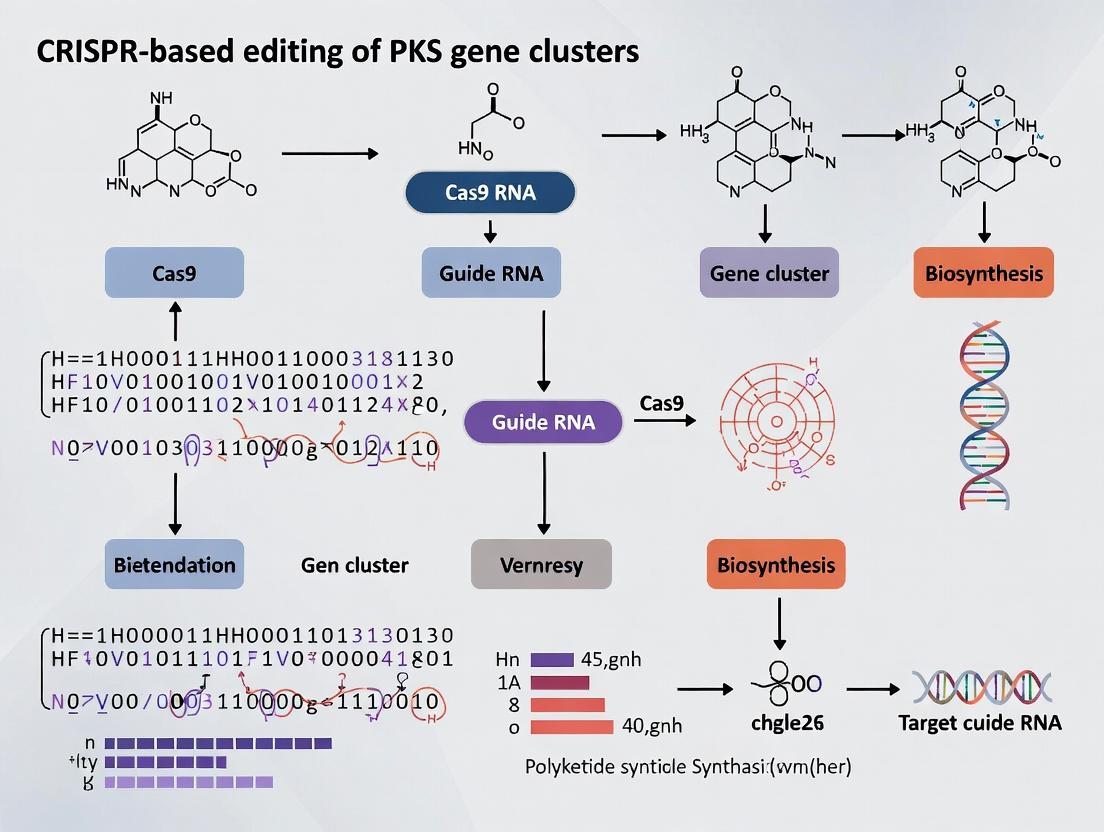
This article provides a comprehensive guide for researchers, scientists, and drug development professionals on utilizing CRISPR-Cas systems to edit polyketide synthase (PKS) gene clusters.
Harnessing CRISPR: A Guide to Editing PKS Gene Clusters for Next-Gen Drug Discovery
Abstract
This article provides a comprehensive guide for researchers, scientists, and drug development professionals on utilizing CRISPR-Cas systems to edit polyketide synthase (PKS) gene clusters. It covers the foundational biology of PKS pathways, details cutting-edge methodologies for precise genetic manipulation, addresses common troubleshooting and optimization challenges, and explores rigorous validation and comparative analysis techniques. The goal is to empower the targeted audience to effectively reprogram these microbial factories to produce novel bioactive compounds with therapeutic potential.
PKS Gene Clusters 101: Understanding Nature's Chemical Factories for CRISPR Targeting
Application Notes: CRISPR-based Editing of PKS Gene Clusters
Polyketide synthases (PKSs) are large, modular enzymatic assembly lines that produce polyketides, a class of structurally diverse natural products with immense pharmaceutical value (e.g., antibiotics, antifungals, anticancer agents). Recent advances in CRISPR-Cas systems have revolutionized the ability to precisely engineer these complex multi-gene clusters for rational drug design and yield optimization.
Key Applications in Research & Development:
- Pathway Refactoring: Replacing native promoters in PKS clusters with synthetic, tunable promoters to decouple production from complex native regulation and increase titers in heterologous hosts like Streptomyces coelicolor or Saccharomyces cerevisiae.
- Module Swapping & Engineering: Using CRISPR-Cas9 coupled with recombineering to replace specific acyltransferase (AT) or ketoreductase (KR) domains within a PKS module, altering the extender unit or redox state to generate novel "unnatural" natural products.
- Cluster Activation & Discovery: Activating cryptic or silent PKS gene clusters in microbial genomes by editing repressor genes or inserting strong promoters upstream of the cluster, enabling the discovery of new compounds.
- Deletion of Competing Pathways: Knocking out genes for competing secondary metabolite pathways in a production host to redirect metabolic flux toward the target polyketide.
Current Quantitative Landscape (2023-2024): Recent studies highlight the efficiency and impact of CRISPR-based PKS engineering.
Table 1: Efficacy Metrics for CRISPR-Editing of PKS Clusters
| Editing Goal | Host Organism | CRISPR System | Average Efficiency | Max Titer Improvement | Key Reference (Year) |
|---|---|---|---|---|---|
| Promoter Replacement | S. avermitilis | Cas9 + λ-Red | 85-95% | 8.5-fold | Zhang et al. (2023) |
| AT Domain Swapping | S. albus | Cas12a (Cpfl) | 60-75% | Novel compound | Volz & Bernhardt (2024) |
| Full Module Exchange | S. coelicolor | Cas9 + HR | 40-55% | 3.2-fold of variant | Lee & Kim (2023) |
| Silent Cluster Activation | Pseudomonas sp. | dCas9-SoxS | N/A (transcriptional) | 120 mg/L new product | Costa & Müller (2024) |
| Competing Pathway KO | Aspergillus nidulans | Cas9 + NHEJ | >90% | 4-fold flux increase | Patel et al. (2023) |
Detailed Experimental Protocols
Protocol 2.1: CRISPR-Cas9 Mediated Promoter Replacement in a Type I PKS Cluster
Objective: To replace the native promoter of a target PKS gene with a constitutive synthetic promoter (e.g., PermE) in a Streptomyces host.
Materials & Reagents: See "The Scientist's Toolkit" below.
Method:
- gRNA Design & Donor Construction:
- Design a 20-nt gRNA sequence targeting a non-coding region 0-100 bp upstream of the PKS gene start codon using a validated design tool (e.g., CHOPCHOP).
- Synthesize the gRNA oligonucleotide and clone into a Streptomyces CRISPR-Cas9 plasmid (e.g., pCRISPomyces-2).
- PCR-amplify the synthetic promoter PermE with ~500 bp homology arms (HA) flanking the target site. This is the donor DNA.
Transformation & Selection:
- Transform the E. coli donor strain (e.g., ET12567/pUZ8002) with the CRISPR plasmid via heat shock.
- Perform intergeneric conjugation between the donor E. coli and the Streptomyces sp. recipient. Plate on selective agar containing apramycin (for plasmid) and nalidixic acid (to counter-select E. coli).
- Incubate at 30°C for 5-7 days until exconjugant colonies appear.
Screening & Curing:
- Patch exconjugants onto selective agar with and without a Cas9 inducer (e.g., anhydrotetracycline). Colonies that grow only in the presence of the inducer are potential edited strains, as ongoing Cas9 expression is lethal without repair.
- Isolate genomic DNA from potential mutants. Verify promoter replacement via PCR using one primer binding within the new promoter and one binding outside the homology arm.
- Sequence the PCR product to confirm precise integration.
- Streak verified mutants on non-selective media for several rounds to cure the CRISPR plasmid.
Fermentation & Analysis:
- Inoculate validated mutant and wild-type control into liquid production media.
- After 5-10 days, extract metabolites and analyze polyketide production via HPLC-MS.
Protocol 2.2: Cas12a-mediated Multigene Deletion for Metabolic Flux Optimization
Objective: To delete a competing secondary metabolite gene cluster (e.g., a non-essential siderophore cluster) to increase precursor availability for the target PKS.
Method:
- Multiplex gRNA Array Construction:
- Design two gRNAs targeting sequences at the 5' and 3' ends of the cluster to be deleted.
- Clone the direct repeat (DR)-flanked gRNA array into a Cas12a (Cpfl)-expression plasmid suitable for the host (e.g., derived from pCRISPR-Cpfl).
- Transformation & Double-Strand Break Induction:
- Introduce the plasmid into the production host via standard transformation.
- Induce Cas12a expression to generate two double-strand breaks, excising the entire intervening cluster.
- Repair & Screening:
- The host's error-prone non-homologous end joining (NHEJ) repair will ligate the ends, resulting in a deletion.
- Screen colonies by multiplex PCR using primers outside the deletion boundaries and internal to the deleted cluster. Successful deletion yields a smaller product and no internal product.
- Phenotypic Validation:
- Quantify intracellular malonyl-CoA and methylmalonyl-CoA levels in deletion mutants vs. wild-type using LC-MS/MS to demonstrate increased precursor pool.
- Measure target polyketide yield.
Visualizations
Title: CRISPR-Cas9 Homology-Directed Editing of a PKS Gene
Title: Basic Catalytic Cycle of a Single PKS Extension Module
The Scientist's Toolkit
Table 2: Essential Reagents for CRISPR-PKS Engineering
| Item Name | Function & Application | Example/Supplier |
|---|---|---|
| pCRISPomyces-2 Plasmid | All-in-one Streptomyces CRISPR-Cas9 vector with gRNA scaffold and temperature-sensitive origin. | Addgene #61737 |
| Cas12a (Cpfl) Expression Vector | Plasmid for CRISPR-Cpfl editing, useful for multiplexing with simpler gRNA design. | Custom or Addgene #69974 |
| λ-Red Recombinase System | Enables efficient generation of homology donors in E. coli for recombineering. | Takara Bio |
| Anhydrotetracycline (aTc) | Inducer for TetR-regulated Cas9 expression in many CRISPR plasmids. | Sigma-Aldrich |
| Maltose Extract Peptone (MEP) Media | Optimized conjugation media for intergeneric E. coli-Streptomyces mating. | Lab formulation |
| Apramycin Sulfate | Antibiotic for selection of plasmids in most Actinobacteria. | GoldBio |
| Nalidixic Acid | Counterselection agent against donor E. coli during conjugation. | Sigma-Aldrich |
| HiFi DNA Assembly Master Mix | For seamless assembly of multiple DNA fragments (e.g., gRNAs, homology arms). | NEB |
| MycoTool DNA Extraction Kit | Optimized for genomic DNA isolation from high-GC, mycelial microorganisms. | MP Biomedicals |
| Polyketide LC-MS Standard Mix | Reference compounds (e.g., erythromycin, rapamycin analogs) for HPLC-MS calibration. | Santa Cruz Biotech |
Polyketide synthases (PKSs) are mega-enzymes responsible for the biosynthesis of structurally diverse and pharmaceutically vital natural products, including antibiotics (erythromycin), antifungals (amphotericin), and anticancer agents (epothilone). Their biosynthesis follows an assembly-line logic, where gene clusters encode coordinated sets of enzymatic domains and modules. Understanding this hierarchical architecture—from cluster organization to module sequence and domain function—is the critical foundation for genome mining and pathway engineering. Within the broader thesis of CRISPR-based editing of PKS gene clusters, precise architectural knowledge dictates target selection. CRISPR tools (e.g., Cas9, base editors, multiplexed guide RNAs) are deployed to delete, insert, or refactor modules/domains, alter substrate specificity, byload docking domains, or reactivate silent clusters, enabling rational reprogramming of polyketide biosynthesis for novel drug development.
Hierarchical Architecture of PKS Systems
PKSs are classified primarily into Types I, II, and III. Type I PKSs, which are modular and most relevant for engineering, are the focus here.
Table 1: Hierarchical Levels of Type I Modular PKS Architecture
| Architectural Level | Definition & Function | Key Components | Quantitative Example (6-Deoxyerythronolide B Synthase, DEBS) |
|---|---|---|---|
| Gene Cluster | The complete set of co-localized genes required for polyketide biosynthesis, including PKS genes, tailoring enzymes, regulators, and resistance genes. | Structural genes, regulatory ORFs, transporters. | ~56 kb erythromycin cluster (Saccharopolyspora erythraea); 3 large PKS genes (eryAI, eryAII, eryAIII) + 19 other genes. |
| Gene | A single open reading frame encoding one or more PKS modules. | DNA sequence transcribed into mRNA. | eryAI gene: ~9.7 kb, encodes modules 1 and 2. |
| Module | A functional unit within a PKS protein responsible for one cycle of chain elongation and β-keto processing. The core unit for assembly-line logic. | Catalytic domains for condensation and processing. | DEBS has 6 modules (M1-M6) to build the 6-membered lactone core. Each module ~3-5 kb of DNA. |
| Domain | The fundamental catalytic unit within a module. Each domain performs a specific biochemical step. | KS, AT, ACP, KR, DH, ER, TE. | Module 1 of DEBS: KS, AT, ACP. Module 4: KS, AT, DH, KR, ACP. |
| Linker/DD | Docking domains (N- and C-terminal) or inter-domain linkers that mediate protein-protein interactions and ensure vectorial substrate channeling. | N-Terminal DD, C-Terminal DD. | ~100-150 amino acid regions at ends of multi-enzyme subunits. |
Core Catalytic Domains: Function and Logic
The sequence and combination of domains within a module determine the structural contribution of each elongation cycle.
Table 2: Essential PKS Catalytic Domains and Functions
| Domain | Abbr. | Primary Function | Key Conserved Motif/Feature | Engineering Target via CRISPR |
|---|---|---|---|---|
| Ketosynthase | KS | Catalyzes decarboxylative Claisen condensation between the growing chain and the incoming extender unit. | Active site Cys residue (e.g., GxCS). | Swap to alter chain length logic; knockout to truncate product. |
| Acyltransferase | AT | Selects and loads the specific extender unit (e.g., malonyl-CoA, methylmalonyl-CoA) onto the ACP. | Signature sequence (e.g., GHSxG). | CRISPR-mediated point mutation to change substrate specificity (e.g., malonyl to methylmalonyl). |
| Acyl Carrier Protein | ACP | Carries the growing polyketide chain and extender units via a phosphopantetheine (PPant) arm. | Ser residue for PPant attachment (LGGxS). | Essential; editing nearby linkers can affect transfer efficiency. |
| Ketoreductase | KR | Reduces the β-keto group to a β-hydroxy group. | NADPH-binding motif. | Inactivation to produce a keto group; swapping to alter stereochemistry. |
| Dehydratase | DH | Dehydrates the β-hydroxy group to form an α,β-alkene. | His-Asp catalytic dyad. | Deletion to retain hydroxyl group. |
| Enoylreductase | ER | Reduces the α,β-alkene to a fully saturated methylene. | NADPH and FAD binding sites. | Deletion to retain a double bond. |
| Thioesterase | TE | Releases the full-length polyketide chain from the PKS, often via cyclization or hydrolysis. | Catalytic triad (Ser, His, Asp). | Replacement with alternative releasing domains (e.g., reductase). |
Protocol: CRISPR-Cas9 Mediated Module Swapping in a Type I PKS Gene Cluster
This protocol outlines the steps to replace a specific module within a bacterial PKS gene cluster using homologous recombination (HR) facilitated by CRISPR-Cas9 counterselection.
Aim: To swap Module 3 (M3) in the DEBS-like gene cluster in Streptomyces coelicolor with a heterologous module from another PKS.
I. Materials & Reagents (The Scientist's Toolkit) Table 3: Key Research Reagent Solutions
| Item | Function/Description |
|---|---|
| pCRISPR-Cas9-ts (Temperature-sensitive) | Streptomyces-E. coli shuttle vector with Cas9, gRNA scaffold, and oriT for conjugation. Allows counterselection at permissive temperature. |
| HR Donor DNA Fragment | Linear dsDNA containing the heterologous module, flanked by ~1.5 kb homology arms matching sequences upstream of M3 and downstream of M3. Synthesized in vitro or via PCR assembly. |
| Chloramphenicol & Apramycin | Antibiotics for selection of the integrated donor DNA and the pCRISPR plasmid, respectively. |
| S. coelicolor ΔM3 Competent Cells | Strain with a pre-deleted M3 (or wild-type if performing a direct swap). Facilitates HR. |
| Tris-Glycine-SDS Buffer | For polyacrylamide gel electrophoresis (PAGE) analysis of PKS mega-proteins post-editing. |
| PCR Reagents & Primers | For verification of correct integration (junction PCR) and sequencing. |
| Luxol Rapid-Growth Media | Specialized Streptomyces sporulation and fermentation medium for polyketide production analysis. |
II. Experimental Procedure Day 1-3: Vector Construction & Donor Preparation
- Design gRNA: Identify a 20-nt protospacer adjacent motif (PAM: NGG) sequence within the KS or AT domain of the target M3. Design oligonucleotides and clone into the BsaI site of pCRISPR-Cas9-ts.
- Prepare HR Donor: Assemble the heterologous module sequence with 1.5 kb flanking homology arms via Gibson Assembly or long-range PCR. Purify the linear fragment.
- Transform: Introduce the constructed pCRISPR-Cas9-ts plasmid into E. coli ET12567/pUZ8002 for conjugation.
Day 4: Conjugation into Streptomyces
- Grow the E. coli donor and S. coelicolor ΔM3 recipient to late-log phase.
- Mix cells, pellet, and resuspend in LB. Plate onto MS agar with 10 mM MgCl₂. Incubate at 30°C for 16-20 hours.
- Overlay with apramycin (50 µg/mL) + nalidixic acid (25 µg/mL). Incubate for 3-5 days until exconjugant colonies appear.
Day 9-12: Selection & Curing
- Pick exconjugants and restreak on apramycin plates. Incubate at 30°C (permissive for plasmid replication).
- Screen colonies by PCR for successful integration of the donor DNA.
- For plasmid curing, take a positive colony and grow at 37°C (non-permissive temperature) without antibiotic selection for several rounds of sporulation. Patch colonies to screen for apramycin-sensitive (plasmid-cured) isolates.
Day 13-20: Verification & Analysis
- Perform junction PCR and Sanger sequencing across both recombination junctions to confirm precise module swap.
- Analyze the edited strain by:
- Southern Blot: Confirm single-copy integration.
- Protein Gel (SDS-PAGE): Check for production of full-length, correctly sized PKS protein.
- LC-MS/MS: Ferment in Luxol medium and analyze extracts for the predicted novel polyketide.
Visualization: CRISPR-Based PKS Engineering Workflow & Domain Logic
Diagram 1: Workflow for CRISPR-Cas9 Module Swapping
Diagram 2: Domain Organization and Logic in a Type I PKS Module
Why Edit PKS Clusters? Goals in Drug Discovery and Synthetic Biology
Polyketide synthases (PKSs) are multi-domain enzymatic assembly lines responsible for producing a vast array of structurally complex natural products with potent biological activities. Within the broader thesis on CRISPR-based editing of PKS gene clusters, this application note details the rationale and methodologies for such engineering. The primary goals are threefold: (1) to rationally diversify polyketide scaffolds for novel drug leads, (2) to optimize titers for economically viable production, and (3) to elucidate fundamental structure-activity relationships (SAR) to guide synthetic biology efforts.
Table 1: Primary Goals and Outcomes of PKS Cluster Editing
| Goal | Target | Typical Editing Approach | Reported Yield/Outcome Increase | Key Reference (Example) |
|---|---|---|---|---|
| Novel Analog Generation | Module/ Domain Swapping | CRISPR/Cas9 + HR | 15-40 mg/L of novel compound | Zhang et al., 2023 |
| Titer Improvement | Promoter/ Regulatory Gene | CRISPRa/i, Promoter Swap | 2.5 to 8-fold yield increase | Thong et al., 2024 |
| Pathway Elucidation | Gene Knockout | CRISPR/Cas9 Knockout | N/A (Functional data) | Chen & Gao, 2023 |
| Precursor Diversion | Starter/ Extender Module | AT Domain Engineering | Production of >12 new analogs | Lee et al., 2022 |
| Cluster Refactoring | Native Regulation Removal | Complete in vitro reassembly | 50-fold improvement in heterologous host | Wang et al., 2023 |
Experimental Protocols
Protocol: CRISPR-Cas9 Mediated Domain Replacement in a Type I PKS Module
Objective: To replace an acyltransferase (AT) domain within a modular PKS gene to alter extender unit incorporation.
Materials:
- Strains: Streptomyces coelicolor host containing target PKS cluster.
- Plasmids: pCRISPomyces-2 vector (Cas9, sgRNA, and homology-directed repair template).
- Reagents: apramycin, thiostrepton, PCR reagents, Gibson Assembly mix, T4 DNA ligase.
Procedure:
- sgRNA Design: Design a 20-nt spacer sequence targeting the region immediately upstream/downstream of the AT domain coding sequence. Clone into pCRISPomyces-2 via BsaI site.
- HDR Template Construction: Synthesize a linear dsDNA fragment containing: (i) 1 kb upstream homology arm, (ii) the new AT domain coding sequence, (iii) 1 kb downstream homology arm. Assemble into the sgRNA-containing plasmid.
- Transformation: Introduce the final plasmid into the Streptomyces host via intergeneric conjugation from E. coli ET12567/pUZ8002.
- Selection & Screening: Select exconjugants on apramycin (plasmid) and thiostrepton (genomic integration). Screen for double-crossover events via apramycin sensitivity and PCR verification.
- Fermentation & Analysis: Cultivate positive mutants and analyze metabolite profiles using LC-MS.
Protocol: CRISPRi-Mediated Knockdown for Titer Enhancement
Objective: To repress a competing metabolic pathway gene to increase precursor flux towards polyketide biosynthesis.
Procedure:
- dCas9/sgRNA Expression: Clone sgRNA targeting the promoter or coding region of the competing gene (e.g., a fatty acid synthase) into a vector expressing dCas9 (e.g., pCRISPRi).
- Integration: Integrate the plasmid at a neutral phage attachment site (attB) in the production host.
- Induction: Induce dCas9/sgRNA expression with anhydrotetracycline (aTc) at the onset of production phase.
- Quantification: Measure target polyketide titer via HPLC against a standard curve. Compare to non-induced control.
Diagrams
Title: Primary Goals of PKS Cluster Editing
Title: CRISPR-Based PKS Editing Workflow
The Scientist's Toolkit: Research Reagent Solutions
Table 2: Essential Reagents for CRISPR-based PKS Engineering
| Reagent/Tool | Function/Description | Example Product/Supplier |
|---|---|---|
| CRISPR-Cas9 System for Actinomycetes | Plasmid vectors for sgRNA expression, Cas9/dCas9, and homologous recombination in high-GC hosts. | pCRISPomyces-2, pCRISPRi plasmids (Addgene) |
| Gibson Assembly Master Mix | Enzymatic assembly of multiple DNA fragments for seamless construct building (HDR templates, vector backbones). | NEBuilder HiFi DNA Assembly (NEB) |
| Intergeneric Conjugation Donor E. coli | E. coli strain optimized for transferring plasmids into recalcitrant Streptomyces and other actinomycetes. | ET12567/pUZ8002 |
| Actinomycete-Specific Antibiotics | Selective agents for plasmid/maintenance and genomic integration screening in GC-rich bacteria. | Apramycin, Thiostrepton, Nalidixic acid |
| LC-MS/MS System | High-resolution analysis of polyketide production profiles, titer quantification, and novel analog identification. | Agilent 6546 Q-TOF, Thermo Orbitrap |
| Genome Mining Software | In silico identification and analysis of PKS cluster architecture, domain boundaries, and potential editing sites. | antiSMASH, PRISM |
| Specialized Media | Supports robust growth and secondary metabolite production in actinobacterial hosts. | R5, SFM, TSB media |
Within the broader thesis on engineering polyketide synthase (PKS) gene clusters for novel drug discovery, the need for large, complex genomic edits is paramount. PKS clusters are often >50 kb, containing repetitive sequences and complex regulatory elements. Traditional CRISPR-Cas9 systems are limited by double-strand break (DSB) toxicity and low homologous recombination efficiency for such large-scale manipulations. This primer details advanced CRISPR-Cas mechanisms—specifically Cas9 nickases, Cas12a, and CRISPR-associated transposases—that enable precise, multiplexed, and large-fragment edits suitable for PKS engineering.
Key CRISPR Systems for Large-Scale Editing: Quantitative Comparison
Table 1: Comparison of CRISPR Systems for Large Genomic Edits in PKS Clusters
| System & Mechanism | Primary Editor | PAM Requirement | Cleavage Type | Typical Insert Size Limit | Key Advantage for PKS Clusters | Major Limitation |
|---|---|---|---|---|---|---|
| Dual nickase (Cas9-D10A) | Pair of Cas9n proteins | NGG (SpCas9) | Two staggered single-strand breaks (nicks) | >10 kb | Reduces off-target & DSB toxicity; high fidelity for large HR. | Requires two guides; lower efficiency than DSB. |
| Cas12a (Cpf1) | AsCas12a or LbCas12a | T-rich (TTTV) | Staggered DSB far from PAM | ~2-3 kb | Self-processing crRNA array for multiplexing; no tracrRNA needed. | Lower raw cutting efficiency in some hosts. |
| CRISPR-associated Transposase (CAST) | Cascade + Tn7-like transposon | Varies (Cas-dependent) | No cleavage; RNA-guided transposition | >10 kb | Precise, large insertions without DSB or donor template. | Limited to insertion; low cargo size flexibility. |
| Prime Editing | Cas9-reverse transcriptase fusion | NGG (SpCas9) | Nick + reverse transcription | ~100 bp | Precise point mutations & small indels without DSB or donor. | Very low efficiency for very large edits. |
| CRISPRa/i (dCas9) | Catalytically dead Cas9 fused to effector | NGG (SpCas9) | No cleavage; transcriptional modulation | N/A | Activates/silences entire PKS clusters for metabolic flux studies. | Epigenetic; no permanent sequence change. |
Detailed Protocols
Protocol 3.1: Multiplexed Gene Cluster Inactivation via Cas12a crRNA Array
Aim: Simultaneously knock out multiple genes within a 30 kb Type I PKS cluster in Streptomyces coelicolor.
Materials:
- AsCas12a expression plasmid (Addgene #69982)
- crRNA Array Cloning Kit (Synthetic gBlocks, Golden Gate Assembly)
- Streptomyces conjugation-proficient E. coli ET12567/pUZ8002
- Apramycin and thiostrepton antibiotics.
Procedure:
- Design crRNA Array: Design four 23-nt spacers targeting essential domains (KS, AT, KR, ACP) within the target PKS gene. Order as a single gBlock with direct repeats (DRs) for AsCas12a flanking each spacer.
- Clone Array: Assemble the gBlock into the Cas12a expression plasmid (Golden Gate, BsaI-HFv2). Transform into E. coli DH5α, select with apramycin. Sequence-verify the array.
- Conjugative Transfer: Introduce the plasmid into E. coli ET12567/pUZ8002. Co-cultivate with S. coelicolor spores on MS agar. Overlay with apramycin (50 µg/mL) + nalidixic acid (25 µg/mL). Incubate at 30°C for 7-10 days.
- Screening: Pick exconjugants. Re-streak on selective plates. Validate large deletions via long-range PCR (PrimeSTAR GXL) and phenotypic assay (loss of pigment).
Protocol 3.2: Large-Fragment Replacement using Paired Cas9 Nickases
Aim: Replace a 15 kb segment of a PKS loading module with a heterologous module via homology-directed repair (HDR).
Materials:
- Cas9-D10A nickase (Cas9n) expression plasmid.
- Two sgRNA plasmids (targeting opposite strands, 50-100 bp apart).
- Linear dsDNA donor fragment (15 kb insert + 1 kb homology arms on each side, Gibson assembled).
- Nucleofector (for fungal/prokaryotic delivery).
Procedure:
- Design Nick Sites: Design two sgRNAs with 5'-NGG PAMs on opposite strands, 50-100 bp apart, flanking the region to be replaced.
- Prepare Donor: Generate the donor fragment via Gibson Assembly of the new module with homology arms amplified from the target locus. Purify using agarose gel electrophoresis + Zymoclean Gel DNA Recovery Kit.
- Co-delivery: For Aspergillus nidulans, co-nucleofect 5 µg Cas9n plasmid, 2.5 µg of each sgRNA plasmid, and 10 µg of linear donor DNA into protoplasts.
- Selection & Validation: Recover on selective media. Screen survivors via colony PCR with junction primers. Confirm correct 15 kb swap via PacBio long-read sequencing of the entire locus.
Diagrams
Diagram Title: Decision Workflow for CRISPR System Selection in PKS Editing
Diagram Title: CRISPR-Associated Transposase (CAST) Mechanism for Large Insertions
The Scientist's Toolkit: Research Reagent Solutions
Table 2: Essential Reagents for CRISPR Editing of Large PKS Clusters
| Reagent / Solution | Supplier Example | Function in PKS Cluster Editing | Critical Note |
|---|---|---|---|
| High-Fidelity Cas9/Cas12a Expression Plasmid | Addgene (e.g., #62933, #69982) | Provides nuclease/dnickase under inducible promoter for controlled expression. | Use shuttle vectors with appropriate replicons for your host (e.g., Streptomyces, fungi). |
| Chemically-Competent E. coli ET12567/pUZ8002 | Lab-constructed or commercial (e.g., BioVector) | Methylation-deficient donor strain for conjugative transfer of CRISPR plasmids into actinomycetes. | Essential for overcoming restriction-modification barriers in wild Streptomyces. |
| Gibson Assembly Master Mix | NEB (E2611S) / Thermo Fisher | Seamless assembly of large (>10 kb) donor DNA fragments with long homology arms. | Preferred over traditional restriction cloning for large, complex constructs. |
| Long-Range PCR Kit (PrimeSTAR GXL) | Takara Bio | Amplifies 10-30 kb products for screening large deletions/insertions in PKS clusters. | Higher fidelity and success rate than standard Taq for GC-rich sequences. |
| PacBio HiFi Sequencing Service | PacBio (Sequel IIe system) | Gold standard for validating complete sequence of edited, repetitive PKS clusters. | Provides complete haplotype resolution; expensive but necessary for final validation. |
| Rapid DNA Damage Assay Kit (γ-H2AX) | Abcam (ab206461) | Monitors DSB toxicity during editing; verifies cleaner repair from nickase systems. | Useful for optimizing delivery to minimize cell death in precious hosts. |
Application Notes
The successful CRISPR-based engineering of polyketide synthase (PKS) gene clusters for novel bioactive compound production hinges on two foundational strategic choices: the selection of an appropriate host organism and a suitable PKS target cluster. These decisions must align with the ultimate goal—efficient heterologous expression, genetic tractability, and scalable compound yield.
Host Organism Selection: The ideal host provides a permissive physiological background for PKS expression and precursor supply, combined with robust genetic tools for large-cluster manipulation. Native producers (e.g., Streptomyces) offer a natural enzymatic environment but can be slow-growing and genetically recalcitrant. Heterologous hosts (e.g., E. coli, S. cerevisiae, B. subtilis) offer faster growth, superior genetic tools, and simplified fermentation, but may lack essential post-translational modifications or cofactors.
PKS Target Selection: The target PKS cluster should be chosen based on genetic stability, known product activity, and compatibility with the chosen host. Factors include cluster size (which impacts cloning and editing efficiency), the presence of positive regulatory elements, and the complexity of post-PKS tailoring steps required for bioactive compound maturation.
CRISPR Integration: The chosen CRISPR system (e.g., Cas9, Cas12a) must be optimized for the host's GC content and have proven efficacy for large, repetitive genomic edits. Delivery methods (conjugation, transformation) and editing templates (linear dsDNA, CRISPR-associated recombinering) are host-dependent.
Table 1: Comparison of Common Host Organisms for PKS Engineering
| Host Organism | Typical Growth Rate (Doubling Time) | Max. Cluster Insert Size (kb) | Established CRISPR Tools? | Key Advantages | Key Limitations |
|---|---|---|---|---|---|
| Streptomyces coelicolor | 2-3 hours | >100 kb | Yes (pCRISPR-Cas9) | Native PKS host; supports complex modifications | Slow growth; complex morphology |
| Escherichia coli (BAP1) | 20-30 minutes | ~80 kb | Yes (λ-Red + Cas9) | Fast growth; excellent genetics; high titer potential | Lack of native PTMs; potential toxicity |
| Saccharomyces cerevisiae (CEN.PK2) | ~90 minutes | ~50 kb | Yes (CRISPR/Cas9) | Eukaryotic PTMs; compartmentalization; easy DNA assembly | Lower yield; plasmid instability for large clusters |
| Bacillus subtilis (168) | ~30 minutes | ~50 kb | Yes (CRISPR/Cas9n) | Generally Recognized As Safe (GRAS); efficient secretion | Less developed for very large PKS clusters |
Table 2: Key Metrics for Evaluating PKS Target Clusters
| Metric | Ideal Range for Initial Engineering | Rationale |
|---|---|---|
| Cluster Size | 20 - 60 kb | Balances chemical complexity with manageable genetic manipulation. |
| GC Content | Similar to host organism | Facilitates heterologous expression and homologous recombination. |
| Number of Editing Sites (Modules/DRs) | Low to Moderate (<10 key sites) | Reduces risk of off-target effects and simplifies multiplex editing strategies. |
| Known Precursor Requirements | Simple (e.g., Malonyl-CoA, Methylmalonyl-CoA) | Avoids need to engineer complex precursor pathways in heterologous host. |
| Characterized Regulatory Gene | Present, inducible | Enables controlled expression to avoid host burden/toxic intermediates. |
Experimental Protocols
Protocol 1: CRISPR-Cas9 Mediated Multiplex Deletion of a PKS Tailoring Gene Region inStreptomyces
Objective: To simultaneously disrupt two cytochrome P450 genes (cypA, cypB) within a target PKS cluster in S. coelicolor to alter compound hydroxylation.
Materials: See "The Scientist's Toolkit" below.
Method:
- sgRNA Design & Plasmid Construction:
- Design two 20-nt spacer sequences targeting unique regions within cypA and cypB using a validated design tool (e.g., CHOPCHOP). Ensure minimal off-targets via BLAST against the host genome.
- Clone each spacer into the pCRISPR-Cas9 plasmid under separate, constitutive promoters via Golden Gate assembly.
- Editing Template Construction:
- Synthesize a linear dsDNA editing template containing 1 kb homology arms upstream of cypA and downstream of cypB, flanking a selectable marker (e.g., aac(3)IV apramycin resistance gene).
- Transformation & Selection:
- Introduce the pCRISPR-Cas9 plasmid and the linear editing template into S. coelicolor via protoplast transformation.
- Plate on media containing apramycin (for integration selection) and thiostrepton (for plasmid maintenance). Incubate at 30°C for 5-7 days.
- Screening & Curing:
- Screen apramycin-resistant, thiostrepton-resistant colonies by PCR across the homology arms to confirm correct double-crossover replacement.
- Pass positive clones through 3 rounds of growth in the absence of thiostrepton to cure the pCRISPR-Cas9 plasmid. Verify plasmid loss by patching onto thiostrepton plates.
- Verification:
- Perform final diagnostic PCR and Sanger sequencing of the edited locus. Analyze metabolite profile via LC-MS compared to wild-type.
Protocol 2: Cas12a-assisted Recombineering for PKS Module Swapping inE. coli
Objective: To replace a single module in a Type I PKS expressed in E. coli BAP1 using CRISPR-Cas12a for counter-selection.
Method:
- Donor DNA Preparation:
- Amplify the donor DNA fragment (the new PKS module) with 500 bp homology arms identical to the sequences flanking the target module.
- Cas12a-crRNA Ribonucleoprotein (RNP) Complex Formation:
- Design a crRNA targeting the sequence to be replaced within the chromosomal PKS cluster.
- In vitro, complex purified LbCas12a protein with the synthesized crRNA to form the RNP.
- Electroporation:
- Induce the λ-Red recombinase proteins (Gam, Bet, Exo) in the E. coli BAP1 strain harboring the PKS cluster.
- Electroporate a mixture of the donor DNA (100-200 ng) and the RNP complex (5 pmol Cas12a, 10 pmol crRNA) into the induced, electrocompetent cells.
- Recovery & Screening:
- Recover cells in SOC medium for 2 hours at 30°C.
- Plate on LB agar and incubate overnight at 30°C.
- Screen colonies by colony PCR using primers outside the homology region. Cas12a cleavage provides counter-selection against unedited cells, enriching the pool.
- Validation:
- Sequence the swapped module. Analyze protein expression via SDS-PAGE and product intermediate via LC-MS/MS.
Diagrams
Diagram 1: Strategic Decision Pathway for Host & Target Selection
Diagram 2: CRISPR-Cas9 Workflow for Streptomyces Editing
The Scientist's Toolkit: Essential Research Reagents
| Item | Function & Application |
|---|---|
| pCRISPR-Cas9 (tsr, oriT) | Streptomyces shuttle vector with temperature-sensitive origin, carries Cas9 and sgRNA scaffold for targeted DSB creation. |
| λ-Red Plasmid (pKD46, pSC101 ori, araBAD) | E. coli plasmid expressing Gam, Bet, Exo recombinases under arabinose control for promoting homologous recombination. |
| LbCas12a (Cpf1) Protein | Purified Lachnospiraceae bacterium Cas12a nuclease for in vitro RNP complex formation; creates staggered DSBs with T-rich PAM. |
| aac(3)IV (aprR) Cassette | Apramycin resistance gene; a selectable marker for stable integration in actinomycetes and some gram-negative bacteria. |
| Gibson Assembly Master Mix | Enzyme mix for seamless assembly of multiple DNA fragments (e.g., building editing templates or cloning large constructs). |
| Mycelium Protoplasting Solution | Contains lysozyme and osmotic stabilizers for generating Streptomyces protoplasts competent for transformation. |
| NEB Stable Competent E. coli | E. coli strain optimized for stable maintenance of large, repetitive, or toxic DNA constructs such as PKS clusters. |
| Synthrophic Medium (e.g., ISP2) | Rich medium for cultivating Streptomyces and supporting optimal polyketide production during small-scale analysis. |
CRISPR Toolkit for PKS Engineering: Step-by-Step Protocols and Application Workflows
This application note is situated within the broader thesis of CRISPR-Cas mediated genome editing for the precise engineering of Polyketide Synthase (PKS) gene clusters. These massive, repetitive, and highly similar sequences present a formidable challenge for targeted genetic manipulation. The design of highly specific and efficient guide RNAs (gRNAs) is the critical first step for successful editing, enabling gene knockouts, domain swaps, and combinatorial biosynthesis to generate novel bioactive compounds for drug development.
Key Design Parameters for PKS gRNAs
When targeting large, repetitive PKS sequences, standard gRNA design rules are insufficient. The following parameters are paramount.
| Parameter | Target Value / Consideration | Rationale for PKS Context |
|---|---|---|
| Specificity (Off-target risk) | Minimum 3-4 mismatches to any other genomic locus. | Prevents unintended cleavage of homologous acyltransferase (AT), ketosynthase (KS), or acyl carrier protein (ACP) domains across the cluster or genome. |
| On-target Efficiency | High CFD or Doench '16 score. | Ensures robust Cas9 binding and cleavage despite potentially complex DNA secondary structures. |
| Protospacer Adjacent Motif (PAM) | NGG for SpCas9. Consider alternative Cas proteins (e.g., SaCas9, Cpf1) for expanded PAM options. | NGG sites may be limited in GC-rich PKS clusters; alternative Cas proteins increase targetable sites. |
| gRNA Length | 20-nt standard. Consider truncated gRNAs (17-18 nt) for increased specificity. | Truncated gRNAs can reduce off-target effects while maintaining on-target activity in repetitive regions. |
| Genomic Context | Avoid regions with high DNA secondary structure or epigenetic marks. | PKS clusters are often heterochromatin-rich; accessibility influences cleavage efficiency. |
| Repetitive Element Mapping | Unique gRNA must map to a single module/domain. | Essential for precise editing of a specific module within a string of highly similar repeats. |
Essential Tools and Workflow
A multi-step, tool-assisted workflow is mandatory for successful gRNA design.
Table: Computational Tools for PKS gRNA Design
| Tool Name | Primary Function | Key Output for PKS |
|---|---|---|
| antiSMASH | Identifies and annotates PKS cluster boundaries and domains. | Genomic FASTA file of the target cluster; delineation of repetitive modules. |
| BLASTN (local) | Performs exhaustive alignment of candidate spacer sequences against the entire host genome. | List of all potential off-target sites with mismatch counts. |
| CRISPRseek, Cas-OFFinder | Genome-wide off-target search. | Quantitative off-target potential scores across the genome. |
| CRISPOR | Integrates efficiency scoring (e.g., Doench score) and off-target detection. | Ranked list of gRNAs with combined efficiency and specificity metrics. |
| UGENE or Benchling | Visual alignment of gRNAs to the cluster architecture. | Confirms physical placement of gRNA within a target domain. |
Title: Computational gRNA Design Workflow for PKS Sequences
Detailed Protocol: gRNA Design and Specificity Validation
Objective: To design and computationally validate highly specific gRNAs for a target ketosynthase (KS) domain within a repetitive Type I PKS cluster.
Materials & Reagents:
- The Scientist's Toolkit:
Item Function antiSMASH Database Provides precise annotation of PKS cluster architecture and domain coordinates. Local BLAST+ Suite Enables comprehensive, offline alignment of gRNAs against the full genome sequence to identify homologs. CRISPOR Web Tool / Script Integrates multiple on-target efficiency algorithms and off-target search engines into one report. Genome FASTA File The complete genomic sequence of the host organism (e.g., Streptomyces coelicolor). UGENE Platform Visualizes the alignment of selected gRNAs onto the graphical map of the PKS cluster.
Procedure:
- Sequence Acquisition:
- Input your organism's genome into the antiSMASH server.
- Identify your target PKS cluster. Download the GenBank file and the cluster-specific nucleotide FASTA sequence.
Initial gRNA Identification:
- Using a text editor or script, scan the target domain's sequence for all instances of the PAM sequence (e.g., "NGG" for SpCas9).
- Extract the 20-nt genomic sequence immediately 5' adjacent to each PAM. These are your candidate spacer sequences.
Rigorous Off-target Analysis:
- Create a custom BLAST database from your host's complete genome FASTA file.
- Perform a BLASTN search for each candidate 20-nt spacer against this database.
- Filtering Rule: Eliminate any spacer with a perfect match or ≤2 mismatches to any other locus in the genome. For PKS, a minimum of 3-4 mismatches in the seed region (PAM-proximal 12 bases) is strongly advised.
Efficiency Scoring:
- Input the surviving candidate spacer sequences into CRISPOR.
- CRISPOR will return efficiency scores (e.g., Doench '16 score). Prioritize gRNAs with a score >50.
Final Selection and Visualization:
- For the top 5-10 candidates from CRISPOR, use the "Custom Track" feature in UGENE.
- Load the PKS cluster GenBank file and add the gRNA sequences as an annotation track. Visually confirm the gRNA lies uniquely within your target domain and not in a conserved region shared by non-target modules.
Title: Off-target Filtering Decision Process
Experimental Validation Protocol
Title: In Vitro Validation of gRNA Specificity Using Plasmid Interference Assay.
Background: This protocol tests gRNA efficacy and specificity against repetitive PKS target sequences cloned in a plasmid-based system before committing to genomic edits.
Procedure:
- Cloning of Target Sites: Clone a ~500-bp genomic fragment containing the intended on-target PKS domain, and fragments from the 2-3 most homologous off-target domains (identified in BLAST), into separate, identical plasmid backbones containing an antibiotic resistance gene (e.g., AmpR).
- Co-transformation: Co-transform each "target plasmid" with a second plasmid expressing SpCas9 and the candidate gRNA into an E. coli strain.
- Efficiency Quantification: Plate transformations on double antibiotic selection. The functional cleavage of the target plasmid by Cas9-gRNA leads to its degradation, reducing colony count relative to a non-targeting control gRNA.
- Specificity Calculation:
- Compare colony counts for on-target vs. off-target plasmids.
- Specificity Index = (Colonies with Off-target Plasmid) / (Colonies with On-target Plasmid). A value >5-10 indicates good specificity.
Within the framework of CRISPR-based PKS engineering, meticulous gRNA design is non-negotiable. By prioritizing specificity over efficiency, leveraging a combination of bioinformatic tools for off-target minimization, and employing intermediate in vitro validation steps, researchers can overcome the challenges posed by repetitive PKS sequences. This enables precise, predictable edits to reprogram metabolic pathways for novel drug discovery.
Within the broader thesis on CRISPR-based editing of polyketide synthase (PKS) gene clusters for novel drug discovery, a critical bottleneck is the delivery of editing machinery into genetically intractable, yet biochemically valuable, microbial hosts. These hosts—often slow-growing Actinomycetes, myxobacteria, or fungi—possess complex cell envelopes, potent restriction-modification systems, and lack established genetic tools. This application note details three core delivery methods—conjugation, transformation, and transduction—tailored for such challenging hosts, providing protocols and comparative analysis to enable successful genetic intervention.
Comparative Analysis of Delivery Methods
The following table summarizes key quantitative parameters and suitability for challenging hosts.
Table 1: Comparison of Delivery Methods for Challenging Hosts
| Parameter | Conjugation | Transformation | Transduction |
|---|---|---|---|
| Primary Mechanism | Cell-to-cell plasmid transfer via Type IV secretion. | Direct DNA uptake via chemical or physical permeabilization. | Bacteriophage-mediated DNA injection. |
| Typical Efficiency (CFU/µg DNA) | 10⁻⁵ – 10⁻² (transconjugants/donor) | 0 – 10³ (for electrocompetent cells) | 10⁵ – 10⁹ PFU/ml (phage titer dependent) |
| Max Insert Size (kb) | >100 | 5-50 | ~10-15 (cosmid), ~45 (phage genomic) |
| Key Barrier Overcome | Restriction systems, cell wall permeability. | Cell wall integrity (if protoplasted). | Specific receptor recognition bypasses envelope. |
| Host Specificity | Broad (RP4-based mobilizable vectors). | Broad, but highly dependent on protocol optimization. | Narrow, requires specific phage/host pairing. |
| Time to Experiment | Days (donor growth, mating). | Hours to days (competent cell preparation). | Weeks (phage isolation/propagation). |
| Best For | Large CRISPR cargoes (e.g., Cas9 + gRNA + template) into Actinomycetes. | Rapid testing of editing constructs in amenable strains. | Efficient, high-titer delivery in hosts with known phages. |
Research Reagent Solutions
Table 2: Essential Reagents for Delivery Experiments
| Reagent/Material | Supplier Examples | Function |
|---|---|---|
| RP4 mob-containing Vector | Addgene, custom synthesis. | Provides oriT for conjugative transfer from E. coli donor. |
| Methylase-deficient E. coli (e.g., ET12567/pUZ8002) | Lab stock, commercial. | Donor strain; avoids host restriction by lacking plasmid methylation. |
| Heat-Inactivated Horse Serum | Sigma-Aldrich, Gibco. | Used in conjugation overlays to enhance cell-to-cell contact and survival. |
| Sucrose & MgCl₂ Solution | Common chemicals. | Osmotic stabilizers for protoplast generation and transformation in fungi/Actinomycetes. |
| Lysozyme & Lysostaphin | Sigma-Aldrich. | Enzymes for cell wall digestion to generate protoplasts. |
| Polyethylene Glycol (PEG) 1000/4000 | Sigma-Aldrich. | Induces membrane fusion for protoplast transformation or phage adsorption. |
| PhiC31 attP/int-containing Vector | Addgene. | Enables site-specific integration via phage integrase in Actinomycetes. |
| Broad-Host-Range Phage (e.g., TM4) | ATCC, research labs. | Transducing phage for Mycobacterium and related Actinomycetes. |
Experimental Protocols
Protocol 1: Intergeneric Conjugation for Actinomycetes
Objective: Deliver a CRISPR-Cas9 editing plasmid from E. coli into a slow-growing Streptomyces sp.
Materials:
- Donor: E. coli ET12567/pUZ8002 containing mob-enabled CRISPR plasmid.
- Recipient: Streptomyces spores or young mycelium.
- Soya Flour Mannitol (SFM) agar plates.
- LB agar with appropriate antibiotics.
- Nalidixic acid (stock).
- Apatite (optional, to induce sporulation).
Method:
- Donor Preparation: Grow donor E. coli in LB with antibiotics (e.g., kanamycin, chloramphenicol) to mid-log phase (OD₆₀₀ ~0.4-0.6). Wash 2x with LB to remove antibiotics.
- Recipient Preparation: Harvest Streptomyces spores or young mycelium. Heat-shock spores at 50°C for 10 min to synchronize germination.
- Mating: Mix donor and recipient cells at a 1:1 to 10:1 ratio (vol/vol) on an SFM agar plate. Incubate at 30°C for 16-24h.
- Selection: Overlay the mating plate with 1mL sterile water containing appropriate antibiotics to select for transconjugants (e.g., apramycin) and nalidixic acid to counterselect E. coli. Distribute evenly.
- Incubation & Analysis: Incubate plates at 30°C for 5-10 days until transconjugant colonies appear. Patch colonies onto selective plates for genetic analysis (PCR, sequencing) to confirm CRISPR delivery.
Protocol 2: PEG-Mediated Protoplast Transformation for Fungi
Objective: Introduce CRISPR ribonucleoprotein (RNP) complexes into a filamentous fungus.
Materials:
- Fungal mycelium.
- Osmotic stabilizer (1.2M MgSO₄, 10mM NaPO₄, pH 5.8).
- Lysing enzymes (e.g., Glucanex, Novozyme).
- STC buffer: 1.2M sorbitol, 10mM Tris-HCl, 10mM CaCl₂, pH 7.5.
- PEG solution: 60% PEG 4000, 50mM CaCl₂, 10mM Tris-HCl, pH 7.5.
- Regeneration agar (with osmotic stabilizer).
Method:
- Protoplast Generation: Grow fungal mycelium overnight. Harvest, wash, and digest in osmotic stabilizer with 10mg/mL lysing enzymes for 3-4h at 30°C with gentle shaking.
- Protoplast Purification: Filter through sterile Miracloth, pellet protoplasts gently (1000 x g, 10 min). Wash 2x with STC buffer.
- Transformation: Aliquot 10⁷ protoplasts in 100µL STC. Add pre-assembled Cas9-gRNA RNP complex (5µg Cas9, 3µg gRNA) and 1-10µg repair template (if HDR). Incubate on ice 30min.
- PEG Fusion: Add 500µL PEG solution, mix gently, incubate at room temp for 20min.
- Regeneration: Dilute with STC, mix with molten regeneration agar (cooled to 48°C), pour onto selective regeneration plates.
- Incubation: Incubate at optimal temperature for 3-7 days. Screen regenerated colonies for edits via phenotype or molecular genotyping.
Protocol 3: Phage Transduction forMycobacteriumspp.
Objective: Deliver a CRISPR-interference (CRISPRi) construct into Mycobacterium smegmatis using phage.
Materials:
- High-titer phage stock (e.g., phage phAE159 derivative carrying CRISPRi construct).
- Log-phase M. smegmatis culture (OD₆₀₀ ~0.8-1.0).
- 7H9 broth + ADC supplement.
- MP buffer (50mM Tris-HCl pH 7.5, 150mM NaCl, 10mM MgSO₄, 2mM CaCl₂).
- 7H10 agar plates with appropriate antibiotics.
- Top agar (7H9 broth + 0.7% agar).
Method:
- Phage Preparation: Amplify and titer phage on a permissive host. Filter sterilize (0.45µm).
- Infection: Mix 100µL log-phase recipient cells with a multiplicity of infection (MOI) of 0.1-10 phage particles/cell in MP buffer. Incubate at 37°C for 4h.
- Selection: Pellet cells, resuspend in 100µL 7H9 broth, plate on selective 7H10 agar. Alternatively, mix infected cells with 5mL molten top agar and pour over a selective bottom agar plate.
- Incubation & Screening: Incubate plates at 37°C for 3-5 days. Isplicate transductants. Confirm chromosomal integration of the CRISPRi construct via PCR and downstream silencing phenotype analysis.
Visualizations
Diagram Title: Conjugation Workflow for Actinomycetes
Diagram Title: Delivery Method Decision Guide
Application Notes
The engineering of polyketide synthase (PKS) gene clusters via CRISPR-based systems is a cornerstone of modern synthetic biology for drug discovery. These editing strategies enable the rational redesign of biosynthetic pathways to produce novel polyketides with improved pharmacological properties or reduced side-effects. Within the broader thesis on CRISPR-based editing of PKS clusters, these techniques facilitate direct genotype-to-phenotype studies, allowing researchers to dissect complex assembly-line logic and reprogram chemical output.
- Gene Knockouts: Essential for functional genomics within PKS clusters, knockouts identify essential tailoring enzymes, silence competing pathways, or simplify product profiles by removing redundant modules. Recent studies show knockout efficiencies >90% in actinomycete hosts using CRISPR-Cas9 coupled with homology-directed repair (HDR) templates.
- Domain Swaps: This strategy exchanges acyltransferase (AT), ketosynthase (KS), or ketoreductase (KR) domains between modules to alter extender unit incorporation or reduction states. Success hinges on precise fusion at conserved linker regions to maintain protein folding. A 2023 study reported a 65% success rate in generating functional hybrid PKS modules.
- Module Insertions: Inserting an entire catalytic module extends the polyketide chain, increasing molecular complexity. The key challenge is maintaining correct inter-module communication (docking domain compatibility). Protocol optimization has improved correct insertion and functional expression rates from ~20% to ~50% in model systems.
- Promoter Engineering: Replacing native promoters with constitutive or inducible systems decouples PKS expression from complex native regulation, boosting titers and enabling orthogonal control. Strong synthetic promoters (e.g., ermEp*) have been shown to increase polyketide yield by 3- to 8-fold in various Streptomyces strains.
Table 1: Quantitative Comparison of CRISPR-Based PKS Editing Strategies
| Editing Strategy | Typical Editing Efficiency (%) | Key Success Factor | Primary Application in PKS Research | Reported Yield Change* |
|---|---|---|---|---|
| Gene Knockout | 90-95 | HDR template design & delivery | Functional analysis, pathway simplification | N/A (knockout) |
| Domain Swap | 60-75 | Homology arm length & linker integrity | Alter substrate specificity, redox state | Variable (-80% to +300%) |
| Module Insertion | 40-55 | Docking domain compatibility | Chain length extension, add functional groups | -90% to +150% |
| Promoter Engineering | 80-90 | Promoter strength matching host | Titre improvement, regulatory decoupling | +200% to +800% |
*Yield change refers to the production of the target novel or modified polyketide relative to wild-type or starting strain.
Experimental Protocols
Protocol 1: CRISPR-Cas9 Mediated Gene Knockout in a Type I PKS Cluster
Objective: To disrupt a specific tailoring enzyme gene (tailX) within a PKS cluster in Streptomyces coelicolor.
- gRNA Design: Design a 20-nt spacer sequence targeting an early exon of tailX using an online validator (e.g., CHOPCHOP). Clone into a Streptomyces CRISPR-Cas9 plasmid (e.g., pCRISPomyces-2).
- HDR Template Construction: Synthesize a linear DNA fragment containing >800 bp homology arms flanking a selectable marker (e.g., aac(3)IV for apramycin resistance) or a premature stop codon.
- Transformation: Introduce both the CRISPR plasmid and the HDR template into S. coelicolor via intergeneric conjugation from E. coli ET12567/pUZ8002.
- Selection & Screening: Select exconjugants on apramycin (for marker insertion) and trimethoprim (for plasmid loss). Screen colonies by PCR across both homology arms to confirm precise knockout.
- Metabolite Analysis: Cultivate wild-type and knockout strains in production media for 7 days. Extract metabolites and analyze via LC-MS for changes in the polyketide profile.
Protocol 2: Domain Swap via CRISPR-Cas12a (Cpfl) Assisted Recombineering
Objective: To swap the AT domain in Module 3 of a PKS with an AT domain from a heterologous cluster.
- Vector Assembly: Using Golden Gate assembly, construct a donor plasmid containing: the new AT gene, flanking homology regions (500 bp) to the swap sites, and a temporary selection marker.
- CRISPR-Cpfl System Preparation: Design a crRNA targeting a sequence within the native AT domain to be replaced. Use a plasmid expressing Francisella novicida Cas12a.
- Co-transformation: Electroporate the donor plasmid and the CRISPR-Cpfl plasmid into the host actinomycete protoplasts.
- Double Strand Break & Repair: The Cas12a-induced double-strand break within the native gene stimulates replacement via HDR from the donor plasmid.
- Screening: Screen for loss of the temporary marker and verify the swap by diagnostic PCR and Sanger sequencing of the entire modified module.
- Functional Validation: Ferment the engineered strain and analyze the polyketide intermediates (using LC-HRMS) to confirm incorporation of the new extender unit.
Diagrams
Title: PKS Editing Strategy Validation Workflow
Title: CRISPR-Mediated Domain Swap Mechanism
The Scientist's Toolkit
Table 2: Essential Research Reagents for CRISPR-PKS Engineering
| Reagent / Material | Function & Role in Experiment | Example Product / Specification |
|---|---|---|
| CRISPR-Cas Plasmid (Actinomycete-specific) | Delivers Cas nuclease and guide RNA expression cassettes to the host cell. | pCRISPomyces-2 (Cas9), pCRISPR-Cpf1 (Cpf1). |
| HDR Template DNA | Provides homology-directed repair template for precise editing (knockout, swap, insertion). | Linear dsDNA or Gibson Assembly fragment with >500 bp homology arms. |
| Conjugation Donor E. coli | Facilitates intergeneric conjugation for plasmid transfer into actinomycetes. | E. coli ET12567/pUZ8002 (non-methylating, carries conjugation helper). |
| Protoplasting Enzymes | Creates host protoplasts for transformation via PEG-mediated DNA uptake. | Lysozyme (10 mg/mL) in P Buffer for Streptomyces. |
| PKS Domain/Module Donor Vector | Source of standardized, well-characterized genetic parts for swaps/insertions. | Cloning vector (e.g., pUC19) with AT, KR, or whole module flanked by linkers. |
| Strong Synthetic Promoters | Replaces native promoters to boost or control PKS gene expression. | ermEp, *kasOp, SF14 promoter series. |
| Polyketide Extraction Solvents | Extracts polyketides from fermentation broth and mycelium for analysis. | Ethyl acetate, methanol, dichloromethane (HPLC grade). |
| LC-MS/MS Standards | Authentic chemical standards for identifying and quantifying polyketides. | E.g., Doxycycline (for tetracycline-like PKS), Erythromycin A. |
Within the broader thesis of utilizing CRISPR-Cas systems for editing polyketide synthase (PKS) gene clusters, heterologous expression and refactoring represent the ultimate functional validation and production platform. CRISPR enables precise deconstruction and engineering of these massive biosynthetic gene clusters (BGCs) in their native, often intractable, hosts. Heterologous expression in a well-characterized "chassis" like Streptomyces coelicolor, S. albidoflavus, or E. coli is the subsequent reconstruction phase. Refactoring—the process of rebuilding the cluster with standardized genetic parts (promoters, RBSs, terminators) while removing native, complex regulation—decouples cluster expression from host-specific signals. This creates a portable, predictable, and high-yielding production system in a tractable host, directly translating CRISPR-edited cluster designs into measurable chemical output.
Application Notes & Key Data
The success of heterologous expression relies on strategic host selection, vector design, and precursor supply. Recent advances highlight the following trends:
Table 1: Comparison of Common Heterologous Hosts for Refactored PKS Clusters
| Host Organism | Tractable Genetics | Native Precursor Supply (Malonyl-CoA, methylmalonyl-CoA) | Major Advantages | Key Limitations | Recent Yield Example (Refactored Cluster) |
|---|---|---|---|---|---|
| Streptomyces albidoflavus | Moderate (conjugation) | High | Protease-deficient, efficient DNA uptake, natural secondary metabolite producer. | Slower growth than E. coli. | 120 mg/L of novel polyketide (2023 study). |
| Pseudomonas putida | Good | Moderate (engineerable) | Robust growth, solvent tolerance, diverse carbon source utilization. | Less established PKS expression toolbox. | 45 mg/L of a complex polyketide from a Streptomyces cluster (2024). |
| Escherichia coli (engineered) | Excellent | Low (requires extensive pathway engineering) | Fast growth, unparalleled genetic tools, high predictability. | Lack of post-translational modifications (PKS folding issues). | 1.2 g/L of a simple polyketide (6-deoxyerythronolide B) after refactoring and host engineering (2023). |
| Saccharomyces cerevisiae | Excellent | Moderate (engineerable) | Eukaryotic folding machinery, compartmentalization. | Low intrinsic precursor supply, potential toxicity. | 25 mg/L of a fungal polyketide after refactoring and peroxisomal targeting (2024). |
Table 2: Quantitative Impact of Refactoring Strategies on Expression Yield
| Refactoring Strategy | Primary Goal | Typical Quantitative Outcome (vs. Native Cluster Expression in Heterologous Host) | Key Protocol Step (see below) |
|---|---|---|---|
| Promoter Replacement | Remove native regulation; enable constitutive/inducible expression. | 10x to 100x increase in transcript levels of pathway genes. | Step 3.1 & 3.2 |
| RBS Optimization | Balance translation initiation rates across multi-enzyme pathways. | 2x to 20x increase in protein expression for rate-limiting enzymes; can improve titer 5x. | Step 3.3 |
| Operon Re-organization | Create logical transcriptional units; remove toxic intermediates. | Can shift product profile from undetectable to >50 mg/L. | Step 3.4 |
| Codon Optimization | Match host tRNA pools for efficient translation. | 3x to 10x increase in soluble protein expression for large PKS genes. | Step 2.2 |
Detailed Experimental Protocols
Protocol 1: CRISPR-Assisted Capture and Refactoring of a PKS Cluster
Objective: To excise a target PKS cluster from its native genomic DNA and clone it into a refactoring vector using CRISPR-Cas9.*
Materials: Native genomic DNA, pCRISPomyces-2 plasmid (or similar), Gibson Assembly mix, refactoring vector (e.g., pCAP01-derived with landing pads), E. coli DH10B, E. coli ET12567/pUZ8002 for conjugation.
Methodology:
- In Silico Design: Identify cluster boundaries via bioinformatics (antiSMASH). Design two CRISPR gRNAs targeting sequences ~50 bp outside the 5’ and 3’ cluster boundaries. Design ~500 bp homology arms (HAs) flanking these cut sites for recombination into the refactoring vector.
- Plasmid Construction: Clone the two gRNAs into pCRISPomyces-2. Assemble the refactoring vector: Digest the pCAP01-based vector with a rare cutter (e.g., PacI/AscI). Use Gibson Assembly to insert a "cassette" containing: Strong Constitutive Promoter (SCP) > RBS > attB site > Multiple Cloning Site (MCS) with terminators > attP site.
- Excision & Capture in E. coli: Transform the gRNA plasmid and the refactoring vector into E. coli DH10B containing the native genomic DNA as a BAC (Bacterial Artificial Chromosome). Induce Cas9 expression. Cas9-mediated double-strand breaks at cluster boundaries will release the cluster fragment, which is then captured into the refactoring vector via Gibson Assembly using the pre-cloned HAs.
- Conjugal Transfer: Isolate the assembled refactoring vector. Transform it into E. coli ET12567/pUZ8002. Conjugate from this donor into the chosen Streptomyces tractable host (e.g., S. albidoflavus). Select for exconjugants.
Protocol 2: Systematic Refactoring of a Captured PKS Cluster
Objective: To replace native promoters/RBSs in the captured cluster with standardized parts.*
- Part Library Preparation: Assemble a library of characterized genetic parts (e.g., ermEp, *SF14p, kasOp) and RBSs (e.g., RBS A-J of varying strengths) in a modular plasmid toolkit (e.g., MoClo compatible).
- PCR Amplification of Gene Modules: Using high-fidelity polymerase, amplify each gene or essential module (e.g., each PKS module, the thioesterase) from the captured cluster, omitting its native promoter and RBS.
- Golden Gate/Gibson Assembly: For each transcriptional unit:
- 3.1 Assemble: Selected Promoter + Selected RBS + Gene Module + Terminator into a Level 0 acceptor plasmid.
- 3.2 Verify sequence.
- 3.3 Iterate for all genes, creating a library of units with varying part combinations.
- Combinatorial Assembly into Final Vector: Use a multi-part Golden Gate assembly to combine all refactored transcriptional units in the correct order into the final expression vector backbone containing necessary replication origins and selection markers for the target host.
- Screening & Analysis: Transform/Conjugate the refactored library into the tractable host. Screen for antibiotic resistance (selection). Analyze culture extracts via LC-MS for product titer and profile. Correlate high-producing strains with specific promoter/RBS combinations.
Signaling Pathway & Workflow Diagrams
Title: CRISPR to Heterologous Expression Pipeline
Title: Native vs. Refactored Regulatory Logic
The Scientist's Toolkit: Research Reagent Solutions
| Item | Function in Heterologous Expression/Refactoring | Example Product/Catalog Note |
|---|---|---|
| CRISPR-Cas9 System for Streptomyces | Enables precise excision of large BGCs from native genomes for capture. | pCRISPomyces-2 vector (Addgene #61737) or newer pCRISPomyces-Cas9-TP variants. |
| Gibson Assembly Master Mix | Seamless assembly of multiple large DNA fragments (e.g., cluster + vector) without reliance on restriction sites. | NEBuilder HiFi DNA Assembly Master Mix (NEB). Critical for assembling >10 kb fragments. |
| Golden Gate Modular Cloning Kit | Enables rapid, standardized, and combinatorial assembly of promoter, RBS, gene, and terminator parts during refactoring. | MoClo Toolkit for Streptomyces (e.g., SEP or CASP kits). |
| Broad-Host-Range Conjugal Vector | Shuttle vector capable of replication in E. coli and integration/transfer into actinomycete hosts. | pCAP01/pCAP03 vectors (integrative via ΦC31/ΦBT1 attP sites). |
| Engineered Streptomyces Chassis | Deletion of native proteases and secondary metabolite clusters reduces product degradation and background. | Streptomyces albidoflavus J1074 (industry standard), S. coelicolor M1152/M1154 (PKS-deficient). |
| LC-MS Grade Solvents & Columns | Essential for accurate detection and quantification of novel polyketides from culture extracts. | Acetonitrile, methanol, and C18 reverse-phase columns (e.g., Waters ACQUITY). |
| Malonyl-CoA/Methylmalonyl-CoA Feeding Solutions | Precursor supplementation in hosts with low endogenous supply (e.g., E. coli). | Sodium salts of methylmalonate/malonate, or enzymatically synthesized CoA esters. |
Within the broader thesis on leveraging CRISPR-Cas systems for the precise editing of modular polyketide synthase (PKS) gene clusters, this case study demonstrates a targeted application. The objective was to reprogram the biosynthesis of a known polyketide, Aureothin, by substituting its starter unit module to generate a novel, structurally distinct analogue. This work validates a key hypothesis of the thesis: that in vivo CRISPR-Cas9-mediated homology-directed repair (HDR) can be efficiently used for the domain-swapping of large PKS modules, a critical step towards combinatorial biosynthesis of new bioactive compounds.
Experimental Protocols
Protocol: Design and Assembly of CRISPR-HDR Construct for Module Replacement
Objective: To replace the native starter unit (methylmalonyl-CoA-specific) loading module of the Aureothin PKS (aurA) with a benzoate-specific loading module from the Sorangicin cluster (sorA).
Materials:
- Genomic DNA from Streptomyces thioluteus (Aureothin producer) and Sorangium cellulosum (Sorangicin producer).
- pCRISPR-Cas9-Streptomyces vector (apramycin resistant, contains cas9 and sgRNA scaffold).
- E. coli ET12567/pUZ8002 for conjugation.
- Streptomyces albus J1074 heterologous host.
- PCR reagents, Gibson Assembly Master Mix, restriction enzymes.
Procedure:
- sgRNA Design: Identify a 20-nt protospacer sequence directly upstream of a 5'-NGG-3' PAM site within the aurA loading module. Clone this sequence into the BsaI site of the pCRISPR-Cas9 vector.
- Donor DNA Construction:
- Amplify ~1.5 kb left homology arm (LA) upstream of the target cut site from S. thioluteus gDNA.
- Amplify the ~3.2 kb heterologous sorA loading module from S. cellulosum gDNA.
- Amplify ~1.5 kb right homology arm (RA) downstream of the target cut site from S. thioluteus gDNA.
- Assemble LA-sorA-RA fragment via Gibson Assembly into a pJET1.2 vector, creating pJET-Donor.
- Conjugation: Co-transform the pCRISPR-Cas9-sgRNA and pJET-Donor plasmids into E. coli ET12567/pUZ8002. Perform intergeneric conjugation with S. albus J1074 spores. Select exconjugants on apramycin-containing plates.
- Screening: Isolate genomic DNA from exconjugants. Screen via PCR using primers flanking the recombination site and internal to the sorA module. Sequence-confirm positive clones.
Protocol: Fermentation and Metabolite Analysis of Engineered Strain
Objective: To produce and characterize the novel polyketide analogue.
Procedure:
- Fermentation: Inoculate confirmed S. albus mutant and wild-type control into liquid TSB medium. Incubate at 30°C, 220 rpm for 48 hours. Use 2% (v/v) to inoculate production medium (SM10). Culture for 5-7 days.
- Extraction: Adjust culture broth to pH 3.0, extract twice with equal volume ethyl acetate. Dry organic layer in vacuo.
- LC-MS Analysis: Resuspend extract in methanol. Analyze by UHPLC-HRMS (C18 column, water-acetonitrile gradient + 0.1% formic acid). Compare UV traces (300-500 nm) and mass spectra of mutant vs. control.
- Purification & NMR: Scale up fermentation. Purify the major novel peak by preparative HPLC. Acquire 1D and 2D NMR spectra (1H, 13C, COSY, HSQC, HMBC) in deuterated DMSO for structural elucidation.
Table 1: Editing Efficiency and Production Titers
| Strain / Parameter | Editing Efficiency (%) | Final Titer of Target Compound (mg/L) | Molecular Formula [M+H]+ (Observed) |
|---|---|---|---|
| S. albus (Wild-type Aur Cluster) | N/A | Aureothin: 12.5 ± 1.8 | C20H18NO6: 368.1132 |
| S. albus (Engineered: aurA::sorA) | 41.5 ± 6.2 | Novel Analogue (Neo-aureothin): 4.1 ± 0.7 | C26H20NO6: 442.1289 |
Table 2: Key NMR Data for Structural Confirmation (Neo-aureothin)
| Proton (δ, ppm) | Multiplicity | Correlation (HSQC, HMBC) | Inference |
|---|---|---|---|
| 8.12 | d (J=8.5 Hz) | H to C (aryl) | Ortho-coupled proton on benzoate ring |
| 7.45-7.55 | m | H to C (aryl) | Multiple protons on benzoate ring |
| 6.78 | s | H to C (olefin) | Conserved aureothin pyrone olefin |
| 2.45 | s | CH3 to C=O (ketone) | Conserved O-methyl acetophenone methyl |
The Scientist's Toolkit: Research Reagent Solutions
| Item | Function in This Study |
|---|---|
| pCRISPR-Cas9-Streptomyces Vector | All-in-one Streptomyces shuttle vector expressing Cas9 and sgRNA; contains apramycin resistance for selection. |
| Gibson Assembly Master Mix | Enables seamless, one-pot assembly of multiple DNA fragments (homology arms, donor module) without reliance on restriction sites. |
| E. coli ET12567/pUZ8002 | Non-methylating E. coli strain with conjugation helper plasmid; essential for transferring DNA into Streptomyces. |
| Streptomyces albus J1074 | Well-characterized, fast-growing heterologous host with minimal native secondary metabolism, ideal for cluster expression. |
| C18 Reversed-Phase UHPLC Column | Core analytical tool for separating complex natural product extracts based on hydrophobicity. |
| High-Resolution Mass Spectrometer (HRMS) | Provides exact mass measurement, crucial for determining molecular formula and confirming structural modifications. |
Visualization Diagrams
CRISPR-HDR Workflow for PKS Module Swapping
Starter Unit Swap Alters Final Polyketide Structure
Solving the Puzzle: Troubleshooting Common CRISPR-PKS Editing Challenges
Overcoming Toxicity and Low Editing Efficiency in Native Hosts
Within the broader thesis on CRISPR-based editing of Polyketide Synthase (PKS) gene clusters for novel drug discovery, a central technical hurdle is the direct genetic manipulation of native microbial hosts. These hosts, often uncharacterized actinomycetes or fungi, present significant challenges: intrinsic toxicity of CRISPR components (e.g., Cas9 nuclease) leading to poor host viability, and low editing efficiency due to inefficient DNA repair pathways or delivery barriers. This application note details integrated protocols and solutions to overcome these obstacles, enabling robust engineering of PKS clusters in situ.
The table below summarizes primary bottlenecks and quantitative benchmarks for improvement based on recent literature.
Table 1: Key Challenges and Performance Metrics for CRISPR Editing in Native Hosts
| Challenge | Typical Baseline Efficiency (%) | Improved Efficiency with Optimized Protocol (%) | Key Factor Influencing Outcome |
|---|---|---|---|
| Cas9/Cas12a Toxicity (Host Viability) | 10-30% colony formation | 60-85% colony formation | Inducible promoter use; anti-CRISPR proteins |
| HDR Editing Efficiency (Point Mutations/SNPs) | <1% | 10-25% | ssDNA vs dsDNA donor length & concentration; RecET/λ-Red co-expression |
| Large Deletion Efficiency (>10 kb) | 0.5-5% | 20-40% | Dual-guRNA strategy; NHEJ inhibition |
| Plasmid/CRISPR Tool Delivery | Varies widely by host | >10^8 CFU/µg DNA | Ex vivo conjugation; optimized electroporation buffer |
| False Positive (Wild-Type) Survival | 30-70% of colonies | <5% of colonies | CRISPR-assisted "dead-guide" counterselection |
Experimental Protocols
Protocol 1: Mitigating Cas9 Toxicity Using Tunable Induction
Objective: To express Cas9 only during a short window to minimize persistent toxicity.
- Vector Design: Clone a cas9 gene under the control of a tightly regulated, titratable promoter (e.g., tipAp or ermEp*) into a replicating or integrating vector suitable for the target host.
- Transformation: Introduce the vector into the native host via optimized intergeneric conjugation from E. coli ET12567/pUZ8002 or via PEG-mediated protoplast transformation.
- Pre-Culture: Grow transformants in non-inducing media for 48 hours to allow for biomass accumulation.
- Induction: Sub-culture into media containing a sub-inhibitory concentration of the inducer (e.g., 20-50 ng/mL anhydrotetracycline for tipAp). Induce for 6-8 hours.
- Recovery: Harvest cells, wash to remove inducer, and allow recovery in rich media for 12-24 hours before proceeding to editing experiments.
Protocol 2: Enhancing HDR with RecET-assisted ssDNA Recombineering
Objective: To integrate precise point mutations into a target PKS module using long single-stranded DNA (lssDNA) donors.
- Design lssDNA Donor: Synthesize a 100-nt lssDNA donor homologous to the target locus, centering the desired mutation(s). Phosphorothioate modifications at the 5' and 3' ends are recommended to resist exonuclease degradation.
- Co-expression System: Use a vector expressing both the CRISPR guide RNA (targeting the wild-type sequence) and the recET genes from a constitutive promoter.
- Electrocompetent Cell Preparation: Grow the native host containing the RecET+CRISPR plasmid to mid-log phase. Wash cells three times with ice-cold 10% glycerol + 0.5M sucrose solution.
- Electroporation: Mix 100 µL competent cells with 100-500 pmol of lssDNA donor. Electroporate at host-specific settings (e.g., 12.5 kV/cm, 5 ms pulse for streptomycetes). Immediately add 1 mL of rich recovery medium.
- Outgrowth and Selection: Recover cells for 24-48 hours, then plate on appropriate antibiotic media to select for edited clones. Screen via colony PCR and Sanger sequencing.
Protocol 3: Counterselection to Eliminate Wild-Type Escapers
Objective: To apply selective pressure against unedited cells after the initial editing round.
- Design a "Dead-Guide": Following the initial editing step, design a second guide RNA (gRNA2) that targets the original, wild-type sequence but not the newly edited sequence.
- Delivery of Counterselection Cassette: Introduce gRNA2 on a plasmid with a conditionally essential gene (e.g., a toxin) or via a CRISPR-based "toxin-antitoxin" system. Alternatively, if using a constitutively active Cas9 strain, simply transform with a plasmid expressing gRNA2.
- Selection: Plate cells on media that activates the counterselection (e.g., with anhydrotetracycline to induce the "dead-guide"). Only cells that have incorporated the edit (and are immune to gRNA2 cleavage) will survive.
Visualizations
Diagram 1: Inducible Cas9 strategy reduces toxicity.
Diagram 2: Workflow for RecET-assisted precise editing.
The Scientist's Toolkit: Research Reagent Solutions
Table 2: Essential Reagents for CRISPR Editing in Native Hosts
| Reagent / Material | Function & Explanation |
|---|---|
| Inducible Expression Vectors (e.g., pIJ10257, pCRISPomyces) | Shuttle vectors with tunable promoters (tipAp, ermEp*) for controlled Cas9/nuclease expression to mitigate toxicity. |
| RecET or λ-Red Plasmid (e.g., pHAEM) | Encodes phage-derived recombinases essential for promoting high-efficiency homologous recombination with ssDNA/dsDNA donors. |
| Long ssDNA (lssDNA) Donors (100-200 nt) | Chemically synthesized single-stranded DNA donors with terminal phosphorothioate bonds; the optimal substrate for RecET-mediated recombineering. |
| Anti-CRISPR Proteins (AcrIIA4, AcrVA1) | Proteins that inhibit Cas9 or Cas12a activity; can be expressed transiently post-editing to further reduce nuclease toxicity. |
| Methylation-Competent E. coli ET12567 | Donor strain for intergeneric conjugation; its dam-/dem- methylation profile avoids restriction system cleavage in many actinomycetes. |
| Optimized Electroporation Buffers (10% Glycerol + 0.5M Sucrose) | High-osmolarity preparation buffers critical for achieving high transformation efficiency in filamentous bacterial hosts. |
| NHEJ Inhibitors (e.g., SCR7) | Small molecule inhibitors of DNA Ligase IV; can be added during recovery to bias repair toward HDR in hosts with functional NHEJ. |
| "Dead-Guide" Counterselection Plasmids | Vectors expressing a gRNA targeting the wild-type sequence, used post-editing to selectively kill unedited escape colonies. |
Managing Off-Target Effects in Repetitive, Multi-Copy Gene Clusters
Application Notes
The application of CRISPR-Cas systems for engineering polyketide synthase (PKS) gene clusters is a cornerstone of modern natural product drug discovery. These clusters often contain highly repetitive, homologous sequences across multiple modules and domains, presenting a significant challenge for specificity. Off-target editing within these regions can disrupt the precise assembly line, leading to non-productive enzymes, altered product spectra, or toxic metabolic intermediates. This document outlines current strategies and protocols to manage these risks within the broader thesis of developing high-fidelity CRISPR tools for PKS refactoring.
Table 1: Quantitative Comparison of CRISPR-Cas Systems for PKS Cluster Editing
| System/Variant | Targetable PAM | Relative Size (aa) | Reported Fidelity (vs. SpCas9) | Key Advantage for Repetitive Clusters | Primary Limitation |
|---|---|---|---|---|---|
| SpCas9 (WT) | NGG | 1368 | 1x (Baseline) | Broad compatibility, well-characterized | High off-target risk in homologous regions |
| SpCas9-HF1 | NGG | ~1368 | ~4-5x Higher | Reduced non-specific contacts; maintains on-target efficiency in unique loci | PAM restriction; efficiency can drop in repetitive contexts |
| eSpCas9(1.1) | NGG | ~1368 | ~2-3x Higher | Weakened non-target strand binding; good balance of specificity & activity | May still promiscuously bind highly identical sequences |
| Cas12a (Cpfl) | T-rich (TTTV) | ~1300 | Reported as higher* | Shorter crRNA, minimal seed region; reduces homology-driven off-targets | Lower raw cleavage activity in some hosts |
| Base Editors | Varies by deaminase fusion | >1600 | N/A (Does not create DSBs) | C•G to T•A or A•G to G•C transitions without DSBs; ideal for precise SNP introduction | Risk of bystander edits in stretches of identical sequence |
| Prime Editors | Varies by RT fusion | >2200 | N/A (Does not create DSBs) | Precise insertions, deletions, all base changes; guide extension adds specificity | Complex construct delivery, variable efficiency in fungal/actinomycete hosts |
*Quantitative fidelity comparisons for Cas12a are less standardized but consistently indicate superior specificity in genomic contexts.
Experimental Protocols
Protocol 1: In Silico Off-Target Prediction for PKS Clusters
- Sequence Extraction: Isolate the full nucleotide sequence of the target PKS cluster and its genomic flanking regions (e.g., 50 kb upstream/downstream).
- Homology Mapping: Use BLASTN (local alignment) against the entire host genome to identify all regions with >70% sequence identity to the intended sgRNA target sequence (20-nt spacer + PAM). Pay particular attention to ketosynthase (KS), acyltransferase (AT), and dehydratase (DH) domains.
- Tool-Based Prediction: Input the sgRNA sequence into at least two dedicated prediction tools (e.g., Cas-OFFinder, CHOPCHOP) with relaxed stringency parameters (allow up to 5 mismatches, especially in the PAM-distal region).
- Cross-Reference & Prioritize: Generate a ranked list of potential off-target sites by cross-referencing BLAST and prediction tool outputs. Prioritize sites within other secondary metabolite gene clusters or essential genes.
Protocol 2: Validation of Off-Target Effects via CIRCLE-seq
- Genomic DNA Isolation: Extract high-molecular-weight gDNA from the host organism (e.g., Streptomyces spp., fungal mycelia).
- Cas9 RNP Complex Formation: In vitro, assemble the ribonucleoprotein (RNP) complex using purified high-fidelity Cas9 protein (e.g., SpCas9-HF1) and the in vitro transcribed sgRNA targeting the PKS gene of interest.
- In Vitro Digestion & Circularization: Digest the gDNA with the RNP complex. Blunt-end and 5’-phosphorylate the resulting fragments. Ligate under dilute conditions to promote self-circularization.
- Rolling Circle Amplification & Processing: Use phi29 polymerase to amplify circularized fragments. Shear the product, add sequencing adapters, and perform high-throughput sequencing.
- Data Analysis: Align sequences to the reference genome. Identify all cleavage sites by detecting ligated adapter sequences. Compare to the in silico prediction list to validate and discover novel off-target sites specific to the genomic context.
Visualizations
Workflow for Managing Off Target Effects
On vs Off Target in Repetitive Clusters
The Scientist's Toolkit: Key Research Reagent Solutions
| Item | Function & Relevance |
|---|---|
| High-Fidelity Cas9 Variants (e.g., SpCas9-HF1, eSpCas9) | Engineered proteins with point mutations that reduce non-specific DNA backbone interactions, lowering off-target cleavage in repetitive regions while maintaining on-target activity. |
| Cas12a (Cpfl) Nuclease | Alternative to Cas9 with different PAM (TTTV), shorter crRNA, and staggered double-strand breaks. Its distinct recognition mechanism can bypass some homology issues prevalent in PKS clusters. |
| CIRCLE-seq Kit | Comprehensive in vitro kit for genome-wide, unbiased identification of Cas nuclease off-target sites. Critical for empirical validation in the specific host genome prior to complex editing campaigns. |
| Next-Generation Sequencing (NGS) Platform | Essential for amplicon sequencing of potential off-target loci, whole-genome sequencing of edited clones to confirm specificity, and analyzing CIRCLE-seq outputs. |
| Gibson or HiFi DNA Assembly Master Mix | For rapid and faithful construction of large, complex CRISPR plasmid vectors required for delivering editors and homology-directed repair templates into microbial hosts. |
| Specialized Delivery Vectors (e.g., ActinoPhage, AMA1-based fungi) | Optimized vectors for efficient transformation and CRISPR component delivery in common PKS-hosting organisms like actinomycetes and filamentous fungi. |
| Bioinformatics Suites (e.g., antiSMASH, Cas-OFFinder) | antiSMASH for PKS cluster identification and homology analysis. Cas-OFFinder for exhaustive search of potential off-target sites across a genome given mismatch/bulge allowances. |
Within the broader research thesis on CRISPR-based engineering of polyketide synthase (PKS) gene clusters for novel drug discovery, a persistent challenge is the generation of host strains that produce target polyketides at low titers or that yield inactive shunt products. This application note details systematic approaches to diagnose and overcome these bottlenecks, integrating modern analytical and synthetic biology tools to optimize product yield and functionality.
Diagnostic Framework and Quantitative Analysis
The first step involves a multi-faceted analysis of the engineered pathway. Key performance indicators (KPIs) must be assessed to pinpoint the limitation.
Table 1: Diagnostic Analysis for Low Titer/Inactive Polyketide Pathways
| Analysis Category | Specific Metric/Target | Typical Tool/Method | Interpretation of Low/Null Result |
|---|---|---|---|
| Transcriptional Efficiency | mRNA levels of each PKS gene | RT-qPCR, RNA-Seq | Poor promoter strength, negative regulation, or genetic instability. |
| Protein Expression & Assembly | Protein abundance & complex formation | Western Blot, Native PAGE, LC-MS/MS | Improper folding, inclusion bodies, or failed post-translational modification (e.g., phosphopantetheinylation). |
| Metabolite Profiling | Intermediate & precursor accumulation | LC-HRMS, Extracted Ion Chromatograms | Blocked enzymatic step or impaired domain activity within the PKS. |
| Co-factor/Precursor Supply | Intracellular pools of malonyl-CoA, methylmalonyl-CoA, NADPH | Enzymatic assays, Metabolomics | Insufficient building block flux from primary metabolism. |
| Product Characterization | Chemical structure of isolated compound | NMR, HRMS, Tandem MS | Incorrect tailoring (e.g., methylation, oxidation) leading to inactive analogs. |
Protocol 1: CRISPR-Mediated Promoter/Enhancer Library Integration for Titer Improvement
Objective: To replace native promoters of bottleneck PKS genes with a randomized promoter library to optimize transcription levels.
Materials:
- Strain: Heterologous host (e.g., Streptomyces coelicolor or Aspergillus nidulans) harboring the silent or low-titer PKS cluster.
- Plasmids: pCRISPR-Cas9 (or similar) system specific to your host; Donor DNA library containing a strong, constitutive promoter (e.g., ermEp) with randomized RBS sequences.
- Reagents: Protoplasting/TE Buffer, PEG-mediated transformation reagents, appropriate antibiotics, PCR reagents for screening.
Procedure:
- Design gRNAs: Design two gRNAs flanking the native promoter region of the target PKS gene. Verify specificity.
- Library Construction: Synthesize a donor DNA fragment containing the new promoter-RBS library, with 40-60 bp homology arms matching sequences immediately upstream and downstream of the cut sites.
- Transformation: Co-transform the CRISPR plasmid (expressing Cas9 and the two gRNAs) and the donor library DNA into the host strain via established methods (e.g., protoplast transformation for actinomycetes).
- Screening: Plate transformations on selective media. Screen individual colonies via colony PCR to verify correct integration.
- Fermentation & Analysis: Inoculate verified clones in 24-deep well plates with production media. After 5-7 days, extract metabolites and analyze target polyketide titer via LC-MS. Select top 5-10 producers for scale-up and further genomic analysis.
Protocol 2: In vivo Analysis of PKS Intermediates via LC-HRMS
Objective: To capture and identify stalled metabolic intermediates, revealing the exact enzymatic step causing the bottleneck.
Materials:
- Strains: Wild-type (control) and engineered low-titer strains.
- Growth Media: Appropriate production medium.
- Extraction Solvents: Ethyl acetate, Methanol, 0.1% Formic acid in water.
- Equipment: Analytical balance, Centrifuge, Sonicator, SpeedVac, LC-HRMS system (e.g., UHPLC coupled to Q-TOF).
Procedure:
- Culture & Quench: Grow strains in biological triplicate. At multiple timepoints (e.g., 24, 48, 72, 96h), withdraw 1 mL culture. Centrifuge immediately (13,000 rpm, 5 min, 4°C). Quench cell pellet with 1 mL cold 80% MeOH/H₂O.
- Metabolite Extraction: Sonicate quenched pellets on ice for 5 min. Centrifuge (13,000 rpm, 15 min, 4°C). Transfer supernatant to a new tube. Repeat extraction on pellet. Pool supernatants and dry in a SpeedVac.
- Sample Reconstitution: Reconstitute dried extract in 100 µL of 50% MeOH/H₂O with 0.1% formic acid. Filter through a 0.22 µm PVDF spin filter.
- LC-HRMS Analysis:
- Column: C18 reverse-phase (e.g., 2.1 x 100 mm, 1.7 µm).
- Gradient: 5% to 100% acetonitrile (with 0.1% formic acid) over 20 min.
- MS Settings: ESI+ and ESI- modes; Full scan m/z 150-2000; Data-dependent MS/MS on top ions.
- Data Processing: Use software (e.g., MZmine, XCMS) to align peaks, perform peak picking, and integrate areas. Identify potential intermediates by predicting m/z for plausible chain elongation/processing steps and comparing MS/MS fragmentation patterns to databases or simulated spectra.
Visualization of Workflows and Pathways
Title: Diagnostic and Solution Pathway for Low Titer PKS Clusters
Title: Experimental Workflows for Pathway Bottleneck Analysis
The Scientist's Toolkit: Research Reagent Solutions
Table 2: Essential Materials for PKS Pathway Troubleshooting
| Item Name | Supplier Examples | Function in This Context |
|---|---|---|
| Host-Specific CRISPR-Cas9 Kit | Addgene, Fungal Genetics Stock Center, Custom Synthesis | Enables precise genome editing for promoter swaps, gene knockouts, or module replacements within the PKS cluster. |
| Sfp Phosphopantetheinyl Transferase | Merck, Lab stock | Activates apo-PKS carrier proteins by attaching the phosphopantetheine arm; essential for in vitro activity assays and potential in vivo co-expression. |
| Malonyl-CoA & Methylmalonyl-CoA | Sigma-Aldrich, Cayman Chemical | Standard substrates for in vitro PKS activity assays to test individual domain or module function. |
| Stable Isotope-Labeled Precursors (¹³C-Acetate, ¹³C-Propionate) | Cambridge Isotope Laboratories | Used to feed engineered strains and trace carbon flux through the PKS pathway via LC-HRMS, confirming enzyme activity and identifying blockages. |
| Polyketide Natural Product Standards | Analyticon, TimTec, In-house isolation | Essential references for LC-MS/MS method development, allowing accurate quantification and verification of final product structure. |
| Broad-Spectrum Protease/Phosphatase Inhibitor Cocktails | Thermo Fisher Scientific, Roche | Added during cell lysis for protein analysis to maintain native PKS protein integrity and phosphorylation state. |
| Native PAGE Kit | Invitrogen, Bio-Rad | Allows analysis of intact, multi-domain PKS protein complexes to check for proper assembly, which is critical for function. |
1. Introduction & Thesis Context Within the broader thesis research focused on CRISPR-based editing of polyketide synthase (PKS) gene clusters for novel bioactive compound discovery, a critical bottleneck lies in rapidly identifying optimal genetic edits and fermentation conditions. This document provides application notes and detailed protocols for integrating high-throughput screening (HTS) and machine learning (ML) to accelerate this optimization cycle, moving from library construction to high-yield strains efficiently.
2. Application Notes: Integrating HTS and ML for PKS Engineering
2.1 Quantitative Data Summary Table 1: Comparison of HTS Modalities for PKS Strain Screening
| Modality | Throughput | Key Measured Parameter | Approx. Cost per Sample | Best Suited For |
|---|---|---|---|---|
| Microplate Spectrophotometry | 10^3 - 10^4/day | Optical Density (Growth) | $0.10 - $0.50 | Primary growth fitness screening |
| Fluorescence-Activated Cell Sorting (FACS) | 10^7 - 10^8/day | Intracellular/Reported Fluorescence | $1.00 - $5.00 | Library enrichment based on fluorescent biosensors |
| Liquid Chromatography-Mass Spec (LC-MS) | 10^2 - 10^3/day | Target Polyketide Titer & Purity | $10.00 - $50.00 | Secondary, validation screening |
| Raman Spectroscopy | 10^3 - 10^4/day | Chemical Fingerprint | $0.50 - $2.00 | Label-free metabolite screening |
Table 2: Common ML Algorithm Applications in Pathway Optimization
| Algorithm Type | Example Algorithms | Application in PKS Editing | Typical Dataset Size Required |
|---|---|---|---|
| Supervised Learning | Random Forest, Gradient Boosting | Predicting titer from genetic variant features | 100s - 1000s of strains |
| Unsupervised Learning | PCA, t-SNE | Dimensionality reduction for clustering strain phenotypes | 50+ strains |
| Bayesian Optimization | Gaussian Processes | Guiding the Design-Build-Test-Learn cycle | Iterative, starting with ~20 data points |
3. Detailed Experimental Protocols
3.1 Protocol: CRISPR-PKS Library Construction & HTS Workflow Objective: To generate and screen a library of Streptomyces strains with CRISPR-Cas9 edited PKS loading modules.
Materials: See "The Scientist's Toolkit" below.
Procedure:
- Design: Using genome sequence, design sgRNAs targeting the acyltransferase (AT) domains of the loading module. Create a pooled oligo library.
- Library Construction: a. Clone the sgRNA pool into a Streptomyces-CRISPR-Cas9 plasmid (e.g., pCRISPomyces-2). b. Introduce plasmid library into E. coli ET12567/pUZ8002 for conjugation. c. Conjugate library into the chosen Streptomyces host. Select for exconjugants on apramycin-containing plates. d. Pool ~10,000 colonies and sporulate in liquid culture.
- Primary HTS (Growth Fitness): a. Dispense spores into 384-well microplates containing production medium using a liquid handler. b. Incubate at 30°C with continuous shaking in a plate reader. c. Monitor OD600 every hour for 72h. Flag strains with growth defects >50% vs. wild-type.
- Secondary HTS (Metabolite Production): a. Inoculate top 500 strains from primary screen into deep-well 96-block plates. b. After 120h fermentation, quench cultures and extract metabolites with ethyl acetate. c. Analyze extracts via high-throughput LC-MS. Quantify target polyketide peak area.
3.2 Protocol: Building a Predictive ML Model for Titer Prediction Objective: To train a model that predicts polyketide titer based on edit sequence and fermentation parameters.
Procedure:
- Data Curation: Create a structured table. Rows = strains, Columns = features (sgRNA sequence [one-hot encoded], editing efficiency score, precursor concentration, pH, temperature) and label (LC-MS titer).
- Data Splitting: Randomly split data into training (70%), validation (15%), and test (15%) sets.
- Model Training & Validation: a. Using Python (scikit-learn), train a Random Forest Regressor on the training set. b. Tune hyperparameters (nestimators, maxdepth) using grid search on the validation set to minimize Mean Absolute Error (MAE).
- Model Evaluation: Apply the final model to the held-out test set. Report key metrics: R² score and MAE.
- Deployment for Prediction: Use the trained model to predict titer for in silico designed sgRNA libraries. Proceed with synthesis and testing of the top 50 predicted high-performing edits.
4. Mandatory Visualizations
(Diagram Title: CRISPR-PKS Optimization Cycle: HTS and ML Integration)
(Diagram Title: From HTS Data to ML Prediction Pipeline)
5. The Scientist's Toolkit
Table 3: Key Research Reagent Solutions for CRISPR-PKS HTS/ML
| Item | Function/Application | Example Vendor/Product |
|---|---|---|
| CRISPR-Cas9 System for Streptomyces | Enables targeted editing of PKS clusters. | pCRISPomyces-2 plasmid (Addgene) |
| Pooled sgRNA Library Synthesis | Generation of diverse targeting oligos for library construction. | Twist Bioscience / Custom Array Oligo Pools |
| High-Throughput Fermentation Plates | Cultivation of strain libraries under controlled conditions. | 96-Deepwell Square Plates (Axygen) |
| Automated Liquid Handling System | Precfficient inoculation and reagent addition for HTS. | Beckman Coulter Biomek i7 |
| Microplate Spectrophotometer | High-density growth curve measurement. | BioTek Synergy H1 |
| UHPLC-HRMS System | Rapid, sensitive quantification of polyketide products. | Thermo Scientific Vanquish Horizon / Q Exactive |
| Fluorescent Metabolite Biosensor | FACS-based enrichment of producing strains. | Custom transcription-factor based biosensors |
| ML Development Environment | Platform for data analysis and model building. | Python with scikit-learn, pandas, Jupyter Notebook |
Within the context of CRISPR-based editing of Polyketide Synthase (PKS) gene clusters, the precise removal of large, non-contiguous genomic segments is a critical tool for elucidating biosynthetic pathways and engineering novel drug candidates. This application note details the synergistic use of multiplexed CRISPR-Cas9 targeting with the RecET homologous recombination system from E. coli for efficient, scarless mega-deletion (10-100 kb) in high-GC content actinomycete genomes, the common hosts for PKS clusters.
Key Concepts and Mechanisms
Multiplexed CRISPR-Cas9 Targeting
Simultaneous introduction of double-strand breaks (DSBs) at multiple defined genomic loci flanking the target region, facilitating the excision of large intervening sequences. For PKS clusters, this often targets conserved flanking regions or internal non-essential modules.
RecET Recombination System
The E. coli RecET system, expressed in trans, mediates homologous recombination between short (~50 bp) linear DNA fragments (donor DNA) and the chromosomal DSB sites, promoting precise repair and the joining of distant ends after large deletion.
Cascade/CRISPR-Cas3 for Large Deletions
As an alternative, the Type I-E CRISPR-Cascade system recruits the Cas3 helicase-nuclease to processively degrade DNA from the Cascade-bound site, enabling unidirectional large deletions without the need for dual DSBs. This is particularly useful for poorly characterized PKS cluster boundaries.
Table 1: Comparison of Large Deletion Techniques in Actinomycetes
| Technique | Typical Deletion Size | Efficiency (Precise Deletion) | Required Homology Arm Length | Key Advantage for PKS Editing |
|---|---|---|---|---|
| Multiplex CRISPR-Cas9 + RecET | 10 - 150 kb | 20-60% (on selectable clones) | 50-100 bp | Precise, scarless; good for internal module swapping. |
| CRISPR-Cas9 (Dual sgRNA) + Native HR | 1 - 30 kb | 1-10% | 500-2000 bp | Lower background; requires long homology arms. |
| CRISPR-Cascade-Cas3 | 10 - 200+ kb | 10-30% (deletion frequency) | N/A (unidirectional) | No need for dual targeting; useful for boundary mapping. |
| Conventional Red/ET Recombineering | Any size, but laborious | <1% for large deletions | 50 bp (with RecET) | Low efficiency without counterselection. |
Table 2: Example Multiplex Editing Outcomes in Streptomyces spp.
| Target PKS Cluster (Organism) | Number of sgRNAs | Deletion Size (kb) | RecET Expressed? | Final Efficiency (%) | Primary Application |
|---|---|---|---|---|---|
| Actinorhodin (S. coelicolor) | 2 | 25 | Yes | 45 | Cluster inactivation |
| FR-008/Candicidin (S. sp.) | 3 (two for deletion, one for counterselection) | 52 | Yes | 32 | Removal of superfluous modules |
| Tü 3016 (S. sp.) | 2 | 108 | Yes | 18 | Megacluster refactoring |
Detailed Protocols
Protocol 4.1: Multiplex CRISPR-Cas9/RecET Mediated Mega-Deletion
Objective: Precise deletion of a 50 kb region within a Type I PKS cluster in Streptomyces albus.
Materials: See "Research Reagent Solutions" below.
Procedure:
- sgRNA Design and Plasmid Construction:
- Design two sgRNAs targeting sequences immediately upstream and downstream of the 50 kb target. Ensure minimal off-targets via BLAST against the host genome.
- Clone both sgRNA expression cassettes (U6 or J23119 promoters) into a temperature-sensitive E. coli-Streptomyces shuttle vector containing: a) a codon-optimized Cas9 (with or without nickase mutation for reduced toxicity), b) the RecET operon under a constitutive promoter (e.g., ermE), and c) an apramycin resistance marker (aac(3)IV).
- Optional: Include a third sgRNA targeting the backbone's antibiotic resistance gene for later curing of the plasmid.
Donor DNA Preparation:
- Synthesize a linear single-stranded or double-stranded DNA (ss/dsDNA) donor (~100 nt). This donor should contain 50 bp homology arms corresponding to the sequences immediately adjacent to the cut sites of the two sgRNAs, such that when recombined, the two ends are fused, deleting the intervening 50 kb.
- Purify the donor DNA via ethanol precipitation.
Conjugation and Primary Selection:
- Transform the constructed plasmid into E. coli ET12567/pUZ8002.
- Conjugate this E. coli strain with S. albus spores or mycelia on MS agar.
- Incubate at 30°C for 16-20 hours, then overlay with apramycin (50 µg/mL) and nalidixic acid (25 µg/mL) to select for exconjugants. Incubate for 3-5 days.
Induction of Editing and Donor Delivery:
- Pick exconjugants and culture in liquid medium with apramycin at 28°C for 24-36 hours.
- Subculture into fresh medium and add 0.5-1 mM IPTG to induce Cas9/sgRNA expression. Concurrently, electroporate or transform the purified donor DNA (100-200 ng) into the mycelia if not co-conjugated.
- Alternative: The donor can be provided as a PCR product co-conjugated on a separate plasmid.
Screening and Validation:
- After 48-72 hours, plate cells on agar without antibiotics and incubate to allow for plasmid loss.
- Replica-plate onto apramycin-containing and antibiotic-free plates to identify sensitive clones (plasmid cured).
- Perform colony PCR using primers annealing outside the deletion junction. Validate the precise junction sequence by Sanger sequencing.
- Confirm phenotype change (e.g., loss of pigment/antibiotic production) and by PFGE or whole-genome sequencing for large deletions.
Protocol 4.2: CRISPR-Cascade-Cas3 Mediated Unidirectional Deletion
Objective: Unidirectional deletion from a defined point within a PKS cluster to map essential boundaries.
Procedure:
- Cascade Expression Plasmid:
- Clone a cassette expressing the E. coli Cascade complex (CasA-E) and Cas3 under a strong, inducible promoter (e.g., tipA) on a replicating plasmid.
- Clone a CRISPR array containing a single 32 bp spacer targeting the desired start point for deletion within the PKS cluster.
Transformation and Induction:
- Introduce the plasmid into the actinomycete host via conjugation or protoplast transformation.
- Isolate exconjugants and grow in medium with appropriate antibiotic.
- Induce Cascade expression with the relevant inducer (e.g., thiostrepton for tipA).
Screening:
- After induction for 2-3 generations, plate dilutions to obtain single colonies.
- Screen colonies by PCR using a forward primer upstream of the target and reverse primers at progressively distal points downstream. A positive PCR product indicates the deletion endpoint.
- Sequence the novel junctions to identify Cas3 stopping points, often associated with secondary structures or GC-rich regions.
Visualization
Diagram 1: Multiplex CRISPR-RecET Workflow
Diagram 2: RecET-Mediated Repair Mechanism
The Scientist's Toolkit: Research Reagent Solutions
Table 3: Essential Reagents for Multiplex Editing of PKS Clusters
| Reagent/Solution | Function/Description | Example/Supplier Note |
|---|---|---|
| Temperature-Sensitive Shuttle Vector (e.g., pKC1139-derived) | Allows for plasmid curing at non-permissive temperatures (>37°C) after editing, essential for sequential edits. | Often contains an apramycin resistance (aac(3)IV) marker. |
| Codon-Optimized Cas9 | Ensures high expression and activity in high-GC actinomycetes. | Use Cas9(D10A) nickase to reduce toxicity from dual DSBs. |
| RecET Operon Expression Cassette | Provides the recombination machinery for efficient integration of short homology donors. | Clone recE and recT from E. coli under a strong constitutive actinomycete promoter (e.g., ermEp). |
| Linear dsDNA or ssDNA Donor | Serves as the repair template for homologous recombination, defining the new genomic sequence. | Chemically synthesized oligonucleotides or PCR products; ssDNA often yields higher efficiency. |
| Methylation-Deficient E. coli Donor Strain (ET12567/pUZ8002) | Used for conjugation into actinomycetes; lacks methylation systems to avoid host restriction barriers. | Standard for intergeneric conjugation from E. coli to Streptomyces. |
| CRISPR Array Plasmid for Cascade | Expresses the multi-subunit Cascade complex and a custom CRISPR RNA for targeting. | Type I-E system from E. coli can be reconstituted on a single plasmid with inducible Cas3. |
| High-Efficiency Protoplast Transformation or Electroporation Buffers | For direct delivery of donor DNA into mycelia alongside CRISPR machinery. | Critical for achieving high recombination frequencies with RecET. |
Validating Success: Analytical and Comparative Frameworks for Edited PKS Clusters
Within the broader thesis on CRISPR-based engineering of Polyketide Synthase (PKS) gene clusters for novel drug discovery, validating intended genomic modifications is a critical, non-trivial step. PKS clusters are large (10-100+ kb), repetitive, and GC-rich, making standard Sanger sequencing insufficient. This document outlines contemporary sequencing strategies and protocols for confirming large, complex edits such as multi-domain swaps, deletions, and insertions in these challenging genomic regions.
Sequencing Strategy Comparison
The optimal strategy depends on edit size, locus complexity, and required resolution.
Table 1: Comparison of Sequencing Strategies for Large Edit Validation
| Strategy | Optimal Edit Size Range | Read Length / Resolution | Key Advantage for PKS Clusters | Primary Limitation |
|---|---|---|---|---|
| Long-Read Sequencing (PacBio HiFi, ONT) | >5 kb - Full Cluster | 10-25 kb+ (HiFi), up to 100s of kb (ONT) | Spans repetitive domains and full edit; phased haplotyping. | Higher cost per sample; requires high-molecular-weight DNA. |
| Linked-Read Sequencing (10x Genomics) | 1 kb - 100 kb+ | ~150 bp but linked to ~50-100 kb molecules | Maps short reads to long molecules; good for structural variants. | Not true long-read; complex data analysis. |
| Hybrid Capture + NGS | 100 bp - 50 kb | ~150-300 bp (targeted) | Enriches for specific locus; reduces cost and complexity. | Capture efficiency for high-GC/repetitive regions can be low. |
| Amplicon Sequencing (Long-Range PCR + NGS) | 100 bp - 20 kb | ~150-300 bp (amplicon) | High depth at target; cost-effective for validation. | PCR bias; challenging for very large/GC-rich targets. |
Detailed Protocols
Protocol: Oxford Nanopore Sequencing for Mega-Base Deletion Validation
Objective: Confirm precise deletion boundaries of a >50 kb segment within a PKS cluster.
Materials & Reagents:
- High-quality genomic DNA (gDNA) from edited and wild-type clones (Qubit dsDNA HS Assay).
- Oxford Nanopore SQK-LSK114 Ligation Sequencing Kit.
- NEB Next FFPE DNA Repair Mix (M6630) and NEBNext Ultra II End Repair/dA-Tailing Module (E7546).
- AMPure XP beads (Beckman Coulter A63881).
- Flow Cell Priming Kit (EXP-FLP002).
- MinKNOW software (v22.10+).
Procedure:
- DNA Qualification: Assess gDNA integrity via FEMTO Pulse or agarose gel. Target average fragment size >30 kb.
- DNA Repair & End-Prep: Combine 1.5 µg gDNA, 3.5 µL FFPE Repair Buffer, 2 µL Repair Mix, and nuclease-free water to 30 µL. Incubate at 20°C for 5 min, then 65°C for 5 min. Add 3 µL Ultra II End-Prep reaction buffer and 3 µL enzyme mix. Incubate at 20°C for 15 min, then 65°C for 15 min.
- Adapter Ligation: Add 30 µL Blunt/TA Ligase Master Mix (NEB, M0367), 1 µL Adapter Mix II (AMII), and 20 µL NEBNext Quick T4 DNA Ligase to the end-prepped DNA. Incubate at room temperature for 20 min.
- Bead Cleanup: Add 80 µL AMPure XP beads to bind DNA. Wash beads twice with 250 µL Long Fragment Buffer (SFB). Elute in 15 µL Elution Buffer (EB).
- Priming & Loading: Mix 1170 µL Flow Cell Priming Mix (FLP) with 30 µL Flush Tether (FLT). Load 800 µL into the flow cell via the priming port. Mix the eluted DNA library with 35 µL Sequencing Buffer (SQB) and 25.5 µL Loading Beads (LB). Load the entire mix to the sample port.
- Sequencing: Run MinKNOW for 72 hours with basecalling enabled.
- Analysis: Use MinKNOW for basecalling. Align reads to reference with minimap2. Visualize alignments in IGV or use Sniffles2 for structural variant calling to identify precise deletion breakpoints.
Protocol: Hybrid Capture Enrichment Followed by Illumina Sequencing
Objective: Validate a 15 kb multi-domain swap with single-nucleotide resolution.
Materials & Reagents:
- Sheared gDNA (300-500 bp fragments) from edited clone.
- IDT xGen Hybridization Capture Kit.
- Custom xGen Lockdown Probes (120-mer RNA) tiling across the wild-type and edited PKS locus (3x tiling density).
- KAPA HyperPrep Kit (KK8504).
- Streptavidin-coated magnetic beads.
- Illumina-compatible dual-index adapters.
Procedure:
- Library Prep: Prepare Illumina sequencing library from 500 ng sheared gDNA using KAPA HyperPrep Kit per manufacturer's protocol. Perform 8-10 cycles of PCR amplification.
- Hybridization: Combine 500 ng prepped library, 5 µL xGen Universal Blockers, 1 µL custom probe pool (final 0.5 µM), and xGen Hybridization Buffer to 25 µL. Denature at 95°C for 10 min, then incubate at 65°C for 4-16 hours.
- Capture: Add 50 µL streptavidin beads (pre-washed) to hybridization mix. Incubate at 65°C for 45 min with mixing. Wash beads 3x with 200 µL stringent wash buffer (65°C).
- PCR Amplification: Elute captured DNA in 25 µL low-EDTA TE. Perform 14-16 cycles of PCR using Illumina primers.
- Sequencing & Analysis: Pool and sequence on Illumina MiSeq (2x300 bp) for high depth. Map reads with BWA-MEM. Call variants using GATK HaplotypeCaller. Manually inspect integrative genomics viewer (IGV) for precise swap junctions and absence of unintended mutations.
Diagrams
Decision Workflow for Sequencing Strategy Selection
Oxford Nanopore Sequencing Workflow
The Scientist's Toolkit
Table 2: Key Research Reagent Solutions for Genotypic Validation
| Item (Supplier & Catalog) | Function in Validation | Key Consideration for PKS Clusters |
|---|---|---|
| AMPure XP Beads (Beckman Coulter, A63881) | Size-selective purification of DNA fragments. | Critical for removing short fragments and enzymes after library prep steps. |
| NEB Next Ultra II FS DNA Library Prep Kit (NEB, E7805) | Prepares high-quality Illumina libraries from low-input DNA. | Robust performance across varying GC content; important for GC-rich PKS DNA. |
| xGen Custom Hybridization Capture Probes (IDT) | Biotinylated RNA probes for enriching target loci. | Design 120-mer probes with 3x tiling density; avoid repetitive regions within probes. |
| SQK-LSK114 Ligation Sequencing Kit (Oxford Nanopore) | Prepares genomic DNA for nanopore sequencing. | Optimal for high-throughput, high-accuracy (Q20+) long-read sequencing. |
| Qubit dsDNA HS Assay Kit (Invitrogen, Q32851) | Accurate quantification of low-concentration DNA. | Essential for quantifying HMW DNA where absorbance methods are inaccurate. |
| KAPA HiFi HotStart ReadyMix (Roche, KK2602) | High-fidelity PCR amplification. | Necessary for error-free amplification of long, complex targets for amplicon sequencing. |
Application Notes
Within CRISPR-based editing of Polyketide Synthase (PKS) gene clusters, phenotypic and metabolomic profiling serves as the critical downstream analytical pipeline. It bridges genetic manipulation to tangible functional outcomes. Successful editing is validated not just by sequence confirmation but by changes in the host organism's chemical output and biological activity. This integrated approach deconvolutes the complex interplay between genetic modifications, metabolic flux, and bioactive potential, accelerating the discovery and engineering of novel polyketide-derived therapeutics.
- Phenotypic Screening (Bioassays): Provides the functional readout. It answers whether the edited cluster produces metabolites with altered or novel bioactivity against target pathogens or cancer cell lines.
- Metabolomic Profiling (LC-MS & NMR): Provides the chemical readout. It identifies and quantifies the specific metabolic changes—expected intermediates, shunt products, or novel polyketides—resulting from the CRISPR edits.
Protocols
Protocol 1: Untargeted Metabolomic Profiling via LC-HRMS Objective: To comprehensively detect and relatively quantify changes in the metabolome of wild-type vs. CRISPR-edited PKS strains.
- Sample Preparation: Harvest microbial culture (e.g., Streptomyces) at stationary phase. Quench metabolism with 60% methanol at -40°C. Centrifuge. Extract metabolites from cell pellet using a 2:2:1 (v/v) mixture of methanol:acetonitrile:water. Dry under nitrogen and reconstitute in LC-MS grade water.
- LC-HRMS Analysis:
- Column: C18 reversed-phase (e.g., 2.1 x 100 mm, 1.7 µm).
- Mobile Phase: (A) Water + 0.1% formic acid; (B) Acetonitrile + 0.1% formic acid.
- Gradient: 5% B to 95% B over 18 min, hold 3 min, re-equilibrate.
- MS: High-resolution mass spectrometer (e.g., Q-TOF) in positive and negative electrospray ionization modes. Data-Dependent Acquisition (DDA) mode: top 10 most intense ions per cycle for MS/MS fragmentation.
- Data Processing: Use software (e.g., MZmine, XCMS) for peak picking, alignment, and deconvolution. Annotate features using accurate mass (± 5 ppm) and MS/MS spectral matching against databases (GNPS, MiBIG).
Protocol 2: Structural Elucidation of Novel Polyketides via NMR Objective: To determine the chemical structure of isolated metabolites of interest.
- Metabolite Isolation: Scale-up fermentation of the producing strain. Extract culture broth with ethyl acetate. Fractionate via flash chromatography (silica gel). Further purify target fraction using semi-preparative HPLC.
- NMR Spectroscopy: Dissolve pure compound (≥ 1 mg) in deuterated solvent (e.g., CDCl3, DMSO-d6).
- Acquire 1D spectra: ¹H NMR, ¹³C NMR (with proton decoupling).
- Acquire 2D spectra: COSY (H-H correlation), HSQC (¹H-¹³C one-bond correlation), HMBC (¹H-¹³C long-range correlation), and optionally NOESY/ROESY.
- Structure Assignment: Interpret spin-spin coupling, chemical shifts, and 2D correlation signals to piece together the planar structure and relative stereochemistry.
Protocol 3: Phenotypic Bioassay for Antimicrobial Activity Objective: To assess the bioactivity of crude extracts or purified compounds from edited strains.
- Agar Diffusion Assay:
- Seed molten Mueller-Hinton Agar with standardized inoculum (e.g., Staphylococcus aureus ATCC 29213).
- Solidify in Petri dish. Apply sterile filter paper disks impregnated with 10 µL of test extract (1 mg/mL in DMSO) or purified compound.
- Include controls: blank disk (DMSO), antibiotic standard (e.g., vancomycin).
- Incubate at 37°C for 18-24h. Measure zone of inhibition (ZOI) diameter.
- Microbroth Dilution MIC Assay:
- Prepare serial 2-fold dilutions of compound in cation-adjusted Mueller-Hinton broth in a 96-well plate.
- Inoculate each well with ~5 x 10⁵ CFU/mL of test bacterium.
- Incubate 18-24h at 37°C. The Minimum Inhibitory Concentration (MIC) is the lowest concentration that prevents visible growth.
Data Presentation
Table 1: Comparative Metabolomic Analysis of Wild-type vs. CRISPR-Knockout PKS Strain
| Feature ID (m/z @ RT) | Fold Change (KO/WT) | Putative Annotation | MS/MS Score (GNPS) | Associated Bioassay Result (ZOI mm) |
|---|---|---|---|---|
| 487.2501 @ 8.2 min | 0.05 | Target Polyketide A | 7.8 | 15.0 (WT) → 0 (KO) |
| 532.1804 @ 9.7 min | 12.5 | Shunt Product B | 6.5 | 8.5 (Novel activity) |
| 445.2103 @ 7.1 min | 1.1 | Housekeeping Metabolite | N/A | No activity |
Table 2: ¹H NMR Data for Isolated Novel Polyketide (Shunt Product B, 500 MHz, CDCl3)
| Chemical Shift δ (ppm) | Multiplicity | Integration | Proton Assignment (from 2D) |
|---|---|---|---|
| 6.92 | d (J=16.0 Hz) | 1H | H-2 |
| 6.25 | dd (J=16.0, 10.5 Hz) | 1H | H-3 |
| 5.85 | d (J=10.5 Hz) | 1H | H-4 |
| 3.45 | s | 3H | OCH3-7 |
| 2.75 | m | 1H | H-5 |
| 1.25 | d (J=6.5 Hz) | 3H | CH3-6 |
Visualizations
Integrated Profiling Workflow for Engineered Strains
Metabolic Reprogramming After PKS Gene Editing
The Scientist's Toolkit: Research Reagent Solutions
| Item/Category | Function in PKS Editing & Profiling |
|---|---|
| CRISPR-Cas9 System (RNP) | Enables precise knockout or editing of target domains within large PKS gene clusters. RNP (ribonucleoprotein) delivery reduces off-target effects. |
| Quenching Solution (60% MeOH, -40°C) | Rapidly halts cellular metabolism at harvest to provide an accurate snapshot of the metabolome. |
| Biphasic Extraction Solvent (MeOH:ACN:H2O) | Efficiently extracts a broad range of polar and semi-polar intracellular metabolites for LC-MS analysis. |
| C18 UPLC/HPLC Columns (1.7-2.7 µm) | Provides high-resolution separation of complex metabolite mixtures prior to mass spectrometry detection. |
| Deuterated NMR Solvents (CDCl3, DMSO-d6) | Allows for lock and shimming of the NMR magnet and provides a solvent signal that does not interfere with sample analysis. |
| Mueller-Hinton Agar/Broth | Standardized medium for antimicrobial susceptibility testing, ensuring reproducible bioassay results. |
| Tetrazolium Dye (e.g., MTT) | Used in cell viability assays to quantify cytotoxic effects of novel polyketides on cancer cell lines. |
| MS/MS Spectral Libraries (GNPS, MiBIG) | Public databases for annotating metabolomic features by comparing experimental fragmentation patterns to known standards. |
Within the broader thesis on harnessing CRISPR-based technologies for the targeted engineering of Polyketide Synthase (PKS) gene clusters, a comparative analysis of genome editing tools is foundational. PKS clusters are large, complex, and often genetically intractable. Efficient editing is critical for elucidating biosynthetic pathways and optimizing drug candidate production. This application note details the operational, efficiency, and outcome parameters of contemporary CRISPR systems versus the well-established recombineering and λ-RED methods.
Quantitative Comparison of Key Parameters
Table 1: Core Methodology and Efficiency Comparison
| Parameter | Traditional Recombineering (λ-RED) | CRISPR-Based Editing (Cas9/sgRNA + Donor) |
|---|---|---|
| Editing Principle | Homologous recombination via bacteriophage proteins (Exo, Beta, Gam). | Targeted DNA cleavage by Cas9, repair via HDR or NHEJ. |
| Typical Editing Efficiency | 10²–10⁴ recombinants/μg DNA (highly target-dependent). | 10³–10⁵ edits per transformation (can exceed 90% for deletions). |
| Multiplexing Capability | Limited; requires sequential rounds or multiple cassettes. | High; enabled by multiple sgRNAs in a single construct. |
| Primary Application | Gene knock-outs, knock-ins, point mutations in bacterial systems. | Knock-outs, precise point mutations, large deletions, transcriptional modulation. |
| Throughput | Low to medium, suitable for individual construct engineering. | High, enables library-scale screening and multiplexed edits. |
| Key Constraint | Requires recombination-proficient strains; size limit for ssDNA oligonucleotides. | Off-target effects; PAM sequence requirement; optimal donor design. |
| Best for PKS Editing | Large fragment (>5 kb) insertion into a specific locus. | Rapid, simultaneous inactivation of multiple cluster genes or precise domain swaps. |
Table 2: Protocol and Timeline Summary
| Stage | λ-RED Recombineering | CRISPR-Cas9 Editing |
|---|---|---|
| Vector/Construct Prep | ~3-5 days. Amplify linear cassette with homology arms (500-1000 bp). | ~2-3 days. Clone sgRNA(s) into plasmid and synthesize donor DNA. |
| Transformation | Electroporate linear dsDNA or ssDNA oligo into induced λ-RED-expressing cells. | Electroporate plasmid(s) expressing Cas9, sgRNA, and donor DNA. |
| Screening & Validation | 3-5 days. Requires counter-selection (e.g., SacB) or PCR screening of colonies. | 2-3 days. Often includes a selectable marker (e.g., antibiotic resistance) for enrichment. PCR and sequencing confirmation. |
| Total Hands-on Time | 7-10 days (for one round). | 5-7 days (can include multiplexing). |
Detailed Experimental Protocols
Protocol 1: λ-RED-Mediated Large Fragment Insertion into a PKS Cluster (in E. coli) Objective: Insert an accessory enzyme gene (e.g., a methyltransferase) into a neutral site within a heterologously expressed PKS gene cluster. Materials: E. coli GB05-dir or similar hosting PKS BAC; pKD46 or pSIM series plasmids; electrocompetent cells; SOC medium; LB+ antibiotic plates.
- Induce λ-RED Proteins: Grow PKS-hosting strain containing pKD46 (Amp⁺) at 30°C to OD₆₀₀ ~0.3-0.4. Add L-arabinose (final 10 mM) and incubate 1 hour.
- Prepare Electrocompetent Cells: Chill culture on ice, wash 3x with ice-cold 10% glycerol, concentrate 100x.
- Amplify Donor Cassette: PCR-amplify target gene with a selectable marker (e.g., Kan⁺) flanked by 500 bp homology arms identical to the insertion site.
- Electroporation: Mix 50-100 ng of purified, linear PCR product with 50 μL induced cells. Electroporate (1.8 kV, 200Ω, 25μF). Immediately recover in 1 mL SOC at 37°C for 1-2 hours.
- Selection & Verification: Plate on LB + Kanamycin. Incubate at 37°C (to cure pKD46). Screen colonies by PCR using verification primers outside the homology region.
Protocol 2: CRISPR-Cas9 for Multiplexed Gene Knockout in a PKS Cluster (in Streptomyces) Objective: Simultaneously inactivate two competing pathway genes within a PKS cluster to shunt production toward a desired compound. Materials: Streptomyces sp. hosting target PKS cluster; CRISPR-Cas9 plasmid (e.g., pCRISPomyces-2, Apra⁺); donor oligonucleotides (for HDR if repair template is needed).
- sgRNA Design & Cloning: Design two 20-nt spacer sequences targeting each gene, adjacent to NGG PAM. Clone spacers into the plasmid's BsaI sites via Golden Gate assembly.
- Prepare Donor DNA (Optional): For clean deletion, design a dsDNA donor fragment with homology arms flanking a selection/counter-selection cassette.
- Conjugation: Transform the plasmid into E. coli ET12567/pUZ8002. Mix this donor E. coli with Streptomyces spores/protoplasts. Plate on MS agar with MgCl₂. Overlay with apramycin (for plasmid selection) and nalidixic acid (to counter E. coli).
- Selection & Screening: Incubate at 30°C for 5-7 days. Pick exconjugants. For knockouts relying on NHEJ, screen colonies directly by PCR. For HDR, screen for integration, then induce cassette excision.
- Validation: Validate edits by PCR and Sanger sequencing of the target loci. Analyze metabolite profile via HPLC-MS.
The Scientist's Toolkit: Key Research Reagent Solutions
Table 3: Essential Reagents for PKS Gene Cluster Editing
| Reagent / Solution | Function in Experiment | Example & Notes |
|---|---|---|
| pKD46 / pSIM Series Plasmids | Temperature-sensitive, inducible expression of λ-RED (Exo, Beta, Gam) proteins in E. coli. | Essential for traditional recombineering. pSIM series offers improved stability. |
| CRISPomyces-2 Plasmid | All-in-one plasmid for Cas9 and sgRNA expression in Streptomyces; contains apramycin resistance. | Key for CRISPR editing in high-GC actinobacteria. |
| Linear dsDNA Donor Cassette | Repair template with long homology arms (≥500 bp) for HDR in both λ-RED and CRISPR. | Generated via PCR or synthesis. Critical for precise insertions. |
| ssDNA Oligonucleotides (Ultramers) | Single-stranded repair templates for introducing point mutations or short tags via λ-RED. | High-efficiency, up to 200 nt. Requires electroporation optimization. |
| Electrocompetent Cell Preparation Buffer | 10% Glycerol solution, ice-cold, for washing and maintaining cell competency during electroporation. | Critical for high transformation efficiency. Must be RNase-free for CRISPR workflows. |
| HPLC-MS Metabolite Profiling Kit | Validates functional outcome of PKS edits by analyzing polyketide production changes. | Confirms that genetic edits yield the predicted biochemical phenotype. |
Visualized Workflows and Logical Pathways
Title: Decision Workflow for PKS Editing Method Selection
Title: CRISPR and λ-RED Molecular Mechanism Comparison
Benchmarking Different CRISPR Systems (Cas9, Cas12a, Base Editors) for PKS Engineering
Application Notes
This protocol is situated within a broader thesis investigating CRISPR-based genome editing for the precise engineering of Polyketide Synthase (PKS) gene clusters. The goal is to accelerate the discovery and optimization of novel polyketide natural products for therapeutic applications. PKS clusters are large, repetitive, and often GC-rich, presenting unique challenges for genetic manipulation. This document provides a comparative benchmark of three CRISPR systems—SpCas9, AsCas12a (Cpf1), and adenine base editors (ABEs)—for performing common editing tasks in model PKS-producing actinomycetes.
Key Findings from Recent Studies (2023-2024):
- Editing Efficiency: For simple knockouts in Streptomyces, SpCas9 remains the fastest but can be limited by its strict NGG PAM and higher toxicity. Cas12a, with its T-rich PAM, often shows superior efficiency and lower toxicity in high-GC content genomes. Base editors achieve precise point mutations with efficiencies up to 100% but are restricted to transition mutations (A•T to G•C or C•G to T•A).
- Multiplexing: Cas12a's inherent ability to process its own crRNA array makes it significantly more efficient for multiplexed editing (e.g., disrupting multiple domains in a module) compared to Cas9, which requires multiple sgRNAs or complex operon constructs.
- Large Deletion Efficiency: For excising large segments of DNA (e.g., an entire module), dual Cas9 or dual Cas12a guide RNAs are most effective. Recent optimizations in recombinase-assisted strategies have pushed deletion sizes to over 100 kb in some strains.
- Delivery: Conjugative plasmid delivery from E. coli ET12567/pUZ8002 remains the gold standard for actinomycetes. However, the use of CRISPR-RNP (ribonucleoprotein) complexes via electroporation is gaining traction for rapid, plasmid-free editing, especially with Cas12a.
Quantitative Benchmarking Table: Table 1: Performance Metrics of CRISPR Systems in Model Actinomycetes (e.g., S. coelicolor, S. albus)
| CRISPR System | Primary Function | Typical Efficiency in PKS Clusters | Key Strength for PKS Engineering | Major Limitation |
|---|---|---|---|---|
| SpCas9 (NGG PAM) | DSB → Knockout/Knock-in | 50-90% for knockouts | High efficiency, well-established protocols | PAM restriction, high off-target/toxicity in some hosts |
| AsCas12a (TTTV PAM) | DSB → Knockout/Knock-in | 70-95% for knockouts | T-rich PAM ideal for GC-rich genomes, multiplexing, lower toxicity | Slower kinetics, larger protein size |
| ABE (e.g., ABE8e) | A•T to G•C Point Mutation | 30-100% | Precise, no DSB, high efficiency for key residue changes | Restricted to A to G edits, bystander editing |
| Dual-guide (Cas9/Cas12a) | Large Deletion (>10 kb) | 10-60% (size-dependent) | Enables module or domain excision | Efficiency drops with increased size, requires careful screening |
Experimental Protocols
Protocol 1: Multiplexed Domain Inactivation Using Cas12a crRNA Array
Objective: Simultaneously disrupt multiple ketosynthase (KS) domains within a single PKS module via small indels.
Materials:
- Strain: Streptomyces sp. harboring target PKS cluster.
- Plasmid: pCRISPomyces-2 (Cas12a variant) or similar.
- Oligos: DNA oligos for crRNA array synthesis (targeting KS domains). Include direct repeats.
- Reagents: Gibson Assembly Master Mix, E. coli ET12567/pUZ8002 helper strain, apramycin, thiostrepton.
Procedure:
- Design: Identify 20-24 bp protospacers adjacent to 5' TTTV PAMs in each target KS domain. Design four 42-45 nt oligos to assemble a crRNA array via Golden Gate or Gibson assembly.
- Assembly: Assemble the synthesized crRNA array into the BsaI site of the Cas12a expression plasmid. Transform into E. coli DH5α and verify by sequencing.
- Conjugation: Transform the verified plasmid into the methylation-deficient E. coli ET12567/pUZ8002. Perform intergeneric conjugation with the Streptomyces sp. as per standard protocols.
- Selection & Screening: Select exconjugants on apramycin (plasmid) and thiostrepton (counter-selection). After 3-5 days, patch colonies onto non-selective media to allow for plasmid curing.
- Validation: Screen via colony PCR and Sanger sequencing across each target site to identify indel mutations. Confirm loss of plasmid.
Protocol 2: Precise Active Site Mutation using an Adenine Base Editor (ABE)
Objective: Introduce a specific A•T to G•C point mutation to alter a critical catalytic residue (e.g., in an acyltransferase domain).
Materials:
- Strain: Streptomyces sp.
- Plasmid: pnCasSA-BEC or similar ABE system optimized for actinomycetes.
- Oligos: Oligos to clone sgRNA targeting the adenine within the editing window (positions 4-8).
- Reagents: PCR reagents for site-directed mutagenesis, NLB buffer for protoplast transformation.
Procedure:
- Design: Design a sgRNA (20 bp) with an NGG PAM placing the target adenine residue within the editing window (protospacer positions 4-8, counting the PAM as 21-23) of the ABE.
- Cloning: Clone the sgRNA into the ABE expression plasmid using a Golden Gate or site-directed ligation method.
- Delivery: Introduce the plasmid into the Streptomyces host via protoplast transformation or conjugation.
- Selection & Cultivation: Select transformants with appropriate antibiotics. Cultivate for 4-6 days to allow expression and editing.
- Genotyping: Isolate genomic DNA. Perform PCR on the target locus and sequence amplicons using Sanger sequencing. Quantify editing efficiency by analyzing chromatogram peak heights or by using TIDE decomposition analysis.
Protocol 3: Large-Scale Module Deletion using Dual Cas9 Guides
Objective: Delete an entire PKS module (20-50 kb) between two conserved linker regions via dual double-strand breaks and non-homologous end joining (NHEJ) or homologous recombination.
Materials:
- Strain: Streptomyces sp.
- Plasmid: pKCcas9dO or similar dual-guide Cas9 plasmid.
- Oligos: Two pairs of oligos to clone sgRNAs targeting sequences flanking the module.
- Reagents: REDIRECT PCR targeting kit (optional), agarose gel electrophoresis supplies.
Procedure:
- Design: Design two sgRNAs targeting NGG PAM sites at the 5' and 3' boundaries of the module to be deleted.
- Vector Construction: Clone both sgRNA expression cassettes into the Cas9 plasmid, using different termination signals.
- Delivery: Introduce the plasmid via conjugation.
- Screening: After selection and curing, screen colonies by PCR using primers annealing outside the deletion boundaries. A successful deletion will yield a single, smaller PCR product.
- Confirmation: Verify the deletion junction by Sanger sequencing of the PCR product. Perform secondary analysis (e.g., metabolite HPLC) to confirm phenotypic change.
Visualizations
Diagram Title: ABE Workflow for Point Mutations in PKS Domains
Diagram Title: CRISPR System Selection Guide for PKS Engineering Tasks
The Scientist's Toolkit
Table 2: Key Research Reagent Solutions for CRISPR-PKS Editing
| Reagent/Material | Supplier Examples | Function in Protocol |
|---|---|---|
| pCRISPomyces-2 Plasmid | Addgene (#75013) | A modular, Cas9/Cas12a-compatible vector for actinomycetes. Contains temperature-sensitive origin for curing. |
| pnCasSA-BEC Plasmid | Addgene (#114995) | An all-in-one base editing plasmid (nickase Cas9 + ABE) optimized for Streptomyces. |
| E. coli ET12567/pUZ8002 | Lab stocks, CGSC | Methylation-deficient donor strain essential for efficient conjugation into actinomycetes. |
| Gibson Assembly Master Mix | NEB, Thermo Fisher | Enables seamless, single-step assembly of multiple DNA fragments (e.g., crRNA arrays). |
| FastDigest BsaI (Esp3I) | Thermo Fisher | Restriction enzyme for Golden Gate assembly of sgRNA/crRNA into destination vectors. |
| NLB Buffer (Novel Lysis Buffer) | Self-prepared | Critical for high-quality genomic DNA extraction from Streptomyces for post-editing genotyping. |
| TIDE (Tracking of Indels by Decomposition) | Web tool (tide.nki.nl) | Bioinformatics tool to quantify editing efficiency and indel spectra from Sanger sequencing traces. |
| REDIRECT PCR Targeting Kit | John Innes Centre | A PCR-based kit for rapid, seamless construction of gene knockout/deletion cassettes in actinomycetes. |
Evaluating Production Yield, Purity, and Biological Activity of Novel Compounds
This document provides detailed application notes and protocols for evaluating novel compounds produced via CRISPR-based editing of polyketide synthase (PKS) gene clusters. Within the broader thesis, these methodologies are critical for assessing the success of genetic interventions aimed at generating novel bioactive polyketides. Precise quantification of yield, rigorous purity assessment, and relevant biological assays are fundamental to determining the functional impact of specific edits within these complex biosynthetic pathways.
Application Notes: Key Evaluation Metrics
Production Yield Analysis
Yield is the primary metric for assessing the feasibility of scaling a novel compound. After CRISPR-mediated editing of a PKS cluster, yield evaluation determines if the genetic modification has impaired, maintained, or enhanced the biosynthetic flux.
Key Considerations:
- Fermentation Optimization: Post-editing, host strains (e.g., Streptomyces spp.) may require re-optimization of fermentation parameters (media, pH, temperature, induction timing) to maximize titers of the novel compound.
- Time-Course Analysis: Sampling at multiple time points is essential to identify production peaks and potential degradation of the novel compound.
- Internal Standards: Use of structurally similar internal standards during extraction is critical for accurate quantification, especially for novel compounds lacking a commercial standard.
Purity Assessment
High purity is non-negotiable for structural elucidation and biological testing. CRISPR edits can lead to shunt products or altered ratios of pathway intermediates.
Analytical Hierarchy:
- Analytical HPLC/UV-MS: Initial purity check.
- Semi-Preparative/Preparative HPLC: Isolation for further analysis.
- NMR Spectroscopy (¹H, *¹³C, 2D):* Confirmation of structural identity and assessment of purity at the molecular level. The absence of extraneous signals in NMR is the gold standard.
Biological Activity Profiling
The ultimate validation of a successful PKS edit is the production of a compound with novel or enhanced bioactivity. A tiered screening approach is recommended.
Tiered Screening Strategy:
- Primary Screen: High-throughput assay against target pathogens or cancer cell lines.
- Secondary Screen: Dose-response (IC₅₀/EC₅₀) determination and counter-screens for cytotoxicity (e.g., mammalian cell lines) to assess selectivity.
- Mechanistic Studies: For hits, investigate the mode of action (e.g., enzyme inhibition, membrane disruption).
Detailed Protocols
Protocol 3.1: Quantification of Production Yield by qNMR
Principle: Quantitative ¹H NMR (qNMR) provides absolute quantification without the need for a identical certified reference material, using a calibrant with a distinct signal (e.g., maleic acid).
Materials:
- Purified novel compound isolate.
- qNMR standard (e.g., 1,2,4,5-Tetrachloro-3-nitrobenzene, maleic acid).
- Deuterated NMR solvent (e.g., DMSO-d₆, CDCl₃).
- High-precision analytical balance.
- NMR tube.
- 500+ MHz NMR spectrometer.
Procedure:
- Accurately weigh a known mass (mstd) of the qNMR standard (e.g., 2.0 mg) into a vial.
- Accurately weigh a known mass (msamp) of the isolated novel compound into the same vial.
- Dissolve both components in a known volume of deuterated solvent to achieve a homogeneous solution.
- Transfer to an NMR tube and acquire a standard ¹H NMR spectrum with sufficient relaxation delay (≥5 x T1) to ensure complete longitudinal relaxation.
- Identify a well-resolved, non-overlapping signal from the standard (integral Istd) and a well-resolved signal from the novel compound (integral Isamp).
- Calculate the purity or absolute mass (msamp_pure) of the novel compound using the formula:
msamp_pure = (Isamp / Istd) * (Nstd / Nsamp) * (MWsamp / MWstd) * mstdWhere N = number of protons giving rise to the signal, and MW = molecular weight. - The production yield (mg/L) is calculated by relating msamp_pure back to the original fermentation broth volume.
Protocol 3.2: Purity Assessment by Analytical HPLC with Photodiode Array (PDA) and Mass Spectrometry Detection
Principle: HPLC separates components, PDA detects UV-visible impurities, and MS provides molecular weight confirmation and detects co-eluting impurities.
Materials:
- HPLC system with PDA and ESI-MS detectors.
- C18 reversed-phase column (e.g., 2.1 x 100 mm, 1.7 µm).
- Mobile Phase A: 0.1% Formic acid in H₂O.
- Mobile Phase B: 0.1% Formic acid in Acetonitrile.
- Sample: Crude extract and purified compound in suitable solvent.
Procedure:
- Method: Gradient from 5% B to 95% B over 15 min, flow rate 0.4 mL/min.
- Inject 1-5 µL of sample.
- Acquire PDA data from 210-600 nm.
- Acquire MS data in positive and/or negative ion mode, scanning from m/z 150-2000.
- Analysis: Purity is assessed by integrating the peak area of the target compound (identified by exact mass) at its specific UV λmax and calculating its percentage relative to the total integrated peak area at that wavelength across the chromatogram. Co-eluting impurities are identified by extracting ions not belonging to the target.
Protocol 3.3: Determination of Minimum Inhibitory Concentration (MIC) for Antibacterial Activity
Principle: Serial dilution of the compound to find the lowest concentration that inhibits visible growth of a target bacterium.
Materials:
- Cation-adjusted Mueller-Hinton Broth (CAMHB).
- Log-phase culture of target bacterium (e.g., S. aureus).
- 96-well sterile microtiter plate.
- Dimethyl sulfoxide (DMSO).
- Positive control antibiotic (e.g., ciprofloxacin).
Procedure:
- Prepare a 1 mg/mL stock solution of the novel compound in DMSO.
- Perform two-fold serial dilutions of the compound in CAMHB across a 96-well plate (e.g., 64 µg/mL to 0.125 µg/mL). Include a growth control (no compound) and a sterility control (no inoculum).
- Dilute the bacterial culture to ~5 x 10⁵ CFU/mL in CAMHB.
- Add 100 µL of the bacterial suspension to each well containing 100 µL of diluted compound.
- Incubate the plate at 37°C for 16-20 hours.
- The MIC is the lowest concentration of compound at which no visible turbidity is observed.
Table 1: Representative Yield and Purity Data for Compounds from Edited PKS Clusters
| Strain / Edit ID | Target Compound | Fermentation Titer (mg/L) | Post-Purification Yield (mg) | HPLC-PDA Purity (%) | qNMR Purity (%) |
|---|---|---|---|---|---|
| S. coelicolor ΔKR | Novel Derivative A | 15.2 ± 2.1 | 4.1 | 95.3 | 98.5 |
| S. albus + ATswap | Novel Derivative B | 8.7 ± 1.5 | 2.3 | 91.8 | 96.2 |
| Wild-Type Strain | Parent Compound | 45.0 ± 5.0 | 12.0 | 99.0 | 99.5 |
Table 2: Biological Activity Profile of Selected Novel Compounds
| Compound | Antibacterial MIC (µg/mL) | Cytotoxicity IC₅₀ (µM) | Selectivity Index (IC₅₀/MIC) | |
|---|---|---|---|---|
| S. aureus | E. coli | HEK293 Cells | (vs. S. aureus) | |
| Novel Derivative A | 2.0 | >64 | >50 | >25 |
| Novel Derivative B | 8.0 | 32 | 10.5 | 1.3 |
| Parent Compound | 1.0 | 64 | >50 | >50 |
| Ciprofloxacin (Ctrl) | 0.5 | 0.06 | N/D | - |
Diagrams
Title: CRISPR PKS Editing and Evaluation Workflow
Title: From Gene Edit to Compound Metrics
The Scientist's Toolkit: Research Reagent Solutions
| Item | Function / Application in PKS Compound Evaluation |
|---|---|
| CRISPR-Cas9 System (e.g., pCRISPomyces-2) | Plasmid system for targeted editing of Streptomyces PKS gene clusters. |
| qNMR Standard (e.g., 1,2,4,5-Tetrachloro-3-nitrobenzene) | Provides a sharp, quantifiable NMR signal for absolute quantification of novel compounds. |
| Deuterated NMR Solvents (DMSO-d₆, CDCl₃) | Essential for NMR analysis; choice depends on compound solubility. |
| UPLC/HPLC-MS Grade Solvents | Essential for reproducible chromatography and sensitive mass spectrometry detection. |
| C18 Reversed-Phase UPLC/HPLC Column | Workhorse column for separating and analyzing medium-to-nonpolar polyketides. |
| Photodiode Array (PDA) Detector | Detects UV-visible impurities and provides spectral purity assessment of HPLC peaks. |
| High-Precision Analytical Balance (0.01 mg) | Critical for accurate weighing of samples and standards for qNMR and bioassay dosing. |
| Cation-Adjusted Mueller Hinton Broth (CAMHB) | Standardized medium for reproducible antibacterial MIC assays. |
| Cell Viability Assay Kit (e.g., MTT, Resazurin) | For determining cytotoxicity IC₅₀ values against mammalian cell lines. |
| Anaerobic Chamber / GasPak System | Required for evaluating activity against anaerobic pathogens if relevant to compound target. |
Conclusion
CRISPR-based editing has revolutionized the programmable manipulation of PKS gene clusters, transforming them from static genetic blueprints into dynamic platforms for drug discovery. By mastering the foundational biology, implementing robust methodological workflows, proactively troubleshooting technical hurdles, and employing rigorous validation, researchers can reliably generate novel chemical entities. The convergence of CRISPR precision with synthetic biology principles paves the way for the bespoke production of optimized antibiotics, anticancer agents, and other therapeutics, directly addressing the urgent need for new drugs in the face of rising antimicrobial resistance and complex diseases. Future directions will involve increased automation, AI-driven design, and in vivo continuous evolution platforms to unlock the full chemical diversity encoded within microbial genomes.